


They are the last intact members of the so-called “Axis of Resistance.”
Following the fall of the regime of Bashar al-Assad in Syria, the partial dismantling of Hamas in Gaza, Hezbollah in Lebanon and the Houthis in Yemen, and then the decapitation of the Iranian regime itself, Iraqi Shiite militias now stand as the final unbroken link in this loose constellation of pro-Iranian armed groups. Patiently cultivated over decades by the Islamic Revolutionary Guard Corps (IRGC), the network has been severely weakened by Israeli and American attacks over the past two and a half years.
Unlike other allied factions, Iraqi Shiite militias are not merely tolerated by the state — they are deeply embedded within it. To understand Iraq’s ruling Shiite constellation, one might picture a set of Russian nesting dolls.
The largest and most visible doll is the Coordination Framework, a coalition of Shiite parties that came to power after the 2021 parliamentary elections. It holds a parliamentary majority and dominates the executive branch led by Prime Minister Mohammed Shia al-Sudani. Within it sit both relatively moderate political actors and armed factions.
Nested within is the middle doll: the Popular Mobilization Forces (PMF), an umbrella organization consisting of roughly 60 predominantly Shiite militias, most of which emerged during the war against the Islamic State group. These groups wield both military and economic control across large parts of the country. Institutionalized in recent years, the PMF receive over $3 billion annually from the Iraqi state, which considers them an integral part of the national security apparatus. Some of their leaders hold positions in government and seats in parliament, and their flags are ubiquitous across Baghdad. While some Iraqis view them as providers of local security, others denounce what they see as a mafia.
The smallest and most radical doll is the Islamic Resistance in Iraq, a coalition of three hard-line militias: Kataib Hezbollah, Harakat al-Nujaba and Sayyid al-Shuhada. Formed in the aftermath of the Oct. 7, 2023, attacks by Hamas, the group remained largely inactive during last year’s brief Iran-Israel confrontation but entered the fray following the joint U.S.-Israeli offensive launched against Iran on Feb. 28. It has since shelled the U.S. Embassy in Baghdad, kidnapped — and later released — American journalist Shelly Kittleson, and targeted Kurdish bases in northern Iraq suspected of preparing a ground incursion into Iran. In response, U.S. airstrikes have hit militia positions and targeted its leadership.
Since the start of the war, this fighting, conducted primarily through missiles and drones, has killed around 100 people. Most were militia members, but the toll also includes around 20 Kurdish fighters and a French officer killed at an international base near Erbil. Caught in the crossfire, the Iraqi government — already criticized before the war for its inability to control armed factions — has limited itself to condemning attacks on both sides. Meanwhile, most of the remaining foreigners in Baghdad, actively sought by militias for potential kidnappings, have left the country.
In a luxurious hotel in Baghdad, a senior official from the Islamic Resistance spoke with New Lines on condition of anonymity. He argued that both military and moral victory lie with the Shiite camp.
“In Lebanon, Hezbollah is still standing, even though everyone thought it would be destroyed quickly. In Iran, 90% of leaders may have fallen as martyrs, but their successors are even stronger. And in Iraq, we forced the last Americans to leave,” he said. “The United States, blinded by its naivete and arrogance, has once again miscalculated across the board. They deliver good speeches but make poor assessments.”
Having “grown up in a country under occupation,” the official framed the conflict in moral terms. “We are being bombed by a power located 15,000 kilometers away — this is not normal. We did not choose this war. We are acting in self-defense, responding as best we can to an unjustified attack, even though we pose no threat to those attacking us. We are fighting for our survival. Our religion, which is inherently peaceful, forbids us from targeting civilians, and the numbers show it.”
Since the start of the war, roughly 1,600 civilians have been killed in Israeli and American strikes, primarily in Lebanon and Iran. Attacks by Iran’s IRGC and its proxies have caused fewer than 50 civilian deaths, focusing largely on energy and military infrastructure. Asked about the deadly repression of protests in Iran in January, which left anywhere between 3,000 and 30,000 dead, the official dismissed the issue, claiming that Kurdish fighters had infiltrated what began as a civilian movement.
Contrary to the consensus among analysts, the militia leader insisted that the Islamic Resistance in Iraq operates independently and does not take orders from Tehran. He acknowledged, however, that the current wave of attacks was triggered in part by the killing of Ali Khamenei, Iran’s former supreme leader.
“This is an existential war,” he said. “The United States and Israel are targeting Shiism itself. This war has a religious dimension. We believe it will lead to the return of the Mahdi. We see the signs.”
In Twelver Shiism, the Mahdi — the hidden 12th imam — is believed to have been in occultation for over a millennium and will return to end injustice. According to tradition, his apparition will occur amid wars against unjust forces and be heralded by three figures: al-Yamani, a righteous leader from Yemen; al-Sufyani, a tyrant rising in Syria; and al-Khorasani, a military leader from the region of Khorasan who allies with al-Yamani.
Since the outbreak of war, some Shiite circles have drawn parallels between this prophecy and current events: al-Yamani is identified with Abdul-Malik al-Houthi, the leader of the Houthis in Yemen; al-Sufyani with Ahmed al-Sharaa, the Syrian president; and al-Khorasani with Mojtaba Khamenei, Ali Khamenei’s son and Iran’s new supreme leader.
Locked in what they perceive as a struggle for survival, Iraqi Shiite militias occupy a position distinct from other Iranian proxies, explains Laurence Louër, a French expert on Shiism and politics. “The most radical Iraqi Shiite militias were formed by the Revolutionary Guards, and their survival depends entirely on them,” she said. “This puts them in a very different position from, for example, the Houthis in Yemen, who have deep local roots and would continue to exist with or without Iranian support.”
Meanwhile, Tehran itself — also engaged in an existential struggle — has undergone a decapitation that could further complicate relations with Baghdad. “The Iranian leaders who were killed were the more moderate ones,” said Ahmed al-Wandi, spokesperson for the al-Nasr party and member of the Coordination Framework. “Take [former senior Iranian official Ali] Larijani — he studied philosophy and admired Kant. His replacement is a general. The new leadership consists of hard-liners with whom dialogue is nearly impossible, even for us.”
Mohammed Husam al-Husaini, member of al-Hikma, a moderate Islamic party that is also a member of the Coordination Framework, echoed this concern. “There are two Shiisms in Iraq. One, rooted in Najaf, advocates a degree of separation between religion and politics. The other, influenced by Qom in Iran, promotes a theocratic model. The balance between them shifts depending on whether the context is calm or violent. Unfortunately, the current war is likely to strengthen the latter.”
On the streets of Baghdad, this pro-Iran reflex is visible. Within days of the war’s outbreak, tents sprang up across the city to collect donations for Tehran. Social media is flooded with videos of mothers and grandmothers giving what little cash and jewelry they have to support the “resistance.”
On bridges, barricades and billboards, portraits of Shiite heroes are everywhere. There is, of course, Imam Ali, but also political figures, whether still alive or fallen as “martyrs”: Khamenei (father and son), Ali al-Sistani (the highest authority in Iraqi Shiism), Qassem Soleimani (the former commander of the Quds Force, the elite IRGC unit, killed in Baghdad in 2020), as well as Muqtada al-Sadr (a political leader and religious figure).
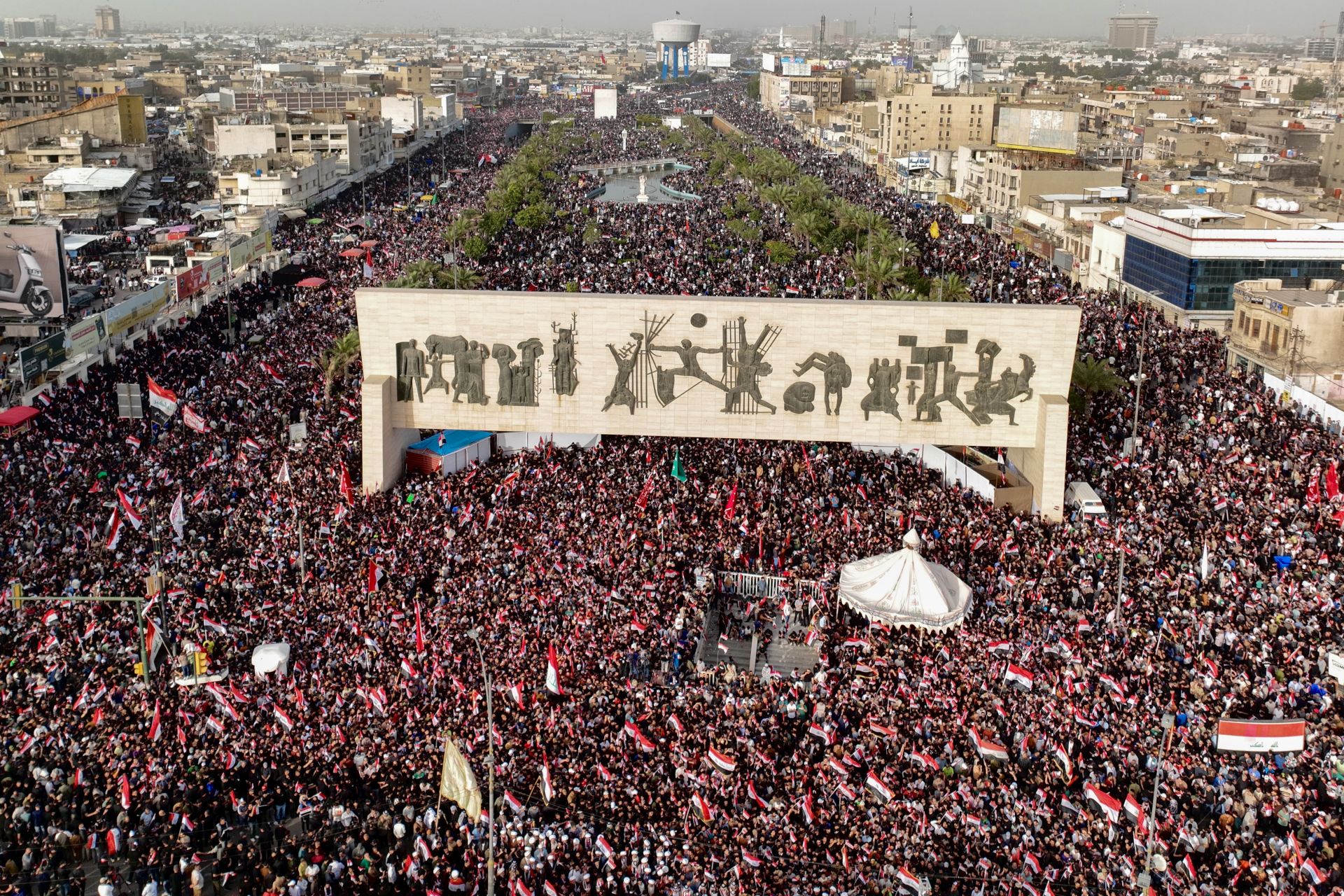
At the initiative of al-Sadr, who is still immensely popular despite his withdrawal from politics following his defeat to the Coordination Framework in 2021, a large demonstration “for peace” and “against war” was held on Saturday, April 4, in Baghdad’s Tahrir Square. It was here, in 2019, that the Tishreen protests took place, a vast popular uprising led by a younger generation, denouncing both creeping Iranian interference and dependence on the United States. The movement, which openly dreamed of “an Iraq for Iraqis,” was brutally repressed by security forces and Shiite militias, leaving more than 600 dead and 20,000 wounded.
Seven years later, the wars in Gaza and Iran have changed the equation. The bitter divisions of recent years over Iranian influence, even within the Shiite community, have been set aside. The Israeli-American offensive, widely seen as unjustified, has generated solidarity with Iran and revived an anti-imperialist reflex in a country still scarred by the invasion of Iraq in 2003 and its 300,000 to 600,000 dead.
Wrapped in an Iraqi flag amid tens of thousands of other demonstrators, Muqtada, a nursing student who bears the same name as his idol, declared: “Seven years ago, I took part in Tishreen, but today I am here to show my support for Iran. As Shiites, we fight oppression wherever it may be. Above all, I call for peace: It is not Iraq’s role to interfere in this war.”
A short distance away, Ghada al-Bayati, a 36-year-old journalist, was demonstrating for the first time in her life. In a clear, steady voice, she said: “Shiites, Sunnis, Christians, Kurds or Turkmens — we stand together today in the face of this American war against Islam and Muslims. Whatever our political leanings, it is our duty to support Iran — with our words, with our donations, but not with weapons.”
The chants rising from the crowd contradict her: “We will be the first to strike the Americans! If the Sayyid [Muqtada al-Sadr] gives the order, we will face the tanks!”
In theory, the instructions issued by al-Sadr — an Iraqi nationalist known for rejecting both Iran and the United States — were clear: a peaceful gathering, with no flags other than Iraq’s, and no chants except the official ones. In practice, however, the organizers flouted their own directives. At the center of the stage, overlooking the jubilant crowd, stood an Iranian flag. Behind it, a large banner read: “No to the Americans, no to the Israelis, no to normalization [with Israel], no to colonization.”
The war between Iran and the United States has unfolded against a backdrop of political deadlock in Iraq. Following the parliamentary elections held last November, three men are vying to become prime minister: al-Sudani, who currently holds the post; Haider al-Abadi, who served from 2014 to 2018; and Nouri al-Maliki, who held office from 2006 to 2014. Al-Maliki was initially nominated by the Coordination Framework, but the United States — viewing him as too close to Iran — is maneuvering to stop his bid, threatening Baghdad with economic sanctions.
Despite the partial withdrawal of U.S. troops from Iraq in January and a planned exit from the northern Kurdistan region by year’s end, Iraq remains deeply dependent on Washington. Oil revenues pass through the Federal Reserve Bank of New York, and the United States remains an indispensable technological and military partner.
“The Iraqi army is entirely dependent on the Americans,” explained Adel Bakawan, a French researcher focused on Iraq. “Take, for example, the radars. They are all supplied by the U.S. military. If the Americans press a button, the Iraqis go blind. In recent years, if Iraq has not territorially fragmented, it is because of the American guarantee.”
Economically tied to the U.S. yet politically aligned with Iran, Iraq walks a precarious line. The resolution of its political deadlock will likely depend on the outcome of ongoing negotiations.
“All politicians are waiting for the war’s outcome before moving forward with government formation,” said Sunni lawmaker Layth al-Dulaimi. “They will rally behind the candidate backed by whoever emerges victorious — or is perceived to have won — whether Iran or the United States.”
Become a member today to receive access to all our paywalled essays and the best of New Lines delivered to your inbox through our newsletters.