


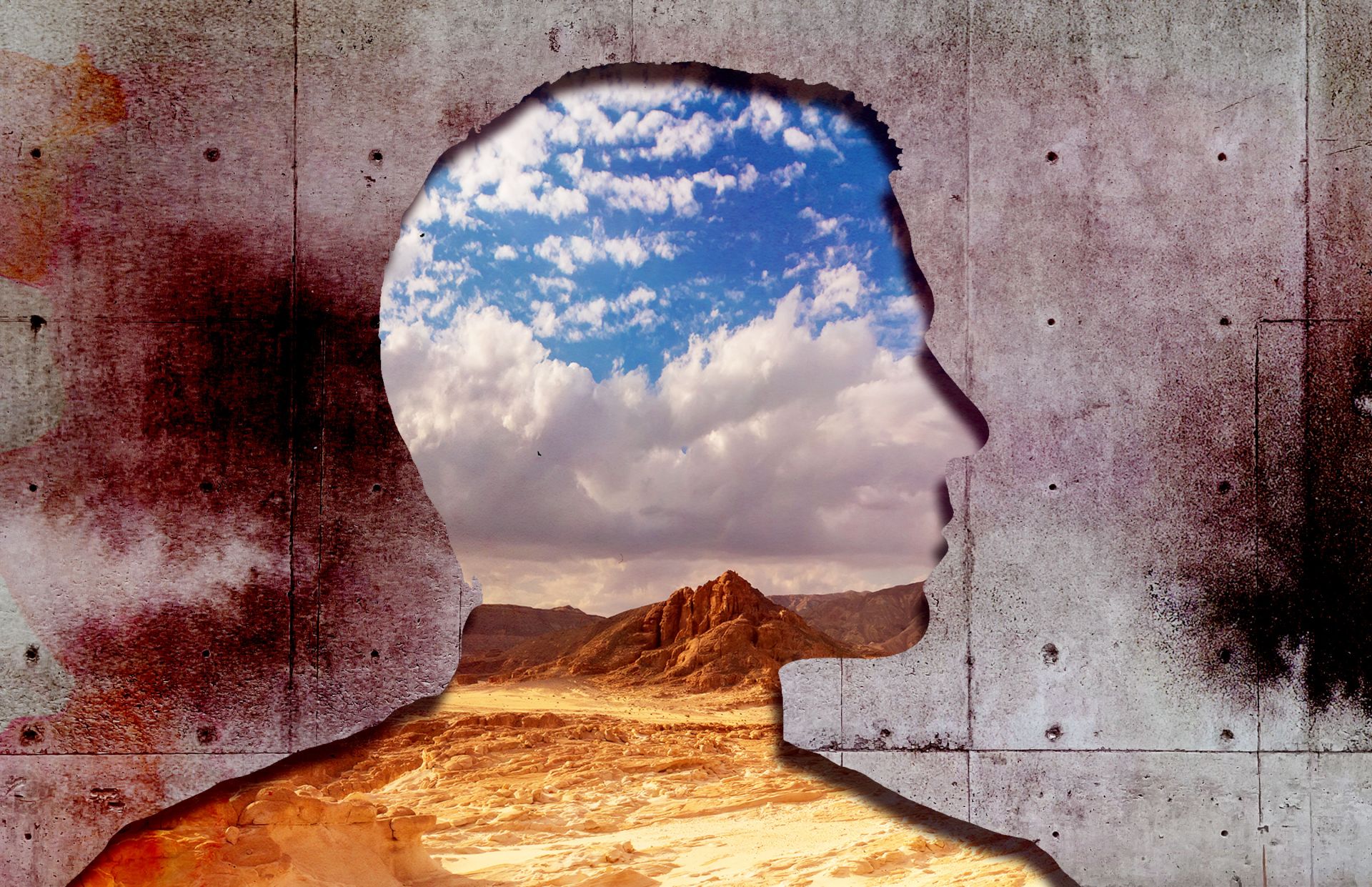
In October 2025, Nasser Abu Srour traveled by coach from Israel into Gaza and then through the Rafah crossing. As he entered Egypt, he pulled back the curtain to reveal the streaming sunshine — an act that had been forbidden by the Israeli guards who had escorted him earlier in his journey. The sight that greeted him was unfamiliar: not just the Sinai desert, where he’d never been, but the sense of space itself. “It was a very large window,” he tells me over video link from his temporary home in Cairo, neatly dressed in a dark suit and white shirt. “And I wasn’t used to that because the window in my cell was small, and the window I had in the refugee camp was even smaller.” The vista meant more than panoramic possibility: It signaled liberty itself. After 33 years in Israeli prisons, Abu Srour was finally free.
In his prison memoir, “The Tale of a Wall,” written from his cell and ingeniously smuggled out, Abu Srour writes in a long tradition of incarcerated authors left only with their thoughts and words as vestiges of their autonomy. Words, for the prison writer, are both personal and political, a means to self-determination and to bearing witness. Emerging from his confinement, however, Abu Srour had a new challenge on his hands: how to make meaning of his new life in exile. Would words be sufficient? The preceding two years had been especially traumatic as the Israeli prison system shifted gears following Oct. 7, becoming a military machine designed to torture and humiliate. In the wake of such horrors, which Abu Srour describes to me in graphic detail, what would it take to relearn how to live, as both a private and political individual? And what about the guilt? Oct. 7 and the ensuing Gaza genocide were the catalysts for Abu Srour’s release, as part of the Israel-Hamas exchange of hostages and prisoners. What did it feel like to gain freedom on the back of so much slaughter?
Abu Srour was born in 1969 and grew up in the Aida refugee camp, near Bethlehem, in the Israeli-occupied West Bank. In “The Tale of a Wall,” he describes his early life as an imprisonment that was not just geographical but also cultural and spiritual. The camp, he writes, was “a text without a time or place.” Instead, his rootedness came from something lost. “I inherited [my refugee] status from my father and grandfather,” he tells me. “And I carried that experience on my shoulders, chest and back.” As he puts it in his memoir, “my father burdened us with requiting everything that had been stolen from him.” Specifically, this meant the village of Bayt Nattif, between Jerusalem and Hebron, from which the Abu Srour family had been expelled during the Nakba of 1948. More generally, it meant agency and peace, internal and external.
After Abu Srour crossed into Egypt, more firsts were to follow. There was the five-star hotel in Cairo where his relatives awaited him, bearing hugs and kisses; there were the many gifts and gadgets. The effects of ownership were disorientating: “the latest iPhone, an Apple watch. If I was going out, I had to go back and forth multiple times as I kept forgetting things, my watch, my glasses … way too many details,” he tells me. Downstairs, in the plush surroundings of the Renaissance Hotel, “I saw a pool for the very first time in my life. It was my first time seeing women in bikinis. I’m still like a baby, trying to learn how to live.” Abu Srour is also learning to grapple with a new identity: For now, he is an exile. Having been released as part of the prisoner exchange that marked the first phase of the Israel-Gaza ceasefire in October, he was told he could not go back home to Palestine. He was deported to Egypt along with over 150 other long-term detainees, where his fate remains uncertain. So far, he’s been offered asylum in Malaysia, Turkey, Qatar, Algeria and Brazil — all countries he’s never visited.
Abu Srour came of age during the First Intifada (1987-93). Growing up in Aida under Israeli occupation, brutality was all around him. “I was living in this violent geography,” he says. “It was more aggressive in the refugee camp compared to the village or city.” Despite these obstacles, he did well at school and gained a place at Bethlehem University to study English literature. He began to hatch a dream of a simple, cerebral life: “a small balcony, with a small garden, having coffee, cigarettes and writing.” But as the cause of Palestinian liberation shifted gears, he yearned to be a part of it. “The history of the camp was devoid of legends,” he writes in his book. It felt like his generation’s role to create some. Violence begat violence. Over 1,000 Palestinians are estimated to have been killed during the six years of unrest, along with around 150 Israeli civilians and 60 soldiers; tens of thousands of Palestinians were injured, and well over 100,000 were imprisoned. Months before the intifada ended, Abu Srour joined their ranks. In early 1993, he was arrested by the military and found guilty of being an accessory to the murder of an Israeli security official. The evidence was based on a confession that, he claims, was extracted under torture. He was given a life sentence. “Farewell, world!” he writes in his book.
“The Tale of a Wall” — which first appeared in Arabic in 2022 and two years later in Luke Leafgren’s English translation — is a chronicle of reconciliation, a reckoning with its author’s fate. It looks neither backward nor forward but straight ahead, the view impeded by a pile of bricks. It asks what happens when you let go of freedom, when you cease to hope. What is left? How can you survive? The answers are to be found in a volume rich in poetry, philosophy and psychology.
Abu Srour’s memoir sits in a tradition of prison writing from Boethius (who wrote “The Consolation of Philosophy” while awaiting execution) to Aleksandr Solzhenitsyn and Brian Keenan, via Fyodor Dostoyevsky, Oscar Wilde, Antonio Gramsci and Jean Genet. Each sought to reckon with the self in the context of extreme confinement; each sought to relearn how to regain, or renounce, sovereignty over it — whether spiritually, politically or physically. Should you confront your powerlessness by turning inward (the route favored by Genet, whose onanistic fantasy “Our Lady of the Flowers” (1943) is a testament to imaginative erotic transcendence)? Or should you turn outward (the route favoured by Solzhenitsyn, most notably in “The Gulag Archipelago” (1973), which insisted above all on meticulous documentation, bearing witness to suffering and cruelty)?
For Abu Srour, his initial reckoning required a kind of rebirth. “I stood,” he writes, “in the middle of my cell, half naked, and stripped away everything that had taken place there before my arrival.” Imagination then takes hold: “I began to assign names to each of its features. The iron rack became a bed. The ceiling became blue and then more blue until it turned into a sky. The door with its metal bars evaporated: it was replaced by a hotel suite door.” But rather than transcend his situation, he chooses to embrace the very instrument of his oppression. The titular wall that confines him becomes his world: his interlocutor, his anchor. Abjuring hatred as “yet another lock” (“There is no door except the one I close upon myself”), he instead clings to his wall, submits to it, uses it as his “document,” his text. “The wall remained my single point of stability. … I came to see that everything that happened in my life … was part of a grand design to unite me with that wall in that cell.” We also see in “The Tale of a Wall” how Abu Srour comes to situate this state of being in the framework of Palestinian dispossession. “In that way I was like every other Palestinian aware of their bondage, who has to lose their freedom in order to be free.” There are echoes here of Gramsci, that great intellectualizer of suffering, who always viewed his own struggle in the broader context of the struggle of the Italian working class.
Abu Srour’s resignation “from the beginning” was practical. “I genuinely believed I would spend the rest of my life behind bars,” he tells me. “I could not imagine anything outside of prison, and I stopped myself from having any expectations.” This pragmatism quickly proved to be expedient. In 1994, following the signing of the first Oslo Accord, several thousand Palestinian prisoners were released from Israeli jails. Abu Srour was in Shikma Prison in Ashkelon at the time, in a cell of 14 people. “They released 13,” he tells me. Then it was “just me.” He experienced the same crushing fate on three separate occasions: during the exchanges with Hezbollah in 2007; during the Gilad Shalit hostage transfer with Hamas in 2011 (in which Hamas prisoners were, inevitably, favored); and during the Israeli-Palestinian peace talks of 2013-14, in which groups of 30 prisoners were to be released in four separate batches. The first three releases went ahead; the fourth did not. “I was in that batch,” he tells me. But Abu Srour never broke. He had his wall.
One reason that Abr Srour was perpetually passed over may have been the severity of the crime for which he was convicted — the police officer, Chaim Nachmani, in whose murder he was implicated, was reported to have been “stabbed and bludgeoned to death” — and to his continued pronouncements on the Palestinian struggle. “As long as there is no diplomatic horizon, the intifadas will continue,” he told an Israeli news network in 2013. These points were made in an article by Charles M. Covit for the Harvard Crimson (Sept. 27, 2024), in which the author decried the decision of Harvard’s Center for Middle Eastern Studies to co-sponsor a talk on “The Tale of a Wall.” In response, Abu Srour’s English-language publisher Judith Gurewich made the point that, when researching “as best I could the circumstances that led to Abu Srour’s [life] sentence” — which included her contacting the prestigious Israeli human rights lawyer, Michael Sfard — she was told by Sfard that, according to the Israeli Courts Authority, only two documents remained pertaining to Abu Srour’s imprisonment: “indictment and verdict.” “I think it is important,” Gurewich added, “to make clear that Palestinians and Israelis were not treated as equals in the courts already in the 1990s.”
Many captives have written of the importance of routine, however grim, in the bewildering context of a situation that has robbed them of agency. Monotony can be a comfort, something to cling to. “A prisoner’s reconciliation with routine might come sooner, or it might come later, but it inevitably arrives,” writes Abu Srour. For Solzhenitsyn, in “One Life in the Day of Ivan Denisovich” (1963), routine becomes almost a means to freedom. We see it in both the distracting satisfactions to be gained in mundane work and the material ones to be gained in small, positive deviations — an extra bowl of porridge to be savored; a pilfered piece of metal to be used or traded. By contrast, sudden jolts from the routine can be destabilizing, terrifying. When Abu Srour is, at one point, released from an isolation block, his immediate reaction is to panic: “A sudden fear came over me as I was struck by the reality of leaving my solitude.” A few lines later, he writes, “I feared for my relationship with my wall.”
As the years passed, and Abu Srour moved from cell to cell, prison to prison, he learned why it is important not to “set your roots too deep in any world you inhabit.” Fellow prisoners came and went. His father died. His mother visited whenever she could. His one constant was his wall. But then something happened to tear his world apart. Abu Srour fell in love.
As well as being a tale of resistance-in-fortitude, “The Tale of a Wall” is a love story, a story of impossible love. Halfway through, it moves beyond bricks and mortar to flesh and blood. The affair began shortly before Abu Srour failed to find his freedom as part of the thwarted fourth batch of prisoners in 2014. He was visited by a Palestinian-Israeli human rights lawyer, “Nanna” (Nadia), and the pair struck up a friendship. Soon, the relationship took on another timbre. They wrote to each other: long, unburdening letters, poetic and, between the lines, erotic. Nanna visited him whenever she was able to; she “spun … threads … plans,” in the words of the author — fantasies of their future life together. She was in her late 20s at the time; he was in his mid-40s. “But I’m so old,” he told her. “People get old when they stop loving, and you still have an exceptional capacity to love,” she replied. Suddenly, the prisoner was forced to look beyond his wall, beyond himself. “I replaced all nouns with ‘Nanna,’” he writes in his book. “‘I’ became ‘we.’ Individual actions in my lexicon became collective ones.” The effect was shattering; hope began to flower. His wall rebuked him, “turned its back on me.”
Much of the second half of Abu Srour’s book concerns the tumultuous, and entirely circumscribed, affair between the author and Nanna; his insistence that she cannot will his release, his fears about entrapping her in his appalling situation; her fealty, then her despair as she begins to understand that he may be right to fear. Suddenly, the opening lines, in which the author had cited Kierkegaard on love, begin to make sharper sense: “Kierkegaard … argu[es] that the best way to preserve [love] is to release the beloved.” As we see the lovers cling to each other and alternately let go, “The Tale of a Wall” becomes hard to read. It ends with Nanna breaking off the relationship in 2017 and Abu Srour returning to his wall. “I was born twice,” he writes, “and I was killed the same number of times.” But the book concludes with a devastating sense of unfinished business. The author’s final words are a plea for Nanna to “give me back myself!”
When I heard that Abu Srour had been released and was available for an interview, one of my first thoughts was Nanna. What had happened to her? Had the pair stayed in touch? Might she come to visit him in Egypt? Although Abu Srour speaks English well, the interview was arranged with the use of an interpreter — the excellent Salma Helal — and I found myself worrying about the remove: the distance created by the two-dimensionality of Zoom, compounded by the stop-start nature of interpretation. Questions I would feel comfortable asking over a coffee, face-to-face, after a little temperature-testing, would feel harder, harsher, mediated in this way, especially deeply personal questions with an undertow of tragedy.
I knew, for example, that Abu Srour’s mother had died just weeks before he was released — a cruelly painful twist of fate. I wanted to know about his treatment in prison following the Hamas attack of Oct. 7, 2023; all indications pointed to a marked deterioration in conditions. I wanted to know about his life in exile, about his current reading of the political situation, about what it is to start a new life in your mid-50s when you’ve never had a proper adulthood, about what his future looks like. I wanted to know about his love life.
I needn’t have worried. Nasser’s smile is the best icebreaker I could wish for. “Do you mind if I smoke?” he asks, shyly. As we face off in our little squares on our respective laptops, he proves to be both patient in his listening and expansive in his answers. But I’ve also come to the interview armed with a vital piece of information. When I learned it earlier in the week, via Leafgren, I gave a little yelp of joy. Nasser and Nanna are now engaged.
One of the first things I do after our introductions is congratulate Abu Srour on his engagement. “Shukran,” he smiles shyly. “Thank you.” He then fills me in on the gap between the end of his book and our present meeting. He and Nanna were separated “for five years,” he tells me. “And during those five years, I was able to see her around four times. … [She would] check on me just to make sure I was still alive.” They went back to being friends, “though I don’t know if that’s possible.” Then Nanna said she wanted to get back together; no matter that Abu Srour was still serving a life sentence with no parole in sight, no matter that their physical relationship might never be consummated. (No physical contact between the pair was permitted. The room they met in was divided by a glass wall, and they needed to communicate through a telephone to hear each other. The first time they touched each other was in the arrivals area of Cairo International Airport, when Nanna flew in to see him.)
“She didn’t have these kinds of feelings for anybody else,” Abu Srour tells me. “No one,” she told him, “loved her like I did. No one used my vocabulary like I did. … She stopped looking, and couldn’t resist comparing everyone to Nasser.” Once again, the prisoner was forced to confront the agony of hope. Nanna’s desire to get back with him “shocked me, because I didn’t want to relive that kind of pain. It almost broke me … I kept blaming myself and asking myself, ‘Why did I get her involved in this relationship, this impossible relationship?’” Saying yes to her the first time was, he felt, “a cowardly act … and that caused me enormous pain … and so when she said to get back together, I hesitated before accepting. And I only accepted when I realized that this time she was stronger, more mature, had a better understanding of what a life sentence means, had a better understanding of the prison system.” Abu Srour didn’t accept immediately, but “after a few months, I said yes, through smuggled phones.”
This was before October 2023. After that, everything changed. “Their first act of war was removing the word ‘guard’ from the uniforms and [replacing it with] ‘warrior.’ … They started being very violent warriors.” he tells me, signaling the sharp change that was coming. “Before the war,” Abu Srour says, “there was some sort of cultural existence in our lives.” Afterward, “that cultural existence evaporated. … They took everything … we only had four pieces of clothing … one thin blanket each. … They started a war on prisons. … On a daily basis there were repeated assaults, 24/7. They could come in any time for any reason, or would make up a reason to come in and beat us up. [There were] beatings, bone-breaking … and after four or five months they stopped needing the made-up reasons. … I was beaten so many times … starved. … We were reduced to a mere biological existence. … I wasn’t able to see my own face for a year and a half.”
Publishing “A Tale of a Wall” simply wouldn’t have been possible in this regime. “Before the war,” he continues, “we never experienced that level of violence. The conditions were bad, but they never all came together at the same time … There was a radio, TV, notebooks, newspapers, pens. … We could smuggle phones. … In Hadarim prison, in the heart of Occupied Palestine, we were able to establish a prison library… [we] gathered over 8,000 books.” It was in these conditions that Abu Srour had been able to get out his manuscript.
“Compiling all the drafts was very difficult,” he tells me. It was forbidden to write anything other than letters, all subject to the censors, and “many people were punished” for trying to write. “There were lots of methods that they found out about,” he adds, “and that is why I can tell you about these.” One was to smuggle out writings in fake letters to an imaginary lover. The censors would scan the first few lines and then get bored and let them through. Voice recordings were another method. “For a while we had some smuggled phones, so it was easy to record what I wrote.”
After Oct. 7, Nanna was, for a while, still allowed to visit on a monthly basis. But then even these rights were taken away. “They claimed she was bringing me news from the outside, and then they punished her by banning her from visiting.”
Abu Srour has recently described in shocking detail the sea change in Israeli prisons following October 2023, their descent into “systematic violence,” in a forthcoming piece in Equator. For two years, this near-intolerable situation continued, until suddenly his situation changed again.
“Liberation,” Abu Srour says, “came by force … and that in itself is a contradiction. … The news of my release was communicated to me by this fierce and violent officer. He just said, ‘Prepare yourself, we’re getting out.’” Abu Srour’s first impulse was to take this as a sick joke. But events gained momentum. “They opened the door and took me out. … It was a big group. … We received severe beatings from the guards on the way to the prison transport. … [Then] they took us to the Negev prison.” Hours later, he was pulling back the curtain to a view of Rafah.
“Freedom!” exults Dostoyevsky at the end of “The House of the Dead” (1862). “Freedom, a new life, resurrection from the dead. … What a glorious moment!” For Dostoyevsky, the change of state is immediate. A blacksmith removes his fetters, and they “fell to the ground. I picked them up. … Already I could hardly believe they had ever been on my legs at all.” For Abu Srour, this adaptation to freedom may take more time. Nelson Mandela, in “Long Walk to Freedom” (1994), describes having to learn, or relearn, the basics of life, such as being in a car moving at speed, or new technology: a remote control, a microwave. Abu Srour talks of being a baby. And so much has changed since 1993. Now he must reckon with a world transformed by tech, with a Palestinian cause in tatters, with new wars in the Middle East, with what it is to be in a relationship in a state of freedom. Or, given his exile, semi-freedom. He and Nanna want to start a family. They must first find a place to live.
As for writing: “I’m still asking myself if writing is possible in exile. During the next few weeks, I have to find an answer.” His piece for Equator is a start. He also feels guilty about his release, and the reasons for it: “I was released in the prisoner exchange … that was very problematic because we paid very high prices for this exchange … [all the] burning, destruction and mass-murder. And my release is part of [this].” It is a form of survivor’s guilt. And while he loves Egypt, he says, he has so far been unable to imbue his existence there with “meaning.” Citing Theodor Adorno, he wonders if it is “a barbaric act … to write after the genocide in Gaza.” Might language, he wonders, “diminish the suffering?”
But then he reaches for another of his philosophical lodestars, Jacques Derrida: “Then again I remind myself that there is nothing outside language and maybe it’s my, our, responsibility to continue offering testimony … and this is what I intend to continue doing, because nothing is beyond the limits of language and I’m praying that I will still be able to do it.” I, for one, hope his prayers are answered.
Become a member today to receive access to all our paywalled essays and the best of New Lines delivered to your inbox through our newsletters.