


The dawn call to prayer echoed through the Ramadan morning. Just before 5 a.m., a van pulled over on the side of the road. Within seconds, four passengers climbed in. They had been waiting in the spring night air of the Badiya, Syria’s desert.
For 35,000 Syrian pounds (about $3), the driver took them toward the arid steppes west of the town of al-Shola, nearly 20 miles from Deir ez-Zor.
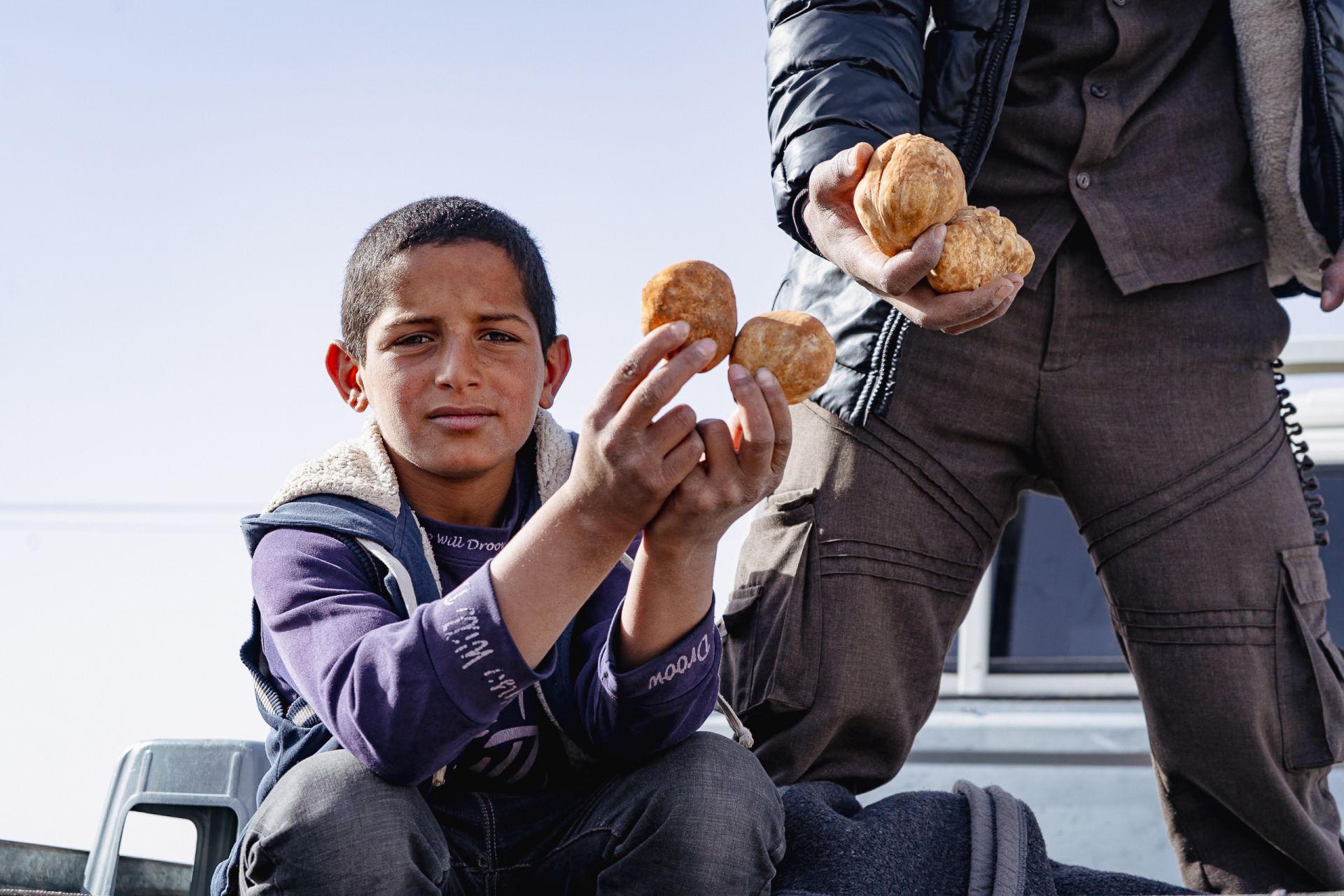
On this March morning, hundreds were converging on the area, known for harboring one of the region’s rarest treasures: the desert truffle. “It’s one of God’s secrets — rain and lightning make them appear,” said Fawaz al-Rahil, a keffiyeh wrapped around his head.
In al-Shola, the season had just begun. It is hard to predict whether it will be as prolific as in 2023, a vintage year everyone still remembers.
“Tradition says that if it rains in September and October, the harvest will be good. If not, even a perfect spring won’t change anything,” he added, fingering his prayer beads.
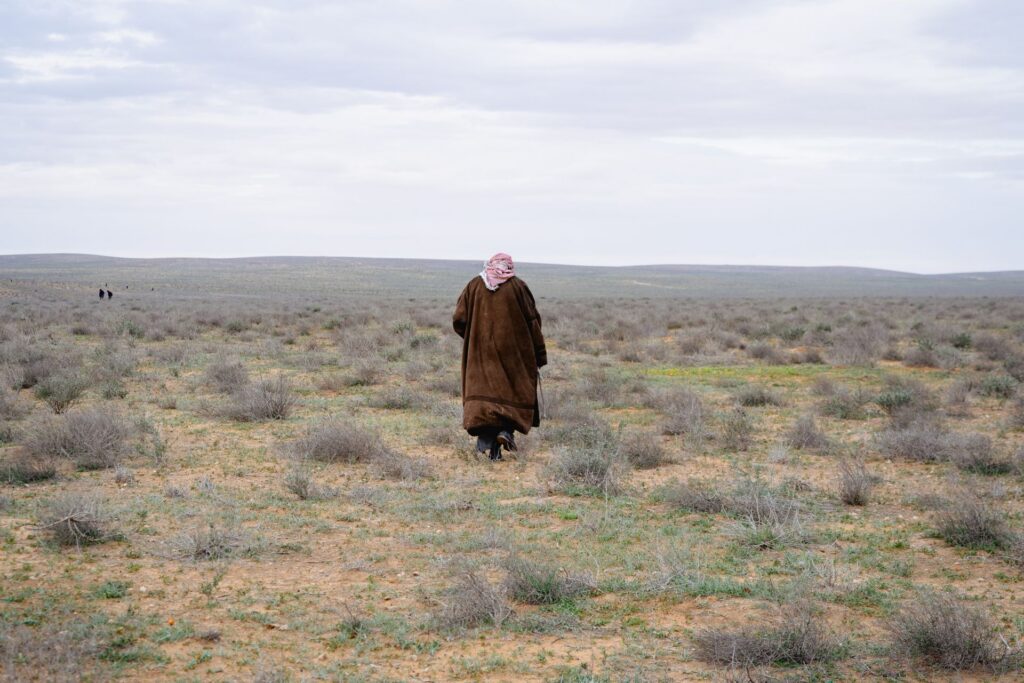
Over the past two years, the truffles have grown only sparingly. In 2025, Syria experienced its worst drought in 60 years, according to the Food and Agriculture Organization, with only 25% of normal rainfall recorded. But truffle pickers — known as “hunters” — pay little attention to climate change. For them, abundance comes from God alone, and only his mercy determines the harvest.
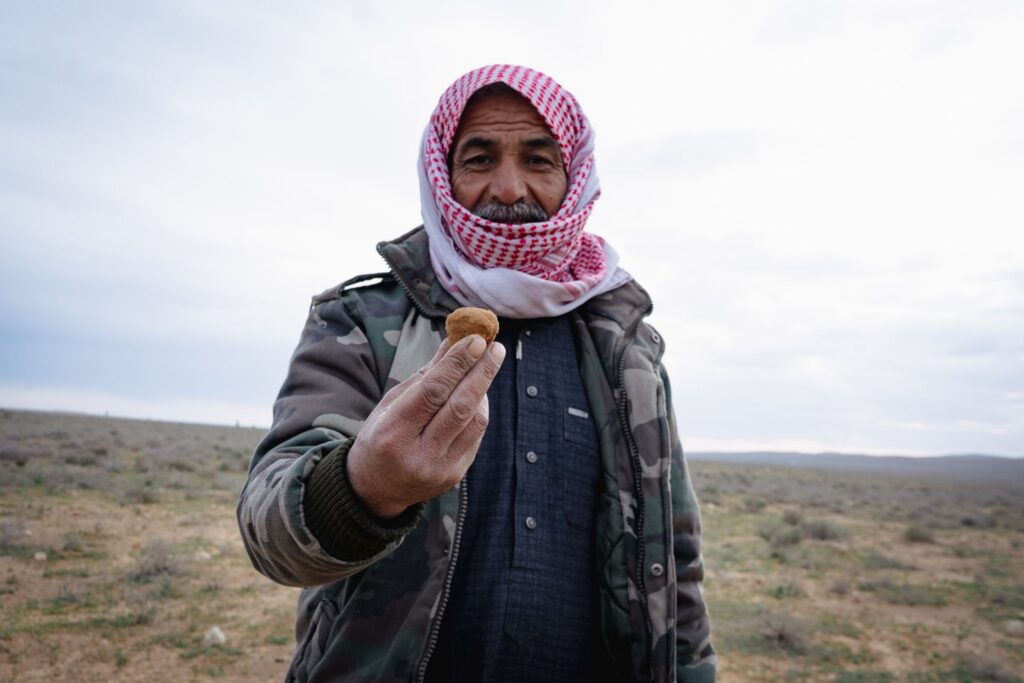
Ahmad al-Hajj, one of the oldest hunters in the group, has been picking truffles since the 1980s. “I haven’t noticed a major change in the climate over the years, but there are certainly fewer today,” he said. Bending toward the ground, he lifted a small truffle — his second of the day, a meager haul after nearly an hour of searching.
A few inches away, he pointed to a small plant similar to a helianthemum. “We call them jarid al kama [“jarid” means plant and “kama” means truffles], and their presence tells us truffles are nearby.” Cracks in the sandy soil are also telling signs, but after the previous day’s rain, few are visible today.
“When I started, we could set up tents in the desert for weeks. We didn’t need tools to dig, they were all on the surface,” al-Hajj recalled. The old man seemed nostalgic for those days, especially since another concern weighs heavily on him. “Before, we could walk freely across the desert. Now the danger of mines is everywhere. I am really scared of it,” he sighed.
According to the nongovernmental organization Handicap International, between 100,000 and 300,000 landmines remain buried across the country, making Syria one of the most contaminated places in the world. Although demining efforts have begun, the area to be cleared is so vast that it could take decades and cost up to $1 billion, according to several studies.
“I’ve seen many cars and motorcycles blown up by mines during the hunt,” al-Hajj said.
“In 2023, just a few hundred meters from here, a motorcycle hit a mine. The largest part of the body we recovered wasn’t bigger than my fist,” added Qusair Ibrahim al-Rahil, Ahmad’s son. “We buried what remained right where the accident happened.”
It was the last time the father and son witnessed such a tragedy. Yet only a month ago, four truffle hunters were killed not far from the area they now search.
“The steppes are full of mines, so people usually follow the same routes while driving. The passengers in that car tried to take a shortcut, and it ended badly,” explained Moussa Abu Mohammed, head of al-Shola’s municipality.
The town of 5,000 people is devastated, a symbol of the different phases of Syria’s civil war. In 2014, it fell under the Islamic State group’s control, forcing most residents to flee. It was only in 2017, during the Syrian regime’s reconquest of the east — backed by Russian airstrikes and Iranian militias — that al-Shola was retaken from the group.
Any hope of return was quickly dashed. “The regime barred us from going back to the town and expelled the last remaining residents after declaring it a military zone,” Abu Mohamed said.
As a result, al-Shola was emptied of its population. Residents mainly sought refuge east of the Euphrates in Kurdish-controlled areas. It was only after the fall of Bashar al-Assad that some began to return.
Despite their forced displacement, many hunters continued venturing into the Badiya at the start of each truffle season, up until the dictator’s fall. The mysterious fungus represents a crucial source of income for this extremely poor population, which largely depends on agriculture and sheep herding.
They also became easy targets for armed groups operating in the region, starting with militias affiliated with the regime. During that period, the roads leading to the fertile steppes were largely controlled by the National Defense Forces (NDF), a pro-regime militia composed of Syrian fighters overseen by Iran. To access the area, locals had to pay fees at numerous checkpoints.
It was an organized racket — and one that went far beyond simple access taxes. “At the end of the harvest, we also had to give them a large share of what we collected. They usually left us with barely 10%,” al-Hajj said.
“The amount they took depended on their mood of the day. You don’t argue with these people, they can make you vanish from the face of the earth in the blink of an eye,” he added.
The deadliest years for Syrian truffle hunters came before the fall of Assad. In 2023 and 2024, several hundred were killed, mostly by landmines but also in attacks often attributed to the Islamic State. In this context, the Syrian regime sometimes invoked the jihadist threat to justify imposing paid “protection” measures on truffle hunters during their expeditions.
Yet testimonies collected on the ground during our reporting paint a very different picture. According to every resident interviewed, these attacks were not carried out by the Islamic State but by the NDF operating in the area.
“Just moments after the harvest began, armed men would sometimes appear on motorcycles in the steppe and open fire on us,” said al-Hajj, who lost his cousin in one such attack. “The media said it was ISIS, but that’s not true. They were pro-Iranian militias wearing ISIS uniforms to hide their involvement.”
Moussab Ahmed al-Saleh, who has documented abuses against truffle hunters for several NGOs, reported the same pattern. “Pro-Iranian militias and the regime used ISIS fighters’ clothing. When Assad fell, those outfits were found in several of their bases,” he said.
“Everything was orchestrated. The areas where attacks occurred were very close to sensitive regime sites. It doesn’t make sense for ISIS to target truffle hunters instead of those locations,” al-Saleh said. “We have documented approximately 120 cases of kidnapping and forced disappearance at the hands of armed militias in the desert.”
For Bachar Hassan, a researcher specializing in jihadist movements in the Deir ez-Zor region, pro-Iranian militias were indeed responsible for the deaths of dozens of truffle gatherers in this area. “In the countryside around al-Shola, most attacks were carried out by pro-Iranian militias,” he said, while not ruling out Islamic State responsibility in other massacres. “But the deeper you go into the Badiya — 50 or 60 kilometers into the desert — the more attacks are carried out by ISIS.”
In the western part of the region and across the desert expanses of the Badiya, Islamic State cells behind these attacks were largely ideological. Hassan pointed to the influence of a particularly radical internal current, known as “Hazimists,” linked to Saudi preacher Ahmad al-Hazimi, which considers large segments of society to be infidels and therefore legitimate targets, including civilians with no ties to the conflict.
It is in this framework that some attacks on truffle hunters in the Badiya of Homs, Hama and Tadmor have been attributed to the Islamic State.
But in al-Shola and the Badiya of Deir ez-Zor, the situation is very different — as are the motives. “Pro-Iranian militias had many military bases in the area and did not want these populations present, fearing they might pass on intelligence,” Hassan said.
He also offered another rationale: With al-Shola sitting at the heart of the regime’s drug trafficking route from Iraq to Lebanon, the presence of truffle hunters in these desert zones was seen as a nuisance.
Even today, several abandoned outposts along the hunters’ route bear witness to the former presence of the NDF. The threat they posed is gone, but the mines they planted remain on everyone’s mind during the few hours of harvesting. Fortunately, none exploded that day.
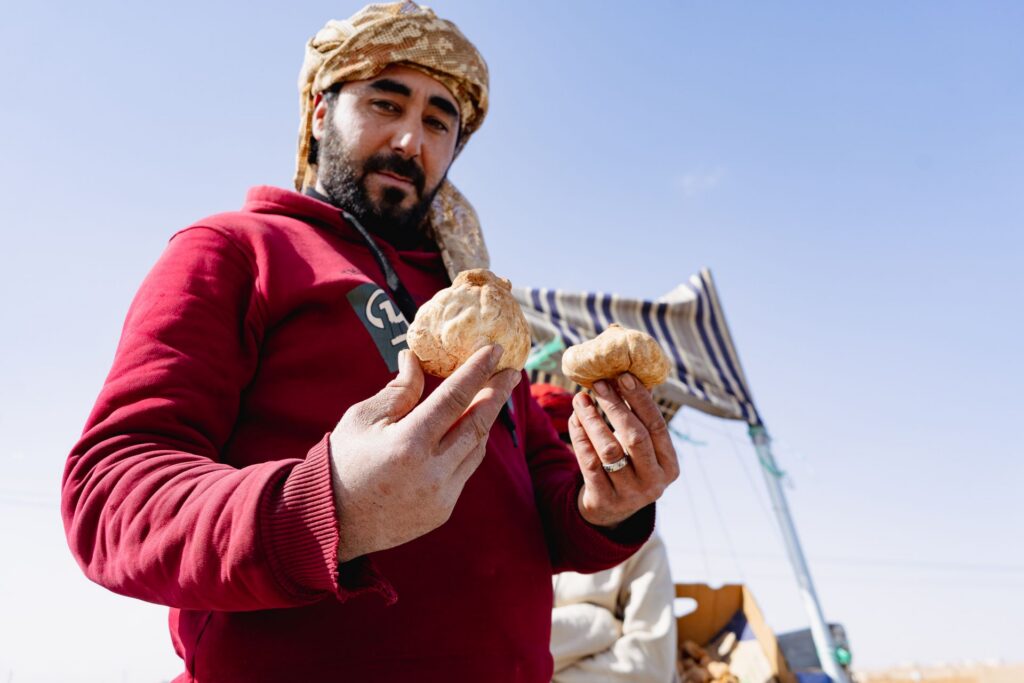
Once finished with the picking, the group headed to the nearby town of Kobajjep. Along the main road, several vehicles were parked in a small square facing a plain where a few camels wandered. The turnout was low — the constant whistle of the desert wind made that clear.
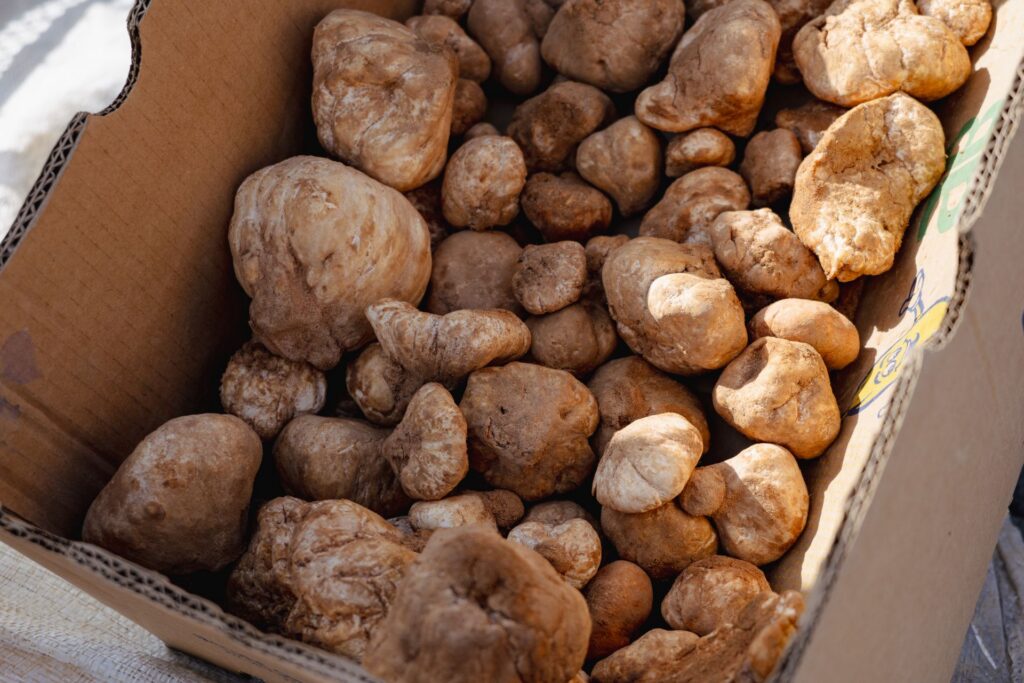
Around 10 buyers were present to collect the fruits of the hunters’ long hours of work. They purchased truffles for 250,000 Syrian pounds per kilo, to resell for 300,000. Some locals made quick stops, transactions carried out directly through car windows.
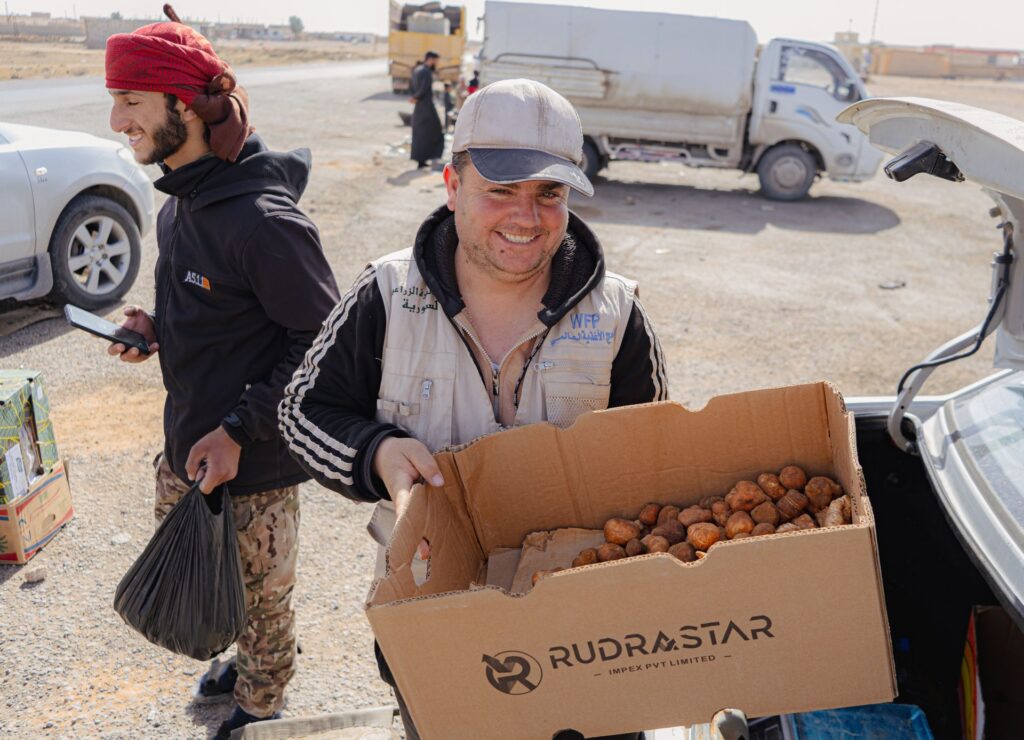
Others drive to Damascus to sell the harvest to private buyers and, above all, exporters. Highly prized in Gulf countries, a kilo can fetch over $100 depending on rarity and quality.
Though inexpensive compared to its European cousins — the black truffle and the Alba truffle, which can sell for thousands of dollars per kilo — the desert truffle remains a luxury beyond the reach of most Syrians, 90% of whom live below the poverty line.
“If the season is abundant, prices will drop and we’ll be able to buy some,” said Fawaz al-Rahil in al-Shola’s village square. He spends his days with his fellow elders, surrounded by children mimicking war, clutching toy guns instead of real ones.
With no income and no longer receiving the humanitarian aid they once depended on, days stretch long, and prospects remain bleak. “If there are truffles, the village can survive. If not, the year will be very hard,” he said with a sigh.
Behind him, a man with a wide smile pointed to a collapsed house. “That’s mine,” he said. “It was bombed by the Russian army in 2017, and I still can’t afford to rebuild it.” A few makeshift tents stood in the dusty ground behind it, sheltering his wife and two daughters.
His case is not unique. In fact, it reflects the situation of nearly all those who have returned since the regime’s fall. Everything in al-Shola is destroyed. Government electricity no longer reaches the area, and the power lines along the main road stand as grim remnants in the desert landscape.
“The regime stole all the electrical cables that supplied the village. Most homes were also burned by soldiers to extract the metal from the walls,” Abu Mohammed said.
In al-Shola, it is already too late for young adults, who have no job opportunities. “This economic desperation drives families — including women and children — into what is effectively ‘indirect suicide’ in minefields, searching for truffles simply to survive,” wrote al-Saleh in his study on the killings of truffle hunters.
But there is still a little hope for the children. With support from UNICEF, school has resumed for 400 of them in al-Shola and 500 in Kobajjep. “If the program stops, children will lose access to education entirely. All the schools here are destroyed,” said Moussa al-Hassan, the center’s director.
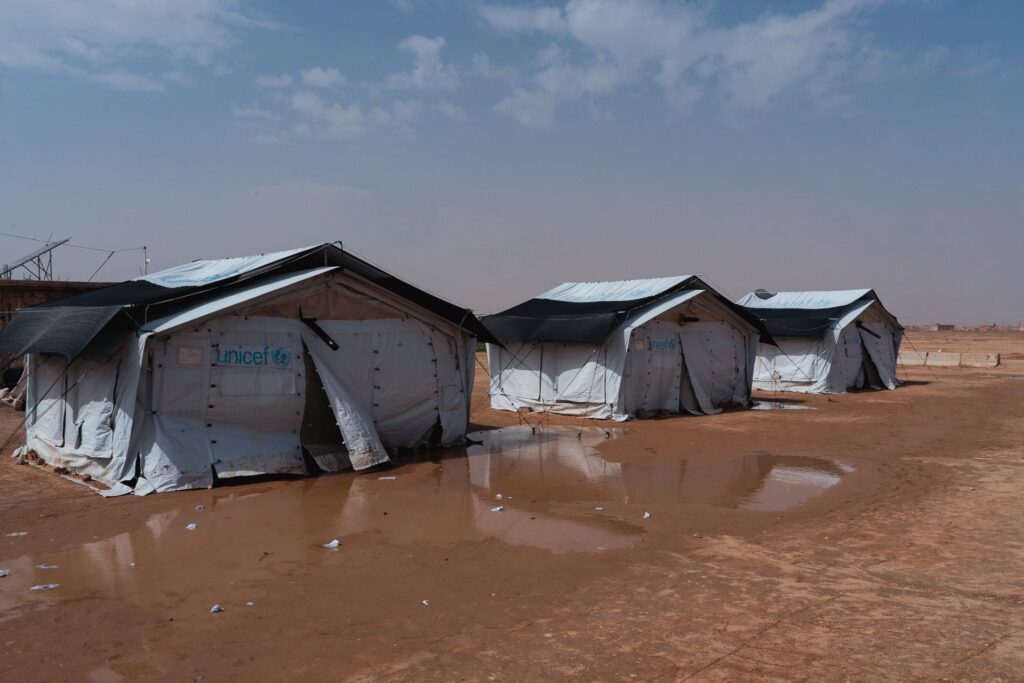
A few tents set up in the mud serve as classrooms. Teachers are paid $150 a month. Abu Mohammed, the municipal leader, also teaches there. It is one of the few initiatives restoring a sense of purpose in a place so far removed from Damascus’ concerns.
“Before, we couldn’t say a word without ending up in prison. Now we can shout as loud as we want, but no one hears us,” Fawaz al-Rahil said.
In these arid steppes lost in the Syrian desert, the truffle is a blessing. Its appearance is almost miraculous, and it is revered as a gift from God.
The mysticism surrounding it also reflects the fragile economic relief it offers a population forgotten by both the war and the new authorities. Here, far from the tables of distant cities, the desert truffle is not a delicacy but a lifeline — the difference between going hungry and putting food on the table.
Additional reporting by Hady Alali.
Become a member today to receive access to all our paywalled essays and the best of New Lines delivered to your inbox through our newsletters.