


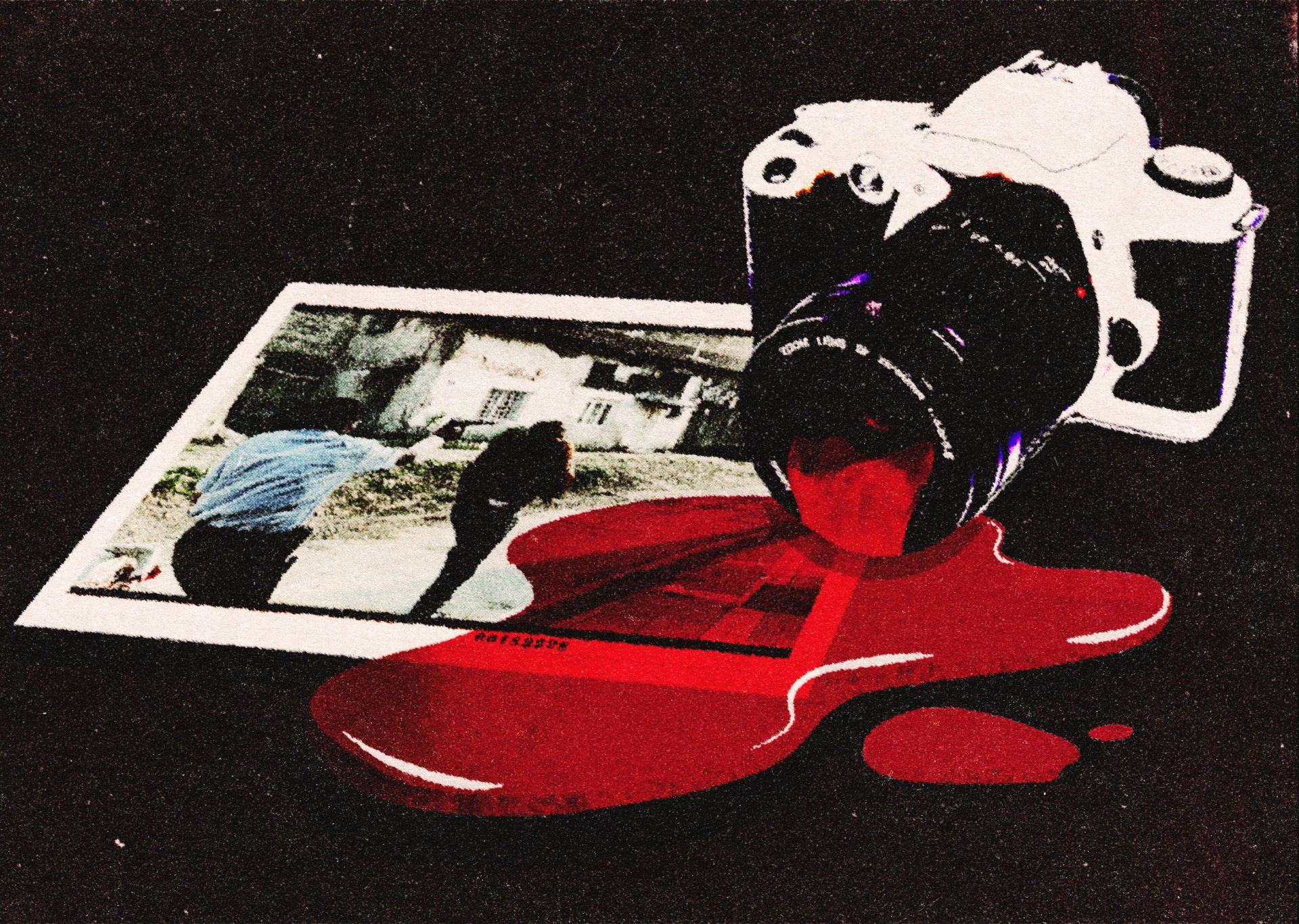
The photos were shown to the witness, one after another. In the first, four men are walking away from the photographer: a young man in a short-sleeved blue police shirt, a gun fitted with a silencer in his lowered right hand; to his left, a man in military uniform with an automatic rifle; in front of them, two men, one in a brown leather jacket, the other in a beige pullover. They are moving along a short cul-de-sac, at the end of which lie a number of dead bodies.
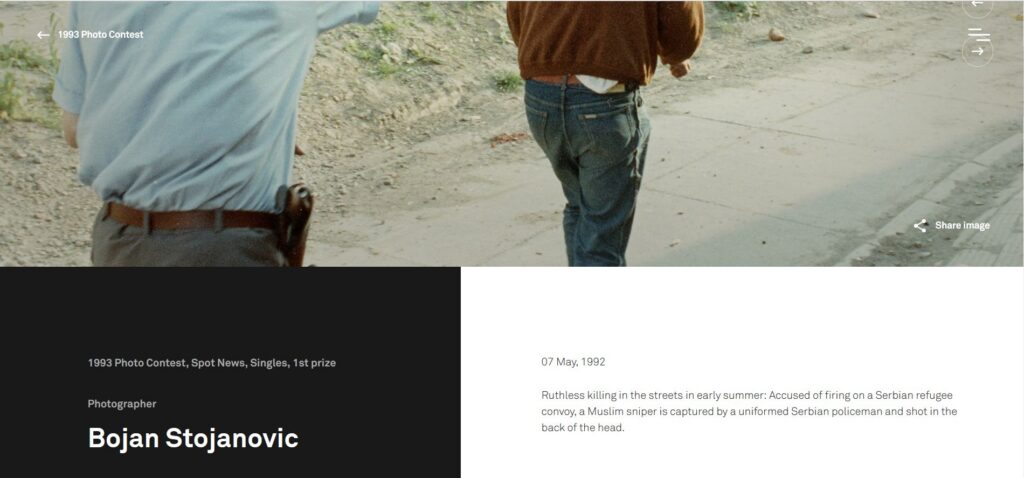
The next photograph shows the police officer pointing the gun at the back of the man in the brown jacket, both men hunched; in the next, the officer has raised the gun level with the man’s head, which he’s drawn even further into his shoulders; in the next, the man is bent over at the waist, his hands raised to his head, as if trying to protect himself. He is still walking.
Then the man is on the ground, one leg lifted in the air, the police officer behind him, gun still raised. In the photographs that follow, the man is face down on the concrete but clearly still alive, given his legs and arms are captured in different positions. The officer is still pointing the gun at him.
The next image shows the man in the beige jumper, lying on his side on the ground, a large pool of blood spreading from his head. The next captures both men on the ground, bleeding heavily. Another image shows corpses tossed into a pit, one on top of the other, limbs intertwined. Some of the faces are visible. There are at least 12, all men. Above the grave stands a truck, presumably used to transport the bodies, and an excavator ready to cover them with earth.
It was Wednesday, Sept. 22, 1999, almost a year into the trial of Bosnian Serb Goran Jelisić at the International Criminal Tribunal for the former Yugoslavia (ICTY) in The Hague. Jelisić, who was 31 at the time of the trial, pleaded guilty to the murder of 13 people in Bosnia and Herzegovina, among other charges. As the court viewed the photos of his crimes, taken by a Reuters photographer in Brcko, northern Bosnia, in 1992, and published widely around the globe, Jelisić listened attentively, his expression timid.
In his green patterned sweater, he looked ordinary. As one witness described him, he was a young man with “brownish hair, medium height, medium build, rather lively.”
“Perhaps you can help me understand something which appears very bewildering to me,” the trial’s judge, Fouad Abdel-Moneim Riad, asked the witness. “We have here at least ten pictures which I wondered how they were taken,” the court transcripts read. “It is pictures taken of an execution, step by step. How can a person who is killing in this way take a photographer with him to picture it?”
Before the witness, ICTY investigator Paul Anthony Basham, could answer the question, the British prosecutor Geoffrey Nice asked that the trial be moved into closed session. There are no transcripts of the conversation, and the record of the trial does not reveal how the photographs came about. Those photographs, entered as exhibit P67, were vital evidence, but there was no examination of how they had been taken.
Did this same question weigh on the minds of the Reuters editors who bought and distributed the photos worldwide? Or on the jury of the World Press Photo awards, which decorated the photographer in 1993? Was there any doubt among the Dutch media, which feted him as a journalistic hero when he fled Belgrade for Amsterdam the same year? And what of the men whose deaths were photographed, in vivid, gory detail?
This story offers answers to those questions. It is the story of how those photographs came to be — the only images from years of war in the former Yugoslavia that captured the actual act of execution. The three-year investigation has exposed a dark intersection of war, ambition, propaganda and the power of visual storytelling, which does not record the truth but manufactures it.
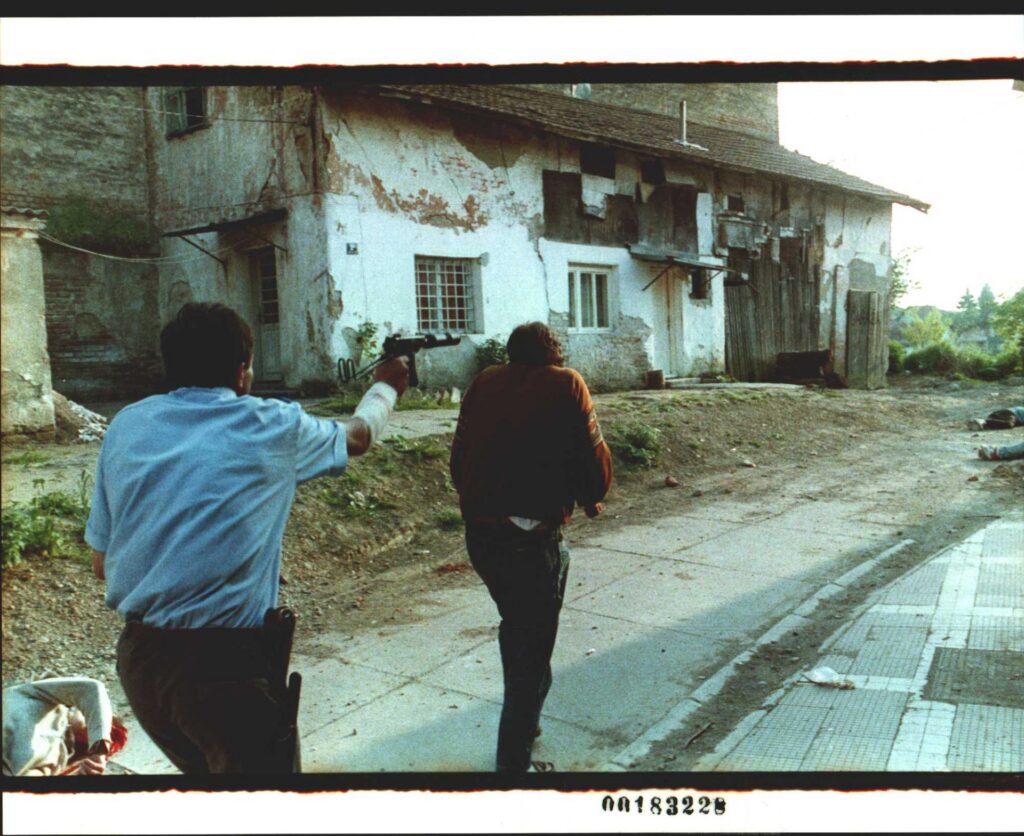
Like Judge Riad, I have been haunted for years by the unsettling proximity of the camera that is revealed in those photographs. We have seen far too many images of the dead in the media from the war in the former Yugoslavia. Yet no camera has ever captured the precise moment of their death. This is why I am so interested in whose gaze, and what kind of gaze, mediated these sequences of killing for us as viewers.
How could a photographer capture a murder so close and so many times? Didn’t the killer see the camera? Why did he let himself be photographed?
Professional war photography is supposed to be an act of noninterference — photographers, like journalists, document reality, observe it. They don’t insert themselves into the events. But these images seemed too intimate, and I found myself wondering if the camera being there affected the outcome and became a form of participation.
To truly understand what was photographed and, most importantly, how, we need to retrace the steps from the photographs back to reality. We need to zoom out from those images. A good photograph can evoke a thousand emotions, but it does not speak a thousand words.
The war in Yugoslavia unfolded in front of cameras and lenses, yet this did little to shorten it: five years in Croatia, four in Bosnia and Herzegovina, and then another year in Kosovo. Over 2,500 articles, recordings and photographs from the war in the former Yugoslavia were used as evidence at the ICTY, according to data from the Media Center in Sarajevo.
But out of all those images and recordings, these are the only professional photographs depicting a direct execution. Such images are rare in the history of photography. One of the most iconic photographs of the 20th century is the one from Saigon in 1968, where the South Vietnamese police chief Nguyen Ngoc Loan is captured firing a bullet into the head of a Viet Cong guerrilla named Nguyen Van Lem. Shot by the American photographer Eddie Adams for The Associated Press, it earned him both the Pulitzer Prize and the World Press Photo award. The executioner allowed Adams to take the photograph because he was convinced of the righteousness of the street execution. The image became famous precisely because it shows what often happens in wars but is rarely depicted. Adams’ photograph sparked protests against the Vietnam War, much to his dismay, since he was a former Marine and supported the American troops fighting for South Vietnam. He considered the executioner a hero for killing a man who had murdered American soldiers.
The circumstances surrounding the creation of Adams’ iconic photographs are well-documented. After all, they were taken in front of numerous witnesses. The ones in Brcko were not: two killers, two victims, two photographers. Or was there someone else present?
The war had only begun in Bosnia and Herzegovina a month before the photographs were taken, in early May of 1992. When Croatia declared independence from Yugoslavia in 1991, Serbia, led by Slobodan Milošević, strongly opposed the dissolution of the federation. This triggered a war between Croatian forces and the Yugoslav People’s Army, supported by local Serb rebels. In March 1992, Bosnia and Herzegovina also declared independence, leading to the bloodiest conflict of the breakup, marked by ethnic cleansing, sieges and mass atrocities.
At dawn on April 30, the war reached Brcko, a town of about 40,000 in the northeast of the country. The majority of the population were Bosniaks — Bosnian Muslims — with Serbs as the largest minority.
Goran Jelisić arrived in Brcko that same day, a volunteer from the nearby town of Bijeljina, where he lived. At 23, he was a young father, with a primary school education, working as a tractor driver on an agricultural estate. Three months earlier, he had been released from prison after serving time for check forgery. In Brcko, he was issued a blue Yugoslav police uniform, a silenced Scorpion pistol, and a Motorola radio. The code name he chose for himself was Adolf. During the trial, a protected witness recalled Jelisić saying, “Hitler was the first Adolf. I am the second.”
The town was empty. Those who could had left, and those who stayed didn’t dare to go outside. Members of the Serbian paramilitary forces looted empty apartments. Bosniaks were detained, initially at the police station in the city center, until the mass camp Luka was opened. It was from this police station that Jelisić led the man in the brown jacket. Why him, specifically, remains unknown. Perhaps he was the first person near the door when it opened, perhaps he wore a valuable watch, or perhaps someone simply didn’t like him. Jelisić couldn’t recall how many times he shot the man, though he said it was his first killing.
He used “maybe two or three bullets” to end his life, he recalled during the trial.
Though the photographed execution was his first, it was not his last. He established a pattern of killing: other victims were also executed with a silenced Scorpion from close range and from behind. Those who knew Jelisić said he was a coward, unable to look his victims in the eye. He would usually shoot them in the back of the head, a detail confirmed during the trial. Later, to save energy on cleanup, Jelisić would instruct his victims to bend their heads over a storm drain.
Jelisić was convicted of murdering 13 people, but the total number of executions he undertook in the mere three weeks he spent in Brcko in May 1992 remains unknown. Since he confessed to the murders he was charged with, the prosecution did not pursue further victims. According to protected witness L, Jelisić claimed that he needed to execute 20 to 30 people before he could have his morning coffee. Witness A said he vividly remembered Jelisić’s voice because 10 to 15 times a day, he heard him ordering, “Lie down and put your head above the storm drain!”
Former detainees who testified at the trial recounted seeing him kill, and described how he would ask them to stack the bodies in a pile so they could be taken away in a meat transport truck to a nearby mass grave. This is the mass grave seen in the photographs — a dozen bodies tumbling down the side of a muddy pit, limbs akimbo, the face of one young man pointing up at the lens. Some witnesses stated that bodies were also taken to the Farma animal feed factory, where they were processed into animal meal.
Witness N estimated that he saw around 100 bodies stacked like firewood, “piled up like logs ready for the furnace.” The prosecution estimated that Jelisić could have killed around 100 people, maybe even more.
The war in Bosnia and Herzegovina lasted a long time and produced many killers. Teachers, police officers and farmers became war criminals. But few killed as prolifically and serially as Goran Jelisić, person by person. That is why he received the longest sentence the ICTY had handed down at the time: 40 years in prison.
Bojan Stojanović was just 22 at the time, a photographer from Belgrade working for the daily newspaper Vecernje Novosti (Evening News). He photographed everything from sports events to daily life. In early May 1992, Stojanović and his friend and Vecernje Novosti colleague Srđan Petrović were recruited to shoot photographs of the early days of the war for the international news agency Reuters. They were headed to Sarajevo on assignment, but ended up in Brcko. They were the ones who captured the photographs of the execution.
At that time, Emil Vaš was a Reuters photographer in Belgrade, and was the first person to see the photographs from Brcko when they came into the bureau. “When I saw them, I couldn’t believe it,” he said in an interview for this investigation. “You can’t believe that someone would take pictures like that. We didn’t even know if it was real. We didn’t know what to do with them.”
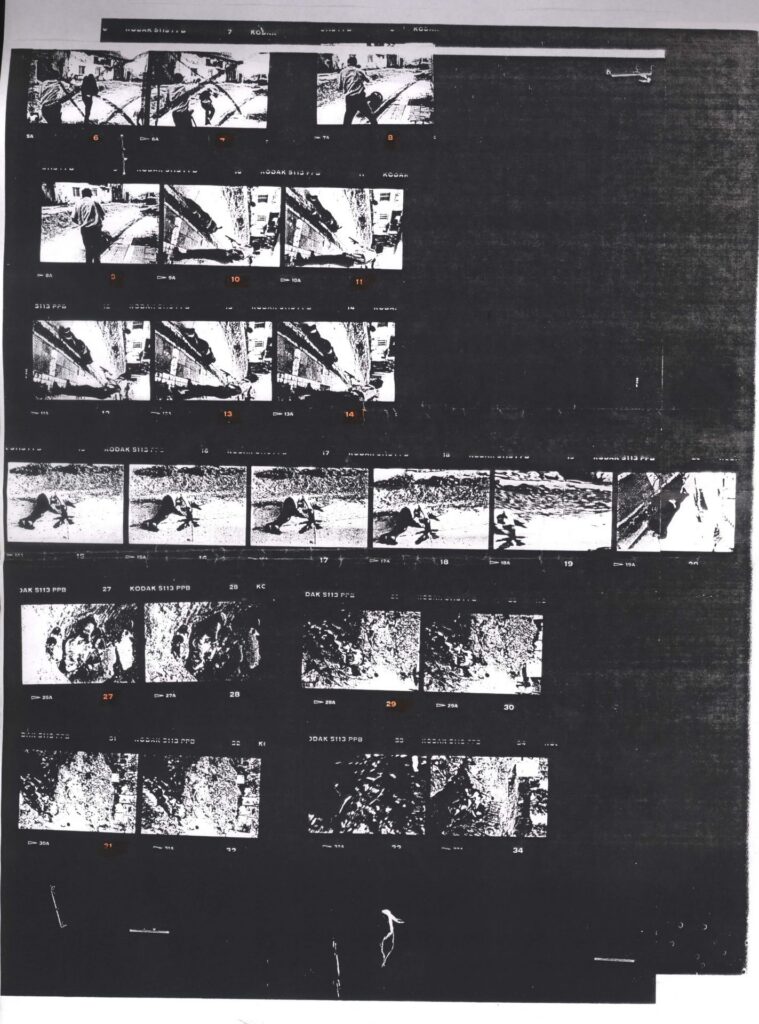
When Petar Kujundžić, then the Reuters chief photographer in Belgrade, saw the photographs, his first thought was that they were staged. He asked Stojanović and Petrović how they had taken them. They replied that they were just passing by, ran into some people, and then it happened. “I was suspicious because I knew no one in their right mind would allow such a thing to be photographed,” Kujundžić said. Something else unsettled him: It wasn’t just a few quickly snapped frames from someone ducking down an alleyway — there were at least two full rolls of film from the event. He also saw Petrović’s film and recalled that the photos were similar.
Kujundžić took the photographs to Donald Forbes, who was the Reuters bureau chief for Yugoslavia in 1992. In an email exchange in April 2022, Forbes didn’t delve into how the photographs were taken, telling me more generally that photographs were accepted based on trust. He remembered Stojanović as a good photographer, though he was a bit of a loose cannon. “At one point, he got a white Golf stolen from the VW factory in Bosnia and put a U.N. sign on it on his own initiative, which got both himself and the Reuters Sarajevo office in trouble with the U.N.,” he recounted. Although he initially said that “at any rate such events occurred and I would certainly have been involved in the decision to use them,” he later wrote that the decision to publish the photographs was made by the Reuters editorial team in London and that it was up to them to assess the ethics of those images. (Forbes passed away in 2025.)
At the time, Pat Benic was Reuters photo editor in London, responsible for Europe, the Middle East and Africa. When I asked if there were any doubts in London regarding those photos, he said: “I recall there was a hold in London on those graphic images until we could verify everything via Belgrade before we transmitted them. The hold lasted hours, not days, as the information was verified,” though he did not clarify how that verification took place.
From May 9 onward, the photographs were published worldwide, credited only with the names in variations such as Bojan Srdjan/Reuters and Srdjan Bojan/Reuters. They were released with slight variations in their descriptions: “A Serbian policeman executes a Muslim sniper with a shot to the back of the head after he was captured near Brčko and accused of shooting at a Serbian refugee convoy.”
Stojanović submitted one of the Brcko photos — the frame where Jelisić has raised his gun, the instant of the execution imminent, three other dead bodies in the shot — for the World Press Photo competition. In February 1993, it won the award in the Spot News category. Stojanović fled Serbia for the Netherlands that same month and would never return to his homeland.
In the Netherlands, he sought political asylum. He emphasized that he was not a war refugee but was being persecuted by the authorities in Serbia and that his life was in danger. In the Dutch media, he was portrayed as a dissident and compared to Salman Rushdie. In interviews, he explained how the photographs came about. The versions differ slightly, but he always said that he managed to take the photographs and leave unnoticed.
He told Dutch media that after publishing photographs that depicted Serbian forces as murderers, a bomb was thrown at the building where he lived with his parents in Belgrade. He told De Stem, “The leader of a Serbian militia has put a price on my head, $20,000. Because I am a traitor to the country. My search warrant notice was shown on Serbian television and appeared in the newspapers.” In November 1992, he was arrested on suspicion of attempting to murder a woman he didn’t even know, he claimed. In another interview, he said he was arrested for “alleged robbery.” He stated that while in custody, he was interrogated about the photographs and accused of espionage. After being released from detention two months later, he discovered, as he claimed at the time, that documents, 4,000 negatives and all his photographic equipment had been taken from his apartment. That was when he decided to flee, but since he had no passport, he allegedly crossed the border with Bulgaria illegally, riding on the roof of a train. In several interviews, he mentioned that Reuters helped him escape.
In response to an inquiry by New Lines, the relevant Second Municipal Public Prosecutor’s Office in Belgrade reviewed the records for 1992 and 1993 but found no information about attacks on Bojan Stojanović. None of the people we spoke to — journalists and photographers who were close to him — knew anything about bombs being thrown at his building, something that would have been particularly memorable, since there was no fighting in Belgrade. A bomb detonating would have been major news. Forbes, Reuters chief in Belgrade, also does not remember a warrant being issued for him on television. “I doubt Serbian TV would have shown photographs of him without my knowing about it. Our staff monitored the news broadcasts,” he said.
Forbes and Benic both deny that Reuters helped him escape. “It was a company rule that if a staff member was wanted by the authorities in any country for any reason, they would remain in place to provide full cooperation. I never received any official approach in Serbia regarding either photographer or the photographs,” Forbes said in an email.
In April 1993, Dutch media reported that two Serbs had kidnapped and attempted to kill Stojanović in Amsterdam. According to a report in NRC Handelsblad on April 21, 1993: “Threatened with a gun, he was forced to get into a car. The kidnappers drove the journalist to Mauritskade. There they tried to strangle him with a piece of steel wire. The 23-year-old Stojanović hit the men with his camera. He managed to escape his killers by diving into the canal.”
That same year, the Dutch public broadcaster VPRO produced and aired a half-hour documentary about Stojanović titled “De Prijs” (“The Price”). As he ate a salad, breaking toast and chewing loudly, Stojanović showed photos from the war — wounded soldiers, the bodies of civilians. Of the award-winning photograph from Brcko, he said, “This guy is a Muslim. Why he died, I don’t know. I was just there, and it all happened in a moment.” He repeated that the killers hadn’t paid any attention to him, even though, he claimed, he was just 3 yards behind Jelisić.
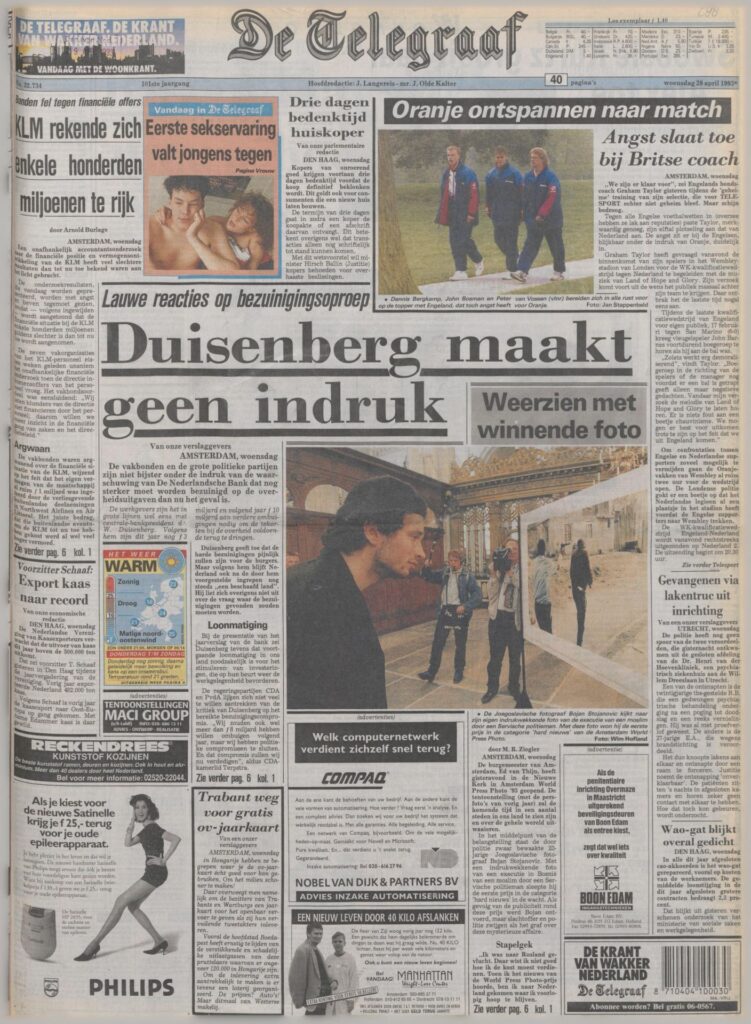
The documentary shows him at the World Press Photo exhibition, observing his enlarged winning photograph with a caption similar to the one that had run in news outlets worldwide. He tells a man, presumably part of the exhibition organization, “Actually, this man wasn’t a sniper. He was just a civilian.” The man nods and says, “Yeah.” He doesn’t seem surprised to learn that the exhibited image perpetuates a lie about the murdered man.
I spoke to the film’s co-director, Thomas Doebele. He said that the film crew assumed that Stojanović was a legitimate photographer and that his work was credible, as he had won the prestigious WPP award. Doebele couldn’t remember who the man was to whom Stojanović said the victim wasn’t a sniper. Neither did anyone at the World Press Photo Foundation.
For years, the caption accompanying that photograph on the WPP website read: “Ruthless killing in the streets in early summer. Accused of firing on a Serbian refugee convoy, a Muslim sniper is captured by a uniformed Serbian policeman and shot in the back of the head.” After I sent the documentary footage to WPP, they changed the caption on their website, though some 30 years after it had already been mentioned on Dutch public television during the exhibition preparation.
At least now, next to the photograph and the corrected caption on their website, there is this note: This caption previously identified the victim as a sniper. We have been provided a video where the photographer says this is not correct. Therefore, the caption was edited on July 21, 2022.
Verifying Stojanović’s statements in the Dutch media revealed that he was indeed in detention in Belgrade at the end of 1992. His colleague Srđan Petrović was also detained. Not because they were falsely accused, but because Stojanović, Petrović, and two other men were convicted of robbing an elderly woman in Belgrade. The Higher Court in Belgrade confirmed that Stojanović was handed the longest sentence — 16 months.
Photographer Kamenko Pajić told me that he was present when Stojanović confessed to Forbes that he had robbed “a grandma” and didn’t want to go to prison. He didn’t go to prison and didn’t serve his sentence. He couldn’t have. He fled to the Netherlands and never returned.
Stephen Mayes was the head of the jury for the 1993 World Press Photo awards when Stojanović was honored. He remembers the photograph, but not any discussion among the jury members regarding it. That year, a total of 1,969 photographers from 84 countries competed for awards with 19,428 pictures. In the Spot News category, which Stojanović won, anything could be included — from celebrity weddings to political elections. Mayes said that in the first round of judging, the nine jury members spent perhaps a second on each photo. It’s “bang bang bang, yes or no,” he explained. There was no information about the photographs or their authors. In the next round, they had a few seconds per photograph, and only in the third and final round, which included just a few dozen photos, did the jury receive any information. “It’s ‘noise’ from a crowd of photos, and those that break through that noise usually have some instant drama,” Mayes said.
Over the past decade, concerns about the credibility of documentary images have periodically erupted, with debates mainly about the manipulation and post-processing of digitally produced photographs — even when the changes had a minimal impact on the image’s meaning. Only in 2015 did WPP introduce a code of ethics stating, among other things, that photographers must ensure captions are accurate and must be open and transparent about the entire process through which their pictures are made.
Though he was recorded as an unidentified victim at the trial in the Hague, the man in the brown leather jacket had a name: Husein Kršo. He was 34 years and 5 months old when he was killed. He was a Brcko waiter. He wasn’t a member of any party, any organization or any army. Husein was married. His oldest son was 9 years old. A month after his death, his second son turned 6. Seven months after his death, his wife Džana gave birth to their third son. The brown suede leather jacket had been a gift his brother had brought back from Switzerland for him, his middle son, Mustafa, told me when we met in Brcko. He said his mother couldn’t talk about it, so he came instead. Džana and her sons saw Husein for the last time a few days before he was killed, when, in early May 1992, the whole family wanted to leave the town. The Yugoslav People’s Army separated the men from the women and children. The men were not allowed to leave. Mustafa remembers saying goodbye to his father near the military garrison. Everyone was crying. His father gave his mother some money and said, “Don’t worry about anything.”
They didn’t know what had happened to Husein until 1993, when his eldest son, 10-year-old Nedžad, was watching TV, saw one of the photographs and screamed, “Mom, there’s dad!” It was his dad’s stance, dad’s jacket, dad’s shirt, dad’s moccasins. There was no doubt.
“The first information about dad’s fate came to us through Bojan Stojanović’s photograph,” Mustafa said.
His father had been friends with the man in the beige sweater who was killed alongside him and is seen with him in the photographs. His name was Hajrudin Muzurović. He was 39 years old, a skilled parquet installer. He had planned to marry in May 1992, the month he was killed. An ordinary civilian, like Husein. The man in the camouflage uniform in Stojanović’s photo, who killed Hajrudin Mazurović, was Enver Stravički, known as “Shock.” He wasn’t mentioned during the Jelisić trial in The Hague, even though they were killing together. He was a volunteer from Serbia. He is no longer alive.
Halfway through my research, I received a confidential excerpt from the interrogation of Goran Jelisić at the ICTY in 1998.
In it is a description of the day the photographs were taken. “On May 6 or 7, 1992, Goran was called into the chief’s office,” where the police chief Dragan Veselić sat with the town’s mayor, Đorđe Ristanić, and a man named Enver, who was known as ‘Shock’. “Veselić told him that he would have his ‘baptism by fire.’”
A month earlier, photographs taken by the American photographer Ron Haviv had been published around the world, showing crimes committed by Serb forces against Muslims in nearby Bijeljina. The Serbs wanted their own propaganda to show that they were being targeted, too.
Ristanić said that “many things had been done in Brcko that needed to be corrected.” Then, he told Jelisić and “Shock” that two journalists, Stojanović and Petrović, “were waiting for them outside to photograph how the two of them would kill two Muslims … and that these photographs would be used as propaganda material.” After the executions, “they would go in front of the station where an empty coffin had been placed and mourn for the supposedly killed Serbs, which the journalists would also photograph.”
Jelisić then went on to describe how “Enver took two unknown Bosniaks” from the station, “and on that occasion, Goran shot one of them with a Scorpion, and Enver shot the other with an automatic rifle, which the journalists photographed. Then they returned to the front of the station to the empty coffin and joined a girl named Violeta, who was crying and lamenting for the supposedly killed Serbs.”
Can the account of a mass murderer be trusted? John Ralston, the chief investigator for the ICTY’s Office of the Prosecutor, told me in an interview that there was no reason for Jelisić to lie. There were enough witnesses and evidence against him, even without those photographs — 25 prosecution witnesses testified against him at The Hague.
While suggestions that Stojanović’s images were perhaps created as propaganda simmered in Jelisić’s interrogation records, a more pernicious theory has been circulating in Belgrade’s photographic circles for a long time: that the photographers paid for the chance to get the shot.
The story originated from Srđan Ilić, a photographer who worked for The Associated Press during the war. I called him in 2019; he didn’t want to talk about it. I called him again in 2022; he said he had decided not to talk about wartime anymore. I then told him that I would use the written source in which he claimed that the photographers paid Jelisić and asked if he still stood by it. He said to leave him out of the text entirely if possible, and if not, to use that written source. In Sandra Vitaljić’s 2013 book “War of Images: Contemporary War Photography,” Srđan Ilić says, “Bojan showed up at the Writers’ Club restaurant in Belgrade with a pile of printed pictures of that event and talked at the table about how they paid that Adolf 500 marks to kill those few Muslims.”
Every photographer I spoke to knew about that story, but no one else had heard directly from Bojan or Srđan that they had paid Jelisić for the murder, only Srđan Ilić.
Stojanović is deeply disturbed by the accusation that he and Petrović paid for the photographs.
I searched for him for months. A few people who had once been close to him told me that he was no longer alive. He is alive, and he has been living in a small town in Spain for the last decade.
He wanted us to “get to know each other first” and see if I “use my brain.” He asked if I was married. Did I have children? Did I have a lover? He was interested in which of the photographers I spoke to had the best sense of humor. At the mention of Ilić, he immediately got angry. He said Ilić made up the story about the payment because he was jealous. “It’s such naive stupidity that I can’t believe people accepted it,” he said.
When I asked him about how he came to take the photographs, his story diverged rather sharply from all the accounts he’d given to Dutch media when he was awarded the WPP. Now he says Jelisić knew he was being photographed. In fact, he spoke with him briefly after the murder. He and Petrović knew people would be killed. I told him that Jelisić had told Hague investigators that it was a staged shoot meant to depict alleged Serbian victims. He laughed and said that was “new information” to him. He said that he and Petrović thought the photographs would change the world for the better, maybe even stop the war.
Why did Jelisić agree to be photographed while committing murder, I asked.
“Because he was proud to defend the Serbian ideology. It was done by a Serb who was crazy,” Stojanović replied.
“Why didn’t anyone else allow it during the whole war?” I asked.
“How should I know? They were probably smarter than Jelisić.”
“Of all the war criminals, Jelisić is the dumbest?”
“You said it.”
Petrović also fled to the Netherlands. Like Stojanović, he was granted political asylum and lived there for a long time. But he eventually returned to Serbia. Petrović has built a good career as a private jet pilot, though he hasn’t given up photography — he now shoots Formula 1. I called him to meet in September 2023 when I was in Belgrade. He couldn’t make it, but he was willing to talk to me over the phone. He said that the day before they left for Bosnia, he and Stojanović heard that something was happening in Brcko and decided to go there. In the center, they saw two men leading two others somewhere. He asked the one in the police uniform — he would later find out it was Jelisić — where they were taking them. “He said, ‘We’re taking them to a wedding,’ and grinned,” Petrović recalled. He told me that Jelisić then added about the man he was about to kill, “This is my 180-something; let me make it 200 and go home.” They were 7 feet away from him, Petrović says. The wide-angle lens confirms it. When the shooting started, Petrović and Stojanović began snapping frames. He said they were shocked.
“You know how journalists go to war? They sit 10 kilometers away from the battles, get drunk, and make up stories,” he said. “We always pushed to go where the action was. We were young, brave, crazy and ambitious. We got the chance to work for a big company, finally paid properly, everything we dreamed of.”
While in ICTY custody, Jelisić socialized with Bosnian detainee Esad Landžo, who was later convicted of war crimes against Serbs. When we met two years ago in Bosnia and Herzegovina, Landžo told me that once Jelisić got angry because he didn’t receive some documents from the police in Brcko that could have helped his case. He started ranting and cursing, saying, among other things, that “a journalist paid him to film that murder.” Landžo said he “remembered that 100%,” but didn’t know the details — whether Jelisić was paid to kill the men or he was going to kill them anyway and was paid to be photographed in the act.
In 2003, Jelisić was transferred from The Hague to Italy to serve his prison sentence. I spent 10 months trying to get permission to visit him. I received rejections from both the prison and the Italian Ministry of Justice. When he was transferred to Belgium, where he had a phone in his cell, he called me regularly for about a month, in April 2023. He was polite, open to questions and hopeful that he would be granted early release within a year, although his request had already been denied twice. He claimed that the photographs of the murder in Brcko were arranged as propaganda. It was on May 6, he remembers. Jelisić was in the office of the police chief Veselić, who, along with Brcko’s mayor, Ristanić, arranged for the murders to be portrayed as if Muslims were killing Serbs. Veselić was later killed. Ristanić refuses to speak to journalists.
Jelisić mentioned that there was also a girl there who had been hired to lament over the supposed Serbian victims.
Violeta. She was 16 years old at the time. She had followed her boyfriend, who was a soldier, to Brcko in 1992 from her hometown of Bijeljina.
Violeta was also mentioned during Jelisić’s trial in The Hague. “I just remember she was carrying a camera and standing next to him. Then she said, ‘Goran, is this your 53rd or 54th?’” recounted the protected witness, adding that Violeta accompanied the question with a hand gesture mimicking the pulling of a pistol trigger.
After Violeta’s boyfriend was killed later that year, her mother came to Brcko and took her home.
I found Violeta’s mother on her porch in the village of Međaši, near Bijeljina, in June 2023. By this time, Slobodanka Zarić, known as Seka, was 67. She received me without prior notice because I came with her acquaintance Duško Tomić, a lawyer who lives in the same village and has been dealing with war crimes for decades. She told me she wasn’t in Brcko in May 1992. I read Jelisić’s statement to her. She said she had never seen Jelisić in person. I showed her the photographs of the murder. She shook her head, saying she was seeing them for the first time. Both Tomić and I believed her. That night, I traveled back to Zagreb.
Early the next morning, she went to Tomić’s house and told him that she actually had been in Brcko at that time and that it was indeed as I had described. Her daughter, Violeta, had been hired to mourn the supposed Serbian victims.
Violeta did not respond to phone calls.
Mustafa Kršo was 6 years old when his father was killed. Today he is 40, six years older than his father was when Bojan Stojanović captured his last moments. Many years have passed, yet the memory is still raw. When I ask him if he’s heard the stories that Stojanović may have paid for the photos, he is stunned. He didn’t even know that the photographer had been awarded a prize for the image of his father’s killing, and that for all those years the World Press Photo website stated under the photograph that his father had been a sniper.
He wonders: Was his father killed because the photographer was there? Maybe he would have been killed anyway on another day, or maybe never. Some were released from the police station. Many were taken to the camp. Some escaped from the camp. Many were tortured and then killed. He would prefer to think his father wasn’t tortured, that he was killed quickly.
“If the photographer paid for the murder, he’s the same as Jelisić to me.”
Additional reporting by Ruben Brugnera and Natalija Jovanović.
This investigation was supported by Journalismfund Europe.
Become a member today to receive access to all our paywalled essays and the best of New Lines delivered to your inbox through our newsletters.