


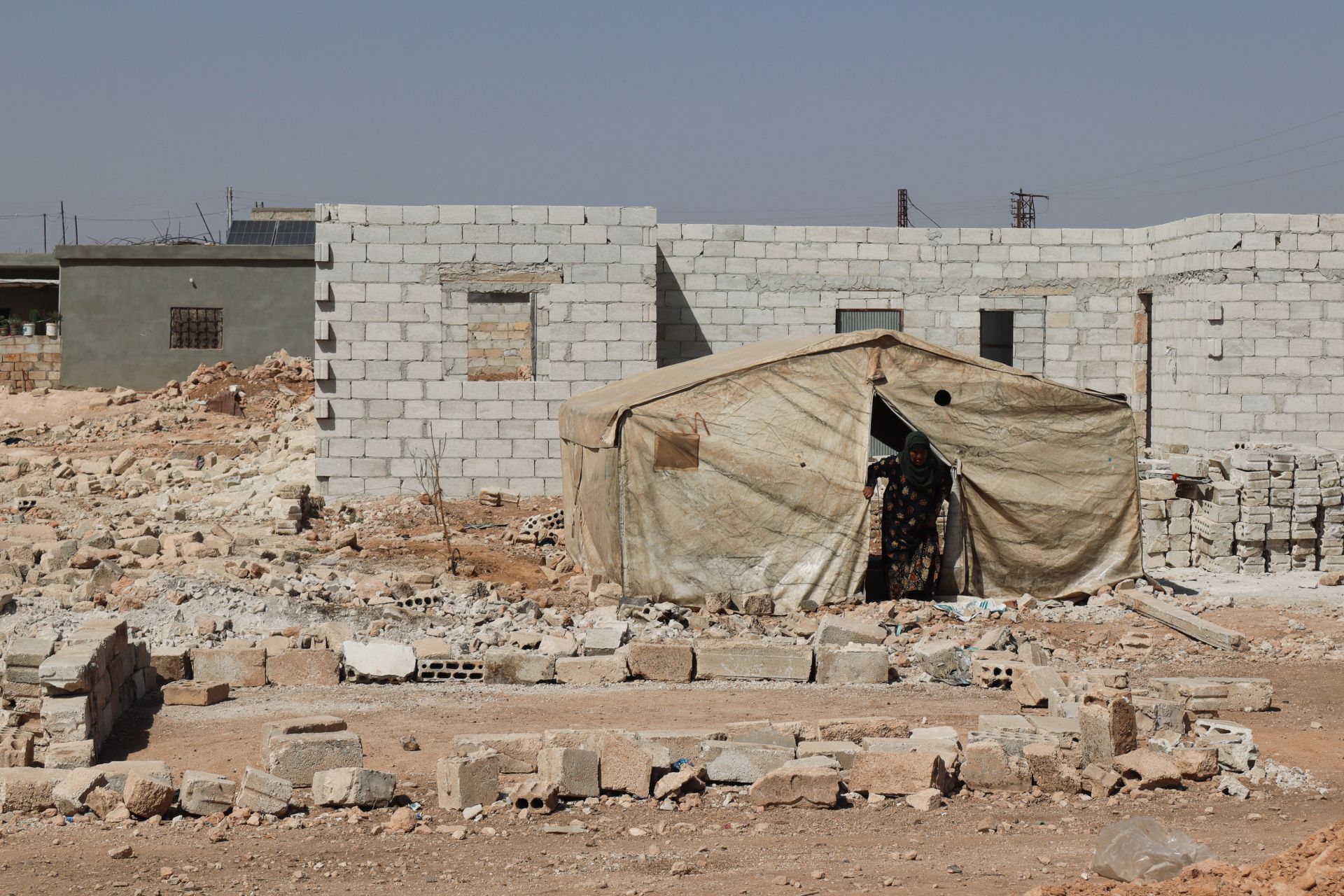
As one drives from Hama to Idlib in northwestern Syria up the M5 highway, the village of Morek comes into view, followed by Maan to the east — idyllic places once known for their blossoming pistachio orchards. Prior to 2011, Syria’s multimillion-dollar pistachio industry ranked fourth in the world. Today, dozens of villages like Maan and Morek in northern Hama are in ruins, and vast stretches of land are barren, their pistachio trees uprooted and sold as firewood.
During the Syrian conflict, Morek and Maan were on the front lines of the battle between regime and opposition forces. Maan, a mixed Alawite and Sunni village, remained under the control of the Bashar al-Assad regime, while the predominantly Sunni village of Morek alternated between regime and opposition control. Maan emerged as a stronghold for the regime’s National Defense Forces and 47th Brigade, along with the notorious Air Force Intelligence and Military Intelligence branches.
When under regime control, both villages were completely depopulated of their Sunni inhabitants, and their homes were systematically looted or destroyed to prevent them from returning. Alawite homes, meanwhile, were largely left standing.
As opposition forces advanced from Idlib last November, thousands of Alawites from northern and eastern Hama and other parts of the province took flight, fearing reprisals for their real or perceived affiliation with the former regime. Within weeks of the regime’s collapse on Dec. 8, Sunnis started returning to their villages, only to find their homes gone.
Destitute and homeless, they moved into the homes of their former Alawite neighbors and began cultivating their fields. While Morek’s reconciliation committee has made significant headway in resolving disputes, efforts to form a similar committee in Maan have stalled, leaving its former Alawite inhabitants in limbo.
Desperate to leave the tents of Atmeh camp, Rahma Ahmed, 60, and her last remaining son were among those who returned to Maan within days of the regime’s collapse. “We suffered from the rain and cold in tents — we burned shoes to keep the children warm,” she recalls. Her lined, sunbaked face, framed by a loosely fitted dark blue hijab, betrays a deep weariness from years of displacement and loss. Her husband and three other sons were killed during the war.
Upon her return to Maan, she arrived at a scene of devastation: Her home was in ruins, and her 20 acres of pistachio orchards were gone. “We left without anything but the clothes on our back, and we returned to nothing.”
Destitute and unable to rebuild her home, she moved into her neighbor’s house, but she does not feel settled: “I want to be in my own home,” she says. “It would be better for us psychologically to live in tents rather than their homes — all Alawites are responsible for what happened, from the women to the men,” she asserts forcefully. “The state needs to expropriate their lands for compensation.”
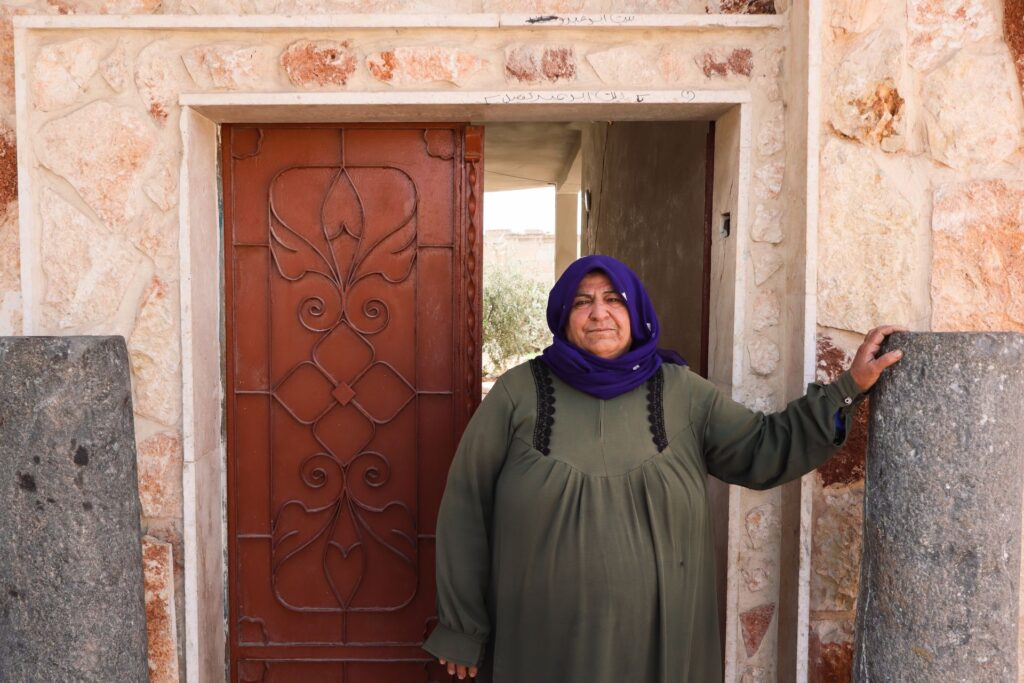
Ahmed’s experience upon returning to Maan was not unique. “I didn’t find olives or pistachios, I found a desolate land without trees,” Mohammed Akhlaf Ansaf, 57, the newly appointed mukhtar (village leader), says. “It was complete destruction.”
He first tried to return to Maan in 2013 to tend to his orchards, but was arrested by the Political Security Directorate and detained for a year. “They kicked me in the mouth and broke my teeth, then forced me to swallow them,” Ansaf recounts, steadying his voice. “I was tortured until I almost died, when Dr. Azzam, a former Alawite neighbor from Maan, healed me.” His family eventually paid $62,000 in bribes for his release, and he left for al-Tarfawi, in opposition-controlled Hama, before finally returning to Maan last December with his two wives and 11 children. He lost two sons during the war.
Ansaf says his Alawite neighbor informed him that he could live in his house to protect his property. “He told me I could live in it at my own expense as long as I paid for the repairs.” While regime forces left Alawite homes standing, they did not spare them from looting. Ansaf had to repair the walls and install a door. But a source close to the family says the owner’s home was taken without his consent and that he only found out four months after it had been occupied.
In return for staying in his neighbor’s home, Ansaf says he is tending to the landowner’s orchards. “We are trimming the weeds for our Alawite neighbors so that the trees don’t burn.” He intended to share the season’s harvest with him, he says, but “it was a weak season.” He also claims that “people from the surrounding areas stole the harvests.”

For many of Maan’s displaced Alawite villagers, the culprits are clear. Five sources New Lines spoke to from the village accused their Sunni neighbors of stealing their harvests.
Alaa Ibrahim, 47, a native of Maan, is one of the over 10,000 people displaced from a cluster of 12 villages northeast of Hama city with significant Alawite populations, according to figures New Lines obtained from the council of Hama governorate. Ibrahim, who has tasked himself with collecting statistics, estimates that tens of thousands more have been displaced from other parts of the province. On Nov. 30, he and his family fled Maan as opposition forces advanced deeper into Hama province.
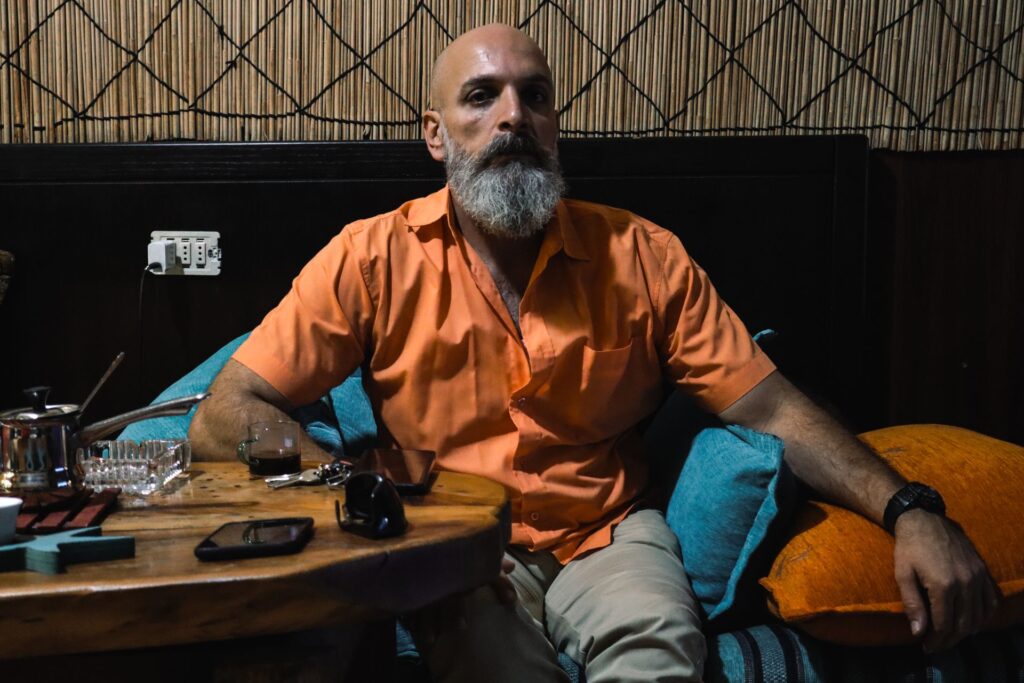
Since then, Ibrahim has made multiple efforts to return to his village but has been threatened with violence each time. “I tried to return — I personally made multiple attempts to communicate with the neighbors, but when I did, they warned me that I could be shot by others in the village,” he says. “The police said they were powerless to do anything.”
His brother is accused of being part of the National Defense Forces, a claim that Ibrahim and even the new mukhtar refute. His name appears on a list of 100 people from Maan who were allegedly part of the regime’s forces. Drawn up by the Ministry of Interior, the names are based on allegations from neighbors.
In 1988, Ibrahim’s parents were among the first farmers to plant pistachio trees in Maan. A highly lucrative industry, pistachio farming is their primary source of income. Since his family’s harvest was stolen this year, he now works at a school in Homs, earning $110 per month. He needs $400 a month for himself and his wife to get by, so he has had to take on debt.
He and his family took a financial hit over the long years of the war. “Maan was an outpost for the regime — we couldn’t access our lands from 2016 to 2020 on the pretext that it was unsafe,” he recounts. Two-thirds of the harvest of Alawite lands would go to the regime, he says.
“In 2016, my brother and I went to cultivate the harvest and we saw Air Force Intelligence steal it in front of our eyes.” Two members of his extended family were part of the National Defence Forces, having joined to defend the village. Despite these connections, Ibrahim’s harvests were stolen.
“While Alawite homes weren’t destroyed, they were looted for iron bars, appliances, even kitchen tiles,” he notes. “Many of our trees were also sold for firewood.”

Unable to access his lands this year, Ibrahim turned to Iktifaa, a private company founded in Idlib that brings together investors and landowners to collect their harvests. One-third goes to the landowner, another third to the investor and the remaining third to the company. Ibrahim found a Sunni investor, but he, too, was accused of being part of the National Defense Forces, despite being a prominent financial backer of the revolution. As a result, Ibrahim’s entire harvest was left untended and stolen. Last week, he found out that all of his family’s lands had been taken by the state because of his brother’s alleged affiliation with the National Defense Forces.
Amal, 34 — who declined to share her last name because of security concerns — was also unable to retrieve her harvest this year. Her family has 10 acres of land on which they grow lentils, barley and pistachios. “We can’t go back to our lands because people are occupying them, and they are currently under the state’s control,” she says. The state has taken control of all lands that allegedly belonged to former members of the regime. She and her family currently live in their second home in Homs city.
The name of her father, the village’s former mukhtar, also appears on the list of 100 wanted persons that Ibrahim’s brother is on, even though her father was killed — and her brother, sister, aunt and uncle kidnapped — in 2014, when opposition factions stormed Maan for a second time.
The family’s primary source of income was from its land, with an estimated $30,000-$40,000 lost for this year’s harvest. Amal’s $30 monthly salary working at a children’s toy store is grossly inadequate to support her family. As a result, she is considering selling a portion of the land to make ends meet.
A few weeks ago, one of her Sunni neighbors sent her a video of some of their pistachio trees that had been cut down since the fall of the regime, in what she considers an act of retaliation. As a result, she is afraid to return to her family’s lands. “If we go back, they’ll kill us,” her younger brother chimes in. “Anyone Alawite is wanted.”

Within weeks, a reconciliation committee — modeled after those in opposition-controlled Idlib — was active in Morek to mediate disputes, including between those who were formerly affiliated with the regime and those who were displaced to opposition-controlled areas. Like in Maan, regime personnel would steal their neighbors’ harvests and loot their homes.
Unlike neighboring Maan, the village has not seen any displacement, despite many of its residents having served in the regime’s ranks. “Only the officers fled — two of whom are now in prison — while their families remained,” says Qutaiba Bakkour, 38, a member of Morek’s reconciliation committee who returned from Idlib in December. He has many years of experience, having served as a member of Sarmada’s reconciliation committee during the war.
“Today, our state, our courts, are weak and overwhelmed. Issues are resolved with mutual understanding through reconciliation committees before reaching the courts — but if they are not, they go to the courts,” Bakkour explains.
“It’s not because someone is Alawite or Sunni. Anyone who is guilty must be held accountable in the courts. We are prosecuting people because they are criminals, not because they are Alawite,” he adds.
Bakkour owns lands in Maan as well as in Morek. He is currently taking care of the lands of his Alawite neighbor in Maan that border his. This season, he delivered $1,200 worth of the pistachio harvest to him, but didn’t take a cut, he says. “I don’t need the money — I’m doing it because he’s my neighbor.” In any given year, he harvests between 100 and 200 kilograms (220 and 440 pounds) of pistachios, with each kilogram worth between $1.50 and $3 depending on market prices.
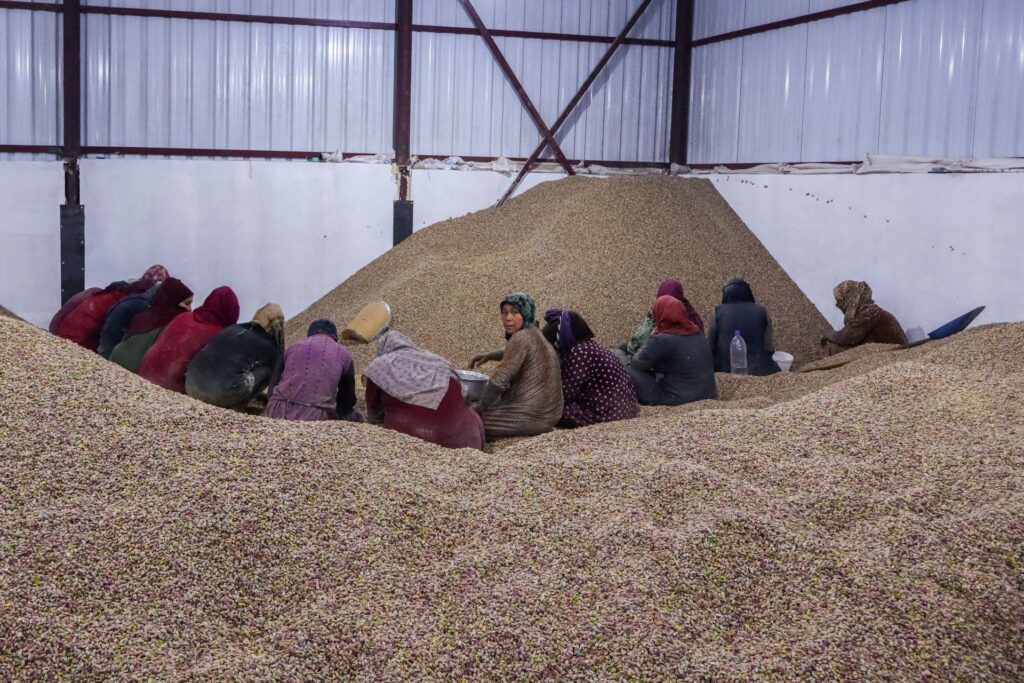
Some of the village’s inhabitants, however, are not content with how the new authorities are dealing with former members of the regime. “They’re holding us accountable for taking revenge, not those who killed,” says Ali Mohamed Hamadi, 37, a small pistachio farmer who recently returned from Kili camp in Idlib with his wife and three daughters. A handful of revenge killings have occurred in Morek, and their perpetrators have been arrested by the police. Moreover, until now, villagers have not received compensation for the harvests and orchards they lost.
“The problem between Sunnis is worse, as those that were with the regime were not defending their own, unlike Alawites,” he adds. His harvests were stolen for years by the regime, and his house’s door and windows were all looted. Hamadi plans to sell off some of his lands to have enough money to repair his home before the winter comes. He needs between $3,000 and $4,000 to renovate and is already $11,000 in debt. Only half of his pistachio trees are left and, of those that remain, 90% are not producing fruit due to years of neglect.
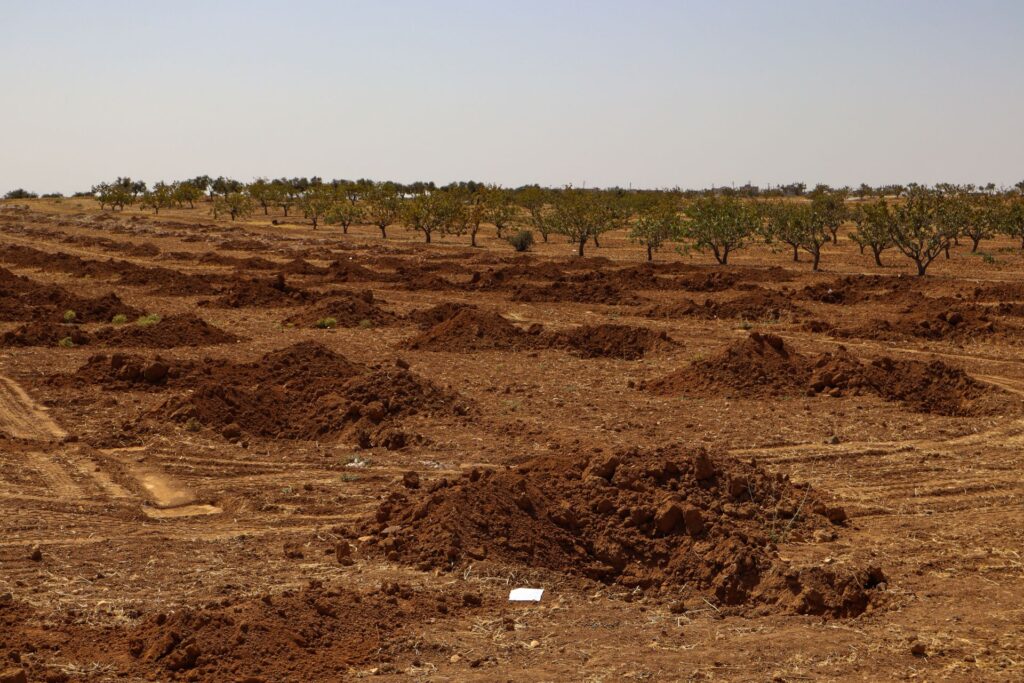
While the reconciliation committee in Morek has been active since December, a similar committee in Maan has yet to be formed to resolve property disputes.
Ali Mahmoud al-Hussein, 37, along with three other villagers, including the mukhtar, have been appointed by the province to form Maan’s reconciliation committee. The remaining five members, who will be Alawite, have not yet been selected. Al-Hussein, who previously fought with the Sunni Islamist force Ahrar al-Sham, has laid down his weapons to work in community mediation.
“The first goal is to prevent sectarian tensions — issues are to be resolved by the committee through compensation, which will be validated by the courts later on.” He and his family are living in a warehouse that belongs to the son of a former regime officer. Careful to distinguish him (meaning the son) from his “criminal father,” he said he will return the property as soon as he is able to move out. In addition to his civic duties, he works on the lands of Alawite landowners who pay him in return.
The committee will correct the list of those wanted for being part of the National Defense Forces, he says. “There must be evidence or eyewitnesses — cases of those who cut down trees and ruined homes will be resolved within months, whereas those who killed will require everyone to come together.”
For Ibrahim, the solution is simple: “Investors need to start working now with popular committees composed of Alawites and Sunnis to protect the lands — security must come first.”
The pistachio industry requires high costs for labor and inputs, such as fertilizer and pesticides. Maan’s current Sunni inhabitants, left destitute by the war, simply do not have the means to continue to maintain the pistachio orchards.
The livelihoods of the entire community are at stake if the trees are not tended to, Ibrahim says. “Landowners won’t receive anything, and those who used to work the fields will not receive anything either, as an entire industry will have been destroyed. The economic wheel will stop.”
“Spotlight” is a newsletter about underreported cultural trends and news from around the world, emailed to subscribers twice a week. Sign up here.