


In the hills overlooking Medellin, Colombia’s second-largest city, with roughly 4 million residents and a growing expat community, a sprawling bald patch of dirt called La Escombrera, or “the dump,” glares down toward the city’s valley floor, crowded with skyscrapers and brick apartment buildings. Luis Fernando Álvarez, or El Aka as he is better known, sees it wherever he goes in his home city. The large dirt mound looming over the city also looms over him. “It’s like an open wound,” he told New Lines.
The mound was once a forest. It was also, for over two decades, a dump site that was piled with thousands of tons of debris over the years. But what continues to haunt Aka are the bodies buried there. La Escombrera, it turns out, was also a mass grave.
Aka is now 38. He was a young teenager in 2002 when the Colombian military under right-wing President Álvaro Uribe executed Operation Orion, a controversial military project to take back Aka’s home neighborhood, Comuna 13, from left-wing guerrilla groups.
In the 1980s and 1990s, Medellin was in the grip of the cocaine drug lord Pablo Escobar and suffered high rates of violence related to drug trafficking. Comuna 13, a lower-income area on the steep hilly outskirts of the city that is now a major tourist destination, was particularly afflicted because of its convenient location along major drug trafficking routes. The residents of the neighborhood, also known as San Javier, suffered under numerous criminal groups that were struggling for control of the routes, though they also offered the community a certain level of order in a neighborhood largely ignored by government authorities.
Operation Orion and its aftermath resulted in hundreds of local civilians being forcibly disappeared, with both state military and illegal paramilitary groups allegedly complicit in targeting civilians who were suspected of collaborating with the guerrillas. It was the largest urban military operation in Colombian history.
Many of those forcibly disappeared, locals firmly held, were discarded in La Escombrera, only to be covered in layers of trash thereafter. Their relatives’ claims, however, were largely ignored by authorities for years.
Nor did the violence in Comuna 13 end with Operation Orion. In the years that followed, activists and artists were often targeted by local gangs. Some locals like Aka, who is a rapper, used artistic expression as a way to speak out against the pervasive violence in their community and the pressure to kill others, he said. But that wasn’t popular with those who sought control of residents’ daily lives.
By the age of 17, Aka had already lost 23 of his friends from the barrio, or neighborhood, a product of the violence that surrounded him throughout his childhood in San Javier.
Amid the death and violence, something else happened during Aka’s formative years. When he was almost 16, a group of women from Comuna 13 took him and other local youths under their wing. Near the mound that had been transformed from a forested patch of land into the graveyard of hundreds of locals who were forcibly disappeared, this group of “doñas,” as he affectionately calls the women, taught the next generation to sow seeds.
Many of these women had lost a son or daughter — or more than one — during the years of violence in their community. The garden they sowed near the site of the mass grave was an act of resistance, a way to cultivate life where lights had been forced out, an act of transformation in soil seeped in blood.
They talked to the plants, Aka said. They shared their sorrows and deep grief. “Those women used their garden to cry for their children,” Aka said. “And, in some way, it helps them console themselves.”
Over two decades later, on a rock wall outside a cemetery in San Javier, people press their fingers into soil, placing small green plants on narrow ledges wedged between photographs of the dead. Memorial de las Ausencias, or Memorial for the Absent, it’s called. Family members of loved ones lost over the decades come to visit their portraits here, wedged between the growing vegetation. Sometimes they talk directly to the portraits of the lost ones, or sing a favorite song.
This garden is just one way Aka and fellow community members have worked to promote peace and reconciliation over the years. Through the grassroots organization Agroarte, they have forged a new path toward peace. Agroarte uses popular art forms, like murals and hip-hop music, to connect people to the history of their community, to each other — and to the literal soil they stand on. Activities include intergenerational gardening events; commemorations held in places of significance across San Javier; and rap, dance and theater performances. The point is to transform places of pain and suffering into something a little different. “To find a way to seek, beyond the horror, the beauty,” Aka said. “To grow a forest together while we repair our hearts from the impacts of war.”
Memory is not objective, after all, and Aka insists the only way to preserve it is to listen to the many small stories kept close to each person’s heart. Many of Aka’s hip-hop songs from over the years speak of the need to search for the truth about past instances of violence and lives lost in his community, and to never forget.
But preserving local memories and promoting the collective healing of an entire community are not easy feats. That’s particularly true when some of the forces that once caused destruction in Comuna 13 never fully left. Gangs still maintain significant control throughout the neighborhood. To speak out against them is to risk your own life, according to locals.
Aka has been there. In 2012, he said he received a threat against his life that forced him to flee San Javier. Some of the others he worked alongside in Agroarte were murdered. Aka’s would-be assassin left him with one sentence. “He said, ‘Remember that this is the jungle, and you are the hare,’” Aka recalled.
While art and activism posed a threat to the illicit powers in San Javier, they also became a powerful form of resistance. In the early 2010s, a series of murals was started in the area, reflecting local stories and perspectives and, in some cases, denouncing past state interventions and military operations, as well as the influence of local organized criminal groups.
Then, in 2011, Medellin’s city government began construction of an innovative outdoor escalator system in a particularly steep part of the hilly neighborhood. The scene was set. Foreign tourists began to take note, and over the next decade the area around the murals and escalators in Comuna 13 would become one of Medellin’s most popular tourist destinations.
The story sold to tourists on graffiti tours spoke of Comuna 13’s transition from one of the most violent parts of the city to a locale booming with street art and hip-hop music. The narrative meshed well with Medellin’s restyled image as a city of innovation after decades of darkness under Escobar’s drug trafficking reign.
That same narrative about San Javier — and Medellin as a whole — still echoes today. “Comuna 13 is, in large part, a reflection of the history of the entire city,” Ana María López Acosta, Medellin’s tourism secretary, told New Lines. “It’s a story of resilience, of transcendence. Of how, finally, with the will of the people in the community, you can transform lives.”
Diego, a community leader whose name has been changed, has lived in Comuna 13 for nearly 50 years. He acknowledged that things have gotten somewhat better there over time. But his neighborhood is still not the shining example of transformation that Medellin’s city government wants to sell to the world. “They’re selling a version of the city of Medellin that doesn’t exist,” Diego told New Lines. “A reality that doesn’t exist.”
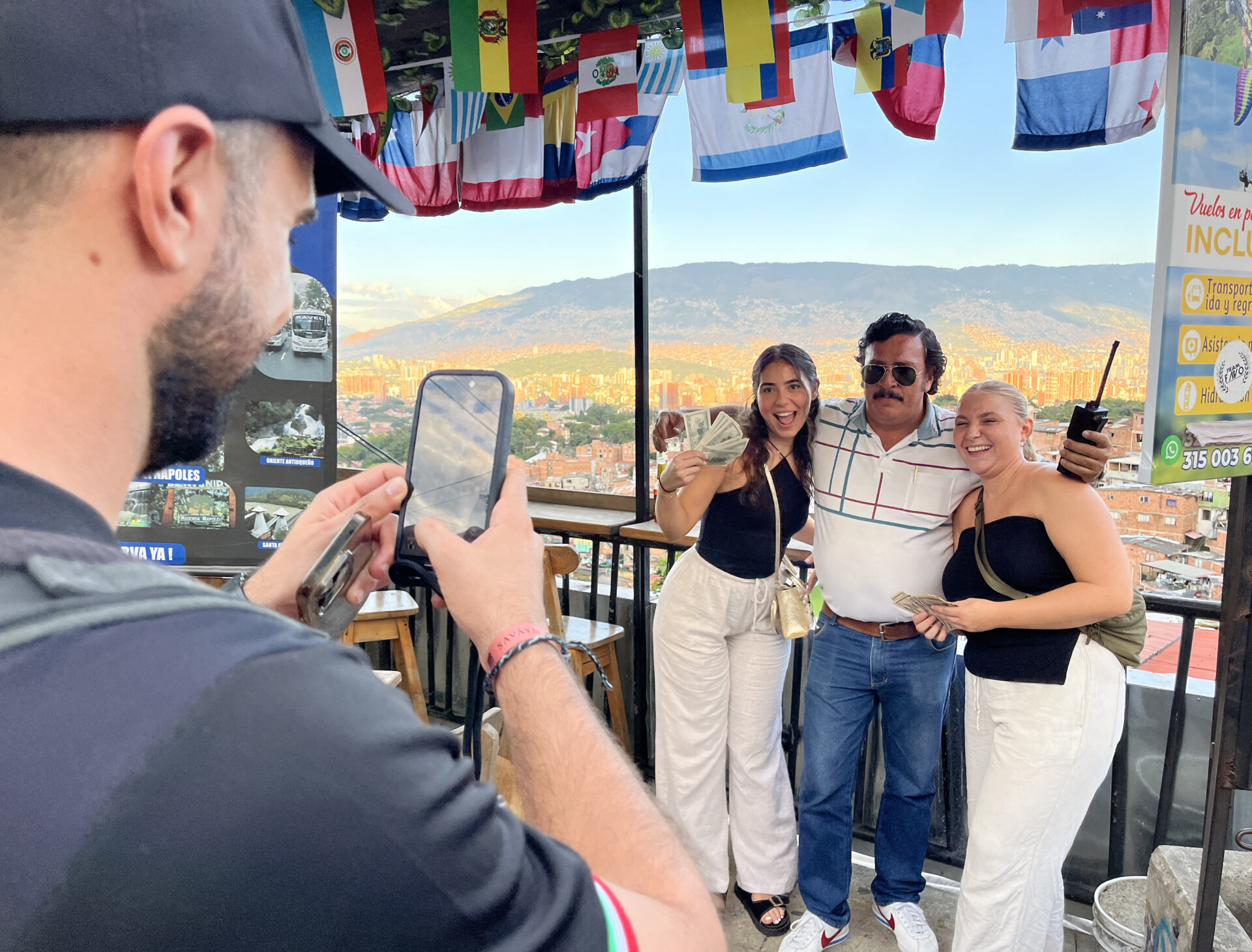
As tourism peaked in Medellin, particularly after the COVID-19 pandemic, demand from an influx of foreign tourists with deep pockets helped convert Comuna 13’s local graffiti tour into what Aka now calls “Comuna-land” — Medellin’s Disneyland, with a dark twist.
According to locals, gangs largely run the show in the tourist area, extorting vendors and orchestrating backdoor drug deals and child sex trafficking. Medellin’s authorities have grappled with this phenomenon in recent years, as sex tourism has surged across the city. Diego said he had heard of locals who were forced to sell their homes around the outdoor escalators under pressure from gangs who wanted to set up businesses there.
These days, ads for beer and tattoo parlors often overshadow original murals detailing aspects of the neighborhood’s history. Loud reggaeton beats and hawkers looking to make a few pesos drown out local voices. In some instances, tour guides invent stories about San Javier to appease tourists. After all, who doesn’t want to make a buck where they can?
Comuna 13’s tourist sector today represents a distortion of Medellin’s history, as well as the history of Colombia, according to Aka, presenting an image of modern transformation and a sensationalized narco saga without acknowledging the nuances of residents’ lives, past and present. Many tourists come after watching TV series about Colombia’s history of drug cartels, hoping to find their slice of the Escobar legend along the steep, winding sidewalks.
Patrick Naef, an anthropologist who has studied the Comuna 13 tourist sector extensively, said that tour guides take great care to show visitors a romanticized version of the neighborhood. “They are super careful not to have people wandering around outside this little touristic bubble,” Naef said. “It really shows a fake image.”
Tourists, perhaps, drink the Kool-Aid. On a midweek visit to the tourist area last year, Lise Rousset, a visitor from France, seemed impressed as she sipped a beer and looked out over the Medellin skyline. “It’s really cool to see that a horrible place can turn into something really great with tourism,” she said.
Vendors, too, appreciate the business that tourism has brought. María (not her real name), who was selling jewelry under a pop-up tent that day, encouraged tourists to come visit her stall. But she also expressed frustration with the lack of regulation in the sector. “So much disorder. There’s no leadership, nothing. No police, nothing,” she said.
Diego believes the area attracts tourists seeking excitement and intrigue. He wonders whether they care at all about the lives of the people who actually live there. “Many of them come for the thrill, right? Because they like terror,” he said. “They don’t ask how we residents survived, do they? How many died, how they died, or where they are now.”
Medellin’s city government has focused on training and certifying tour guides in Comuna 13 over the past year to ensure narrative accuracy and appropriate safety protocols among those leading tour groups through the neighborhood, according to López Acosta. The next big project in 2026 will be finding ways to better control the flow of tourists to the area.
Medellin’s tourist numbers have continued to increase in recent years. In 2024, it received the second-highest number of foreign visitors after Colombia’s capital city, Bogota. The city broke a record this year, with a roughly 12% increase in foreign tourists visiting Medellin from January to June 2025 over the same period last year. Comuna 13 is likely already over capacity. In 2024, over 1 million people visited its tourist corridor, making it the most popular tourist attraction in Medellin by far. By comparison, the touristy Museo del Oro, or Gold Museum, in Bogota receives some 500,000 visitors annually. A 2023 study cited in El Armadillo, an investigative media outlet focused on Medellin, found the daily number of tourists visiting the popular outdoor escalators in Comuna 13 was up to 50 times greater than the capacity they can reasonably handle. Some international tourism agencies have made the decision to stop leading trips there.
López Acosta said that promoting tourism in other culturally rich traditional Medellin neighborhoods may be one solution. But she claimed there is only so much the city government can do. After all, this was a project created by the community, she said, their very own version of “transformation.” “We can’t just tell them, ‘Hey, you can’t set up your beer tent, you can’t change that mural, because this is a tourist attraction,’” she said.
Despite it all, day and night, a shadow falls over the nightclubs and Escobar souvenir stands along the steep streets of the Comuna 13 tourist route. The mound remains — the dump, the grave, the open wound. La Escombrera still reigns over the Medellin skyline.
These days, tents cover large swaths of earth there, evidence of ongoing excavations for human remains, decades after the fact. Almost one year ago, the first human remains were uncovered from 50 feet underground. As of September 2025, seven bodies have been identified as the remains of victims of forced disappearance, according to Colombia’s Special Jurisdiction for Peace, a judicial entity established as part of the country’s 2016 peace accords to investigate and prosecute serious crimes committed during Colombia’s decades-long armed conflict.
After the first remains were exhumed last year, a local political movement catalyzed the creation of murals in Colombia and all over the world stating “Las cuchas tenían razón,” or “The old ladies were right” — a reference to the mothers of Comuna 13 who had long insisted their children were forcibly disappeared and buried unceremoniously in La Escombrera.
This year, the Colombian government took a major step toward reparations for local residents, officially recognizing Comuna 13 as a collective victim of the country’s decades-long armed conflict.
As the community has garnered increasing attention on the international stage, clashes have ensued over which narratives about it should prevail. In some cases, it has become a matter of “who has the right to talk and who is listened to,” according to Naef.
While the Las Cuchas mural movement last spring left a lasting political statement in Colombia and around the world, Aka said he has seen it do little in the long run for the actual cuchas — the mothers — who continue to carry the devastating load of loss on their shoulders.
“Nobody asks about their pain,” he said. “There’s a lot of noise and publicity, right? And these women, as they continue looking for their disappeared loved ones, that anxiety of wondering if they’ll live long enough to find them — I mean, there aren’t clear guidelines for that.”
For her part, López Acosta is convinced that Comuna 13’s tourism industry will find its own way with time. Whether memories of the past get lost along the tourist route depends on the whims of the locals. Maybe the younger generations can’t relate as much to those old memories, she suggested. “The most important thing is to allow it to continue transforming, to continue evolving,” she said. “I think preserving a neighborhood to preserve memory — that’s not going to be possible.”
Diego views it a little differently. If out-of-control tourism is left to rule in his home turf, he sees destruction as imminent. After all, he said, only a handful in the community truly benefit from the tourism sector — for all the rest, there’s been no clear gain. “It’s total chaos. It feels like the arrival time, like when a tornado is coming,” he said. “It’s appalling.”
Aka has been doing this memory work for decades, from rap and hip-hop to gardening. He’s a little tired, but he can’t seem to stop. He recently helped organize a community meeting to discuss the challenges of tourism in Comuna 13 and planned multiple commemorations centered around memory and healing in different parts of the neighborhood.
But today, Aka stands on the foundations of a structure he hopes will one day support a gardening school for locals of all ages. Roosters crow around him, as if beckoning a new day despite the late hour.
“What are we going to leave for future generations?” he asked. “Are we going to leave them rifles under the bed so they can prepare for the next war? Or are we going to leave them corn seeds so they can plant the gardens of the future?”
It all reflects the way Aka views this process: coming from the ground up, step by step. There may not be much standing on this site yet. But Aka knows that with time — amid the chaos, the blood, and the impending storm — this is a place where something new can begin.
“Spotlight” is a newsletter about underreported cultural trends and news from around the world, emailed to subscribers twice a week. Sign up here.