


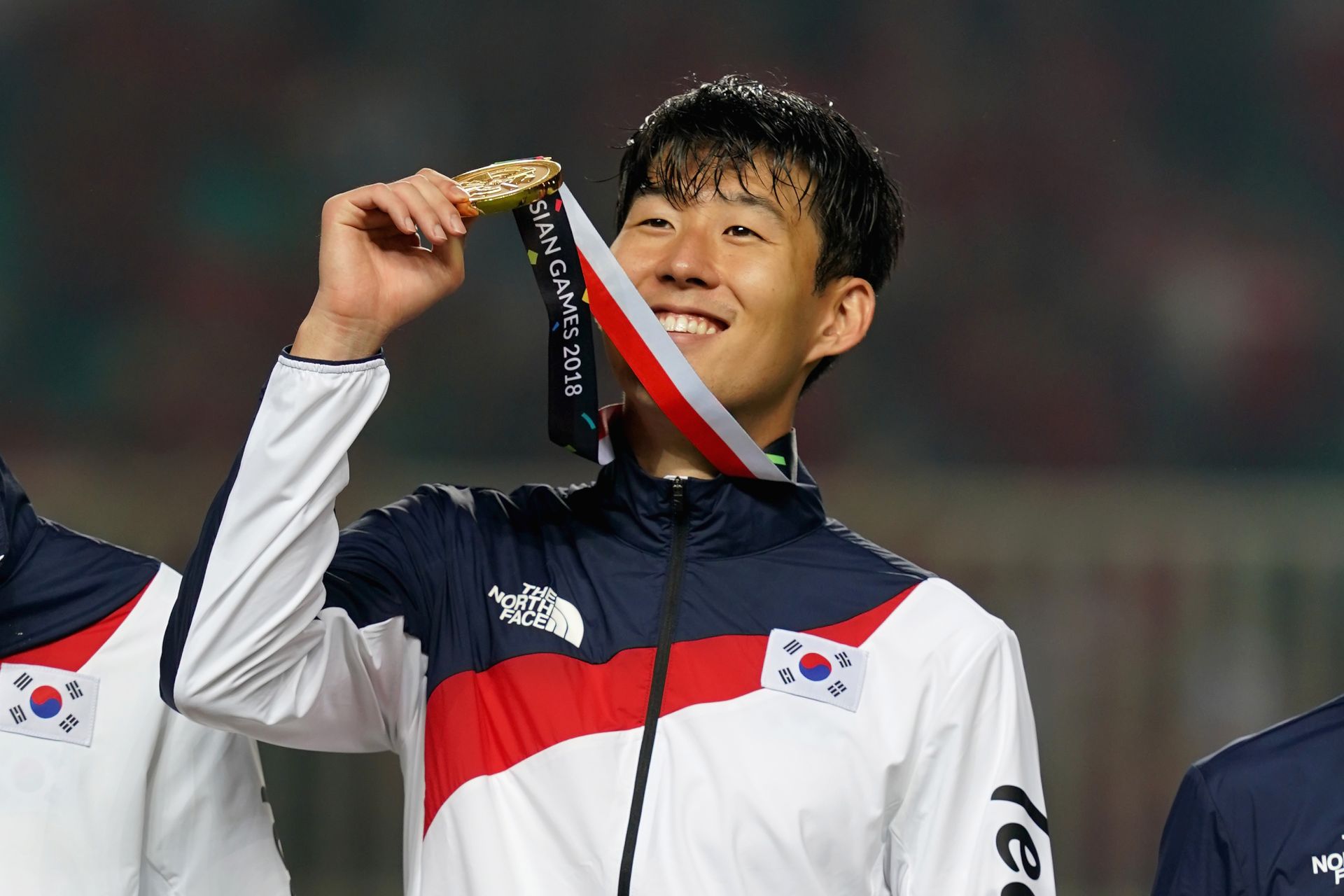
“Nobody calls Son Heung-min a bastard” is not a threat but a statement of fact. The soccer superstar has been a source of South Korean national pride for more than a decade thanks to his talent on the field and his image — handsome, confident and engaging — off it. Yet even a hugely popular figure such as Son is not immune from the sensitive issue of military service in his country, as events in June demonstrated.
The mood around the national soccer team ahead of the World Cup this past summer was not positive, but fans desperately hoped that Son, who had just moved to Los Angeles to play after a decade as one of the biggest and best players in the globally popular English Premier League, could make the difference. On June 7, the players were running around their training field in the Mexican city of Guadalajara, and as usual Son, the captain, was alone to the side of the main group.
A group of Korean journalists was watching, unaware that there was a camera rolling nearby and, as often happens when Korean men of a certain age get together, the talk turned to military service. It’s a common topic, as all able-bodied males have to start their 18-21 months of service by the time they are 28, a mandatory conscription because the country is technically still at war with its hostile neighbor, North Korea.
Since 1973, however, there have been potential exemptions for elite athletes and classical musicians. Any Olympic medal or gold at the Asian Games (the second-largest multisport event in the world, held once every four years) gives the winner the right to do just three weeks of basic military training, as opposed to the usual 78 or more. Son, and some of his jogging teammates, had done just that in the past, hence the disparaging remarks that were caught on camera.
“Is it because he’s the captain that he runs like a platoon leader?” one journalist asked. Another male voice piped in, despite someone warning that there was a camera. “These bastards who have not even served in the army, for God’s sake. These bastards do not even know what the army is.”
The broadcaster JTBC posted the video on YouTube without even realizing what it contained. It became a huge story, and the players organized a boycott of domestic media.
While Son earned his exemption legitimately on the field, there is a long-standing sensitivity to the rich and famous attempting to avoid the service completely, since the average person does not have the same privileges. MC Mong’s career as a rapper and popular mainstream TV game show celebrity never really recovered from allegations in 2010 that he pulled out nine healthy teeth in order to dodge the draft, despite being eventually cleared due to insufficient evidence. The K-pop star Yoo Seung-jun took American citizenship in 2002 just before he was due to enlist and was labeled a deserter by the government and barred from visiting the country ever again. He may have felt the system was unfair, as classical musicians can win exemption in international competitions while pop stars cannot.
The biggest debate in recent years has been around the only Koreans to rival Son in terms of global fame — the K-pop act BTS. In 2022, the seven members of the boy band sensation were approaching the age of enlistment. As international superstars, there was an argument that the group should be left to continue their careers, not least because, in 2018, the Hyundai Research Institute estimated that BTS alone generated almost $4 billion annually for the South Korean economy.
The government actually thought about asking the public to decide whether BTS should be enlisted. “Military service is a sacred duty,” said Culture, Sports and Tourism Minister Park Bo-gyoon. “BTS has increased the world’s awareness of Korean culture and greatly improved Korea’s brand image. … I think public opinion is important, above all.” The vote, which probably would have gone in favor of BTS, was shelved in September 2022. Soon after, Jin, the band’s eldest member, became the first to enlist, shaving off his famous locks and walking past sobbing teenage girls through the gates of one of South Korea’s numerous bases. The others did the same and were all finished by June 2025. Their worldwide comeback tour started soon after, with brand and national status enhanced. Nobody can criticize how BTS handled the situation.
While military service is a major obstacle in the careers of soccer players, which are shorter than those of musicians and entertainers, the same can be said of everyone. Millions of men have had to put careers or studies on hold and leave their girlfriends behind (there is a whole subgenre of sad songs devoted to conscripts who are dumped during their service, a staple of karaoke rooms). They don’t have the opportunity to compete in the Asian Games or the Olympics.
For the players themselves, these tournaments can be incredibly stressful, and the whole issue acts as a drag on Korean soccer. The 2026 Asian Games that kicked off on Sept. 15 in Japan is a case in point. It’s fair to say that South Korea’s soccer team is more desperate for gold than any of the other 15 teams. This is an under-23 tournament, with three overage players allowed. For most nations, it can be a useful developmental tool to give younger talents some international experience. At the Aichi-Nagoya Games, the oldest Japanese player is 21. It’s all about the future. Others are starting to follow suit, even the notoriously impatient Saudi Arabia.
Not South Korea. There can’t be many sporting events where there is more pressure on the players to win. Success really is transformative for their lives and careers. Those already in Europe will be able to stay and sign longer and more lucrative contracts, as clubs can rest assured that the stars won’t be forced home just when they are approaching their sporting peak. It also makes those still at home attractive to European suitors, resulting in more money for cash-strapped domestic teams.
This all brings pressure on the coach too. Lee Min-sung is the man in charge of the Asian Games soccer campaign, and there are doubts as to whether he is the right one after some mixed performances and results in preparation. Yet there is another layer, too. He has the chance to make a huge difference in the careers of the 23 players he calls, and those of all the others he does not. Does he choose the best team, or the one that has the potential to help the most players? The Asian Games and the Olympics come around only once every four years, and both are under-23 tournaments. Most players will likely only get one chance. A single mistake, misstep or bad refereeing decision can make the difference between 18 months in the army or just three weeks.
The very best get the most opportunities, as Son Heung-min’s experience showed, though he had to work hard and wait long. He left the Land of the Morning Calm, as South Korea is poetically known, to go and play in Europe at the age of 16, starting in Hamburg, because his father — a former professional whose career was cut short by injury — wanted him to have a European soccer education. Even so, military duty was always just visible on the horizon.
It was a surprise, then, that Son chose not to go to the 2012 Olympics. At the age of 19 and just breaking into the senior national team, the forward would have been called by coach Hong Myung-bo. “In Korea, an Olympic appearance has a special meaning, but I want to speed up for Hamburg,” Son said at the time, after just becoming a regular starter for the German club. “What matters is to pour all my time into team training.”
Without him, Korea went on to win bronze, its best-ever Olympic showing, earning exemption for a generation of players. Ironically, one of those was Park Chu-young, then of Arsenal, though the forward played only seven Premier League minutes for the London club. One of the nation’s biggest soccer stars, Park had been at the center of huge controversy just months earlier. Due to his three years playing for AS Monaco, he had been given a 10-year residency visa in the principality and, taking advantage of a little-known loophole, was able to delay his service by the same amount of time.
In March 2012, while he sat on the bench in London, a storm brewed in Seoul. Park may have been seeking to delay rather than dodge, but that was enough to provoke an outcry. He was left out of the next senior national team games, vital qualifiers for the 2014 World Cup. “I excluded him because of controversy over his performance and military duty,” explained head coach Choi Kang-hee. “Although players’ performance matters, it is also important to have pride and be willing to make a sacrifice once they join the team.”
Park’s position in the 2012 Olympics was in jeopardy. There was only one thing for it: to go and seek forgiveness. “I would like to apologize for all the trouble this caused, and for letting people down,” he said in Seoul, after bowing. “I learned a lot about soccer while playing with AS Monaco for three years. I started dreaming of learning more in Europe as a soccer player. But even though I delayed my military service, I never planned to emigrate or avoid it altogether,” he said, with coach Hong nearby. “I submitted a handwritten letter to the Military Manpower Administration pledging to fulfill my military duty, and I promise again today that I intend to honor that.”
It did the job in terms of his place on the Olympic team, though, like MC Mong, Park never quite recovered his place in the affections of the public. Had he waited a few more months, he would have been exempt anyway, because he scored the goal to seal the win over Japan in the bronze medal match.
Sitting in Germany, Son could have been forgiven for having mixed feelings watching the bronze medal celebrations, but he knew that the 2014 Asian Games were just around the corner and, with this event taking place on home soil in the city of Incheon, it offered a great chance for gold. Unfortunately, his new club Bayer Leverkusen refused to release him. (Unlike with the Olympics, clubs are under no obligation to let their players go to the Asian Games.) Korea won gold, and more players were given almost 18 months of their careers back.
The following year, Son left Germany for the Premier League’s Tottenham Hotspur. After a mixed first season, the forward was soon showing his worth in North London. By this time, the player was approaching his 24th birthday. Time was running out, and worried Tottenham fans were starting to become familiar with Korea’s military laws.
It should be pointed out that, even during service, soccer players have it a little easier. There is an army team, Gimcheon Sangmu, a unit of the Korea Armed Forces Athletic Corps, a sports division of the Korean military, which came into existence in 1984 to enable army members to undergo athletic training. They have to stay on base when not in action, collecting the standard monthly pay of around $250. Some even go to the World Cup as soldiers and are easily spotted because rather than putting their hands on their hearts during the national anthem, they salute.
This was the fate awaiting Son, one of the biggest stars in the most popular soccer league in the world and a global sporting icon, but there was another chance in the summer of 2016, when he went to the Olympics in Rio. Many thought that the team had a real chance of a medal, especially after topping a group above Germany and Mexico, with Honduras not expected to pose too much of a problem in the quarterfinal. But there was a surprise 1-0 loss to the Central Americans, with Son guilty of missing numerous chances. The image of the forward in tears was beamed around the world. According to coach Shin Tae-yong, the player cried all day and didn’t eat. “After the Olympics I was very upset,” Son said. “I was really down, because I played for my country and I wanted to get some medals for my country.”
Now it was serious, and there was a real prospect of Asia’s biggest star being forced to leave the Premier League and go and play for Gimcheon, which would have done the domestic K League no harm at all and multiplied the club’s average attendance of around 2,000 many times over. The last chance was the Asian Games in September 2018 in Indonesia, though there was talk of a possible special dispensation to compete at the 2020 Tokyo Olympics if necessary.
The problem was that this was during the English Premier League season and Tottenham didn’t really want to let their star go. Son had just played in the World Cup in the summer and, in January 2019, was due to go to the United Arab Emirates for the Asian Cup (Asia’s premier soccer-only competition, for which clubs have to release players). In the end, Spurs had little choice. If Son didn’t fly to Southeast Asia in September, then soon after he would be flying to Northeast Asia for a much longer stay. Not to mention that millions of South Koreans (Tottenham claimed to have 12 million fans in the country, more than anywhere else, including England) would have been up in arms if the club had blocked the superstar.
There was a compromise of sorts: Son didn’t go for the first two group games, but after arriving led the team to gold and all was well with the world. There was a general sense of relief then, and again in 2022, when Korea won for a third time in succession. Even though the delight and relief were obvious, it is hard for players to openly talk about winning exemption, for obvious reasons. “Most people think that military service should not be a punishment but an obligation,” Seo Hyung-wook, a leading TV soccer commentator, said. “Military exemption for elite sports persons means, however, that people regard exemption more as a reward and actually having to do the service as a punishment.”
It is not only attitudes that are changing. In August, Hong So-young, commissioner of the Military Manpower Administration, said there would be an overhaul of the whole system; it was “not a choice,” she said, “but an indispensable task for the survival of our national security.” Korea has one of the lowest birth rates in the world, and there will soon not be enough men to sustain the size of the army needed to face North Korea across the Demilitarized Zone.
Exemption may become a thing of the past, though it could be that athletes are able to delay for a few years until the end of their sporting careers. That would perhaps remove the pressure and the desperation of the hunt for exemption, and enable Korean soccer to develop at the same pace as other Asian nations.
“Spotlight” is a newsletter about underreported cultural trends and news from around the world, emailed to subscribers twice a week. Sign up here.