


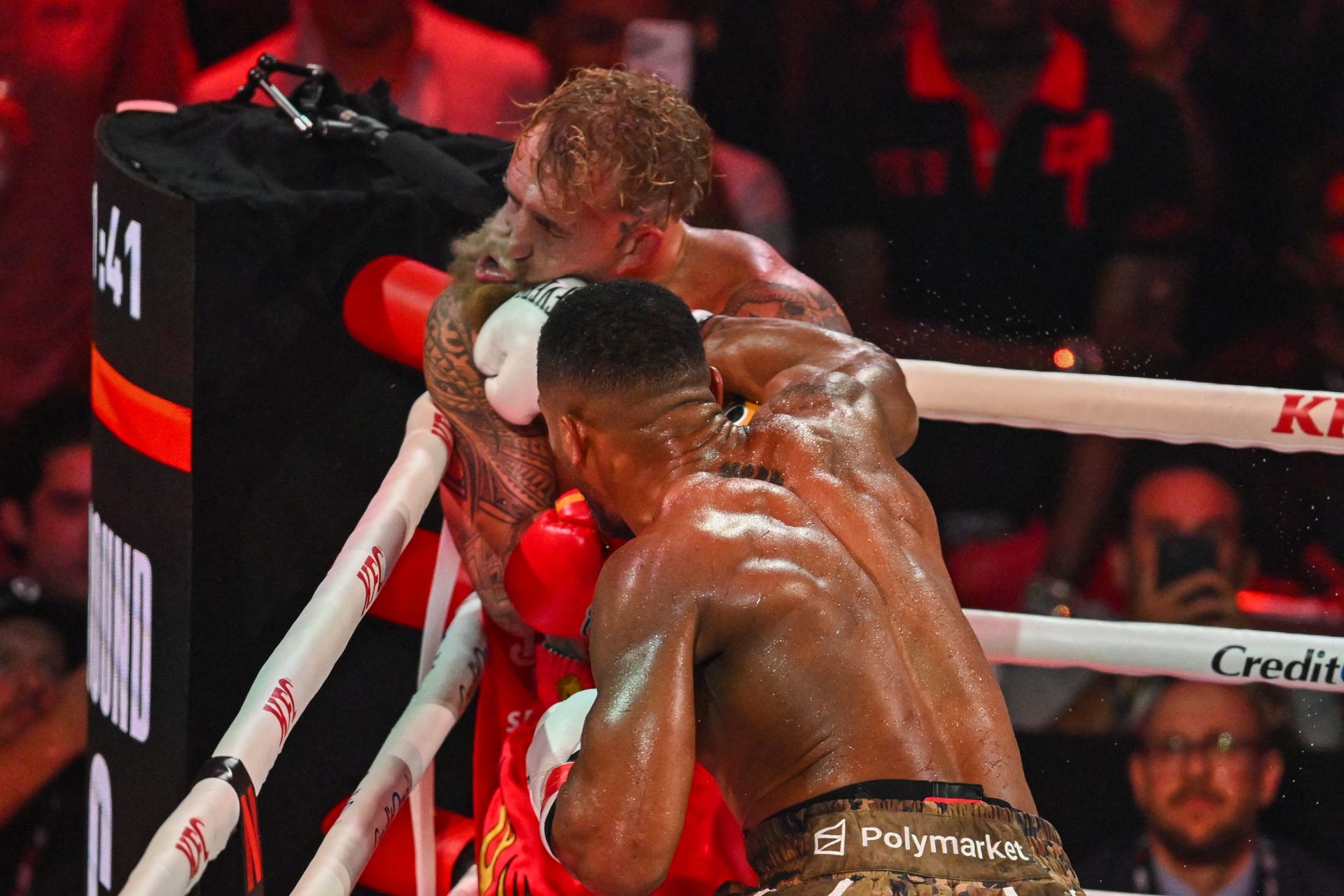
On Dec. 19, 2025, in Miami, Florida, Jake Paul, the former Disney star, faced off against Anthony Joshua, the former two-time world heavyweight champion and Olympic gold medalist. Joshua, with 26 knockout wins to his name, wearing a huge diamond-encrusted necklace resembling the Paw Patrol cartoon logo, paced the ring like a lion waiting to be fed. When the fight began, Paul ran while Joshua stalked him around the ring until Paul ran out of gas in the third round and felt the weight of Joshua’s 10-ounce gloves. Paul clung on for the next two rounds until Joshua cornered him, gave him a knowing smile and landed a cross that broke Paul’s jaw in two places. Down he went. Joshua, gracious to his opponent, left the ring, trailed by fawning celebrities known for little more than being part of a spectacle — or, in the case of Ashton Hall, for plunging his face into ice-cold water at an ungodly hour.
The fight shouldn’t have happened. As former England cricketer Kevin Pietersen posted on X: “Anthony Joshua fighting Jake Paul is like me, in my pomp, facing a club cricketer — and the club cricketer thinking they’re good enough to knock me over. Deluded and sad that it was broadcast!” Paul didn’t deserve to fight the former world champion. He had only started boxing five years earlier during the COVID-19 pandemic. Yet padded by privilege and box office appeal, he had wangled a fight with Joshua, who was coming off a brutal knockout himself. Joshua took it as a tuneup and a money grab. And why not? He’s a prizefighter after all.
The following day, another figure considered a modern-day idol among some groups of young men was beaten in Dubai. Andrew Tate, of red-pill fame, was bloodied by a pink-gloved former college football player, Chase DeMoor. Tate, a former kickboxer and significantly lighter man, put up a spirited fight for three rounds before DeMoor’s weight and conditioning took over. It was a poor performance from both men; their chins were so high they belonged in the skies over Heathrow. Nevertheless, Tate was philosophical about his defeat, posting on X: “In 100 years from now, somewhere on the new earth, there will be a man reading about me in a history section of the Skynet. And that’s not because I never lost. But instead because I always tried.”
I must admit, I did tune in to watch both fights. I was curious to see how good Tate actually was, given his boasts, and I wanted to see Paul get knocked out. I don’t usually watch boxing for the latter. I much prefer two masters finding chinks in each other’s armor. But in this case, I wanted Joshua to finish Paul. Joshua, to my mind, represented mastery, and Paul represented entertainment. I wanted Joshua to restore the natural order, with mastery taking precedence over spectacle — because somewhere along the line, show business and selling tickets had somehow become more valued.
I wasn’t quite sure how it had come to this. I first became aware of the phenomenon when my son alerted me to it. I thought it was a joke. In 2018, a YouTuber with an infectious laugh, known as KSI, decided to fight another internet celebrity, Joe Weller. The same year, KSI fought Logan Paul, another influencer, following it up with a rematch in November 2019. In 2022, KSI fought TV personality Tommy Fury, the brother of former heavyweight champion Tyson Fury. KSI had begun a trend: Suddenly, every child aged 13 to 18 began watching these hollow performances, turning novelty figures like Hasbulla and Likkleman into global internet sensations.
What upset me most was that the masters of the martial art were relegated to the undercards of these events. And from them emerged outfits like Misfits Boxing, which was founded by KSI in partnership with established boxing promoters the Sauerland brothers, who took the concept to the sports broadcaster DAZN. Other offshoots followed, including Wicked N’ Bad, led by Bouncer Play Dirty. Celebrity boxing had turned into a multimillion-dollar industry and a cultural dystopia.
I experienced the full extent of this dystopia firsthand. Last year, I dropped into my local boxing gym on sparring day. The coach, Huzaifa Iqbal, told me to lace up and move around with Danny Aarons, a YouTuber preparing for a fight with Danny Simpson. Aarons’ bout was due to be broadcast on DAZN, and we did a few rounds together.
My son was a big fan of Aarons — a nerdy YouTube gamer, but also a very decent young man who had found boxing and been changed by it. I was glad to be part of that journey in some small way. It was a genuine privilege. Afterward, I took a selfie and sent it to a WhatsApp group where the cousins, sons and men of the Hussein clan usually show off their trophies. I received a lot of praise for being pictured with Aarons, who at that point had only been training for six months. He was still a novice. And I must admit, the praise upset me, because my cousins knew him, but not the coach who had been teaching him.
I knew Aarons would never be able to apply the depth of knowledge that Huzaifa — known simply as H-man — possessed. Those youngsters who knew H tended to know him only as the trainer of Swarmz, another rapper-turned-YouTuber. I wanted to tell these Gen Zers that this coach was a master — that he had trained world champions like Abass Baraou and Olympians like Kurt Walker, all of whom had invested years of their lives into excellence that the youngsters will never appreciate.
In any other era, H would have been known as a trainer of champions and killers. Instead, he was born into the age of clowns and entertainers. The new generation saw the spectacle, not the mastery. That is what upset me most — because I have a deep regard for this trainer.
KSI, and indeed Paul, the counterargument goes, saved boxing by bringing young people into the sport. Yet boxing is one of the oldest sports in history and will survive with or without KSI. KSI’s Misfits Boxing has effectively turned the sport into a circus; it marked the beginning of masters becoming mere clowns. Figures like Quinton “Rampage” Jackson — a genuine legend of mixed martial arts (MMA) — are now better known as streamers who lose their temper when viewers bait them, for which audiences will gladly pay $5. Jackson himself claims he earns more from this than he ever did during his fighting career.
The Paul fight felt like the culmination of this absence of mastery elevated into spectacle. And yet, as I watched Paul talk about his love for boxing and saw his delusional courage, my certainty began to soften. Was I behaving like one of those purists for whom nothing but the very best will do? After all, lacing up gloves and stepping into the ring is, undeniably, an act of bravery.
I don’t doubt Paul’s spirit or his love for the sport. He puts in the time and does the work required of a boxer. His camp has included champions like Lawrence Okolie, among others. He is also a disruptor. In the MMA world, he has called for better safety and pay, and has helped raise the women’s game to new levels. There is no reason to hate on him simply for the sake of hating. And what, after all, is wrong with being an entertainer? All the greats took part in exhibition fights — Muhammad Ali vs. Antonio Inoki, Mike Tyson vs. Roy Jones Jr., Conor McGregor vs. Floyd Mayweather Jr. Why should we begrudge Paul that? After all, boxers know that whether one becomes successful or merely average — and whether one ever gets a title shot at all — often depends on a brutal reality: whether you can sell tickets and fill stadiums.
I have met many brilliant fighters with long losing records who are nonetheless exceptional. Everyone inside boxing knows how good they are. Their defensive skills are so refined that they can fight week in, week out to put food on the table and pay the mortgage. One bad cut or knockout means weeks without work, so survival demands command of defensive boxing. Their only real flaw is that they cannot sell tickets. Just watch Emanuel Augustus, the so-called Drunken Master, and tell me he wasn’t a brilliant fighter.
Conversely, there are many poor fighters who are excellent ticket sellers. They rise quickly, buoyed by attention and hype, until they reach the national level, where they are usually found out. So for me, Paul being entertaining is not the issue. That is expected, as coach Brendan Ingle advised a young Prince Naseem Hamed in “Giant,” the latest biopic of my favorite boxer. Britain’s most bankable boxers, like Chris Eubank and Chris Eubank Jr., understood this very well. You have to be polarizing: loved, hated but never neutral. But these boxers were also good fighters, and when that mastery fell short, they compensated with heart and grit. The recent bout between Conor Benn and Eubank Jr. last October was proof of that. It may have been short on elite-level skill, but the character of the two men gave me goosebumps.
There are also fighters who began with nothing but courage. Fabio Wardley started as a white-collar fighter but paid his dues to the sport. Through dedication, hard work and sparring with champions like Oleksandr Usyk, he has reached the pinnacle of the sport, recently becoming a world champion himself. Paul has done none of that, yet he can cut in line. At heart, my problem with Paul is simple: An unlettered club fighter stepping into the ring with a master offends my sensibilities. It does so in a way that the Tate-DeMoor fight does not, because the latter bout was never about mastery. The Tate-DeMoor fight I can let stand, but the Paul-Joshua fight I cannot, because it demeans an idea I am trying to instill in my own children: the idea that mastery is worth it, that one should spend time becoming an accomplished writer, painter, carpenter, boxer, farmer, calligrapher, whatever it may be, that mastery is about character, that it does something to you. Paul offends that principle.
The danger is that a new generation will assume that Paul is the bigger draw — and that this “influence” alone has somehow earned him the right to share a ring with a former two-time world champion and an Olympic gold medalist. As I write this, there are young fools (for what else can they be?) seemingly determined to irritate me, posting images of four heavyweights — Tyson, Fury, Joshua and Paul — side by side, and posing the question: Who would walk out if you locked these four in a room? To me, that question is the equivalent of me taking photos on my iPhone and displaying them in the same exhibition as a veteran war correspondent like Don McCullin, and then asking whose images are better.
Yet, infuriatingly, it has become a question. The casual fan now argues that Paul lasted longer than former UFC heavyweight champion Francis Ngannou, who was brutally knocked out by Joshua in two rounds — despite Ngannou having floored Fury in his own crossover bout. You can see where this is heading: a possible Ngannou-Paul fight, followed by the endless, exhausting debate in which Paul somehow emerges the winner. Once again, the rules bend for him. That, then, is my problem with Paul. By sharing the stage with Joshua, his presence teaches this generation that mastery doesn’t matter — that hard work, patience and time count for nothing.
I saw this exact thing over the holidays, when I attended a poetry reading by a friend. The first person read a “poem” about the escapades of her two dogs; she admitted she had written it using ChatGPT. It was witty and fun, I suppose. But what was she expecting — applause? Then someone else read a poem by the poet and journalist James Fenton, “The Ballad of the Imam and the Shah,” and the room filled with sounds of appreciation. Why? Because the poem had soul and mastery. And Paul, in some ways, is a manifestation of its absence.
Now, here’s the thing: I don’t worry about teaching my son that Paul doesn’t belong with Joshua. We have watched the great ones — Marvin Hagler, Thomas Hearns, Sugar Ray Leonard. I still remember how engrossed he was as we watched the Gatti vs. Ward trilogy back to back, or the moment he told me he wanted to do pads after we watched Naoya Inoue vs. Nonito Donaire. My soul was filled with joy. He knows who the great ones are. What I worry about instead are my grandchildren — Generation Beta. I imagine myself old, the grandkids running up to me and saying, “Grandad, let’s turn on Skynet and watch Andrew Tate vs. Likkleman and Jake Paul vs. Mike Tyson.” And I’ll say, “They’re not boxers.” And they’ll reply, “Well, at least they tried.” May I not live to see that day.
“Spotlight” is a newsletter about underreported cultural trends and news from around the world, emailed to subscribers twice a week. Sign up here.