

Sabry Nakhnoukh’s Arrest in Egypt Exposes a Political Order Built on Outlaw Enforcers
In Egypt, the script is familiar: Opposition leaders and human rights defenders end up in prison while the regime’s men retreat to their seaside villas on the North Coast. But last week, that script was flipped when the Egyptian government arrested one of its own.
The man in question is Sabry Helmi Nakhnoukh — widely recognized as one of the regime’s invisible fists. Known simply as “Nakhnoukh,” he got his start in Cairo’s nightlife as an enforcer, a position that later evolved into deeper ties with the city’s security and political networks. He publicly backed Abdel Fattah el-Sisi’s rise, even helping manage the victory celebrations that followed, and moved comfortably in Egypt’s elite social circles, driving a Ferrari through Cairo and attending high-level regime weddings. In early June, the notorious underworld boss was arrested alongside several employees on charges of running a criminal gang, whose activities allegedly ranged from possession of exotic animals to kidnapping, sexual assault and torture.
In the final decade of Hosni Mubarak’s rule, under pressure from George W. Bush’s “Freedom Agenda,” the former president found himself obliged to perform a semblance of democracy. He permitted a margin of political activism, allowing parliamentary opposition and street-level protests in designated zones. But even that margin had to be policed, and for that, the regime frequently relied on a network of unofficial enforcers. Nakhnoukh was the most prominent of these. In the final years of Mubarak’s rule, they showed up on university campuses, outside opposition rallies, at protests and at elections for everything from Parliament to student unions.
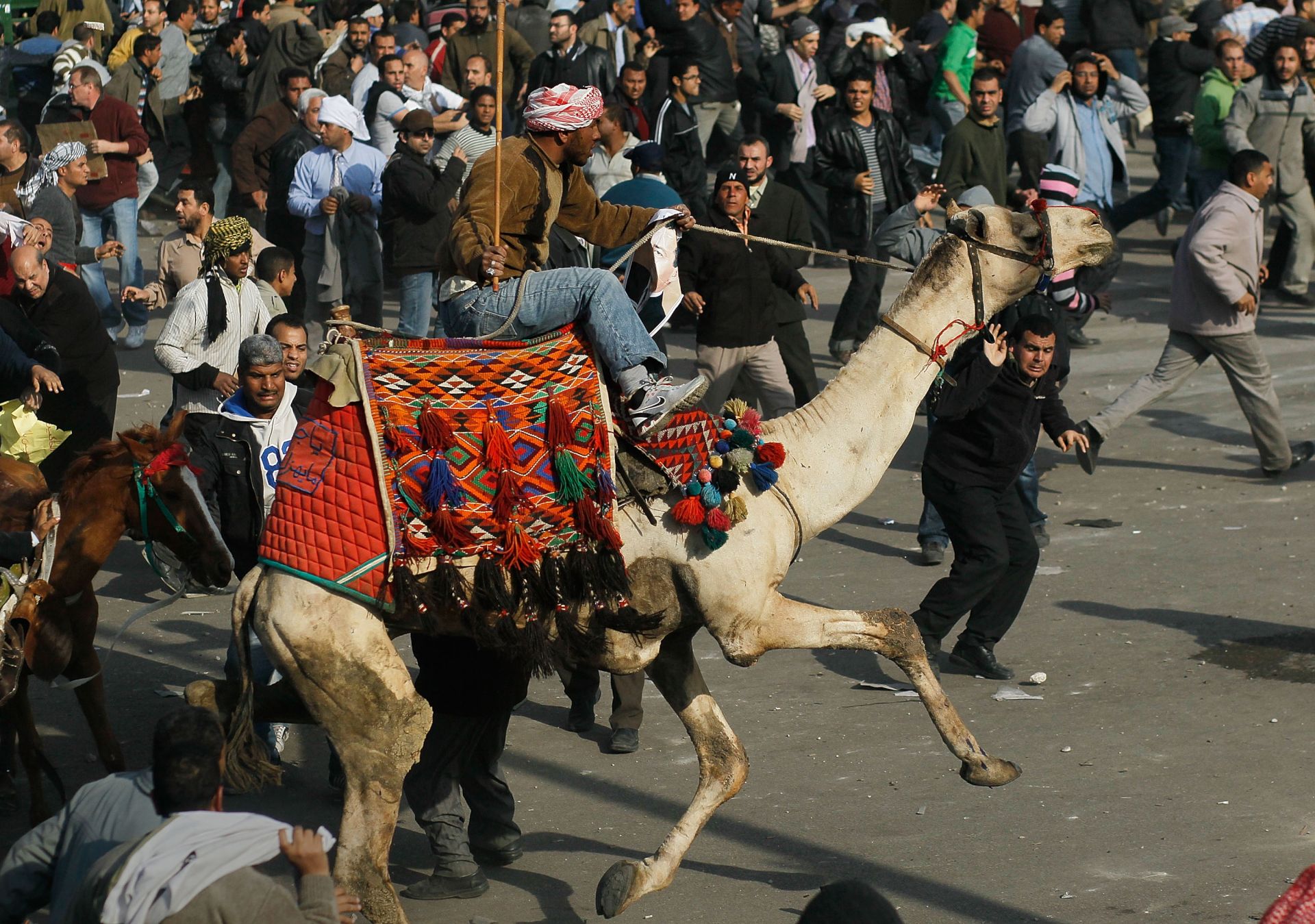
The 2011 revolution was a social and political earthquake. Nakhnoukh’s invisible hands were there during one of its most violent moments, the “Battle of the Camel,” when pro-Mubarak forces, many of them sent by Nakhnoukh, charged into Tahrir Square to crush the uprising. He was loyal to a collapsing regime, and when it fell, he was left without a clear place in what followed.
The following year, under Egypt’s first postrevolutionary Parliament, led by the Muslim Brotherhood, Nakhnoukh was arrested in a high-profile raid on his Alexandria villa on the same charges that he is currently accused of. A bewildered Nakhnoukh was quoted as saying: “I have always maintained very strong ties with the Ministry of Interior. … Ministry officials used to visit me in my mansion in Alexandria. What’s changed?”
If Mubarak’s fatal mistake was leaving a margin for political activism, Sisi’s solution was simple: eliminate it entirely. And in May 2014, Egypt’s Court of Cassation upheld Nakhnoukh’s 28-year sentence. The law had finally caught up with him — or so it appeared.
Under the new regime, most had forgotten about Nakhnoukh. But in 2018, Sisi suddenly granted him a presidential pardon. Nakhnoukh kept a low profile until 2023, when he resurfaced as the majority shareholder of Falcon Group, one of Egypt’s most prominent private security firms, with deep ties to the state security apparatus and regular government contracts. The shadow enforcer had become a corporate shareholder. Until that too took a turn.
Pro-regime media figures such as Ahmed Moussa celebrated Nakhnoukh’s recent arrest loudly, prompting the public and independent outlets to ask the obvious question: Why arrest a man on the same charges he was pardoned for in 2018? The answer likely lies in a business deal that went wrong. According to fact-checking platform Matsda2sh, the Sovereign Fund of Egypt approached Nakhnoukh to acquire Falcon Group, aiming to return it to former military and Interior Ministry figures. The offer amounted to roughly 25% of what he believed his shares were worth, so he objected. Shortly afterward, he was arrested. Some observers drew a parallel to the 2021 detention of Safwan Thabet, founder of Egypt’s largest dairy products and juice producer, Juhayna, who was arrested after allegedly refusing financial demands from security-affiliated actors. If convicted on any of the charges, Nakhnoukh would be legally barred from managing Falcon Group.
Egypt has a class of men who built their power by subcontracting violence from the state. The smarter of them started companies, partnering with figures from the security agencies, and became legitimate business owners. The clearest parallel is Ibrahim Al-Arjani, who exercises de facto control over Sinai through a combination of paramilitary authority and corporate ownership — including his company Hala Consulting and Tourism Services, which reportedly charged Palestinians exorbitant prices to facilitate their movement from Gaza into Egypt during the war.
Nakhnoukh’s rebellion was over a valuation dispute. His rise and fall are ultimately a story about the architecture of power in Egypt, where the only contract that truly matters is the unwritten one between the state and those whom it uses and discards when the terms can no longer be agreed upon.