

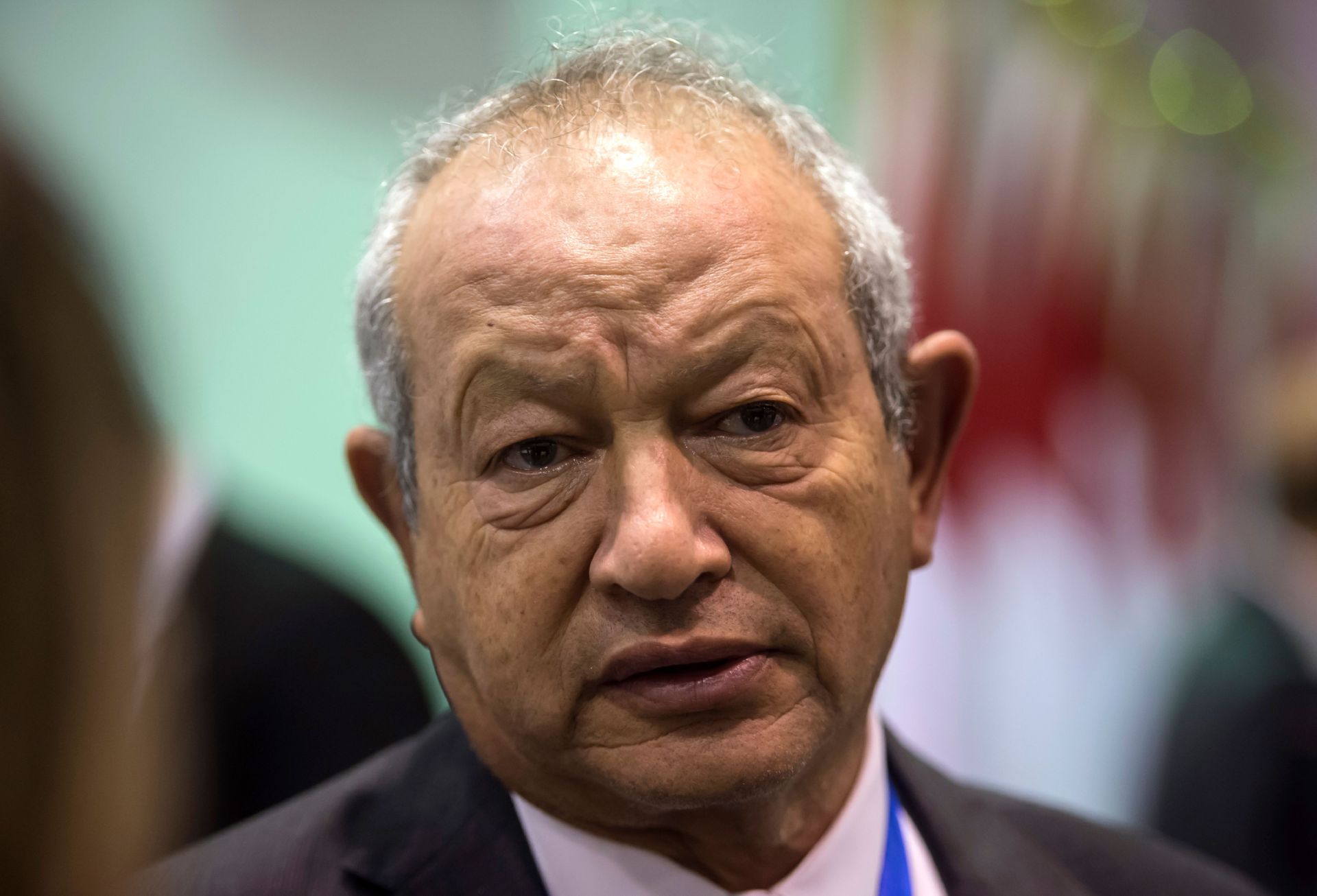
A decade ago, few would have imagined Syrian President Ahmad al-Sharaa hosting Coptic Egyptian billionaire Naguib Sawiris, a figure widely associated in Egyptian public life with opposition to political Islam. Yet that is exactly what happened on Thursday at the People’s Palace in Damascus, where al-Sharaa received Sawiris, a member of a powerful Egyptian family, whose business empire stretches from construction to telecommunications and real estate. The two met before Sawiris continued to the Ministry of Public Works and Housing, in a striking example of how former skeptics are reevaluating Syria’s new leadership.
The visit comes two decades after Sawiris’ hugely successful telecommunications firm Orascom entered Syria at a time of economic liberalization during Bashar al-Assad’s rule, taking a 25% stake in Syriatel, which was majority owned by Rami Makhlouf, Assad’s cousin and one of the regime’s most powerful oligarchs, whose ventures included mobile phone monopolies, tourism, real estate, banking and construction. The arrangement, as Sawiris has repeatedly described it in television interviews and social media posts, quickly turned sour when he was forced to partner with Makhlouf to get a license. When Sawiris sued Makhlouf in the Syrian courts, expecting relief from the arrangement, he instead had his assets frozen, and his company was pushed out of the venture. Rime Allaf, author of “It Started in Damascus: How the Long Syrian Revolution Reshaped Our World,” noted on X that the Egyptian billionaire would “probably have a better experience than he did 25 years ago,” when Makhlouf “robbed him in broad daylight.” As Mfonobong Nsehe wrote for Billionaires.Africa, the Damascus meeting signals that Sawiris likely sees “a genuine opportunity to revisit the claims that were never resolved,” stressing that he “is not a man who travels to Damascus for a photograph.”
Since ousting Assad and coming into power in December of 2024, al-Sharaa has been drumming up business and foreign investment to help rebuild the country after years of war, international sanctions and resource mismanagement. But although investors from the Gulf region and elsewhere have been eyeing ambitious development projects throughout the country, none have materialized yet, signaling caution about the new government. Syria still faces a “state sponsor of terrorism” designation by the U.S. State Department, a designation expected to be repealed this year. The country must also contend with transitional justice that many Syrians complain is moving too slowly, thus threatening waves of extrajudicial retribution and violence, which have so far killed hundreds along the coast and in the eastern provinces. Sawiris’ visit can be seen as likely to provide encouragement to investors who remain too timid to enter Syria despite its potential as offering the largest reconstruction projects in the region.
Back in January, al-Sharaa told a delegation of Egyptian business leaders in Damascus that Egyptian firms would be given “first priority” in reconstruction efforts, describing Syria’s postwar phase as both a period of recovery and an “investment opportunity.” In recent months, Damascus has hosted a handful of other business leaders and delegations, including Egyptian developer Hassan Allam, as well as Emirati and Turkish investors interested in reconstruction and infrastructure projects.
The visit also reflects a gradual recalibration of Egyptian-Syrian relations. Cairo initially reacted cautiously to the political transition in Syria, wary of the Islamist affiliations of the new leadership and reluctant to normalize ties too quickly. Earlier this month, Egypt rejected Syria’s initial nominee for ambassador, Mohammed Taha al-Ahmad, over concerns regarding his affiliation with Hayat Tahrir al-Sham, the Islamist rebel group that spearheaded the campaign that led to Assad’s downfall. While Cairo’s reservation mirrors a dilemma that has confronted much of the region, other governments like Saudi Arabia and the UAE, both with similar suspicions toward Islamist movements and regime change, have also edged toward more engagement. When asked by an X user to clarify “the difference between al-Sharaa and Morsi,” referring to Egypt’s former Islamist president, Sawiris replied that they “can’t be compared at all,” adding that al-Sharaa “studied his mistakes in detail” as well as “all the mistakes of the Arab Spring revolutions.”
As observers like Nsehe have noted, Damascus is not just seeking investment, but also credibility on the international stage. The presence of high-profile investors like Sawiris functions as a form of economic validation, a way of signaling that Syria is no longer a pariah state run by corrupt oligarchs. The effort to project a new image can even be seen in the kind of unconventional personal diplomacy highlighted in a recent New Lines video on al-Sharaa’s appreciation for President Donald Trump’s “Victory 47” fragrance.
For Syria, Sawiris’ return suggests that the new administration is capable of building bridges that were burned by the Assad regime. Whether the Sharaa government is capable of reforming the structural flaws that defined the country’s economy in the past remains to be seen.