


He goes by Anthony John Gambale the Fourth, or Tattoo Tony, which is probably a more fitting moniker given the amount of ink covering every visible inch of his body. On a sweltering summer weekday, he was strolling shirtless out of a homeless encampment in the southern Oregon town of Grants Pass, the handle of a straight-blade knife protruding from the sheath in a shoulder strap attached to his backpack.
Gambale, 37, cuts an intimidating jib, but for much of every day and night he is out of public view, corralled in a sanctioned camp alongside other homeless people, in line with a U.S. Supreme Court ruling that originated in this 39,000-population town, a four-hour drive south of Portland. For much of the decade he has spent in Grants Pass, Gambale and others who don’t have a place of their own could set up a camp pretty much wherever they pleased. Now, if he ventures outside of a fenced concrete lot stacked with tents and designated as an official “resting site,” he could be fined, or even arrested. He’s not happy about that.
“It’s more violent, more ruthless now,” he told New Lines, about living in these newly cramped quarters. “You always have to be on guard. You can’t be spread out. Everybody is grouped into encampments.”
Homeless advocates were dismayed at the Supreme Court’s June 2024 decision in Johnson v. Grants Pass — a case that began in 2018 after a lawsuit against the city for issuing tickets to people sleeping in public — concerned that the decision amounted to “criminalizing poverty.” But many residents and business owners contend that lax enforcement of municipal regulations about where people can and can’t sleep has led to a livability crisis, especially across the American West. It’s been over two years since the Grants Pass decision, in which the court’s conservative majority found that it’s not a violation of constitutional protections against “cruel and unusual punishment” to sanction people for sleeping in public places. That overrode earlier rulings from federal appeals courts in 2019 and 2022, rulings that officials across the country often complained about, saying they prevented them from keeping their streets clean and safe.
Much has changed since, in Grants Pass and across the nation. Emboldened by the ruling, more than 350 cities and 14 states have passed hundreds of local measures restricting sleeping, sitting or panhandling in public. California Gov. Gavin Newsom quickly directed state agencies to adopt new policies to remove encampments. In San Francisco, police arrested more than 1,000 homeless people for living in public spaces in the year after the ruling, a tenfold increase over the year before it.
The court’s conservative majority “focuses almost exclusively on the needs of local governments and leaves the most vulnerable in our society with an impossible choice: Either stay awake or be arrested,” wrote Justice Sonia Sotomayor in a dissenting opinion.
While the justices in the majority insisted the decision was largely about shifting the power to make policy on homelessness from federal courts back to local control, the way local governments exercise that control varies widely. Even in blue states like Oregon, where homelessness has surged to the top of voters’ concerns, failing to address this intractable problem in some measurable way can end a political career. No one knows this better than Jo Ann Hardesty, the Portland City Commissioner who lost her 2022 reelection bid to a political newcomer in Rene Gonzalez, who ran on a law-and-order platform, a previously unthinkable wedge in the uber-progressive City of Roses.
The consensus was clear: Some kind of action was long overdue. The crackdown extended to the seat of federal government, Washington, D.C., where President Donald Trump deployed National Guard troops to battle crime in the nation’s capital and participate in rounding up homeless people, carting them off to shelters and jails or nudging them to neighboring states.
“We’re going to be removing homeless encampments from all over our parks, our beautiful, beautiful parks, which a lot of people can’t walk on, they’re very dirty,” Trump said at a White House press conference, after purging some 70 encampments from the city and threatening fines and jail time for anyone who refuses to go. “There are many places they can go, we’re going to help them as much as you can help. But they’re not going to be allowed to turn our capital into a wasteland.”
Trump didn’t need the Supreme Court’s backing, because the president has uniquely broad powers to operate in the district. But he has sent federal troops into cities across the country (and threatened to send them into more), and the court’s decision provides an added layer of protection for the government while stripping away constitutional protections against “cruel and unusual punishment” for people sleeping on the streets. But the sweep of camps has little chance of ending homelessness, which is fueled by a drug epidemic, a housing shortage, and rising poverty and mental health afflictions across America — a country where healthcare is tied to employment, so medical emergencies can bankrupt people; where government-subsidized housing is scarce, unlike in many European countries that view housing as a basic human right; where welfare benefits and disability support are limited and temporary; and where tenant protections in many states are weak, leading to fast evictions.
By 2024, more than 771,000 people reported experiencing sheltered or unsheltered homelessness on a single night, the highest number ever recorded. While it’s true that some homeless people refuse to stay in shelters, it’s misleading to claim that people on the streets are there because they won’t go to a shelter. Most cities don’t have enough shelter capacity to house everyone safely.
That nationwide number dipped the following year by 3.4%, but chronic homelessness (defined as someone continuously homeless for at least 12 months, or with four separate episodes of homelessness in the prior three years adding up to 12 months) hit a record high, at more than 155,000 people. Homelessness among individuals (as opposed to families) also surged to a new record: 515,286 people. About a quarter of the U.S. homeless population are families of at least one adult and one child, according to the U.S. Department of Housing and Urban Development. There’s no estimate of the average age of individual homeless people, but they tend to skew older and are more likely to be male than the family population. For women, domestic violence shelters are often the primary entry point to homelessness, but there are women-only shelters and transitional housing programs aimed at that group.
“You can do what you want with the tents,” Scott Kerman, executive director of Blanchet House, a Portland homelessness services nonprofit, told New Lines. “The people are still here. We’ve had some moments where there’s a flurry of tents, then they get swept and there are fewer to no tents, then suddenly there are tents again.”
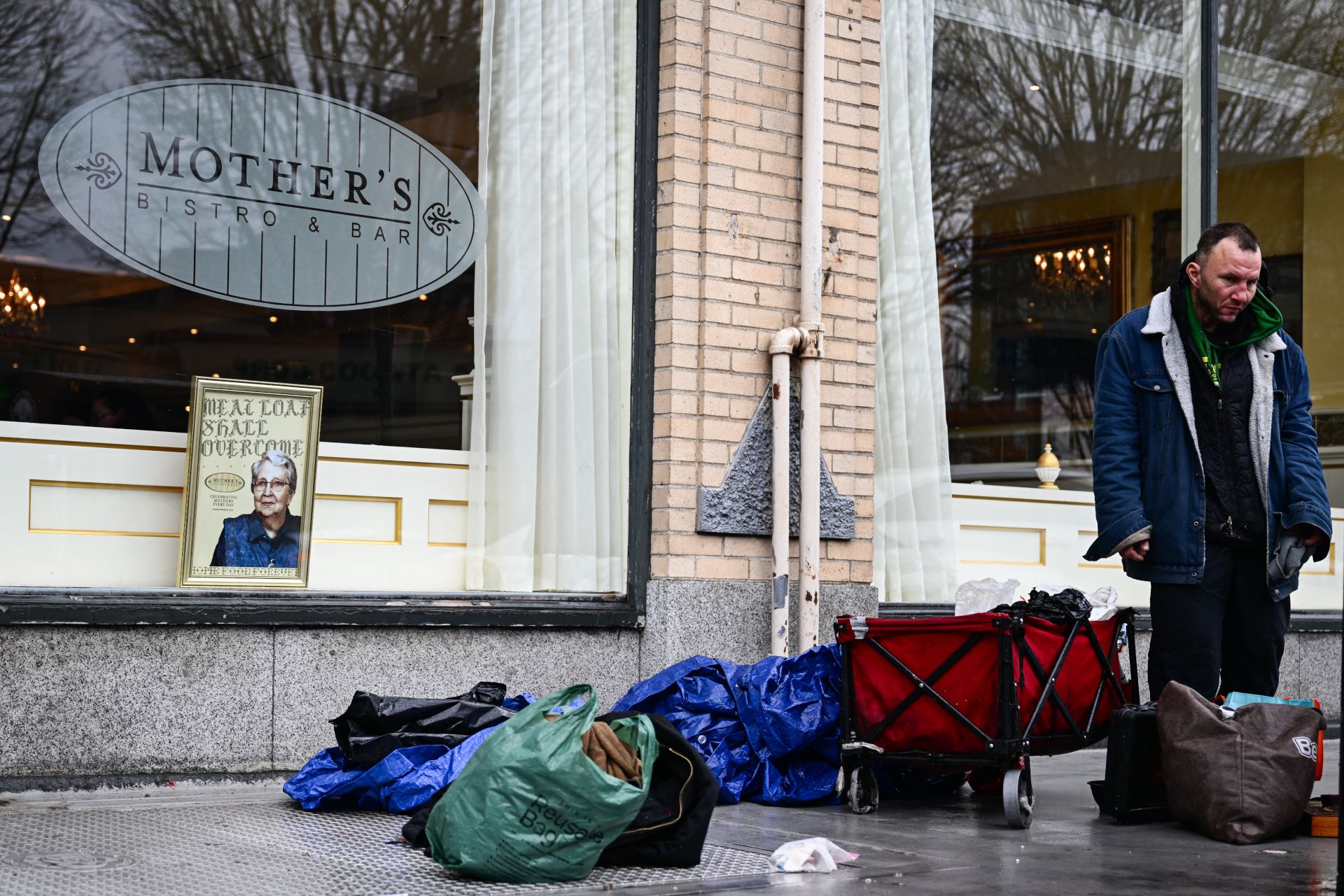
What the sweeping Supreme Court case certainly altered is what it feels like to drive around Grants Pass, on the same day Tattoo Tony left his sanctioned campground for a group meeting for recovering addicts like himself. Once, just about every park in town was dotted with tents. A year later, just a single sleeping man could be seen lying on the lawn in front of City Hall. If you didn’t seek out the encampment, you might not think this city had a problem.
That’s an important difference. The Grants Pass ruling came after residents’ compassion for their unsheltered neighbors had hit a nadir. If they couldn’t make meaningful progress on the underlying circumstances that led to tent cities popping up on sidewalks everywhere, they at least wanted those sidewalks free of people in the throes of a psychotic episode or a drug overdose, free of tents that were reinforced with pallets and warmed with fires that all too often spread to nearby parks and forests. Even if it meant more discomfort for the homeless, the court’s decision represented a pervasive desire for at least the appearance of progress. On that front, the decision led to a palpable change.
Last summer, dozens of revelers gathered in a newly refurbished space in a beleaguered block of downtown Portland to celebrate the opening of a new Mexican restaurant, Madre Cocina Mexicana. In a city with as dynamic a food scene as the Rose City’s, new eateries pop up all the time. This time, Mayor Keith Wilson showed up — to taste some chardonnay from local Latina winemakers, but also to express his gratitude. The restaurant’s owner, Lucy De Leon, made a big investment in a Portland neighborhood that badly needs it. Wilson also came to make some bold promises, not unlike the big one that helped get him elected in 2024: to end unsheltered homelessness in Portland within his first year in office.
At that point, eight months into his term, after overseeing the construction of several shelters like the one just a few blocks from De Leon’s new eatery, Wilson was continuing to make big promises. Because the restaurant sits within 1,000 feet of a shelter, the mayor has direct oversight over how the neighboring blocks are policed, he told the crowd. “There will be no tents,” he promised between sips of chardonnay and bites of delicious tamales and cochinita pibil served at Madre’s opening. “No drug dealing. No crime.”
It was an audacious expression of hope, especially in downtown Portland, which remains beleaguered after a pandemic, a fentanyl crisis and a destructive series of protests over the murder of George Floyd that led to roving battles between late-night rioters and far-right agitators. Just down the street from Madre sits a convenience store where drug users trade cans in for cash to buy fentanyl and meth. That a little-known businessperson could prevail against a gaggle of candidates with more government experience to win the mayor’s race in 2024 speaks to how much voters want something done about homelessness.
By the time Wilson took office, the city had spent much of the prior decade looking the other way, as more and more unhoused folks set up on the streets, calling it “compassion.” But residents’ patience ran out. Portland is now home to more unsheltered homeless people than at any time in its history, with nearly 7,000 people counted in the spring of 2025. A month after the Grants Pass ruling, Portland began enforcing a new ban on daytime camping, which effectively meant the homeless had to pack up their tents each morning, though no more than a few people were arrested for violating the ban in the following year. Wilson ramped up enforcement in November 2025 alongside his shelter-bed push, and citations jumped into the dozens. But as of early 2026, no one had actually been convicted.
“We are committed to providing a safe bed for every person, every night, and our plan will adjust as necessary,” Wilson said in an announcement last spring. “Every person on my team is counting down to our Dec. 1 deadline.”
That deadline passed, with a murky result: In December 2025, Wilson announced that he’d “met his goal” of funding 1,500 new shelter beds, but only about 890 of them were open for use, and the campaign promise, as many understood it, was not just to open new beds but to “end unsheltered homelessness.” Not only did that fail to happen; unsheltered homelessness actually rose during the mayor’s first term, to 7,500 people, thanks to an ongoing housing shortage, declining funding for mental health and drug addiction, and rising rents. While about 1,100 people moved into housing each month during the first year of his term, the number of people becoming homeless, 1,400, outpaced them. Their stories are complex and widely varied: Some were evicted after a big medical debt, or a job loss; some succumbed to a drug addiction; some left homes to flee domestic violence; some just couldn’t earn enough money to cover their rent. By spring 2026, the picture darkened further. Facing the loss of one-time county and state funding, Wilson’s own budget proposed closing 951 shelter beds, a net loss of about 511 funded beds compared to before his pledge — a stark reversal from a campaign built on adding 1,500.
Not all of the numbers are as grim. In 2023, at least 456 people died on the streets in Multnomah County, almost a fivefold increase since 2017. The next year, that number dropped 18%, to 372, the largest year-over-year decline since the county started tracking it in 2011.
De Leon told New Lines she decided to invest in downtown Portland out of an abiding sense of optimism (and because the building she bought was $1 million under its valuation). “I was like, ‘OK, I guess I’m going to own a little piece of downtown.’ This is a beautiful city. I’m telling you, it looks so much cleaner than even a month ago, even from last week,” she said. “There’s new signage up saying you can’t be camping, right in front of our building. I’m really trusting the mayor and our city that there’s gonna be changes, and I’m seeing them already.”
Across the state, the complex picture of homeless policy looks a little different. The high desert town of Bend became a magnet for outdoors-loving remote workers during the pandemic, which caused housing prices to skyrocket. Then came a homelessness boom. In 2025, unsheltered people numbered about 2,100 across the tricounty Central Oregon region, up from prior years, but that number fell 19% in this year’s count, thanks to expanded shelter capacity and new housing initiatives. In recent years, city, county and federal land managers have allowed homeless camps at two dusty locations close to town but on federal property: 1,350-acre Juniper Ridge to the north, and a 35,000-acre stretch of land along China Hat Road, in the Deschutes National Forest. After conditions at the latter site grew increasingly unsanitary and dangerous, officials announced that they were closing China Hat to campers and expanding camping on 45 acres of land bordering Juniper Ridge, which the locals call “Dirt World.” It’s serviced with dumpsters, toilets, potable water and even security guards. After an 80-acre wildfire caused by a cooking fire in the camp in August 2024, officials decided they’d also close Juniper Ridge by the end of 2025, but have postponed that deadline to June 2027. Meanwhile, it’s home to hundreds of homeless people.
The ruling gave city and county officials new impetus to “push people out,” Jordan Walker, a volunteer coordinator with the Bethlehem Inn, a church-based nonprofit, told New Lines. Walker’s shelter houses 10 families at its main facility, and is building more. “A lot of people are having to move around. It’s pretty disastrous. For businesses, it makes sense; you can’t knock people for wanting not to have a tent city pop up in their neighborhood. But it pushes people away from the resources they need, and when you do that, it compounds the problem. People continue to go down the path of intense poverty. Sweeping people under the rug isn’t helping people at all. It’s just hiding the problem.”
Ben and Rhonda Beckstrand moved to Dirt World in January 2024 to help their son get out of a toxic relationship. Ben, a 56-year-old military veteran, has been homeless before but not since his 20s, he said. The couple had lived in Rhonda’s mother’s home in Montana for several years before this, until she ran into financial trouble and the bank foreclosed on it. So after they got their son sorted, they stayed in China Hat, then moved to Dirt World. Ben’s last job was working on an assembly line, but he injured his shoulder three times, he said, and is now pursuing disability benefits. “It’s tight quarters” in the trailer, between the couple and their two dogs and two cats.
It can be a dangerous place. Two years ago, one of the property’s residents was mauled by a pack of pit bulls and died. “It gets scary out here, I’m not gonna lie,” Ben said. “There are gunshots at all hours of the day and night. We’ve had people hang themselves in the trees since I’ve been here. It used to be I didn’t have a neighbor for 200 yards. Now they’re 30 yards away. It’s not where you want to be.”
The Beckstrands’ brief stint of homelessness ended last summer because an organization called Central Oregon Villages found Ben a voucher program with the Department of Veterans Affairs. On the day he spoke with New Lines, Beckstrand met board member Chuck Hemingway to pick up a U-Haul truck so they could load up and move into the new apartment in nearby Lapine. Ben had already seen the new place. “It’s like taking this fifth wheel camper and spreading it out five ways. It’s huge,” he said. “I won’t have to worry about watching my back every five minutes.”
This is the kind of success story that can take a long time, Hemingway told New Lines. “It can be two or three years to develop a relationship with people who are traumatized out in the woods. They’ve lost their sense of hope,” he said. “But seeing the gradual rebuilding of it, getting people out of survival mode and into a place where they’re restoring their lives, it’s really gratifying to be a part of.”
Walker worries that the farther away officials move the homeless from safe shelter, the deeper into the woods they’ll go, using wood to keep warm in the high desert’s cold winters and increasing the likelihood that they’ll start wildfires. “These fires are preventable if we bring people in and give them resources,” he said.
In a way, the Grants Pass ruling doesn’t change anything in Oregon, because in 2021 the legislature passed House Bill 3115, which requires local ordinances to be “objectively reasonable,” and to consider circumstances including how the law impacts the person experiencing homelessness. That protection isn’t settled. A business coalition led by Oregon Business & Industry filed a ballot measure this year to repeal HB 3115’s “objectively reasonable” standard outright, backed by Salem’s mayor and a prominent Portland attorney. They withdrew it from the November 2026 ballot after the Oregon Supreme Court upheld ballot language they said would confuse voters, but organizers say they’ll be back with another attempt in 2027.
Grants Pass was also sued by Disability Rights Oregon and five individuals, who argued that the ban on camping on city property without specific permission from the City Council violated laws about providing “reasonable accommodation” for people with disabilities. They claimed that in January 2025, Grants Pass had winnowed down the sites where homeless people could camp, adding some new unpaved sites that were a challenge for people who use wheelchairs. Grants Pass settled, agreeing to provide accessible camping space for at least 150 homeless people for a year and paying $60,000 in a one-time grant to a nonprofit agency that provides support for disabled homeless people.
“What people were hoping for was that the Supreme Court would side with the city, the city would say ‘You can’t camp in the park,’ and then everybody would magically leave and things would return to normal,” Scott Nelson, board chair of the homeless services nonprofit Mobile Integrative Navigation Team (MINT), told New Lines in a 2025 interview. “But everybody is still here, so now what do we do? What are we going to do with all these people?”
By August 2024, the city had established two camping sites, one with room for about 120 tents and another with space for 60 tents, where Gambale was living, but those sites are now being phased out in favor of a new spot, called Parker’s Place Village, built from shipping containers. Funded by a $1.2 million grant, it opened in July 2026 with 82 residents, with $300,000 spent on nearby restrooms, showers and laundry facilities. Nelson’s group took over full operation of the shelter at the beginning of August.
“I think sometimes the narrative is that cities or counties are antihomeless or that they’re just looking to clear sites or arrest people,” Patty Mulvihill, executive director of the League of Oregon Cities, told New Lines. “Cities are required to provide services and health and safety protection measures for all residents. They have to do so with very limited budgets and financial deficits. Every dollar spent on potholes is a dollar they don’t spend on necessary upgrades to something else. The same is true with the homelessness crisis. In my experience, cities in Oregon are not interested in jailing people experiencing homelessness. They just want every tool in the toolbox.”
Become a member today to receive access to all our paywalled essays and the best of New Lines delivered to your inbox through our newsletters.