


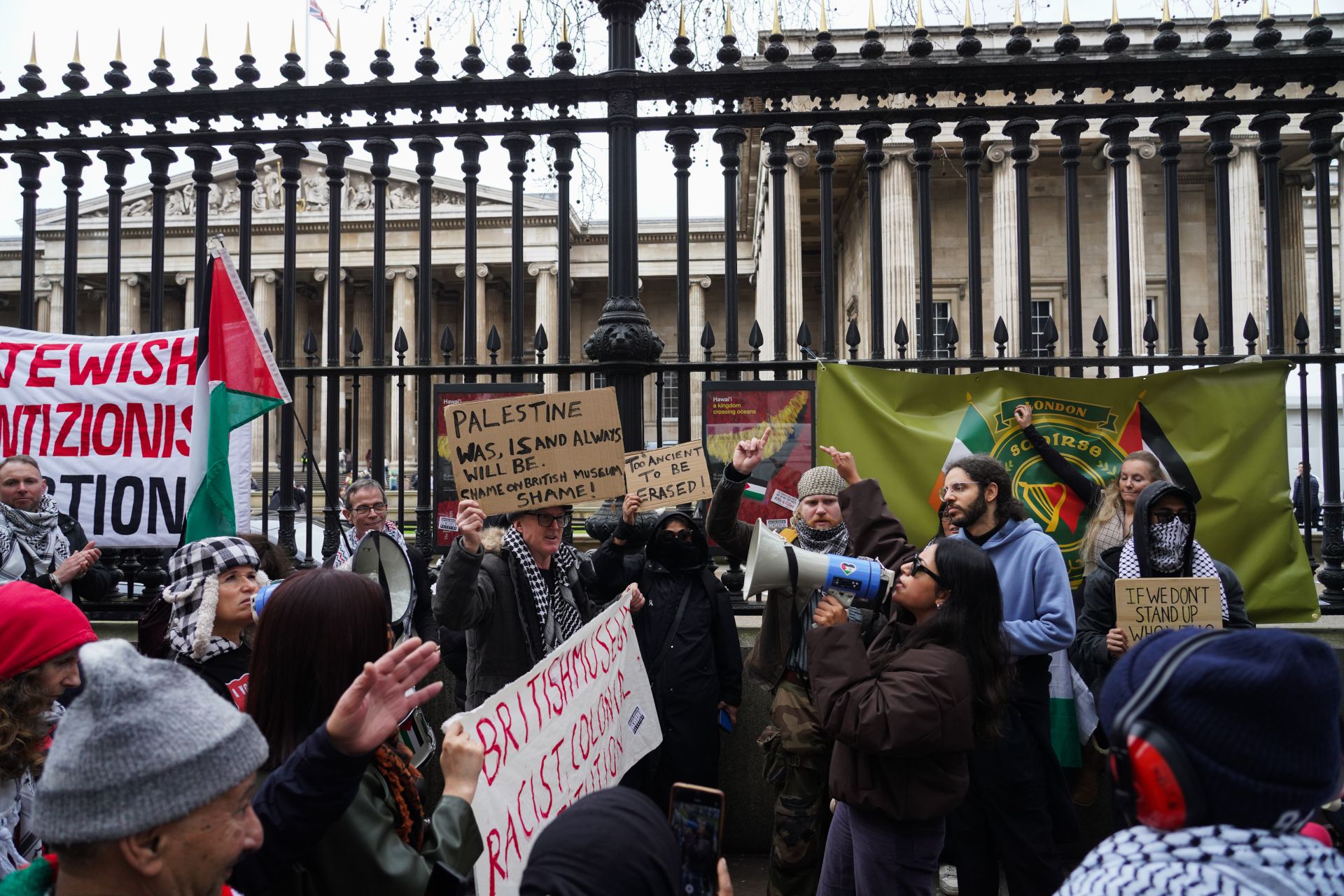
In February 2026, the British national newspaper The Telegraph ran a story seemingly typical of our times. The British Museum, the article claimed, had dropped the word “Palestine” from labels after pressure from the lobby group UK Lawyers for Israel (UKLFI). The public outcry was immediate, and loud. The historian, writer and podcast host William Dalrymple told his 1.2 million followers on X that it was “Ridiculous of the British Museum to remove the word ‘Palestine’ from its displays, when it has a greater antiquity than the word ‘British.’” Many took to social media to say they were canceling their membership. A petition was launched by academics to protest the political basis for the choice of historical content.
The following day came a long follow-up from Dalrymple, again on X. “I’ve just been chatting with Nick Cullinan, the excellent new director of the British Museum, and I’m very relieved to say that the story put by the Daily Telegraph about the BM cancelling the name Palestine is a complete misrepresentation of the facts,” he began, and used quotes from this conversation with Cullinan to make the very strong case that The Telegraph had published what Dalrymple called a “mischief-making story,” without checking it with the British Museum.
This all sounded like a familiar scenario: A media outlet gets played by a lobby group to propagate a particular version of events. But documents shown to New Lines and The Guardian tell a very different story: An institution internationally renowned for historical research is changing nomenclature as a result of unknown reasoning, processes and pressures. Just as importantly, the museum is failing to engage on the issues, whether historical or political; instead, these changes are happening quietly, and the reasons given shift with the audience they are addressing, leading to suspicion that this national institution has fallen under political influence. The following is pieced together from over a dozen interviews with experts, on and off the record. (The British Museum was asked to comment on the claims in this piece prior to publication, but did not respond to our questions within 24 hours.)
Gallery 4 of the British Museum is the Egyptian sculpture room, one of the jewels in the institution’s crown. There are many doors to this very long gallery, but if you choose to enter at its center, from the Great Court, you are greeted by the famous Rosetta stone in a standalone case, usually surrounded by crowds on all four sides. There are also pharaohs and goddesses, tombs and statues from three millennia of Egyptian history, which all help to make it one of the museum’s most popular rooms.
It’s also the site of the changed label that was at the center of The Telegraph’s first piece breaking the story. In a panel on the Hyksos people in the 17th and 16th centuries BCE, the phrase “Palestinian descent” was changed to “Canaanite descent.”
Arguments about terminology are the bread and butter of academic research, but despite the academic’s love of nitpicking, there is surprising unity over the use of the word “Palestine” for the southern part of the Levant. “I don’t know another ancient historian that wouldn’t use the term ancient Palestine,” Marchella Ward, a classical historian and lecturer at the Open University, told me. “The idea that this is somehow a term that’s problematic … that’s just simply untrue within the field.” Every historian and curator I spoke to, on and off the record, reiterated this point: Palestine is the conventional term used in academia for this part of the world.
I pushed Ward on this issue, knowing that the word was not used at the time: Its first documented use was in the 12th century BCE, centuries after the events on the label in Gallery 4. This is from an inscription on a monument in the Medinet Habu temple in Luxor, detailing the exploits of Pharaoh Ramesses III, carved in 1186 BCE. In this and similar subsequent texts from the period, the “Peleset” are recorded as enemies of Egypt from the southern Levant. Cuneiform sources from around 800 BCE refer to the same people as the “Palashtu.” Not long after this, the Hebrew Bible calls them the Philistines, with Abraham arriving from his native city of Ur to live in their lands.
You can thus legitimately argue that the use of the word “Palestinian” for the 17th or 16th century BCE is an anachronism, given there was no such word in use at the time. “Using really any word (including Canaan) before the 13th century BCE [for this area] is really an anachronism,” Ward responded. “Canaan is only very slightly older than Palestine, but less used in historical sources — and what speaks in favour of Palestine rather than Canaan is that Palestine has always referred to a history that is multiethnic and multireligious, it isn’t associated with the Bible in the way Canaan is.”
Although there are mentions of “Canaanites” in Mesopotamian texts from the 18th century BCE, the word is not used by the Canaanites themselves until far later, in the Hebrew Bible, which is the source of the vast majority of references to Canaan and Canaanites. Thus, the self-definition of the group comes around the same time that the word Palestine enters the historical record, but unlike Palestine, relies almost entirely on a single text — the Bible. Palestine, on the other hand, is attested to in a wide range of sources and languages, and refers to a broader category: a multicultural, multiethnic, multilingual geographical area in the southern Levant. Herodotus, in around 480 BCE, described the area as “Syria Palestina,” which was also its name under Roman rule.
There are many reasons, then, to choose “Palestinian” over “Canaanite” descent, because of the historical record and also because Palestine is more widely used by academic convention. So what was the basis for the change? The UKLFI website reports that the British Museum told them: “Audience testing has shown that the historic use of the term Palestine … is in some circumstances no longer meaningful.” This explanation raises a number of further questions, not least: Is “meaning” to the audience really the guiding principle in deciding content? What happened to curatorial expertise and the role of the museum as arbiter?
This is what preoccupies many of the experts I spoke to. “A museum is supposed to be an educational institution,” Ward said. “We’re not supposed to go to what the public already think and simply seek to represent that. Museums have a responsibility to actually teach the public something about history.” This was echoed by an ex-museum curator I spoke to on condition of anonymity: “Focus groups should not write labels.”
Furthermore, any familiarity with Canaan stems entirely from knowledge of the Bible, which is only familiar to one (shrinking) segment of visitors to the British Museum. This is an exclusionary basis for picking one name over another. But even more important to note is that it is prioritizing the Bible as a source, something that curators at the British Museum, and historians and archaeologists all over the world, have long been struggling against. The whole field of study of this geographical area, as it is represented in the British Museum, started as biblical archaeology: attempts to find proof of the Bible through excavations in the Middle East. “The current generation has witnessed great changes in the archaeology of Palestine,” Thomas W. Davis wrote in 2004, in the introduction to his book “Shifting Sands: The Rise and Fall of Biblical Archaeology.” “Before the 1970s, biblical archaeology was the dominant research paradigm. Today, biblical archaeology has been ‘weighed in the balance and found wanting.’” This is when the field acknowledged that the elusive proofs were simply never going to be found, and it was time to treat the archaeology on its own terms. Drawing on biblical sources prioritizes one very particular text over others, and one that is not historically reliable, as demonstrated by decades of research.
“We’ve been banging on about the lack of historicity in the Bible and the problems that it throws up, getting on for 70 odd years,” one historian of Palestine put it to me. “And yet people still assume that it is an unqualified reality in some way. It’s a bit like doing medicine without taking on board the discovery of DNA.”
Avoiding the biblical context was in fact one of the guiding principles in the design of the ancient Levant gallery by Jonathan Tubb, who was then a curator in the department of the Middle East at the British Museum and later its keeper. He transformed the then-Palestine room into the ancient Levant gallery, spanning three rooms and covering the years 8000-539 BCE (from the Neolithic to the fall of the Neo-Babylonian Empire). As his obituary in The Guardian put it, the display “reflects Jonathan’s steadfast commitment to presenting cultural developments using well-provenanced archaeological materials without unproven concession to biblical history.” As someone close to him at the time said to me: “The whole point of his gallery design was to look at the region on its own terms, and not just within a biblical context.”
This gallery is the site of a further disappearance of the word Palestine, an example not included in the original Telegraph article. Before and after photographs (reproduced below) show that the introductory description has been changed. The first says: “The ancient Levant comprises modern Palestine, Israel, Jordan, Lebanon and western Syria.” The British Museum’s website still uses these terms, but the panel in the gallery now says: “The ancient Levant comprises modern Jordan, Israel, Gaza, West Bank, Lebanon and western Syria.” Palestine has been replaced with “Gaza” and “West Bank.”
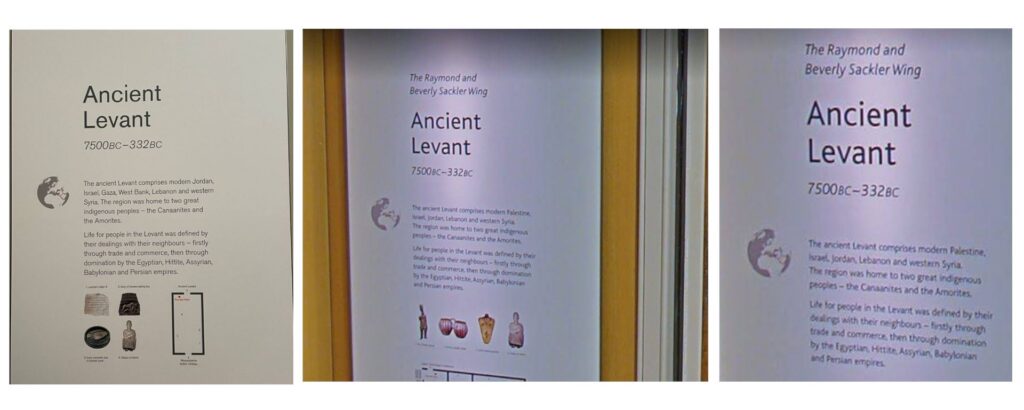
The photographs also hint at the original impetus for the change: The reference to the Sackler family has been removed. “In the case of the Levant gallery, they took the opportunity to make some revisions, given they were taking out the Sackler name,” Venetia Porter, who was senior curator for Islamic and Contemporary Middle East art at the British Museum until her retirement in 2022, described to me. “Now there’s nothing wrong with changing panels, with changing information as you get more up-to-date research and all that. This happens all the time in a museum.” What is problematic, however, is that we don’t know how the decision was made — or who made it. But Porter also told me that the decision could not possibly have been made by a single curator or even the more senior keeper, given how hierarchical, bureaucratic and risk-averse the place is. “I’d just be very surprised that a keeper would even take it upon themselves to actually make that change without any kind of directive,” she summarized. “This is a major decision. It has to come from the top.”
The implications of the change are immediately clear. “The removal of the name ‘Palestine’ from these panels constitutes an erasure of the State of Palestine in the present,” argued the Palestinian Embassy, in a letter to the British Museum seen by New Lines, “and introduces differential treatment of the State of Palestine which has been recognised by the United Kingdom since the 21st September 2025.”
Statements from the museum on this issue, quoted by The Telegraph and confirmed by the Museums Journal (the members’ publication of the Museums Association in the U.K.), are internally incoherent. “We use the UN terminology on maps that show modern boundaries, for example Gaza, West Bank, Israel, Jordan,” a spokesperson said. But the U.N. recognized Palestine in 2012, giving it the status of a nonmember observer state, and so the U.N.-guided terminology would be Palestine and not Gaza and the West Bank. Furthermore, the U.K. also recognized the state of Palestine in 2025, the same year that the British Museum changed the label. We asked whether, given the U.K.’s change in stance, the British Museum had plans to change it back, but had received no reply at the time of publication.
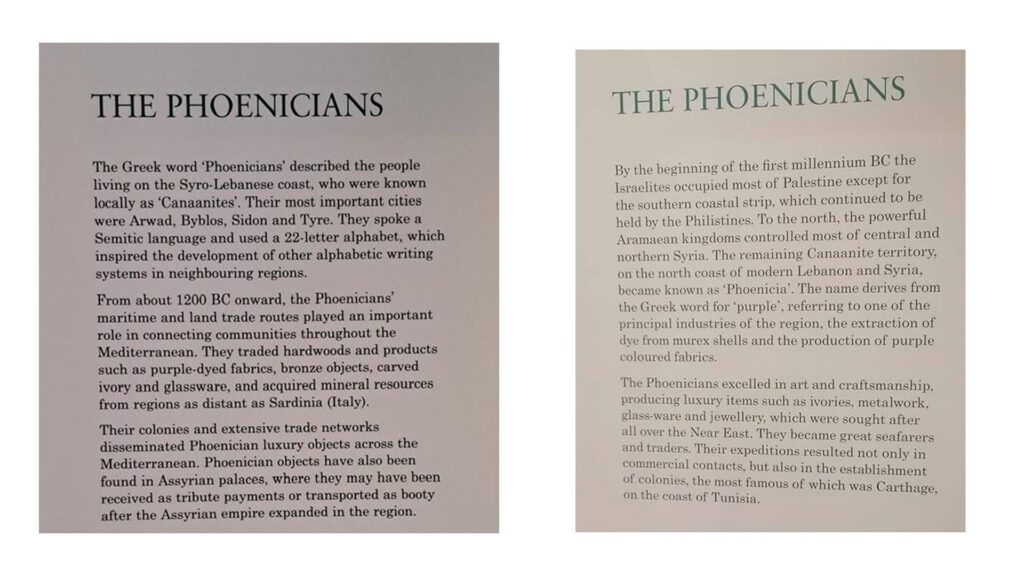
New Lines has since learned of other quiet changes. A panel on the Phoenicians, for example, which is as contested a term as any (the Phoenicians, like the Canaanites, did not originally have any such self-referential label), previously started with: “By the beginning of the first millennium BC the Israelites occupied most of Palestine except for the southern coastal strip, which continued to be held by the Philistines.” The panel currently begins: “The Greek word ‘Phoenicians’ described the people living on the Syro-Lebanese coast, who were known locally as ‘Canaanites’.” Palestinians or Philistines no longer make an appearance on the entire panel, despite the word being more common at the time than the word Phoenician itself. As the historian Josephine Quinn has documented in her book, “In Search of the Phoenicians,” the word had no contemporaneous meaning, with those labeled “Phoenician” by the Greeks self-identifying using their cities of origin, much, in fact, like the Greeks themselves. “The ‘anachronism’ argument is applying a logic to Palestine that we don’t apply to other places,” Ward told me. “We talk about Britain before Britain, for example.” And as already described, when Abraham made his journey from Ur, where he was born, to the promised land, as told in the Book of Genesis, he was met by a Philistine king. If the words “Phoenician” and “Canaanite” are good enough for a museum panel, then Philistine or Palestine surely is too. Why is “Palestinian” being held to a higher historical standard?
There has been one terse statement issued by the British Museum, on Feb. 16, which reads, in its entirety: “It has been reported that the British Museum has removed the term Palestine from displays. It is simply not true. We continue to use Palestine across a series of galleries, both contemporary and historic.” This is untrue, as their own responses to other people confirm. The longest explanation we have is from Dalrymple’s follow-up tweet on the scandal, with direct quotes from his conversation with Nicholas Cullinan. Dalrymple confirmed to me that these quotes were verbatim; indeed, some were by WhatsApp message and therefore he could check them. And they were not wrong — as far as they went.
Dalrymple recorded Cullinan’s messages. ”To reassure you we are not removing mention from [sic] Palestine from our labels … Indeed, we have a display on at the moment about Palestine and Gaza.” (This much is true: Wander through the British Museum today, and there are plenty of labels and maps in various galleries referring to “Palestine.”) “I know this is something our curators have thought long and hard about – as you can imagine,” the post continues. “We amended two panels in our ancient Levant gallery last year during a regular gallery refresh, when some wording was amended to reflect historical terms.” It’s unclear to me whether this is about the change from Palestine to Gaza and West Bank, or the panel about the Phoenicians, but either way, there has been no detail about the change, which is what is needed.
Dalrymple told me that he ended his phone call with Cullinan by connecting him with the Palestinian ambassador to the U.K., Husam Zomlot, and they spoke immediately, with Cullinan reassuring Zomlot he would look into the changes. This phone call, on Feb. 16, was referred to in a follow-up letter Zomlot sent Cullinan a month later, which has been seen by New Lines. In it, Zomlot writes that the embassy’s own research confirmed “that the name ‘Palestine’ has been removed from a number of gallery panels and texts where it had previously appeared.”
The letter was clear in its appreciation for the British Museum’s long record of research on Palestine, and also in what was being requested. Given that the change to “Gaza” and “West Bank” was clearly in breach of the U.K.’s own recognition of the state of Palestine, “We ask that the British Museum restore the earlier wording to these display panels immediately to correct this inaccurate change.” The letter concluded by stating that further engagement would be welcomed.
An invitation was forthcoming, and a meeting happened — one that Ward attended with the delegation from the embassy. “I was there in my professional capacity,” she told me, “and was not invited to take part in the meeting between Zomlot and Cullinan.” Instead, Ward met with Paul Collins, the keeper of the department of the Middle East, and Xerxes Mazda, the director of collections. With the knowledge that the issues to be discussed had been covered in the letter from the week before, Ward was expecting a discussion between peers, on the technicalities of the issues of labeling. “That’s what I had expected. But we didn’t get that,” she told me, frustrated. “Overall the message was: We’ve heard your concerns and will reflect on that.”
The meeting between Zomlot and Cullinan did not go any better, as detailed in the second letter shown to New Lines. Instead of any “corrective action,” the ambassador was offered a tour of the museum, which he could not accept, because “it would not have been appropriate to engage further in a manner that could be interpreted as an endorsement of the current presentation.” Zomlot has since escalated the issue to the U.K.’s Foreign Office and is currently waiting for a reply.
The enigma at the heart of the issue is this refusal of the British Museum to engage openly. Yes, the ambassador, Ward and many others want the labels changed to reflect historical research and U.K. policy and law. But even more than that, the historians I have spoken to want an open debate. It is true that “Palestine” is a term that does not go back further than the 12th century BCE, but replacing it with “Canaan” is clearly also unsatisfactory. The only way to avoid suspicion of political pressure is to have the debates in public, showing why one term was chosen over another.
Porter, who worked at the museum for over 30 years, described an increasingly risk-averse, inward-looking institution, quite at odds with the museum under the directorship of Neil MacGregor, which was, in her experience, “the period of the most openness at the British Museum. … His mantra was that the museum is a place where difficult and complicated issues can be discussed.” Now, she claims, there is more self-censorship and less open discussion. Melissa Gronlund, who wrote a thoroughly reported piece for The Art Newspaper, said to me: “The British Museum seems to be following a policy of risk aversion — with some glaring exceptions — when one wants the museum, as a world-class institution, to own its role, which is to be the adjudicator, to be the expert, to be the deciders.” Current curators — those employees of the museum hired for their historical and geographical expertise — are conspicuous by their absence in this debate. These are the people who should, in theory, adjudicate on such thorny issues. But requests to speak have gone unanswered.
Dan Hicks, author of “Every Monument Will Fall,” wrote to me: “It’s remarkable how little we understand about these changes to the texts in the museum galleries. No logical rationale or explanation has been offered for what appears to be the removal of the word ‘Palestine’ from the description of the contemporary geography of the Levant in Room 57 while the names of other nation states remain.” Hicks is also the author of “Brutish Museums: The Benin Bronzes, Colonial Violence and Cultural Restitution.” “The British Museum has been the centre of calls for the return of objects for many years, but I never imagined we would see a campaign for the return of words to gallery texts.”
The suspicion that the museum’s expertise is not in fact acting as the decider in this case, but that it is instead bowing to external pressures, has been strengthened by the timing of the label changes as well as the inability to provide explanations. “The erasure of Palestine at the British Museum needs to be understood in the context of Israel’s deliberate erasure of Palestinian history and historical sites, which is a part of genocide,” Ward said. “When a museum removes the most commonly used name during a project of deliberate historicide, that obviously isn’t a question of ‘historical accuracy,’ especially when they don’t apply that same logic to other ancient people.” Quinn echoed this unease. “The worrying thing for me is the idea that it matters, that it has any relevance to politics today, or that it can justify or excuse the contemporary story, which is one of genocide,” she told me.
Novelist and lawyer Selma Dabbagh wrote in a message: “The Israeli army has been carrying out such destruction systematically and wantonly for decades now, a process that has become all the more brutal and absolute since the genocide began in 2023. As a British Palestinian, a taxpayer and a former member of the museum, it revolts me to have a British institution showing complicity with the obliteration of Palestinian cultural heritage.”
I previously wrote about this systematic destruction of history and heritage in Palestine that has been happening for decades, and spoke to Nadi Abusaada, a professor at the American University of Beirut and curator of the permanent exhibition of the Palestinian Museum in Birzeit. “We need to remember that Palestinians have been telling their history against the grain of Israeli colonial theft, looting and destruction of their archives since at least the 1948 Nakba,” he told me then. To remove Palestine from labels without explaining the reasons behind the changes is to participate in this erasure.
“For me,” Zomlot said in a phone call, “this is not only a political issue. This is not only a legal issue. This is not even just a historical issue. This is an existential issue. Because erasing our past is erasing our present.”
Become a member today to receive access to all our paywalled essays and the best of New Lines delivered to your inbox through our newsletters.