

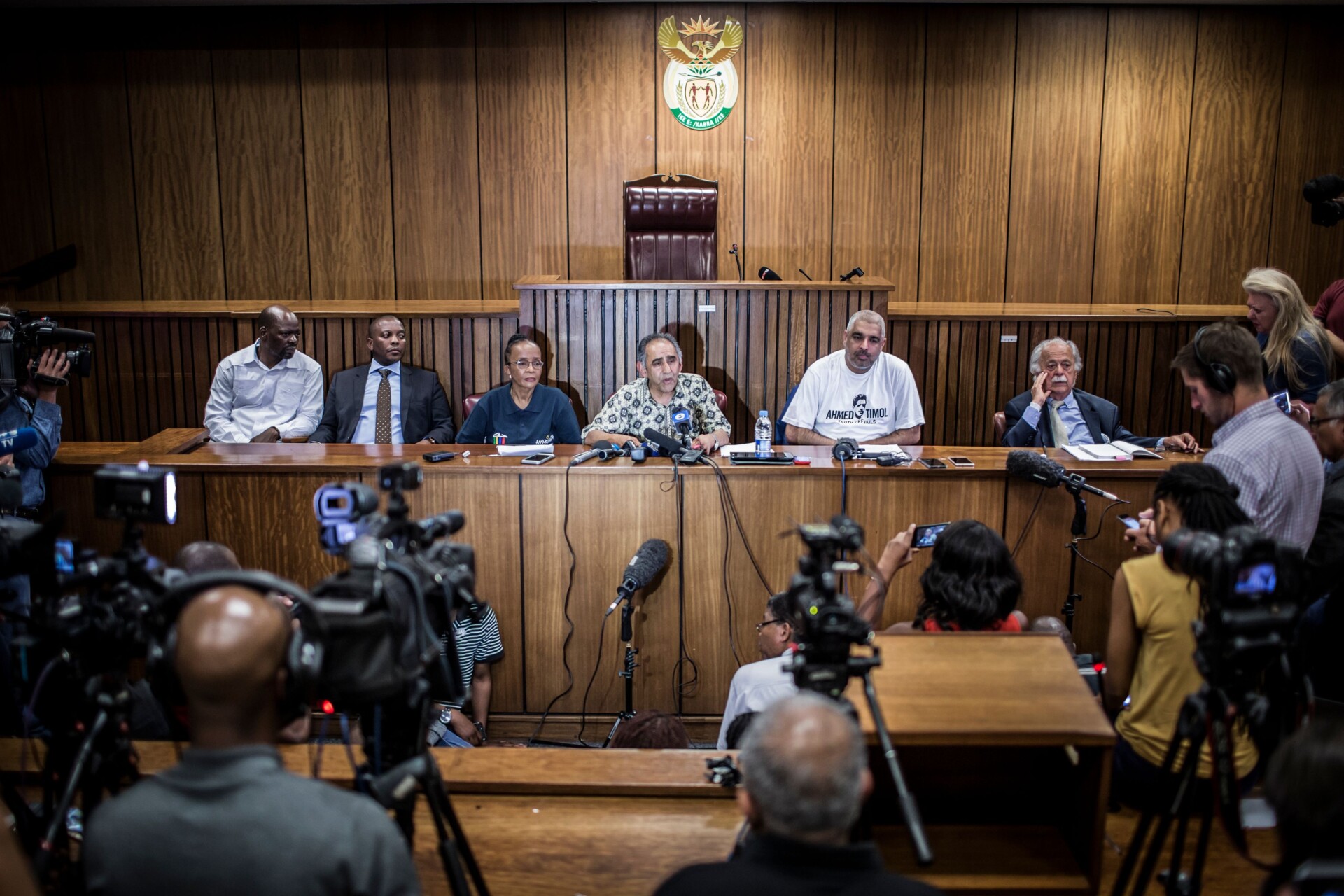
Nomonde Calata’s voice trembled. She breathed deeply, determined to suppress her grief, summon her immense strength and continue her testimony to the High Court in Gqeberha, South Africa. Judge Nomathamsanqa Beshe, presiding in her red robes, listened attentively to her heartbreaking story.
Steadfastly retaining her composure, Calata related the terrible details of the murder of her husband, Fort Calata, along with fellow educators Matthew Goniwe and Sicelo Mhlauli, and the trade unionist Sparrow Mkonto. “My life really changed from then,” she said, as tears overwhelmed her. “What am I to do? I’m 26 years old, I have children, I’m pregnant and my hope was taken away. My friend, my everything was taken away, in such a brutal manner.”
These crimes were committed 40 years ago. The Cradock Four, as they came to be known, were killed on June 27, 1985. Their murders, carried out by apartheid-era state security officers, were part of a bloody campaign of repression against anti-apartheid activists. By organizing successful campaigns in which the community collectively withheld rents, as well as consumer boycotts and school boycotts, Goniwe and his comrades had transformed the town of Cradock into the epicenter of a vibrant community resistance movement stretching across the province, which alarmed the regime at the highest levels. The situation was discussed in the State Security Council, and on June 8, 1985, Brig. Joffel van der Westhuizen sent a military signal marked “urgent” calling for Goniwe and Calata to be “permanently removed from society.” This ultimately set in motion the police death squad that abducted, tortured, stabbed and shot the four activists, leaving their bodies burned and mutilated. Mhlauli’s corpse alone bore 25 stab wounds in the chest and was missing a hand.
Now, decades later, it is becoming clear why those responsible were never brought to trial. Mounting evidence, including affidavits of former officials, court rulings and a 2024 presidential review, points to high-level political interference within the National Prosecuting Authority (NPA). From 2003 onward, successive governments led by the African National Congress (ANC) party quietly shut down efforts to prosecute apartheid-era crimes, despite the Truth and Reconciliation Commission (TRC) issuing a clear directive to do so when amnesty was denied. Whether for financial purposes, to protect elite pacts made during the transition period, to shield its own operatives from reciprocal scrutiny or, possibly, to prevent collaborators from being exposed, the democratic state chose impunity. In response, families of the victims, including relatives of the Cradock Four and victims of other high-profile apartheid-era atrocities, filed a civil suit in January 2024. The case demands not only recognition of rights violations but a public reckoning: a formal inquiry into who interfered, why they did so and what justice might look like.
The failure to prosecute is not only personal to the families — it is a betrayal of the struggle for freedom. The injustice is made more painful by the extraordinary contributions to the movement made by those killed by this apartheid-era state violence. As Derrick Swartz, a former comrade, told the inquest into the Cradock Four case, “In a bitter sort of way, the price that these four comrades paid … laid the foundations and created this avalanche towards what we now enjoy as a relatively peaceful democratic order.” That sacrifice helped birth the postapartheid state. And yet, in death, they have been denied justice by the very government their resistance helped bring to power.
After all these years, the 2025 Cradock Four inquest, in which Nomonde Calata testified, is the first time any South African court has asked to hear from the widows, families and comrades of the murdered activists. It’s the third inquest into the murders of the Cradock Four and was only launched after years of exhausting advocacy on the part of the families still seeking justice from the ANC government. The first inquest, which started in 1987, was an apartheid-era sham conducted exclusively in Afrikaans, without even providing translations for the widows. It found “unknown persons” responsible. A second, held in 1992 and 1993, during the transition period, acknowledged that state security forces were responsible but failed to identify the perpetrators and fell short of establishing the full facts of the case. Despite strong evidence produced by the TRC, which in 1999 denied amnesty to the six state security officials who carried out the killings, no one has ever been tried for the Cradock Four murders.
“We expected justice,” Fort Calata’s son Lukhanyo told New Lines. “Justice in the form of these guys having been prosecuted, having been charged, taken through a fair trial, found guilty.” Instead, “We got absolutely zero.”
For the last three decades, South Africa has cultivated an aura of moral authority grounded in its peaceful transition from apartheid. But that image obscures a darker truth: The democratic state systematically failed to pursue justice in hundreds of cases of political murder and torture committed by the apartheid regime. Despite the TRC’s promise that cases denied amnesty would be prosecuted, only four have resulted in convictions. None of the state’s most notorious apartheid crimes, including the murder of the Cradock Four, has ever led to a full trial.
Shockingly, that bitter experience is shared by the families in the more than 300 cases of murder and torture perpetrated as state crimes of apartheid and referred for prosecution by the TRC. The persistent inaction of state prosecutors under ANC governments, stretching across decades, is no accident. It reflects not just a failure of will but a deliberate dismantling of the promise that truth would lead to justice.
Meanwhile, many perpetrators have died without facing consequences for their actions. Others remain alive and unrepentant. And evidence now suggests that the ANC-led government not only allowed this impunity to take root but may have actively suppressed accountability in the name of political stability. When the TRC concluded its work in 2000, it represented the moral center of South Africa’s postapartheid nation-building effort. In exchange for full disclosure, perpetrators of apartheid crimes could apply for amnesty. But where amnesty was denied or never sought, the expectation was clear: Prosecution would follow. Former TRC Commissioner Yasmin Sooka remembers that expectation vividly. “We compiled a list of more than 300 cases,” she told New Lines, “with a clear understanding that these cases would be investigated and people would be prosecuted.” The NPA even established a specialized Priority Crimes Litigation Unit in 2003 to handle these prosecutions.
Among those denied amnesty were the men responsible for killing the Cradock Four. Their crimes were deemed ineligible for forgiveness by the TRC, but prosecution never came. And they were not alone. The same happened in the case of activist Ahmed Timol, who in 1971 was thrown to his death from a 10th-floor window of the infamous John Vorster Square police station in Johannesburg, after being tortured in custody. A farcical 1972 inquest deemed the death a “suicide.” The same held in the COSAS Four case, in which young anti-apartheid activists from the Congress of South African Students were tricked into carrying explosives and killed in a police trap. Despite these denials of amnesty and the volume of documented evidence, prosecutions stalled.
“Each one of them, other than Madiba’s [President Nelson Mandela’s] administration, have let us down,” said Lukhanyo Calata, who has spearheaded the families’ long campaign to seek justice for the Cradock Four murders. “That ultimately led to the deaths of most or all of the suspects.”
The TRC was never meant to be the end point of justice. It was designed as a bridge, a painful but principled compromise, on the understanding that truth, if not met with amnesty, would be followed by legal accountability. But over the years, case files gathered dust, witnesses died, families aged and a justice system that was supposed to hold apartheid’s killers to account quietly stepped away from the task.
Despite constitutional guarantees, successive ANC governments systematically sidelined prosecutions for TRC-referred cases. In recent years, more and more evidence of this political interference has been emerging, mainly through lawsuits. In the landmark 2021 Rodrigues case, the Supreme Court of Appeal found that “from 2003 to 2017, investigations into the TRC cases were stopped as a result of an executive decision” and “what can only be described as high level executive interference on investigating and prosecuting TRC crimes.” This was the judiciary clearly exposing these delays as consequences of political interference, not mere negligence.
So far, three senior NPA figures have officially acknowledged political interference in TRC prosecutions. As the former director of the NPA from 2005 to 2007, Vusi Pikoli submitted evidence in the Rodrigues case that “at a political level there was an expectation that I would not prosecute TRC cases.” In 2019, the family of the activist Timol brought a case against the NPA for failure to prosecute his 1971 murder. The lawsuit elicited another explosive admission from Torie Pistorius, the former head of the NPA’s Priority Crimes Litigation Unit. His affidavit said the NPA “does not deny that the executive branch of the state took what one can describe as political steps to manage the conduct of criminal investigations and possible prosecution of the perpetrators of the political murders such as that of Mr Timol.”
In 2023, a landmark review was commissioned by the NPA to investigate how the vast majority of apartheid-era cases referred to by the TRC were never prosecuted. Led by former TRC Commissioner Dumisa Ntsebeza, the report “concluded that the National Prosecuting Authority was swayed from carrying out its constitutional and statutory obligations” to prosecute the crimes of apartheid and that “virtually all the cases handed over to the NPA with the recommendation that they be investigated were abandoned.” He cited the evidence of senior NPA officials describing political obstruction and noted that “where some prosecutors had the courage to stand up and resist political interference, they were removed from their positions.”
The motive for this political interference still needs to be officially determined. While Ntsebeza’s review conclusively established that this meddling successfully stymied prosecutions, it didn’t identify who was responsible or what motivated the burial of the TRC cases.
Sooka calls the ANC’s failure to prosecute “a de facto amnesty” for the apartheid-era officials who committed these crimes. While no such policy has ever been openly acknowledged by the government, new evidence substantiating the policy continues to come to light.
In July 2021, the FW de Klerk Foundation, linked to the last apartheid-era president, publicly claimed that the NPA halted the prosecution of apartheid-era crimes due to “an informal agreement between the ANC leadership and former operatives of the pre-1994 government.” For family members, this was an outrage.
“My blood was boiling,” says Lukhanyo Calata in a 2022 documentary he made about the Cradock Four case, discussing an encounter with Deputy Minister of Justice John Jeffery. “An agreement on some kind of amnesty process,” says Jeffery in the film, was “part of the price that had to be paid” for peace in the negotiations that ended apartheid. For Lukhanyo Calata, this was a complete betrayal by the liberation movement his father helped to bring to power. “I was not prepared to accept that my father was used by politicians as some kind of a pawn in a negotiating game,” he told the Cradock Four inquest.
The families are still fighting. In January 2024, a civil suit was lodged against the government by a collective of 25 families of the victims of some of apartheid’s most infamous crimes, including those of the Cradock Four, the COSAS Four, the PEBCO Three (members of the Port Elizabeth Black Civic Organisation) and Timol. Working with the Foundation for Human Rights in South Africa, the families’ lawsuit names President Cyril Ramaphosa, former Justice Minister Brigitte Mabandla, the national director of public prosecutions, the national police commissioner and others.
It demands a government declaration that the constitutional rights of the victims of apartheid were violated by the state because of political obstruction of criminal prosecutions of the perpetrators. It calls for the establishment of an independent commission of inquiry to determine exactly how this happened, who was responsible and why they did it. “We want those names,” as Lukhanyo Calata put it when the suit was announced. “Who in the ANC … made agreements with former apartheid leaders that they won’t be prosecuted? Secondly, who in the ANC … went to [NPA prosecutors] Vusi Pikoli and Anton Ackerman and said, ‘No, you cannot prosecute this matter’?” Finally, the lawsuit demands $9 million in constitutional damages to be used for memorialization, further investigations and private prosecutions, which may be the only way families will ever secure justice.
Without consulting any of the families, Ramaphosa established a judicial commission of inquiry on May 29. Families have welcomed the move as progress, but it’s not all good news. The commission may end up being fruitful in establishing the facts of interference, but it’s also a slick maneuver by Ramaphosa. “He’s kicking the can down the road,” Sooka told New Lines. Because the commission won’t be able to determine the damages or issue the declaration, those issues will have to wait another year or two, at least. “More delays, more obfuscation, more prevarication,” said Sooka, who now leads the Foundation for Human Rights. “And at the end of the day, the losers are the families, and of course, South African society as a whole.” For Lukhanyo Calata, it’s another betrayal. “Publicly [Ramaphosa] shows us love,” Calata said, but “behind closed doors, he stabs us in the heart.”
South Africa is not the only country to emerge from mass atrocities with unprosecuted crimes. But it is one of the few in which a democratic state, with a functioning judiciary, deliberately chose not to act. Other nations, despite their own failures and delays, eventually gathered the political will to confront their past.
In Argentina, it was decades after the fall of the military dictatorship (1976-1983) before the country began reopening cases against those responsible for torture, disappearances and murder. But when prosecutions resumed, they were pursued vigorously. So far, more than 1,200 perpetrators have been convicted in trials that have continued into their old age. Cambodia, too, faced decades of inaction after the fall of the Khmer Rouge, but in 2006 a United Nations-backed tribunal began convicting senior regime leaders. Though imperfect, both processes signaled that a reckoning, however late, was still possible.
South Africa, by contrast, chose a different path. It built the promise of justice into the model of its TRC: Amnesty was conditional and without it perpetrators would be prosecuted. And yet the democratic state in South Africa then helped ensure those crimes remained legally unresolved.
As the legal advocate Howard Varney has observed: “Unlike Argentina or Cambodia there has been no specialised or dedicated approach to investigating and prosecuting apartheid-era crimes in South Africa. No special prosecution units or adjudicatory bodies have been established.” For Varney, who represents the Cradock Four families in the inquest, the NPA’s new unit for producing prosecutions, called the TRC Component, isn’t any better. “The current TRC Component is a toothless body with no authority,” Varney told New Lines. This isn’t simply a historical failure; it is a structural one. A political and prosecutorial culture of impunity became entrenched within the very institutions designed to deliver justice.
As the window for criminal prosecution closes, the question now is whether South Africa, like other nations before it, will find political reckoning through the courts, or whether it will entrench impunity as a permanent condition of its democracy.
So many victims of apartheid crimes, which stretch back decades, are growing old without justice. All six of the perpetrators of the Cradock Four murders have died without facing justice. Van der Westhuizen, who ordered the murders, is one of the few implicated in the crime who is still alive. Despite the damning evidence implicating him in the murder, no prosecution seems likely for the 83-year-old. And there are so many other crimes for which justice has never come. In 2021, the U.N. Human Rights Office spoke to survivors and family members of the 1960 Sharpeville Massacre, in which 69 peaceful protesters were gunned down by apartheid police while demonstrating against the racist Pass Laws. “We have not forgiven my brother’s killers,” Mphonyana Matsabu, sister of 12-year-old James Bessie, the youngest victim gunned down by the police that day, told the U.N. “Because how can we forgive someone who does not come in front of us to ask for forgiveness? The government hasn’t identified the killers to ask for forgiveness on their behalf. They have not come in front of us. Nothing.”
“If political will is absent,” Ntsebeza’s report stressed, not even the best-resourced independent unit will achieve successful prosecutions in these cases. He continued, with prophetic warning, “Where a government does not accept as part of the national identity, the importance of accountability and justice for crimes or atrocities that imprint on the national consciousness, accountability through successful prosecutions will not be achieved.”
In a country with so many problems that are rooted in a lack of accountability, including failures delivering on fundamental needs like health care, education and public safety, one must ask how this betrayal affects the national identity of postapartheid South Africa.
For the families, the lack of justice remains a gaping wound. “I will be very, very sad if this court can’t bring the means of closure to me before I die,” 65-year-old Nomonde Calata told the inquest in June. “The way he was brutally murdered is something that didn’t get out of my head. It’s always there. It is hanging there.” Forty years after Fort Calata’s death, his widow is still waiting for justice. “I want to be able to say to my husband, ‘Rest in peace.’ But for now, I can’t.”
Sign up to our mailing list to receive our stories in your inbox.