


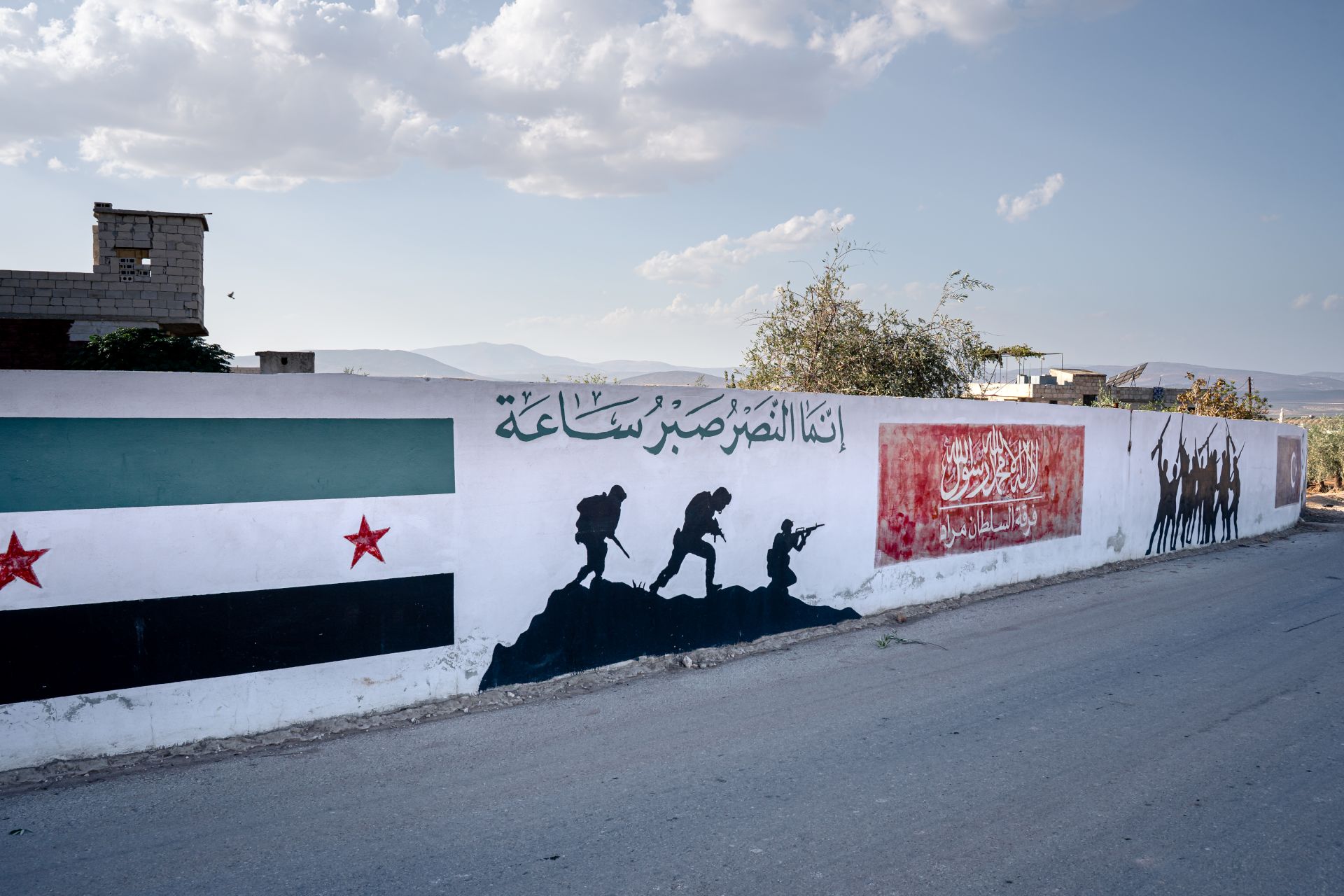
On Jan. 29, 2025, Damascus hosted a ceremony that was meant to close a chapter of Syrian history. Inside the People’s Palace, a building long associated with Bashar al-Assad’s rule, Ahmad al-Sharaa, the man who had toppled the dictator just 53 days earlier, summoned the nation’s newly “unified” military leadership for a carefully orchestrated ceremony that resembled a parade more than a meeting. It was staged as a tableau of reconciliation: yesterday’s rivals, standing in a row, dressed in identical uniforms, promising to become soldiers of the state rather than commanders of their own private realms.
Among the attendees were some of the most influential and controversial men in Syria. A few months earlier, all had belonged to the Turkish-backed Syrian National Army (SNA). But on that day, they came to pledge allegiance to their new leader. Among those assembled were Fahim Issa, former commander of the Sultan Murad Division, now deputy minister of defense and chief of military operations in the north; Sayf Abu Bakr, leader of the Hamza Division; Mohammed al-Jassem, also known as Abu Amsha, leader of the Suleiman Shah Brigade; and Abu Hatem Shaqra, commander of Ahrar al-Sharqiya.
The scene raised several questions, many of which are still relevant now that Damascus has taken control of much of the country’s northeast, an area that was under Kurdish control for the duration of Syria’s civil war: Has the SNA really dissolved? Has Turkey’s decade-long patronage in northern Syria vanished overnight? Or have these factions rebranded, only wearing new uniforms?
To understand the skepticism surrounding last year’s ceremony — and its resonance today — one must return to 2016, when Turkey launched Operation Euphrates Shield. What began as a counterterrorism campaign against the Islamic State group quickly evolved into a broader strategic project: reshaping northern Syria’s political and military landscape while blocking the expansion of Kurdish forces.
The project culminated in the creation of the SNA, a coalition of former Free Syrian Army units, Islamist brigades and Turkmen militias. Through funding, training and political oversight, Ankara built the SNA into a loyal proxy force with its own military bureaucracy — brigades, disciplinary committees, courts, police forces and cross-border supply chains.
The SNA policed Turkish-held areas, fought Kurdish forces and, when requested, deployed to foreign theaters such as Libya and Nagorno-Karabakh. By 2020, it had become a cornerstone of Turkey’s regional strategy.
In January 2025, Turkish Foreign Minister Hakan Fidan announced that the SNA factions would “integrate under the new national army” of Syria, with al-Sharaa as its commander in chief. The message was clear: Turkey was endorsing the new government in Damascus while signaling that it expected its influence to be preserved within the emerging Syrian military structure.
An agreement signed on Aug. 13 in Ankara between Syrian and Turkish defense ministers reinforced this partnership, establishing a Turkish presence in Syria’s defense architecture, going beyond informal coordination or proxy support.
Yet Syrian officials close to the new leadership insist that partnership should not be mistaken for control. “There is cooperation with Turkey today, but this should not be confused with submission,” a security official in Aleppo, who asked to remain anonymous, told New Lines in October. “We cooperate because we share a border.” He conceded that most of the high-profile appointments of former SNA leaders were facilitated by Ankara, but insisted the factions had joined the national army “to be part of the country, not to serve another power’s agenda.”

For the government, integrating former SNA fighters into the new Syrian army is a delicate balancing act. “The factions have surrendered their weapons and been dispersed, with each member sent back to their home province,” explained another security source within the Ministry of Defense in Aleppo, familiar with the process of these factions’ integration. Yet the process is far from simple.
Many fighters retain the familial, tribal and local bonds that once shaped their loyalties inside the SNA. Reassigned together, they often recreate familiar hierarchies within new units. In practice, integration frequently preserves local power structures rather than dismantling them.
“Despite its creation as a Turkish-orchestrated unification effort, the SNA never developed into a coherent institution. It remained a patchwork of militias ranging in size and influence and often run in a personalized manner by an individual commander,” Alexander McKeever, researcher and author of the newsletter This Week in Northern Syria, told New Lines. “Following Dec. 8, HTS [Hayat Tahrir al-Sham, the faction led by al-Sharaa] pursued the path of least resistance with regards to building a new army. It integrated the SNA factions as entities. The lesser ones entered as brigades within HTS-led divisions, a handful of the larger groups ended up as divisions of their own, and the more influential commanders were awarded leadership positions.”

The Suleiman Shah Brigade, for example, rebranded as the 62nd Division and now in charge of security east of the city of Hama, remained under the command of al-Jassem, while personnel of the Sultan Murad and Mehmed al-Fatih brigades largely kept their chains of command and local influence despite formal incorporation into Ministry of Defense divisions.
But McKeever cautioned against viewing the transformation as static. “At the beginning, it really was a rebranding, but with time, the army is institutionalizing to a great degree.”
As demonstrated by the recent operations in northern Syria, the question of Kurdish autonomy remains one of the most significant obstacles in Syria’s evolving political and military landscape.
After seizing Aleppo’s Kurdish neighborhoods in early January, government forces, following months of failed negotiations, swept through Arab-majority areas previously administered by the Kurdish-led Syrian Democratic Forces (SDF). A deal following the clashes ceded most of the SDF’s territory to Damascus, and the government granted the Kurds cultural and political rights.
One major obstacle was the SDF leadership’s deep mistrust of integrating former SNA factions. Before hostilities erupted, Hussein Othman, co-chair of the Executive Council of the Autonomous Administration of North and East Syria, dismissed the integration process as cosmetic. “The factions are only nominally under the Ministry of Defense,” he said, “but in reality they obey only their own interests. They are not taking orders from the government.”
According to Othman, exchanges of fire along the Euphrates front line at that time were frequently initiated by former SNA elements, further undermining trust — an allegation denied by the other side, which claims the SDF were the ones initiating hostilities.
In July, SNA soldiers stationed at the Qara Qozaq bridge, one of the few left on the Euphrates, indicated that Kurdish fighters were attempting at times to use the strategic crossing, access to which neither Damascus nor the SDF was willing to relinquish. “One day we will be on the other side, God willing,” said one of the soldiers, laughing. Like the rest of his new battalion, he once belonged to the Mehmet al-Fatih Brigade, one of the oldest factions in the SNA, and is now part of the 72nd Brigade of the Syrian army. His superiors refuse to comment on recent incidents, as does the brigade’s general staff. The reason is that they now have to report to the Ministry of Defense about any communication with journalists.

The presence of these factions complicated negotiations. Many Kurdish officials feared that a military structure reinforced by men who once led operations against Kurdish communities would erode their fragile autonomy and derail aspirations for decentralization.
Few appointments inflamed tensions more than that of Abu Hatem Shaqra, former leader of Ahrar al-Sharqiya, as commander of the army’s 86th Brigade in Deir ez-Zor. The faction he led is notorious for its deeds in Afrin and the northeast. In 2019, many suspected his culpability when his own men executed in cold blood the Kurdish activist Hevrin Khalaf during a military operation north of Raqqa.
A few months ago, New Lines traveled to Hama to meet another prominent SNA figure: Mohammad al-Jassem, the former head of the Suleiman Shah Brigade who is also known as Abu Amsha.
His new position, commander of the 62nd Brigade, was, according to several military officials, obtained largely because Ankara favored him. These promotions echoed a pattern familiar in the Turkish era: loyalty rewarded with expanded authority.
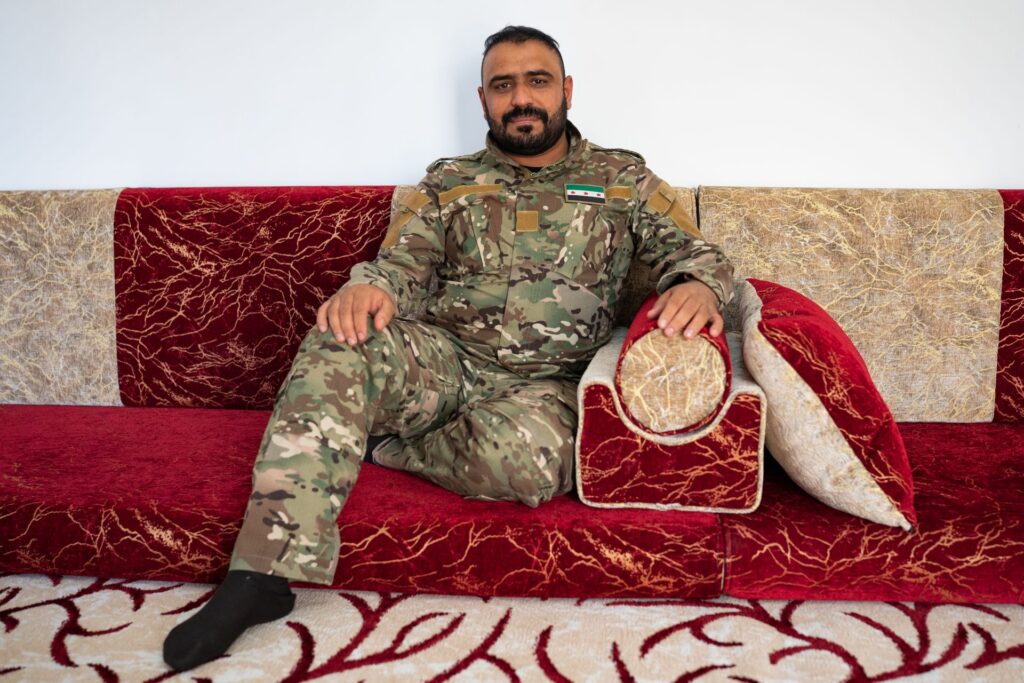
Abu Amsha’s record is controversial. In August 2023, the U.S. Department of the Treasury sanctioned him for violence and forced displacement targeting the Kurdish populations of Afrin, even specifically accusing him of raping the wife of a member of his brigade at gunpoint in 2018, with the victim and her family silenced under threat of reprisals.
The house where he was receiving visitors sat on the outskirts of Hama, sparsely furnished and heavily guarded. The brigade leader wore his new military uniform and was surrounded by his loyal followers. On his right arm, he bore the badge of the new flag of Syria.
When asked whether he was still operating under Turkish influence, he brushed away the question with a flick of his hand. “The Turkish passport? Business. Nothing more.” Yet being given a Turkish passport is a privilege reserved for only a handful of close allies.
Still, Abu Amsha insisted that his future lay with the new Syrian government. He described himself as “a loyal son of the new Syria.” But when pressed to comment on the country’s political situation and his opinion on the new interim president, he hesitated before adding, “One man should not hold all the power.”
Whether due to personal ambition or the constraints imposed by Western sanctions, he appears not to have taken part in this year’s operation in the northeast. Likely sidelined from the current campaign, his name is still everywhere on the internet, celebrating the defeat of the Kurds.
On the Turkish border, in Abu Amsha’s old stronghold of Shaykh al-Hadid, the past lingered in plain sight. His headquarters still bore the Suleiman Shah Brigade’s emblem. Inside, the decor of faux marble, crystal chandeliers and grandiose insignias spoke less of a dissolved faction than of a warlord who never relinquished the aesthetics of his private domain. Though some bases were dismantled, Abu Amsha’s faction was among the few allowed to retain one of its main positions in the north, but the terms of this arrangement remain opaque.
On the day of my visit, two soldiers stood guard. One of them, eager to talk, recalled the battles against HTS as if they had happened only yesterday: “It hasn’t always been easy with the other factions. We’ve fought a lot, especially with HTS.” Even today, despite the uniforms and official communiques, mistrust persists between certain components of the new Syrian army.
Researcher Gregory Waters, from the Syrian Archive, speaks of a deep mistrust. “Abu Amsha and his men are paying for their past as auxiliaries to Turkey,” he told New Lines. “But also for their absence from the decisive battles against the regime. Many in the HTS base don’t forgive either. They don’t trust each other, and they are far from a united force.”
Still, some describe a different reality. A former HTS officer in the Idlib region, who asked to remain anonymous, insisted that the December 2024 liberation of Damascus had reset the relationship between HTS and the northern factions. “Before liberation, there were problems between HTS and the SNA factions,” he said. “But when the time came, we had discussions, we negotiated and we fought together against our common enemy, Bashar al-Assad.” The SDF can now be added to the list.
But, as he admits himself, the differences between the two are embedded in their identity, loyalty and political vision. HTS envisions itself as the disciplined core, following the lead of al-Sharaa. Former SNA factions see themselves as local power brokers, and each faction leader considers himself to be head of his brigade, master of his domain.
No region reflects the challenges of the integration more than Afrin, the Kurdish-majority city that Turkey seized in 2018 and governed through allied SNA factions. Officially, the region is now under the Damascus central authority. In practice, it remains a stronghold of rebranded SNA units. The Turkish flag still flies over the town hall.
“Administrators did leave,” said Azad Osman, a member of the local council and the Association of Independent Syrian Kurds. “But the people running things now are the same fighters as before. They just wear different uniforms.” Many former SNA fighters have joined the General Security forces, while Kurds registered to enlist have still not heard anything about their integration in the security forces.
Osman continued: “I’ve been optimistic for a few months, but the region is still under Turkish and militia control.” According to him, even though they have been disbanded, the factions have not changed their allegiances; it has not been long enough.
The persistence of these power structures is evident in daily life. During the olive harvest, which forms the backbone of Afrin’s economy, residents confronted the reality of quasi-military authority. In the village of Sharran, a Kurdish farmer, who asked not to be named, paid $100 to a local faction that came to his house armed and threatening. “We don’t have a real state here yet,” he said.

From the back of the courtyard, a Kurdish woman who had also come to drop off her olives shouted to the farmer: “Don’t give your name to the reporters, it’s dangerous.” This year, she had hoped for a calmer harvest season, especially with the return of the central government’s authority in the area. But to have access to her crops, she had to hand over 50 sacks of olives, each weighing 175 pounds, to men she identified as former militia members — a loss she estimates at $4,000.
“The Turks act in the shadows. They do nothing visible, but if they weren’t here, there would be no factions,” said Hassan Jamal Kharbash, the local olive press director, who pointed to the Turkish military base overlooking the village.
Here, however, former militia bases had almost all been abandoned, and on some of them the emblems of the factions or the crescent of the Turkish flag had been covered with a layer of black paint. Whether this is a prescient signal of control falling back to Damascus remains to be seen.
Become a member today to receive access to all our paywalled essays and the best of New Lines delivered to your inbox through our newsletters.