


Until a decade ago, the road leading to the College of Education in Yemen’s southern port city of al-Mukalla was crowded with students every morning. Some climbed the steep hill on foot, making their way up the bumpy asphalt road holding books, while others squeezed into packed cars or hitchhiked. The lucky ones arrived on buses.
Inside the campus, classrooms were packed with male and female students, while the corridors bustled with latecomers rushing to their lectures. Groups of students gathered under trees to prepare for classes, while others wandered the corridors after being barred from entering classrooms because they had arrived late. During breaks, long queues of hungry and thirsty students formed outside the college cafeteria, where they crowded around a small serving window, hoping to buy a bottle of water or a snack before returning to class.
The dormitories, located on the same campus, were just as lively in the afternoons and evenings. Some students, wearing white undershirts, sat outside their rooms studying in the dusty courtyard. Others played soccer or slept in the open air to escape the stifling heat and humidity inside their rooms. In the evenings, groups of students headed downtown in search of entertainment or a decent meal, tired of the food served at the college.
During the first semester of their final year at college, hundreds of aspiring teachers were assigned to local schools, where they spent an entire semester teaching, putting into practice what they had learned and preparing for their future careers. The large number of trainee teachers helped fill staffing shortages at local schools, while also allowing regular teachers to take a break from their teaching duties.
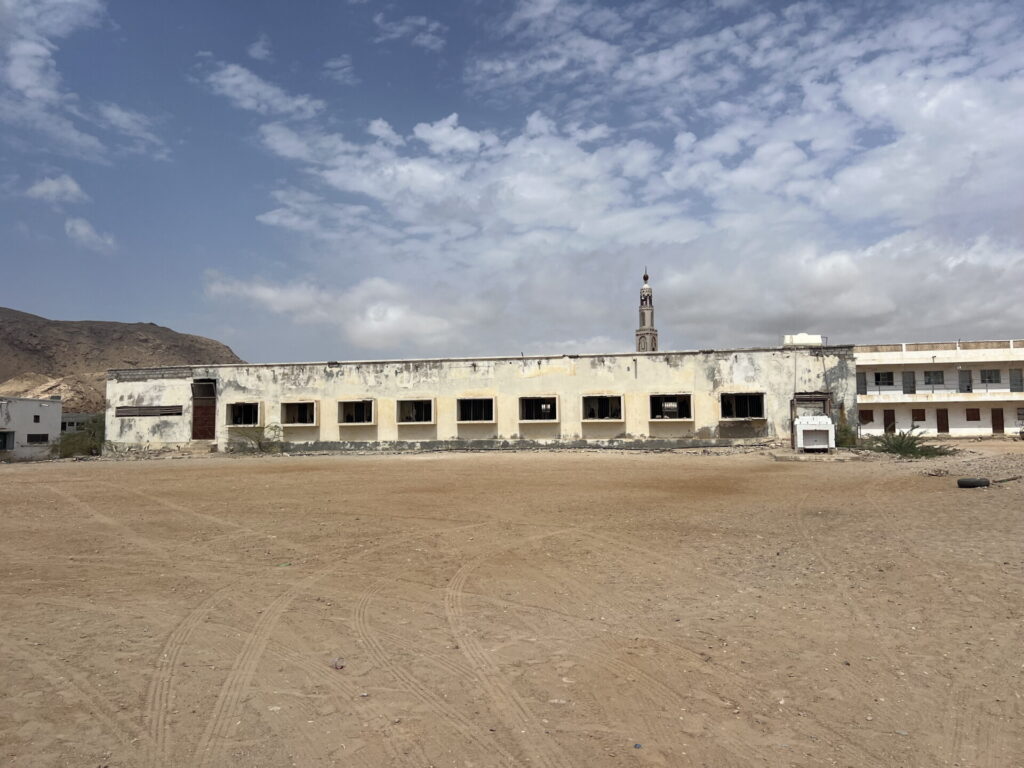
Visiting recently, I was struck by the starkly contrasting scenes at the college. The classrooms were empty, the corridors silent, and the dormitories were gathering dust, with their windows and doors either deteriorating or missing altogether. I was told that similar scenes are unfolding at colleges of education and other teacher training institutions across Yemen, including in Aden, Taiz, Shabwa, al-Mahra and Hadramawt. Many have been forced to phase out departments because enrollment has plummeted, from hundreds of students more than a decade ago to zero in some departments today.
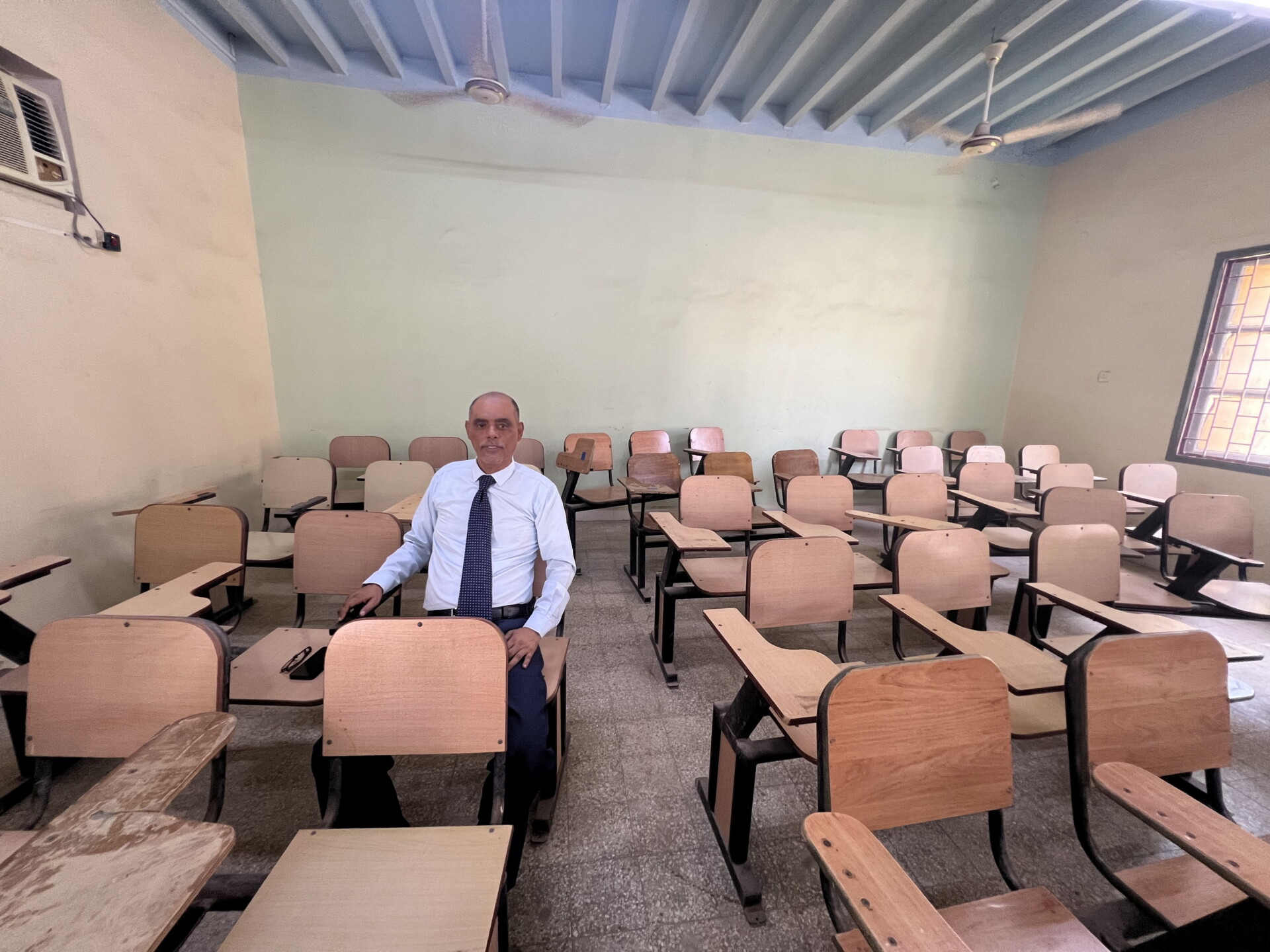
Saeed Salmen Balafair, who studied history in the mid-1990s before rising to become a professor of the same subject and dean of al-Mukalla’s College of Education, sat in a classroom, in the same spot where he had once studied three decades earlier.
Back then, Balafair was one of more than 100 male and female students crammed into the classroom. The neighboring classrooms were equally bustling, with more than 100 students studying geography, another 100 in the English department, and around 30 enrolled in science subjects, mainly mathematics and physics. Due to the large number of students, there was a shortage of chairs, and Balafair and many of his classmates would remain seated during their breaks.
“The moment the professor left the classroom, we would stay in our chairs until the next class because we feared that, if we got up, another student would take our seat,” recounted Balafair, clean-shaven and neatly dressed in a crisp shirt and tie, as he sat in the otherwise empty classroom, with only me and a woman who happened to be cleaning the room. “Students who arrived late would move from one classroom to another looking for a chair because there were simply not enough.”
Most of the college’s departments, including the once-bustling history, geography and Arabic language departments, were shut down years ago. The history department graduated its last batch of around a dozen students several years ago. This means that no new teachers have entered the profession from these departments in recent years, and the outlook is even grimmer: This year, no student enrolled at the college to become a teacher.
“The situation deteriorates further every year. Just imagine: This college, once the cradle and training ground for generations of educators, is now in such a deplorable state. It was established in 1974, and many of the officials, ministers and educators you see today graduated from this college.”
Balafair first sounded the alarm in late 2015, when enrollment at the college dropped from hundreds of students to just a few dozen. The alarming decline prompted him and other professors to organize a workshop to discuss the crisis, during which they found that the prospect of earning salaries in Saudi riyals by joining the army had attracted many secondary school graduates away from teaching.
“We held a workshop to examine the reasons behind the rapid decline in enrollment at the college and found that many young men were joining the military. At the time, recruitment had increased, and soldiers were being paid 1,000 Saudi riyals a month.”
Months before that date in 2015, at the request of Yemen’s internationally recognized government, Saudi Arabia had led a military coalition to halt the advance of the Houthis, who had swept through the capital, Sanaa, and later expanded across the country. The war led to the collapse of the country’s existing military and security services. In an attempt to build allied forces, the coalition established military bases both inside Yemen and in Saudi Arabia, where young Yemenis were recruited and promised hefty salaries that would increase over time.
In Hadramawt province, al Qaeda militants exploited the chaos that followed the outbreak of war and seized control of al-Mukalla, the provincial capital, and surrounding areas, which posed a challenge to the Yemeni government and its backers. To drive them out, the coalition established additional military bases to recruit young men from Hadramawt, trained them for a year and then deployed them to drive the militants out of their stronghold.
The war, which continues to rage today, has left thousands of people dead; displaced millions; devastated essential services such as education, healthcare and electricity; and left millions of young Yemenis unemployed. For many, joining one of the country’s numerous military units has become the only way to earn a living.
Balafair said that when he questioned secondary school graduates about their reluctance to pursue teaching careers, many told him they preferred joining the army, where they could earn a regular salary and start a family rather than spend four years studying for a profession that offered little financial security.
“Amid the economic crisis, students would say, ‘Instead of spending four years at college only to graduate and find no job, I can join the army now, earn a salary, get married by the end of the year and start building a house in the years that follow.’”
As the war in Yemen dragged on over the following years, warring factions recruited more fighters, many of them secondary school graduates, while the Yemeni riyal continued to tumble against the dollar, eroding the value of public sector salaries, including those of teachers. The riyal plunged from 215 to the dollar at the beginning of the war to around 3,000 in the years that followed, before recovering to around 1,500 today; prices of essential commodities, fuel and transportation skyrocketed.
Meanwhile, public sector salaries remained largely unchanged, and teachers faced additional hardship because their salaries were sometimes delayed for months. A teacher’s monthly salary is around 70,000 riyals ($50), with a slight increase depending on experience.
Amid the deepening economic crisis, many departments at the College of Education continued to receive no new students, as more young Yemenis either joined the army, left the country in search of better job opportunities or enrolled in other fields, such as engineering, medicine and information technology. In an attempt to attract students, the college scrapped entrance examinations and lowered admission requirements, but these measures failed to persuade young people to pursue teaching careers.
“They [secondary school graduates] would rather study IT, hoping to travel to Saudi Arabia and find work there. If they could not find anything and conditions improved, they could always turn to teaching. That is why you see IT departments packed with students,” Balafair said.
Teachers, who had to work multiple jobs to make ends meet, with some skipping meals, went on strike for months to pressure the government to improve their salaries, but with no luck. Balafair said that female secondary school graduates, who could not join the army, had watched their relatives working as teachers struggle to secure their salaries and other entitlements, spending months on strike or protesting in the streets. They knew that if they enrolled at the College of Education, they would face the same hardships and earn the same meager salaries.
“As for female students, many had seen their relatives who were already working as teachers struggle to receive their salaries and other entitlements. They therefore chose to enroll in other colleges, such as administrative sciences.”
As teachers’ salaries dwindled, the teaching profession lost its appeal, and teachers lost the high social status they once enjoyed. Many were forced to take on other jobs, working as construction laborers or street vendors to make ends meet.
Three decades ago, Balafair said, the social prestige associated with teaching, the respect teachers commanded in their communities and the honor of being addressed as “ustaz” (“teacher”), alongside a decent salary, attracted young people to colleges of education. “My late father told me to become a teacher. At that time, teachers had social prestige. … The salary was good, and after graduation, you could expect to find a job quickly.”
While teachers’ salaries remained unchanged, workers in other professions, such as construction, farming, carpentry and plumbing, were more able to increase their wages, with some earning the equivalent of a teacher’s monthly salary in just two or three days. Morshed al-Jaro, dean of the Women’s College at Seiyun University in Yemen’s Wadi Hadramawt, another teacher training institution that has closed departments due to low enrollment, said that even workers harvesting onions could earn a teacher’s monthly salary in just a few days.
“A contract teacher’s salary is equivalent to what a construction worker earns in two days, or what an onion harvester makes in three. The only solution is to restore the teacher’s status and salary. If they receive adequate pay and full benefits, there will be a rush to pursue these specializations,” Al-Jaro told me.
The shortage of teachers has taken a toll on the quality of education and the number of functioning schools. As trained teachers have become increasingly scarce, schools across Yemen have turned to thousands of people with no formal teacher training — some secondary school graduates, others job seekers who entered classrooms after failing to find work elsewhere. Some schools in Hadramawt have already closed due to a lack of teachers, while others face the same fate as part-time teachers leave in search of better-paying jobs.
“The impact of this situation on society is disastrous. Just imagine: Some districts have had to close schools because there are no teachers, while part-time teachers leave as soon as they find better jobs elsewhere,” Balafair said.
As the problem continued to worsen and professors found themselves with fewer students to teach, some universities decided to keep departments open regardless of how few students enrolled, while other colleges of education offered financial incentives to attract secondary school graduates. Aden University, in Yemen’s southern port city of Aden, has experienced a similar decline in enrollment at its colleges of education. Instead of closing departments, however, the university has continued to offer classes even when as few as four students enroll, a move intended to keep its professors occupied. Al-Mahra University offered students at its College of Education monthly stipends of several tens of thousands of Yemeni riyals.
In Hadramawt, Balafair said local authorities, his college and local charities had discussed a proposal to offer students a monthly stipend of around $100, provided they signed a contract committing to teach for five years after graduation.
Reversing the decline in enrollment at teacher training colleges will require a concerted effort by local authorities, education experts, and local and international donors, experts say. Otherwise, Yemen may once again be forced to import teachers from Sudan or other countries, reviving a decades-old practice used to address teacher shortages in the country.
“We could end up going back to the old days, when Yemen relied on teachers from abroad, including Sudan, or schools hired anyone available, even people with only a primary school education. If this continues, it could lead to the collapse of the education system.”
Despite taking pride in his career, first as a secondary school teacher and later as a professor at the College of Education, Balafair admitted that if he were starting out today, he would follow in the footsteps of the students who have abandoned teaching in favor of other professions.
“If I were a young man again today, I would rather cultivate my farm in my home village than become a teacher under the current conditions,” Balafair said with a smile as he rose from his seat in the empty classroom and led me through the college, to show me how declining enrollment had transformed the rest of the campus.