

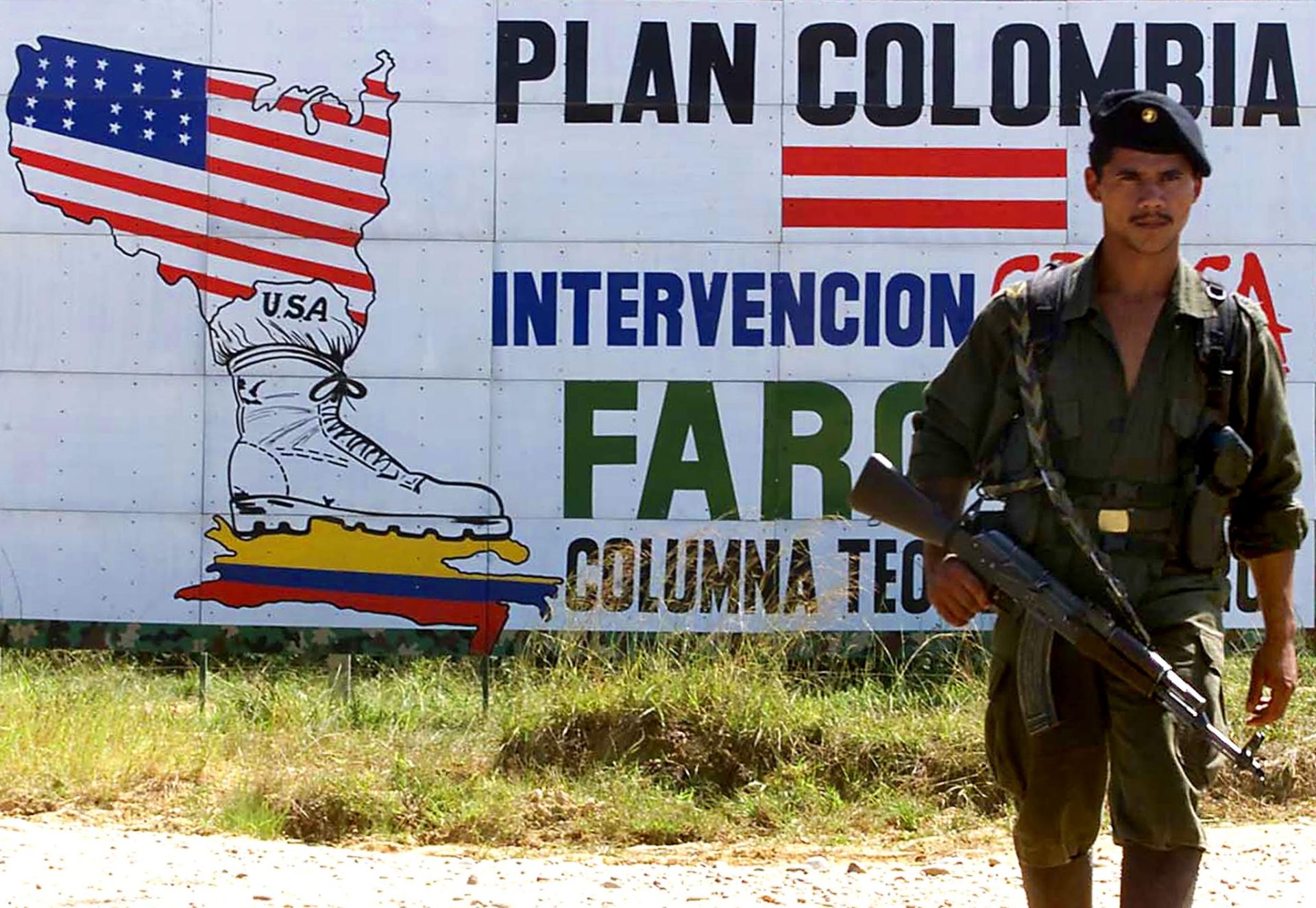
The Cold War had nothing to do with it. The fall of the Berlin Wall in 1989 signaled the waning of the threat of global communism. Western museums and think tanks hauled away blocks of it as triumphal souvenirs. But none of that stopped Colombia when, in 1991, it broke its own laws and a nearly ratified constitution to bring outlawed right-wing paramilitaries into the military chain of command.
They had been banned after they committed attacks on behalf of the drug lord Pablo Escobar. Less than 16 months later, however, the Ministry of National Defense restructured military intelligence “at all levels,” secretly employing the criminal right-wing paramilitaries to target “armed subversion” — the ministry’s term for leftist guerrillas. The move, according to the order, was “based on the recommendation of the commission of U.S. military advisors.”
America’s role in documented war crimes in Colombia decades ago may shed light on how U.S. generals and admirals today must grapple with the dilemma of serving to protect the Constitution or the president. My conversations with lieutenant colonels and other mid-level military officers since Trump’s victory in the November 2024 election reveal what options — like resigning their commission — they believe the Constitution could afford them in the face of an illegal order or other unconstitutional actions by the commander in chief.
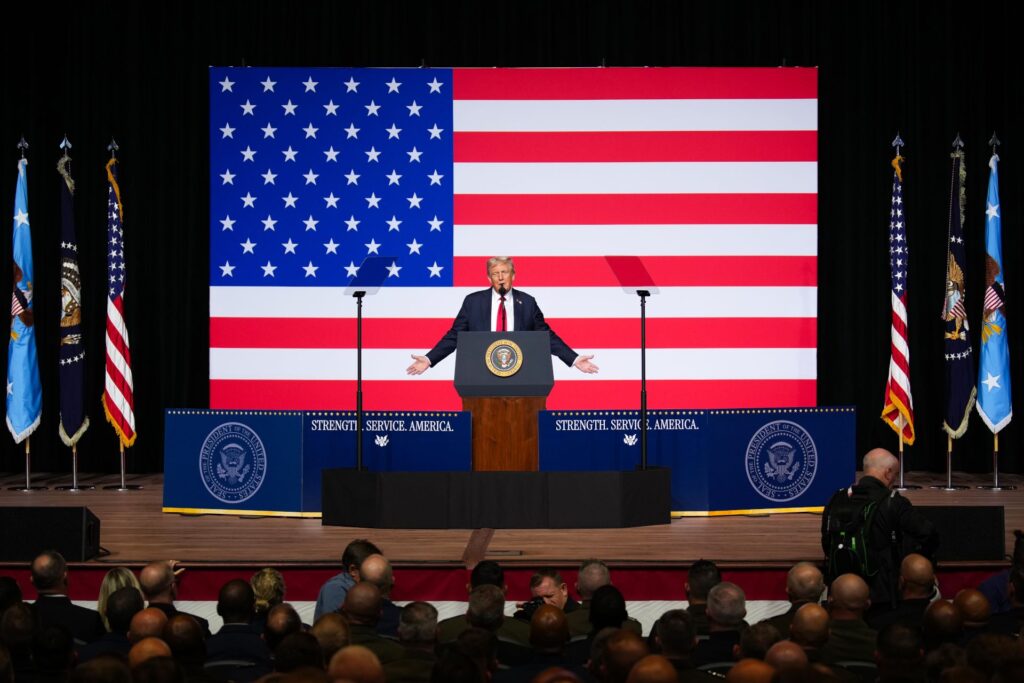
In September, at a gathering of top generals and admirals in Quantico, Virginia, Secretary of Defense Pete Hegseth characterized the U.S. military’s long-standing rules of engagement as “stupid” and “overbearing,” while Trump exhorted the military commanders to focus on “the enemy from within.” Their remarks were unprecedented. They raise the question of whether their rhetoric, combined with recent federal deployments at home, is preparing the public, and perhaps the Supreme Court, for the possibility of war crimes against U.S. citizens.
Could Trump or his senior advisers, like Stephen Miller, employ armed proxies, including right-wing militias such as the Proud Boys and the Patriot Front, or others from among the pardoned Jan. 6 rioters, to target leftist “subversives” at home? In the early 1990s, military commanders and Colombia’s elected government, led by President César Gaviria, did exactly that. With American counternarcotics assistance, which started with the administration of President George H.W. Bush after the end of the Cold War, they used criminal paramilitaries as proxies to give both themselves and their U.S. advisers plausible deniability for their myriad crimes (including massacres of civilians and the murders of human rights activists, trade unionists and journalists).
The United States has long advised other countries on how to assassinate their own citizens suspected of leftist “subversion.” In Vietnam, Green Berets operating under the auspices of the CIA ran the Phoenix Program, an assassination campaign against South Vietnamese citizens suspected of supporting the communist insurgency. In the early 1990s, in Colombia, a U.S. Navy captain, along with CIA and U.S. Army Special Forces advisers, urged the Colombian armed forces to covertly restructure their intelligence networks, which they used to target Colombian citizens, in the name of the war on drugs.
A Colombian navy network in Barrancabermeja, a port city on a deep muddy river that trickles down the Andes mountains, swells through the Magdalena Valley and empties into the Caribbean Sea, targeted Colombian citizens. One of the first was Jorge Gómez Lizarazo, the founding attorney of a regional human rights group. In January 1992, a day after his op-ed, titled “Colombian Blood, U.S. Guns,” appeared in The New York Times, the group’s secretary, Blanca Cecilia Valero, was murdered after work outside the group’s office in Barrancabermeja by men in civilian clothes.
“Three policemen across the street reportedly ignored her cries for help and made no attempt to pursue the assailants who have still not been identified,” Amnesty International reported. That same month, a right-wing paramilitary group in Colombia issued a standing threat to retaliate for every guerrilla action with a murder. A local journalist and editor, Ismael Jaimes, investigated a pattern of murders, for which he himself was targeted. “After following him for several months,” one ex-agent testified, the network “established that he went every morning to drop off his son at school, where he was killed.”
In 1990, Bush, who served as CIA director in the mid-70s, relabeled all U.S. counterinsurgency military aid to Colombia as counternarcotics assistance. Later named “Plan Colombia,” this U.S. effort was a bipartisan initiative. While many in Congress accused the country’s leftist guerrillas of being drug traffickers, they have always been involved at lower levels of the drug trade than the right-wing paramilitaries, which were founded by drug lords. In Bogota, the U.S. Military Advisory Group (known as Milgroup) under Bill Clinton came to occupy its own section within the Colombian Armed Forces high command. Dozens of offices lodged U.S. advisers, technologists, administrative support and the U.S. Milgroup commander. The office of the Colombian army commander was down the hall.
Colombia was in turmoil, and the United States was there to help. By then, Escobar, head of the Medellin drug cartel, had murdered a presidential candidate who had promised to extradite him, a newspaper editor who had exposed him, and thousands more civilians, police and soldiers. In November 1989, Escobar’s paramilitaries blew up a commercial airliner over Colombia, killing all 107 people on board, to intimidate the government into forgoing his extradition.
After four more years on the run, Escobar was shot dead in a Colombian National Police operation in Medellin, his hometown, a scene memorably depicted in the Netflix series “Narcos.” A senior Drug Enforcement Administration (DEA) special agent hung a photo in his office of himself on a rooftop posing by Escobar’s corpse. A CIA team of young technologists later provided new equipment to find the Rodríguez Orejuela brothers, who ran the rival Cali cartel, while they were hiding from Colombian police in secret compartments inside homes in Cali.
Over a decade before, Escobar and other drug lords formed Death to Kidnappers (known by its Spanish acronym MAS, for Muerte a Secuestradores) as an early right-wing paramilitary group. They hunted guerrillas and their sympathizers after the guerrillas kidnapped some of their relatives. The government tolerated MAS, and soon more right-wing paramilitaries, because their methods worked. But Escobar’s actions finally crossed a line. After two judges and 10 civilian investigators were massacred by right-wing paramilitaries in La Rochela in the Magdalena Valley in January 1989, Colombia’s legislators and president outlawed all right-wing paramilitaries, putting them — at least on paper — in the same category as leftist guerrillas.
The Colombian military, however, still wanted to keep using the right-wing paramilitaries in their ongoing operations against those guerrillas. A team of “approximately 14 personnel led by a U.S. Navy Captain” advised the Colombian military on the intelligence reorganization, according to a 1996 letter from Acting Assistant Secretary of Defense Frederick Smith to Sen. Patrick Leahy of Vermont. In April 1991, the Colombian armed forces restructured their military intelligence to create 41 new intelligence networks under the high command’s direct control, according to a copy of the classified Colombian military intelligence reorganization order obtained by the team I led at Human Rights Watch, which produced the 1996 report “Colombia’s Killer Networks: The Military-Paramilitary Partnership and the United States.”
Stamped “reservado” (classified), the order made no mention of fighting drugs in any of its 16 pages, as U.S. military aid to Colombia by then was categorized by law. Three months later, Colombia’s government ratified a new constitution with stronger language about human rights that also kept the ban on right-wing paramilitaries intact. No one knew, however, that the elected government and military high command, following the recommendations of the U.S. team of advisers, was already restructuring “covert and compartmentalized” intelligence networks to circumvent the drafted constitution, before it was ratified, to keep collaborating with criminal paramilitaries.
Saulo Segura was a former Colombian navy sergeant who owned a small clothing store in Barrancabermeja. A Colombian navy captain, whose code name was the “Engineer,” recruited him to be an undercover agent for the Colombian navy intelligence network No. 7. Segura ran navy funds through his store to provide cover for the intelligence network by renting office space, buying furniture and cashing checks. Segura reported to another active-duty, this time noncommissioned, navy officer. Together, these two active-duty navy officers managed dozens of covert agents who were either ranking paramilitaries or former soldiers. They included three control agents and at least seven intelligence agents in a network that oversaw dozens of informants and paramilitary “sicarios,” or assassins.
The “Engineer” reported directly to the chief of Colombian navy intelligence, a Marine lieutenant colonel, Rodrigo Quiñones Cárdenas, who identified the targets, according to the surviving testimony of four ex-agents. The “Engineer” ordered the agents to follow the targets to learn their patterns and find opportunities to strike. The early victims included the president, vice president and treasurer of the local transportation workers union, two leaders of the local oil workers union, the leader of a local farmers union and another human rights monitor.
The intelligence network followed the advice of U.S. advisers as cited in the military intelligence reorganization order. Colombian navy officers down the chain of command, including covert agents, all avoided written orders. The goal, testified Segura, was to “have no formal or legal tie to the Defense Ministry.”
But at least one navy intelligence agent, Felipe Gómez, signed a contract with the Defense Ministry. A reserve officer acting as a covert agent, Gómez later testified that he organized and equipped right-wing paramilitaries in six towns as ordered by the high command through the Magdalena Valley. The navy provided Gómez with bolt-action rifles, M16 rifles, Galil rifles, revolvers, pistols, submachine guns, grenades and two-way radios for the right-wing paramilitaries to communicate with the navy or army. The right-wing paramilitaries demanded that family farmers stop paying “war taxes” to the nation’s leftist guerrillas and instead pay the same to them.
In Barrancabermeja, the navy intelligence network’s cover began to erode. A regular army unit, by chance, captured a team of four navy network assassins after they committed an authorized murder, and turned them over to military intelligence, according to a document signed by the regular Army unit’s commanders. The four men then mysteriously disappeared. Several other intelligence agents were murdered. Segura was shot and wounded twice. The attack led him to join three more agents in testifying against their superiors about the murders of trade unionists, community leaders, human rights defenders and journalists.
The Colombian government, instead of offering Segura witness protection, jailed him over his own testimony. “I hope they don’t kill me,” he told me during an interview in 1995, as he glanced around nervously inside La Modelo, Colombia’s maximum-security prison. Three months later, on Christmas Eve, Segura was killed in prison with a handgun dropped next to his body as he bled out. By then, the three other ex-agents who had testified had disappeared. Senior military officers, including Quiñones, the navy intelligence chief, were “severely reprimanded” for their network murders but were never criminally charged.
The ex-agents’ testimony corroborates details about the murders of 57 Colombian citizens, from farmers to journalists, by this network alone, which was one out of 41. The Colombian government’s own human rights figures showed that right-wing paramilitaries were responsible for the majority of murders and other abuses across the country, more than the leftist guerrillas and the Colombian military combined. In 1999, a right-wing paramilitary warlord murdered the nation’s most popular comedian, Jaime Garzón, who was also a journalist and hostage negotiator. In 2001, the prosecutor in that and other cases fled the country with his family, as did his boss.
While the intelligence networks carried out assassinations, other regular military units carried out massacres of villagers also suspected of supporting the leftist guerrillas. In 1994, Amnesty International documented abuses by 14 different Colombian military units. The U.S. Southern Command (SouthCom), based in Panama, conducted an “official use only” audit and found that 13 out of 14 of the units cited for abuses had received prior U.S. military training or aid. I obtained the SouthCom document and later shared it with Amnesty International. Leahy cited it on the floor of the Senate during deliberations over what became known as the “Leahy Law,” which passed in 1997.
The Leahy Law narrowed the focus of human rights conditioning down to specific units. If a particular military unit was credibly found to have committed abuses, it would no longer be eligible for U.S. training or aid. This could limit the career of a foreign military officer. Even the threat of not being eligible for U.S. training is a big deal for their prospects.
For 28 years, the Leahy Law stood as America’s most consequential human rights act — even though Israeli military units were exempted from it, especially during the war in Gaza. The Trump administration, however, has restructured the State Department to cut the Office of Security and Human Rights that had vetted the military units for evidence of abuses worldwide. Through an executive action, without congressional or judicial approval, the cuts have gutted the Leahy Law and its enforcement.
Colombia was a nation where armed combat involving either military or paramilitary forces against leftist guerrillas such as the Revolutionary Armed Forces of Colombia (FARC) or the National Liberation Army (ELN) was rare, while murders of civilians in towns like Aguachica in the northern Magdalena Valley were common. A classified Colombian army printout that I obtained, by Panther Task Force No. 27 in July 1995, named dozens of alleged “subversives,” like a pair of brothers who “led a meeting of small farmers where they espoused their political objectives and how they plan to achieve them.”
Within months, the brothers were tortured and decapitated by armed men, some wearing army Panther insignias, who walked to another village, said witnesses, to kill a police inspector who had been investigating murders. Dehumanizing the opposition and labeling them as subversives is the kind of step that has led to violence elsewhere, sometimes spiraling out of control.
The United States and other Western nations have always regarded themselves as set apart by their adherence to the rule of law. But ours is no doubt weakened by Trump’s firing of inspector generals while ordering remaining U.S. officials to serve his will. The disdain Hegseth expresses for the military’s rules of engagement is an attitude that has led to war crimes in other countries. Trump’s denigration and demonization of political opponents, journalists, activists and entertainers echoes the kind of rhetoric that often precipitates state violence around the world. Consider his recent AI-generated video in which he gleefully drops excrement from a fighter jet on No Kings protesters.
What would it take for the U.S. military to act against Trump today in the name of the Constitution? Trump is taking no chances. In March, new Air Force and Navy memos warned troops to “watch their political speech online and in person,” and mentioned potential criminal charges for “certain criticisms of the president or their superior officers,” Military.com reported. There has been little pushback. “Service members, owing to their critical role in our national security and the duties and obligations of service, have accepted limits on their freedom of expression,” wrote Acting Air Force Secretary Gary Ashworth.
This is a question I have asked different mid-level military officers from different branches of service in various settings both before and after Trump won the 2024 election. A consensus emerged that I was not expecting. The oath that every military officer takes to uphold the Constitution is not as clear as many may think; every military officer I have spoken with has told me that the military doesn’t have the authority under the Constitution to act on its own. (Perhaps this explains why many military personnel have been hiring their own lawyers since Trump gave the order to deploy the National Guard to major U.S. cities.)
“We might not follow an unlawful order,” one Army lieutenant colonel recently told me. “But we would not intervene to depose him.” Why not, I asked? “We don’t believe we have the authority to do so without approval from Congress,” he said. Dozens of U.S. military officers have told me in recent years that they, too, might resign — as Navy Adm. Alvin Holsey, the head of SouthCom, announced he will do at the end of this year — to avoid carrying out an unlawful order. But the military can’t act on its own to depose a president without being authorized by Congress.
The stoic faces of most of the generals and admirals at Quantico seem to reflect the same dilemma. Trump’s targeting of alleged drug boats off the coast of Venezuela and Colombia, killing people on board without due process, seems like a test. (Trump recently cut aid to Colombia after its current president, Gustavo Petro, accused the United States of having killed a Colombian fisher in one of those attacks.) Another test is Trump’s deployment of agents and troops under federal command in cities like Washington, Chicago and now Portland.
These measures put us “one trigger pull away” from a catastrophe, Maj. Gen. William L. Enyart, who directs the daily operations of the Illinois National Guard and coordinates closely with the National Guard Bureau and the Departments of the Army and Air Force, told the U.S. Senate Judiciary Committee on Oct. 7.
“It took a generation for the Guard to recover from the stain of guardsmen shooting and killing college students at Kent State,” Enyart said, referring to the 1970 calamity in which members of the Ohio National Guard fired into a crowd of demonstrators against the Vietnam War at Kent State University, killing four and wounding nine students.
“Don’t let it happen,” Enyart admonished. “National Guard forces are for a real emergency, not a Band-Aid for long-standing problems that need a long-term solution.”
Our military high command and other military, guard and law enforcement officers may soon face the choice of whether they will remain loyal to the president or to the Constitution. To avoid unspeakable violence, most, if not the overwhelming majority, must uphold the rule of law.
Become a member today to receive access to all our paywalled essays and the best of New Lines delivered to your inbox through our newsletters.