


On Oct. 30, 2024, in the run-up to the presidential election pitting Kamala Harris against Donald Trump, Bill Clinton addressed voters in Michigan, a state with a significant Arab-American population. Democrat strategists were worried that Arab-Americans, along with many students and progressives, would punish their party at the polls for its participation in Israel’s genocide in Gaza. That’s presumably why they brought out Clinton — a former president with star quality — to boost their chances. But Clinton was so lost in his own story that he surely made things worse. His words also revealed the extent to which even elite Americans understand the Middle East through a mythical rather than historical framework.
“I understand why young Palestinians and Arab Americans here in Michigan think too many people have died. I get that,” Clinton started, before exonerating the genocidaires of blame. Hamas, he explained, “force you to kill civilians if you want to defend yourself.” Then his discourse degenerated further. “I got news for them,” he said, meaning Hamas. “They [the Israelis] were there first, before their faith existed.”
Clinton seems to have meant that the Israelis were “there first” because Judaism is an older religion than Islam, but Judaism is not the Israelis and Islam is not the Palestinians. This strange category error emerges from the same myth complex that renders many Americans unable to distinguish between the Land of Israel imagined in Sunday school and the State of Israel established by conquest and mass ethnic cleansing a few years after World War II. Likewise, they fail to distinguish the ancient Israelites from the contemporary Jewish peoples.
The former president would have been better informed had he read some books on the topic other than the Old Testament — books like Nur Masalha’s meticulous and lavishly referenced “The Ancient Cities and Global Trade of Palestine: A 7,000-Year History.” This is the latest in a string of books Masalha has written examining the country’s ancient past, adding a wealth of detail to show the truly multiethnic past of the countries we now call Israel and Palestine.
It’s interesting that Clinton, in American terms a secular liberal, arrives at similar conclusions to America’s Christian Zionists, who read Genesis 12:3 — “And I will bless them that bless thee, and curse him that curseth thee” — as an exhortation to support the Israeli state. The confusion of the ancient and the contemporary when considering the Middle East is a very common confusion throughout the Western world, not just the U.S., and one that has been carefully exploited to ease the dispossession of the indigenous people of what is now Israel and the occupied Palestinian territories.
The usual story goes that Palestine was inhabited mainly by Jews until they were expelled en masse by the Romans. But the Romans are not as convenient an enemy for contemporary Western audiences as the Muslim Arabs, so some are shifting focus — Benjamin Netanyahu, for instance.
“For roughly 2,000 years,” Netanyahu said, unchallenged, on Jordan Peterson’s podcast, “we were conquered by the Romans, we were conquered by the Byzantines. They did a lot of bad things to us, but they didn’t really exile us, contrary to what people think. The loss of our land actually occurred when the Arab conquest took place in the seventh century. The Arabs burst out from Arabia, and they did something that no other conqueror — not the Romans, not the Byzantines, not the Greeks before them, not Alexander the Great, nobody — did before. They actually started taking over the land of the Jewish farmer.”
No doubt Netanyahu knows that this is revisionist history designed to serve very contemporary political purposes. But if he actually believes what he says, he would be well-advised to read the Israeli writer Shlomo Sand’s 2008 book “The Invention of the Jewish People.” In that work, like others before him, Sand dispatches the myth of the Roman mass expulsion (so he agrees to that extent with Netanyahu); premodern states had neither the capacity nor the desire to perpetrate mass expulsions. Instead, the Romans destroyed the Jewish political class when they destroyed the temple. But even before that, Sand shows, there was never a Jewish monoculture in Palestine. The Torah was written in the fifth and sixth centuries BCE by an urban elite that claimed mythical ancestry elsewhere (Mesopotamia, via the patriarch Abraham, and Egypt, via Moses). The majority of the population during the Jewish period were pagans, more likely to worship Baal or Astarte than Jahweh.
Judaism was a proselytizing creed, at least until the adoption of Christianity as the Roman state religion (and later than that in Yemen). According to Sand, there were already more Jews outside Palestine than inside when the temple was destroyed. Many converts were won in ancient Rome. The notion that the Jews were a single “race” separate from others, initially seen in the late Middle Ages, gained ground in 19th-century Europe in concert with the rise of racial theory, the various post-Napoleonic nationalisms and modern forms of antisemitism.
Elements of Sand’s argument have been disputed, but its core makes perfect sense. The Jews are as plural and diverse as anyone else. The idea that Jews originating in Yemen, Ethiopia, Iraq and Poland form one unified people clearly distinguished from others is a construction. The Jews are as “invented” as all peoples are, including the Syrians, the British and African Americans. Nations, as Benedict Anderson formulated it, are always “imagined communities.” This doesn’t mean they are not “real”; if people experience themselves as a nation, then they are a nation. (Even more pertinently, Sand quotes Karl Deutsch: “A nation … is a group of persons united by a common error about their ancestry and a common dislike of their neighbours.”) But it does point to the absurdity of pretending that a contemporary nation was “there first” thousands of years ago, and of expelling or annihilating the natives on that basis.
The “there first” justification for ethnic cleansing is particularly absurd — and ironic — in Palestine. Sand argues that the closest descendants of the ancient inhabitants of Judea are actually the Palestinians, most of whom gradually converted first to Christianity, and then to Islam. Sand’s book was a controversial bestseller in Israel, but it wasn’t the first to posit that the Palestinians had descended from Jewish farmers. “Eretz Israel in the Past and Present,” a 1918 book written by Itzhak Ben-Zvi and Israel’s first prime minister, David Ben Gurion, did just that. But the idea was soon forgotten as Palestinian resistance to Zionist settlement intensified. The Palestinians were increasingly cast as nomads unattached to any specific bit of land. Their generic “Arabness” was emphasized; the minority who escaped expulsion from the new Jewish state were labeled “Arab Israelis” as if they were recent immigrants from Kuwait — or less recent invaders from Mecca.
Now to Nur Masalha’s “The Ancient Cities and Global Trade of Palestine: A 7,000-Year History,” which provides a detailed corrective to such ideological rewriting. Masalha gathers a great deal of evidence to show that Palestine and Palestinians have a very long and very complex history, starting when an agricultural economy developed there 12,000 years ago.
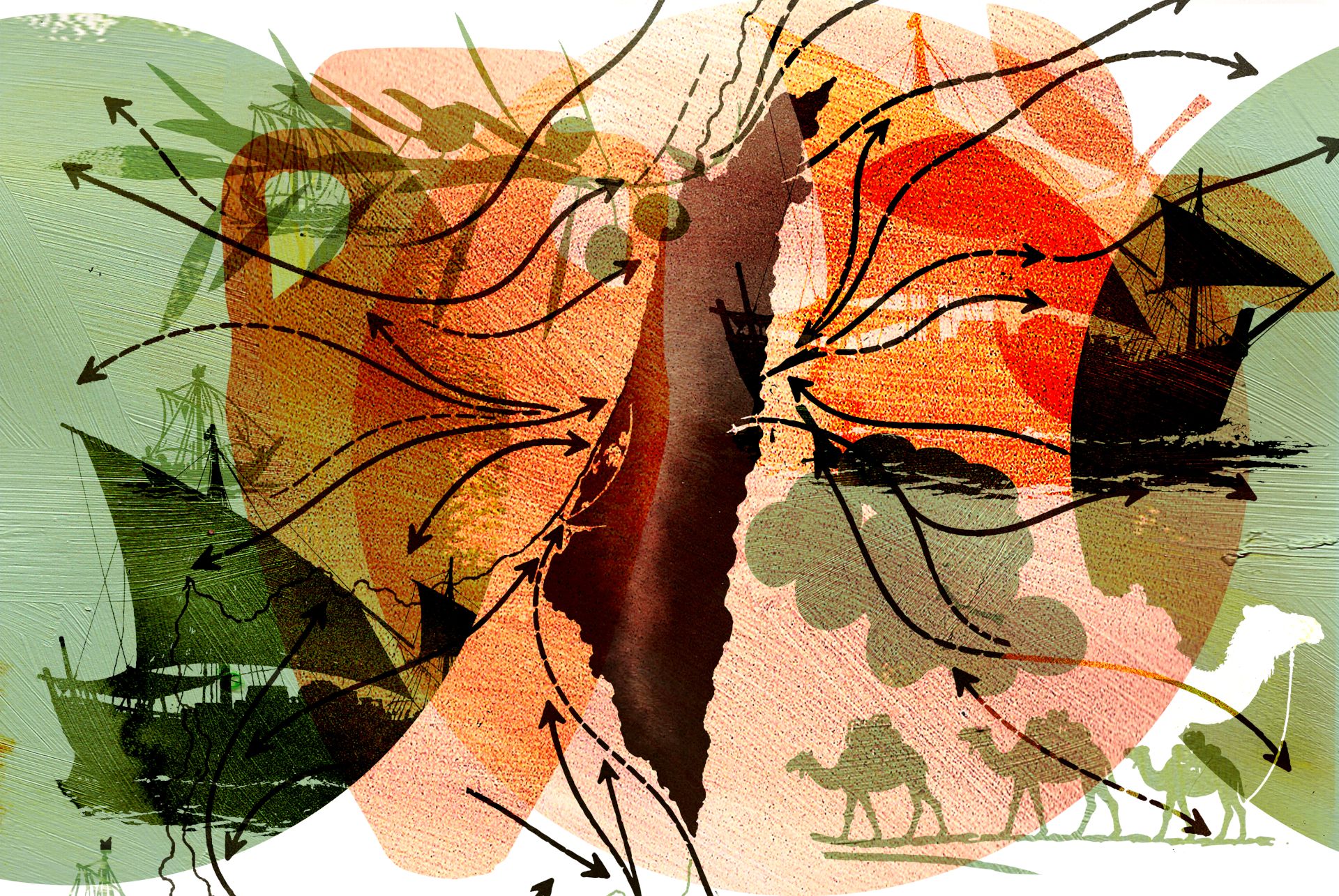
A rich history is what one would expect of a fertile location at the heart of the ancient world’s trade routes. Palestine was no emptier, and no more monocultural, than its neighbors in Syria, Mesopotamia and Egypt. It had been a transit land since the Neolithic period, when Palestinian trading stations bought and sold obsidian (volcanic glass) mined in Anatolia. Starting 7,000 years ago, at the dawn of the Chalcolithic (Copper) Age, the country became studded with market towns and city-states fed by international trade. Copper was mined in the Naqab — today the desert covering southern Israel — and transported either north to Anatolia or south to Egypt. The first recorded use of the name Palestine (or “Peleset”) is found in Egyptian sources of the late Bronze Age. A great deal of Palestinian pottery from that period has been found in Egypt, no doubt containers for exported Palestinian oil and wine. For a century in the Middle Bronze Age, Egypt was ruled by the Hyksos, Palestinian merchants who settled in the country. (Given that Egyptian rulers did not usually elevate foreigners to high positions, the biblical story of Joseph interpreting the Pharaoh’s dreams and serving as his minister makes most sense if the Pharaoh in question was a non-Egyptian Hyksos king.)
Palestine was also at one end of the spice and perfume route that led from Yemen to Gaza. Frankincense from southern Arabia and the Horn of Africa was transported via Palestinian ports throughout the Mediterranean, as were spices that arrived in Arabian ports from India. The Arabic-speaking Nabataeans — whose capital was Petra, the “rose-red city half as old as time” now in southern Jordan — controlled the caravans, and developed their own perfume factories in the “spice cities” of southern Palestine, where dams, cisterns and irrigation systems supported a large urban population. The Nabataean kingdom in the south met a fierce rival in, and fought a trade war with, the Jewish Hasmonean kingdom of Judaea in the north, a polity which lasted from 140 to 37 BCE.
Rather than “bursting out from Arabia in the seventh century” a la Netanyahu, therefore, Arabic-speakers had always been an important element of a multilingual Palestinian society as a result of trade with the Arabian Peninsula. In classical antiquity, Aramaic — a Semitic language like Arabic and Hebrew — was the most widely spoken language in the region. Greek was often used in the Hellenized cities too.
Palestinian religion was similarly plural. Influenced by all points on the east-west and north-south trade routes, Palestine very successfully generated its own spiritual traditions, which were entwined with the millennia of horticultural and agricultural production in the country. Wine was sanctified first by the Dionysian religion that was practiced for centuries, and then by Christianity. Gaza’s wine was famous in the classical world, and exported around the Mediterranean. Bread was sanctified by both Christianity and Islam; Islam also sanctified the olive. Christianity made Palestine an international center of pilgrimage and monasticism.
Under the Romans and Byzantines, Palestine was a distinct political as well as geographical and cultural entity, its southern and eastern frontiers marked by the Limes Palestinae, a string of forts, watchtowers and water cisterns. At that point and earlier, Ascalon was one of the Mediterranean’s most important commercial and banking centers. Its ruins today lie within the Israeli city of Ashkelon, just north of the Gaza Strip. Continuously inhabited for at least the last 4,000 years, Gaza was also a city of immense importance; it is particularly painful to read about this today. As well as an economic engine, the city was an intellectual and cultural center that boasted an elaborate water clock and its own school of rhetoric. (The historian William Dalrymple has recently made a series of episodes about ancient Gaza on his “Empire” podcast.)
Masalha’s narrative continues through the ages and the various phases of Palestinian urbanization and industry, covering cotton, soap and Jaffa oranges among others, bringing us nearly up to the terrible present, when Palestine’s rich religious history, combined with Europe’s racial persecutions, has made the country and its population a target for erasure.
In the 20th and 21st centuries, the labeling of Palestine as “the Holy Land” by foreigners became a curse. Before 1945, thousands of English-language books on archaeology used the word “Palestine” in their titles. After 1945, most replaced that word with “Israel.” Even as many in the West moved away from literalist understandings of religion, when it came to Palestine, biblical stories were still read as history rather than myth. “Western collective memory,” Masalha writes, “often associates Palestine not with highly developed ancient cities with global trade connections but with arcadia: a country of shepherds and sheep, of mountainous topography and a sparse population of pastoralists.” It’s a small step from the vision of a sparsely populated arcadia to the inaccurate formulation, “a land without a people for a people without a land.”
Once the dominant framework of Western excavation in the region, “biblical archaeology” set out with a set of assumptions forged from biblical narratives to discover elusive proofs of scripture. Masalha describes this ideological form of archaeology as “a retrospective settler-colonial project to silence the ancient history of Palestine.” Sand previously called it “an enlisted instrument of the nationalist ideology.” Nevertheless, archaeology has undermined the biblical narrative. There is no archaeological record, for instance, of the God-directed conquest of Canaan described in the Book of Joshua.
Reality is always more complicated than the myths we make to understand it. Mythologizing Palestine as an exclusively Jewish homeland is something like declaring the British Isles the exclusive homeland of the Jutes while ignoring the Angles, Saxons, Celts, Vikings and others (including now Jamaicans and Indians) that entered the melting pot.
When myths are exploited for political purposes, to accompany violent “facts on the ground,” the results are generally disastrous. The imperative to find both a backstory and a redemption narrative for Europe’s Jews, and the concurrent downgrading of the value of Palestinian life, has resulted in the attempted erasure of seven millennia of actual history, the effacement of an ancient people and a century of war.
Since the attacks of Oct. 7, 2023, and the start of the Gaza war, Israel has (in Masalha’s words) “systematically destroyed hundreds of Palestinian archaeological sites and heritage centres across the Gaza region.” These sites include the almost 1,400-year-old Omari Mosque, the 800-year-old Pasha Palace, and the 700-year-old Hamam al-Sammara, as well as unknown numbers of still unexcavated remains that have been obliterated before we can understand them. Similar vandalism has been perpetrated in the West Bank and southern Lebanon. This is an intensification of the process begun in 1947 with the destruction of hundreds of Palestinian villages — a physical erasure to match the ideological obliteration of ancient and contemporary Palestine.
Of course, the Palestinians are an “invented” people too, like everyone else. Had things happened differently, they might have considered themselves Greater Syrians, or citizens of a much larger Arab or Muslim state. But however they defined themselves, they would still have been the indigenous people of Palestine. With millennia behind them, and with a vast Arab and Muslim hinterland supporting them (however dysfunctional it currently is), they aren’t going to simply disappear, even if current Israeli leaders achieve their most extreme expulsion aims.
To emphasize their connection with the ancient past, Palestinian Christians sometimes describe themselves as “living stones.” But the descriptor could be applied to all Palestinians. They carry traces in their blood and in their culture of all the civilizations that have thrived in Palestine — including the Jews. A better, less ideological understanding of this reality by the current supporters and sponsors of Israel could contribute to building a different dispensation in Israel-Palestine that would more accurately reflect its society over the millennia — multiethnic, multilingual and multicultural, and much more peaceful too.
Become a member today to receive access to all our paywalled essays and the best of New Lines delivered to your inbox through our newsletters.