


Zaualkhan Ermakhanov grew up in the village of Ak-basy in western Kazakhstan, on the northern shore of what was once the Aral Sea. He learned to catch fish when he was very young. “The fish fed us, and we had to feed ourselves,” he recalled years later. But by the time he left his village to begin his university studies in 1967, the Aral Sea was beginning to shrink. The water was receding from the shoreline and, as it left, the people did, too. “Everyone abandoned their well-off places and moved to another area,” Ermakhanov said. “The village was completely destroyed.”
Now Ermakhanov is 75, and as a researcher and advocate for fishing communities, he has spent decades trying to revive the sea, which shrank to 10% of its former size between 1960 and 2009. As it vanished, it left behind the world’s newest desert, the Aralkum, filled with sand laden with salt and pesticides that rose up into furious dust storms, even reaching major cities like Uzbekistan’s capital of Tashkent. People in the region suffered from the loss of jobs and food sources, but were also choking; respiratory diseases and cancers shot up in number.
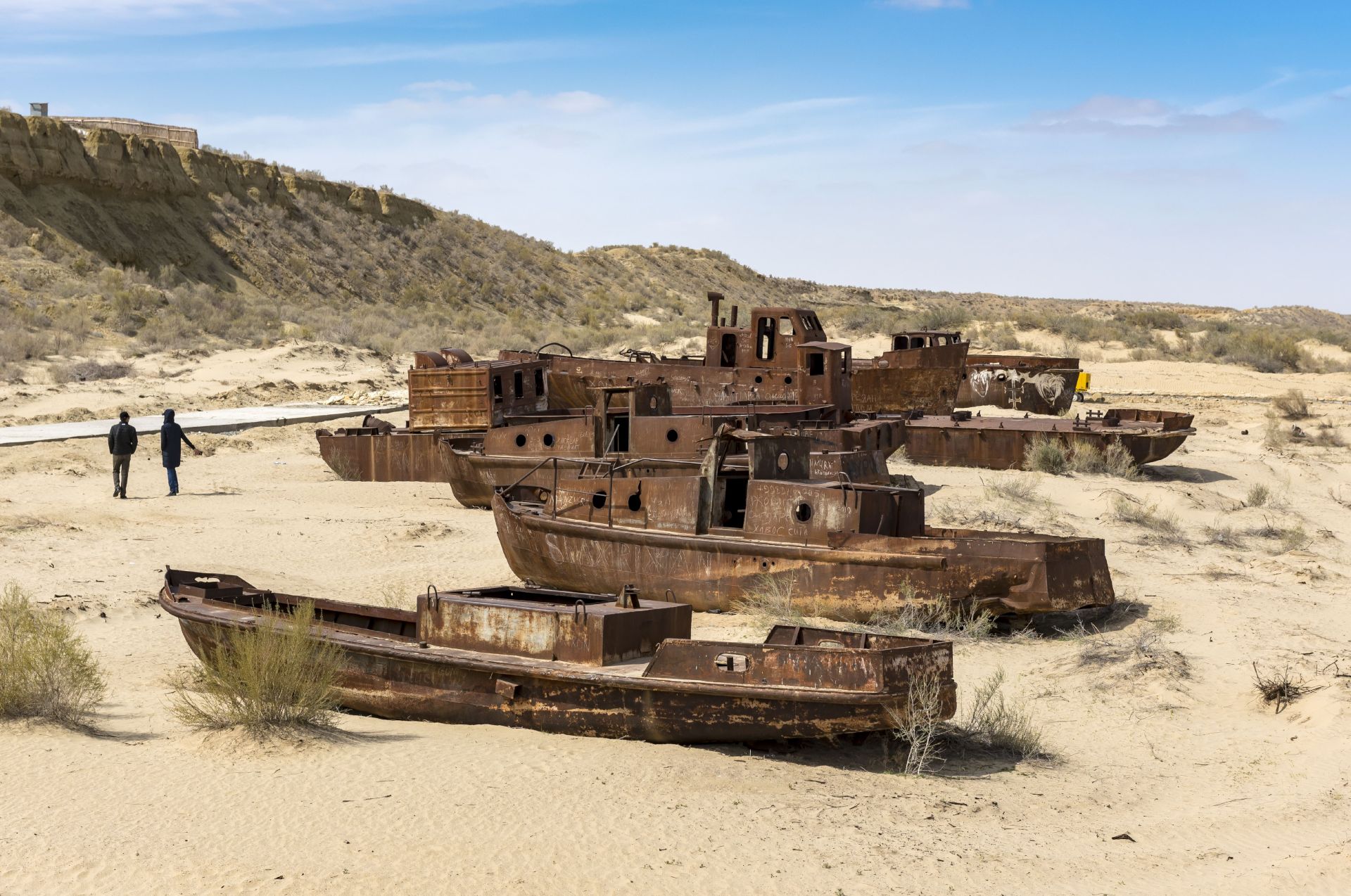
Over time, the Aral Sea has come to be viewed in apocalyptic terms: as a tragedy, a site of mass death, even a vision of hell. Images of rusted ships nestled among sand dunes in the former port of Muynak in Uzbekistan, like beached whales stranded by the receding waters, have made the lake famous and attracted a wave of so-called “dark tourism.” After visiting Muynak in 2011, then-United Nations Secretary-General Ban Ki-moon called it “one of the worst … environmental disasters of the world.”
In June, I set out to understand the reality of these depictions by traveling to Aralsk, a former port town of about 36,000 people on the sea’s northern shore. The settlement is remote even by Central Asian standards; getting there from Astana, Kazakhstan’s futuristic and eerily empty capital, takes two days by train. The town’s wide streets are adorned with murals depicting a bygone era: azure waves, seagulls, boats perched above curious fish. Lonely cranes hover over a bay that hasn’t seen water in over 40 years, waiting to unload cargo from ships that will never come.
The tragedy of the vanished sea is real. But catastrophic frameworks have tended to obscure the living and ever-changing nature of the lake and its surrounding environment. Far from belonging to the distant past, the Aral Sea is the site of countless choices in our present: what kinds of economies we prioritize, what forms of nature we value and what we want our future to look like.
Similar kinds of shrinkage and destruction are taking place in the Salton Sea and Great Salt Lake in the U.S.; Lake Chad in the Sahel region of Africa; Lake Urmia in Iran; and the Dead Sea, at the juncture of Jordan, Israel and the Israeli-occupied West Bank. The people working to restore it now — and there are many — think there’s a lesson to be learned: that humanity needs to look to the Aral’s past to avoid making similar mistakes in the present and future.
For Ermakhanov, thinking of the Aral as a relic of a calamitous past is not an option. “Our life is here, our ancestors’ graves are here,” he told me. “So we have to save the Aral.”
The legend goes like this: When God sent the Great Water to cleanse the earth, a holy man called Nuh (Noah) built an ark. When the water receded, the ark ran aground in the land of Turan, a vast region of steppe between the mountains and the sea, in what is today Central Asia. The ark was left where it lay, to shield the local people from the fierce northern winds, and it towered like an island over the surrounding plains. And so the people, known as Karakalpaks, began to call it Aral, meaning island in their Turkic language. As the centuries passed, God created a broad sea around the ark, filled with fish and other living creatures.
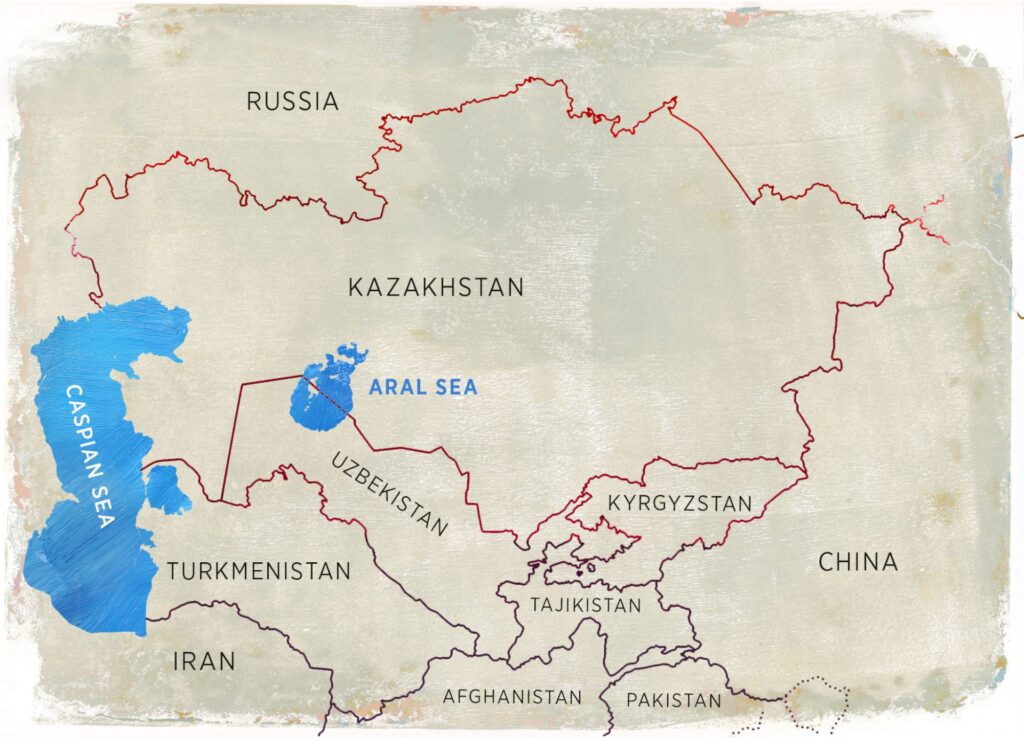
The Aral Sea was once the world’s fourth-largest lake, spanning 26,000 square miles, about the size of Ireland, between what is now Uzbekistan and Kazakhstan. It was an endorheic, or terminal, lake, fed by rivers from Central Asia’s Tian Shan and Pamir mountains, but with no natural outlets aside from evaporation. As a result, its water was brackish, but the fish in it thrived. So did the people — not just Karakalpaks to the south, but Kazakhs to the north. “In the hungriest and leanest years,” the Karakalpak writer Tolepbergen Qayibergenov recounted in 1988, “people could find food in it.”
Between the 1860s and 1880s, the Russian Empire conquered most of the Aral Sea basin: what is now Uzbekistan, Kyrgyzstan, Tajikistan, Turkmenistan and southern Kazakhstan. The land was folded into the Soviet Union, and throughout all of these changes, the people living around the Aral Sea fished.
Their livelihood collided with what the historian Maya Peterson has termed the “irrigation age” — when a new professional class of engineers around the world set out to learn, she wrote, “about the challenges of making the deserts bloom.” In her 2019 book “Pipe Dreams: Water and Empire in Central Asia’s Aral Sea Basin,” she describes how, in the 19th century, arid lands were deemed barren and seen as needing to be tamed and made productive, a vision that harkened back to mythical tales of a verdant garden of Eden. Russian engineers looked for traces of ancient Silk Road civilizations in the deserts of Central Asia to justify their takeover, believing that the people already living there had been poor stewards of the land.
Learning from similar projects taking place in the Western U.S., the Russians determined that the best use for Central Asia’s water resources was to divert them to grow cash crops, such as cotton. As demand for the material boomed after World War II, the Soviet government turned to irrigation projects of an increasingly massive scale. Chief among these was the Karakum Canal, one of the largest water-supply canals in the world. Once completed in 1988, it carried water from the Amu Darya, one of the two main rivers that fed the sea, more than 850 miles through the desert to cotton fields in Turkmenistan. The canal was unlined, and much of the liquid it carried was lost to seepage and evaporation.
The engineers of the time knew that diverting the waters of the Amu Darya and Syr Darya, which drained into the northern part of the sea, would likely cause the Aral to dry up and disappear, but they considered this an acceptable consequence of economic development. Researchers have argued that, far from a tragic accident, the Aral Sea should instead be thought of as one of the earliest “sacrifice zones” — areas intentionally burdened with the costs of environmental pollution and lacking the resources to fight back.
“We often have this story that if the Soviets had known what was going to happen, they wouldn’t have done it,” said Kate Shields, who teaches environmental studies at Rhodes College in Tennessee and has studied the Aral Sea extensively. “[As if] it was their stupidity. But early on, they knew exactly what they were doing. They knew what the consequences were going to be, and they did it anyway because they had economic priorities.”
Never a particularly deep body of water, the Aral’s shrinkage became apparent within just a few decades. Satellite images caused alarm around the world, forcing the Soviet government to admit the scale of the problem. In the late 1980s, the sea split into two parts — a “Lesser Aral” located in Kazakhstan, and a “Greater Aral” in Uzbekistan — and by the beginning of the new millennium, its demise was more or less complete.
Almost as quickly as the sea disappeared, people began working to try to bring it back. In 1991, as the Soviet Union itself was crumbling, Moscow declared the Aral Sea a disaster area, but efforts to address the crisis were stymied by the country’s collapse later that year. Left with few resources to clean up a mess that they did not create, the governments of the independent Central Asian countries nevertheless agreed that they would have to work together to try to fix the problem.
In 1993, the presidents of Kazakhstan, Kyrgyzstan, Tajikistan, Turkmenistan and Uzbekistan created the International Fund for Saving the Aral Sea (IFAS), a multinational body whose mission is to drum up funding and coordinate the five countries’ response to the Aral Sea crisis. While the fund receives some donations from other countries and international lenders like the World Bank, for the most part it runs on contributions from its member states, which decide how much they will contribute and typically pay for projects within their own borders.
Even as they set out to “save” the sea, though, the Aral continued to degrade. No longer able to moderate the regional climate, its drying led to more extreme summer and winter temperatures as well as drier conditions overall, issues that have also been exacerbated by global climate change. Recent studies have found that dust emissions from the seabed have more than doubled since the end of the 20th century, affecting not just the health of nearby residents but also the melting of Central Asian glaciers. Dust from the Aral Sea Basin has been detected as far away as Scandinavia.
Faced with these challenges, IFAS has worked to engineer solutions. After the Aral split in two, hydrologists warned that what little water made it into the seabed from the Syr Darya and Amu Darya was drying up on the dusty plain, too shallow to escape evaporation. So they set out to build a series of dams and diversion canals, which would hold water in some areas of the sea while withholding it from others, which were left to complete their inevitable transformation into desert.
The largest of these was the Kok-Aral Dam, an 8-mile-long berm made of earth and lined with concrete about 60 miles from Aralsk. When it was completed in 2005, it raised the water level of the Small Aral Sea by 6.5 feet and increased its volume by 42%. Since then, the dam has been touted as IFAS’ greatest success: Salinity has dropped by half, fish have been reintroduced and fish-processing plants have returned, bringing jobs back to the area.
In early June, I set out to see the dam, driving south from Aralsk along rutted desert roads, past herds of scraggly camels and tamarisk bushes blooming with pink flowers. My driver, who only gave his first name, Akimzhan, had been ferrying tourists and aid workers around the area for years, and spent a few minutes showing off his ability to say hello in a dozen different languages. As we approached the dam, which was guarded by a pair of fresh-faced soldiers, I was surprised to see the water level relatively high, clusters of bright green reeds growing along the shoreline.
“The sea has recovered, and people have started coming back,” said Ainagul Baimakhanova, who heads IFAS’ office in Aralsk and has lived in the area since 1986. “Drive along the street and look how well they live now. They’re making good money.”
Almost as soon as it was built, though, the dam began experiencing problems. Some years there was too much water, and the excess spilled over the top and evaporated in the desert. Other years, there was not enough, as continued water withdrawals from the Syr Darya River, climate change-induced drought, and the weathering of dam infrastructure all took their toll. Between 2021 and 2024, water levels in the Small Aral shrank by 6 feet, and local fishers began to report a decrease in their catch as the water once again grew saltier.
In May, Kazakhstan’s water ministry announced that it would raise the height of the dam to 145 feet. This would bring the water to within 7 miles of Aralsk, Serikaliy Mukataev, director of Kazakhstan’s IFAS branch, told me when I met him in his office on a leafy side street of Kazakhstan’s largest city, Almaty. Eventually, the government hopes to restore it all the way to the city’s shores.
Doing so, though, would require building more dams and canals to siphon water from other parts of the basin, a plan that was opposed by fishers and residents around the former sea who feared it would negatively impact what little access they have now. Critics have warned that it risks “preserving” one part of the sea for the sake of “aesthetics,” while sacrificing the health and livelihood of people who live in other areas.
Even Mukataev acknowledged that the sea would never be filled to its past extent. Instead, he said, large areas would need to be planted with saxaul trees and other kinds of native salt-loving plants, known as halophytes. With their deep root systems, saxaul can stabilize the seabed, preventing toxic dust storms and helping to retain water in the sandy soil. With help from international organizations like the United Nations Development Programme and the World Bank, as well as aid from countries like Japan and Korea, Uzbekistan and Kazakhstan have planted over 5.2 million acres of saxaul trees on the former seabed over the past decade, with plans to sow millions more.
But tree-planting is not a panacea. As adapted to dry conditions as it is, saxaul still needs some water to grow, and can’t survive in extremely saline soil. At most, only half of the dried seabed is capable of even sustaining saxaul plantations, and many of the seedlings planted succumb quickly to the harsh conditions of extreme heat and cold. Only about 10% to 15% of saxaul trees survive in the long term, according to research from IFAS’ Kazakhstan office.
Faced with funding limitations, IFAS and other organizations working in the Aral Sea region have tried to make the best of a bad situation. A small brine shrimp industry has sprung up in the hypersaline bays of the former sea in Uzbekistan; the eggs of these minuscule extremophiles are sold as fish food to aquaculture farms around the world. Kazakhstan is vying for large parts of the exposed seabed to be declared a UNESCO Geopark, which Mukataev said will attract tourists to the area and provide jobs for local people.
“This problem won’t be solved overnight, in one year or two. It will take decades,” Mukataev told me. Still, he said, there’s a lot to be proud of. “When I get to the Aral Sea bottom and see the saxaul, how it’s grown, it warms my heart.”
On our way back to Aralsk, Akimzhan insisted on stopping at Kambash, a swimming area where bickering families ordered fish from beachside stands and kids splashed each other from inflatable pool floats. The water was clear and approximately the temperature of a warm bath. I didn’t feel like wandering too far out, wary of digging my feet into the gooey brown silt at the bottom, but Akimzhan was determined to swim, which he did with obvious relish. As he dried off, we sipped tea on a shaded porch. “This is our sea,” he told me. “We don’t have any other.”
Kazakhstan’s limited success with the Small Aral aside, it was painfully clear to almost everyone I spoke with that decades of restoration efforts have failed even to stop, let alone reverse, the sea’s demise. This is particularly true in Uzbekistan, where I learned from Vadim Sokolov, who leads project implementation for the country’s IFAS branch, that the problem is getting worse. The Large Aral continues to shrink, and its eastern portion has by this point disappeared entirely.
“We’ve been screaming about the problem of the Aral for at least 30 years,” Sokolov said, without changing the fundamental cause behind it: agricultural water use. Despite well-publicized initiatives to improve irrigation efficiency, like lining canals and installing drip irrigation, water in the Aral Sea Basin still goes almost entirely to thirsty cash crops like cotton, rice and wheat.
“We need to think about whether we need so much cotton, and whether we need wheat at all,” Sokolov said. “If we don’t completely revise our agricultural policy and farming practices now … that’s where the root of all evil lies.”
The situation is about to grow more dire with the entry of another player. Under new Taliban rule since 2021, Afghanistan has begun digging a 177-mile-long canal from the Amu Darya. Once completed in 2028, the Qosh Tepa Canal will siphon as much as one-third of the river’s flow.
Fully restoring the sea to its original volume, by Sokolov’s calculations, would require humans to stop withdrawing all water from the Amu Darya and Syr Darya rivers, allowing them to flow uninterrupted into the lake, for a minimum of 40 years. In a region of 60 million people, that is difficult to imagine. Sokolov believes IFAS’ name should be changed accordingly, from “saving” the sea to “cooperating” to restore certain portions and prevent others from degrading further.
Some people, though, haven’t given up on the vision of salvation. Frustrated with the slow pace of government initiatives, a small but determined group of entrepreneurs, inventors and concerned citizens is questioning the widely accepted conclusion that the Aral Sea can never return to its former size. If the problem is that there’s not enough water, these mavericks say, they’ll bring it from elsewhere — either from swollen rivers to the north, or from the atmosphere itself.
In Astana, I met with Zhanbolat Nadyrov, a Kazakh business owner who has taken on the restoration of the Aral Sea as his personal mission. In his childhood, Nadyrov told me, he remembered fishing in flooded meadows and spotting saiga antelope in the country’s “zhailaus,” or summer pastures. As an adult, he was distraught by the condition of the steppe, which he described as “practically dead.” Last year, he founded the International Caspian-Aral Basin Ecosystem Revival and Flood Mitigation Fund, a nongovernmental organization dedicated to a single ambitious project: diverting the waters of the Yesil River, which currently flows from northern Kazakhstan into Russia, to the Aral Sea.
Doing so would require digging a 26-mile-long canal from the Yesil to the Torgay River, which once drained into the Aral but currently peters out in the desert of western Kazakhstan. The fund has completed an initial feasibility study and is working on obtaining government permits for the project. Though officials are skeptical, Nadyrov insists the idea isn’t so crazy, because it’s been suggested before.
Starting in the 1980s, Soviet planners began to consider diverting Siberian rivers like the Ob and Irtysh, which naturally flow to the Arctic, to the Aral Sea. Deemed economically infeasible as well as ecologically destructive and abandoned, the proposal has received renewed attention in recent years — not only from Central Asian boosters like Nadyrov, but also Russian scientists and policymakers seeking to alleviate flooding that has likely been exacerbated by climate change.
Others believe the sea can only be replenished by stimulating rainfall, countering the desertification effect that’s worsened with the Aral’s demise. Shortly before my trip to Aralsk, I crossed the border into Uzbekistan to meet with Altay Ainabek, a Kazakh engineer who has been experimenting with this technique, known as “cloud seeding,” across the region for the past four years. Known as the “Rain Man” to his 230,000 Instagram followers, Ainabek developed a device made of metal tubes, which he mounted on the roof of a local school in the Navoi region.
While cloud seeding typically uses chemicals such as silver iodide to encourage clouds to form, Ainabek’s machine uses electricity to ionize the surrounding atmosphere, releasing negatively charged particles that, in theory, should latch onto particles in the air and form raindrops. Though the method has some scientific backing, it’s never been proven to work on a large scale, and Kazakhstan’s hydrometeorological service has denied Ainabek’s previous claims to have induced rainfall over the Aral Sea, saying that it’s impossible to stimulate precipitation in such a dry environment. The government has also refused to fund Ainabek’s proposal because of fears about potential unintended consequences, like heavy rainstorms.
But he has continued testing his invention in Uzbekistan and Pakistan, where he is collaborating with several universities to study the impact of ionization on rainfall stimulation. Ainabek’s company is based in the cloud seeding-friendly United Arab Emirates, where experiments with the technology inspired controversy after heavy rainfall fell on Dubai in 2024.
“There is no other way,” Ainabek told me. We watched the horizon, where a few clouds were gathering to the north. The sky earlier that day had been perfectly clear. “We are doing the same thing and nothing is changing. Water resources are shrinking, demand is increasing, and the Aral is getting smaller each year.”
A few hours later, as I drove away from Navoi, it began to rain.
Nearly everyone I talked to about the Aral Sea saw it as a lesson: either a cautionary tale about humans’ capacity to destroy, or a hopeful narrative about nature’s ability to regenerate. Philip Micklin and Nikolai Aladin, water resource experts from the U.S. and Russia who have spent decades collaborating on Aral Sea research, have urged governments around the world to learn from the example of the Aral Sea and address the shrinking of other bodies of water, such as Lake Chad in Central Africa and the Salton Sea in southern California. “Humans can quickly destroy the natural environment, but its restoration is a long and arduous process,” Micklin and Aladin wrote in 2008 in Elements, a Russian science news outlet.
Shields told me that understanding how it’s changed over time should push people to let go of any idealized visions of the lake’s past. Instead, restoration efforts should focus on what they want it to look like in the future, creating what ecologists Richard Hobbs and James Harris have called “novel ecosystems” — areas that have been irreversibly altered by human intervention and won’t be returned to some kind of virgin state. And she emphasized the need to push past a “disaster” framework that, while attention-grabbing, can relegate the Aral Sea to a mistake of the past rather than a dynamic and ever-changing landscape.
“We have to see that this is still a place of value to the people who live there,” Shields told me. “It’s still a place that, while I would say is forever changed, is a place that’s still beautiful, a place where people have long, long histories. And we have to do work that doesn’t devalue the place, and doesn’t write it off as a toxic wasteland.”
It’s also a place that has undergone rapid change before. When visiting Aralsk in June, I spent an afternoon browsing the newly refurbished Fishermen’s Museum, a squat turquoise-roofed building on the banks of the former harbor. Between murals showing the lake in its former glory and diagrams of fish species, I came across a small display on the “Aral Atlantis” — the tongue-in-cheek name given to a civilization that flourished here between the 14th and 16th centuries.
At that time, the waters of the sea were as low as they are today, and for similar reasons. Historians have found evidence of massive irrigation projects that siphoned the waters of the Amu Darya, then known as the Oxus, which only resumed its natural course into the lake after 1573, when it escaped the shallow channels that had been carved to divert its course to the south. The surface of the sea steadily rose, flooding the “Aral Atlantis” under 60 feet of water for the next four centuries.
This story was produced in partnership with the Overseas Press Club Foundation.
Become a member today to receive access to all our paywalled essays and the best of New Lines delivered to your inbox through our newsletters.