


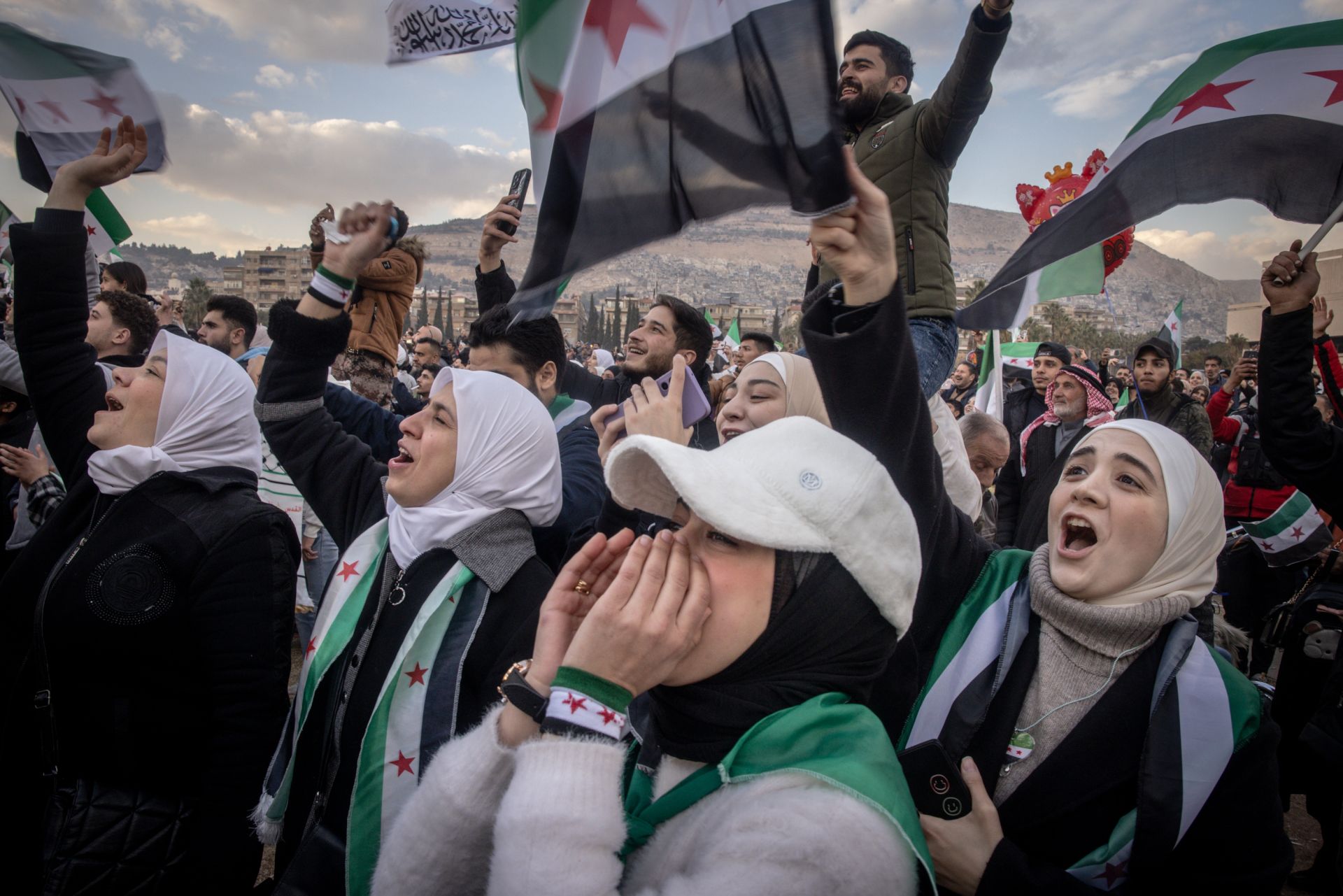
The operation that ended Assad’s rule began almost quietly on Nov. 27, 2024, under the modest name Deterrence of Aggression, and within 11 days the family rule that had defined Syria for more than half a century simply collapsed, on the morning of Dec. 8. At the core of the operation was Hayat Tahrir al-Sham (HTS), a former al Qaeda affiliate that had spent much of the previous decade recasting itself as a broader conservative Sunni movement, drawing on fighters who were disciplined, used to hardship and steeped in an Islamist doctrine that they were pursuing a just cause on behalf of their community. Around them were various rebel factions with members hailing from every part of the country.
Together, this coalition advanced more quickly and met less resistance than almost anyone had imagined, taking charge of a country of more than 20 million people with relatively limited urban battles and laying the ground for the new order that their leader, Ahmad al-Sharaa, would soon preside over. If you had been following the trajectory since 2017, the victory was not out of the blue so much as the moment when a long-accumulated energy finally found its way into power.
In 2017, following the apparent decline of the Syrian uprising after the Russian intervention two years prior, I wrote in The National of the United Arab Emirates that HTS would “inherit” the Syrian uprising against the regime of Bashar al-Assad. One year after the regime fell, the basis of that analysis offers a useful way to understand the current reality of Syria and where the country might be heading. The basic intuition at the time was that the energy of the Syrian revolution would not just go away, despite the rebels’ military defeats at that point. It would be absorbed and redirected by HTS, the force that was best positioned to carry the cause forward.
A year on, the new post-Assad order draws on the energy of the core Syrian population that opposed the former regime, including those who never picked up a weapon during the war but now say they are willing to carry arms to defend what they see as their victory. Any challenge to the new rulers, even mild dissent, is quickly seen as an attempt to undo that victory. A recent example was when Manaf Tlass, a former Assad regime general who defected in the early days of the conflict, gave a talk in Paris in September. News of the event dominated Syrian social media for days, and it was framed as a French-led conspiracy to bring back the old regime. In the end, Tlass’ speech was dull, a rehashing of an argument many made about the need to set up a Syrian military council to “unify the rifle” and rebuild a secular national army. Similar cycles have played out back-to-back in the past few months. It is a form of anxiety or hysteria, but it is actionable hysteria — the kind that can pull the country back into civil war.
The framework I used in 2017 still matters today because it highlights a blind spot that many Syrian and outside observers carry into their reading of the new Syria. It can explain the resilience of the new regime under President al-Sharaa and the mass support that sustains it. It also helps to explain, without justifying, what I call the “revolutionary anxiety” that has underpinned much of the violence in parts of the country since the downfall of Assad, in the coastal region against Alawites and in southern Syria against Druze communities.
I tried to explain this logic by looking first at Iraq, applying the lessons of its postwar experience to the Syrian conflict. The Americans did not defeat the Iraqi insurgency in the late 2000s; they transformed it. The U.S. troop surge and the tribal “awakening” movement in 2007 pushed much of the Iraqi Sunni insurgency away from its original goal of fighting the occupation, and channeled it temporarily into an alliance with that same occupation against both jihadists and the sectarian government of former Prime Minister Nouri al-Maliki.
On paper, it was a success. Violence declined. Many insurgents now fought under the umbrella of U.S.-backed local forces. Washington could present trend lines showing progress. But the underlying grievances that had produced the insurgency were never really resolved. Sunnis were not meaningfully integrated into the state they were now defending. They were not given real autonomy or a durable political stake — at least at the time.
When the U.S. withdrew and Baghdad reverted to sectarian habits, the transformed insurgency could not simply be rebuilt in its previous form. Its organizational structure had changed or crumbled, and its members or leaders had shifted allegiance. But the energy that had once powered it did not dissipate. It lay dormant, hidden in networks, memories and unresolved rage, waiting for a new vehicle.
What is now known as the Islamic State group became that vehicle. It built itself slowly, often in the shadows, and when it captured vast swaths of Sunni Iraq in 2014, it absorbed the latent energy of that defeated insurgency. In the first days after the fall of Mosul, the takeover looked from the outside like a tribal or Sunni uprising as much as a jihadist offensive. The Islamic State could not have pulled it off by virtue of its own military strength alone. It rose because the U.S. surge had deflected, but never neutralized, the original insurgency’s energy.
In August 2017, I argued that a similar process was unfolding in Syria after the Russian intervention in 2015. Moscow launched a relentless air campaign, hitting anything that moved or functioned in rebel-held areas, including schools, hospitals and civilian centers, while simultaneously engaging in diplomacy with rebel actors and their foreign backers. It took about a year for that dual strategy to deliver its first major prize, namely the recapture of eastern Aleppo by the Assad regime. Local ceasefires and “de-escalation zones” followed, creating islands of frozen conflict in which rebels were still technically present but politically neutered.
On the surface, the pieces looked as if they were moving toward a settlement. The mainstream opposition was in visible decline. Foreign backers quietly downgraded their goals from regime change to “counterterrorism” and “stability.” Assad had survived the worst. There was no plausible scenario in which the level of external support enjoyed by the rebels between 2011 and 2015 would return. The international community’s priority narrowed to a single question: what to do about jihadists in Syria.
But beneath that apparent stabilization, something else was happening. The conditions that had given birth to the uprising — decades of repression and humiliation — had not improved. They had worsened. The anger and grief that had sustained the rebellion did not vanish with the fall of city after city. They expanded, but like the Iraqi insurgency after 2007, they did so in ways that no longer fit neatly into the original opposition structures.
At the time of writing that piece, HTS was moving to consolidate its role in Idlib. It pushed aside rival factions, tightened its hold over local resources and, a week prior, had announced plans for a “civil administration” that would replace existing councils, including by asking Idlib’s municipal council to step aside. It looked like yet another jihadist power grab. I saw it as a sign that the group was positioning itself as the custodian of the armed struggle and the natural heir to a defeated but still potent uprising.
What began as a local project in Idlib has now become a national strategy. Not understanding this ability to capture the national energy can create illusions of fragility around the current order in Syria. Such illusions already inform strategies, including those of countries like Israel and Iran, to keep the country weak or to exploit its divisions. Internally, many Syrians, whether minorities or other critics, refuse to integrate or support the current formation because they think it will collapse when the world inevitably turns against it. They think they are confronting a narrow faction or a single leader. In reality, they are pushing against a much broader reservoir of revolutionary energy that has already been absorbed and reorganized by those in power today.
From a distance, the system looks like it is still forming, and brittle enough. Much data supports this perception. Minorities remain a powerful collective in Syria, and many of them are unsettled by the change in Damascus. Too many secular Sunnis oppose the current form of governance. Notable activists attack the new government for failing to hold anyone accountable for the crimes of the old regime. The jihadist rank and file are frustrated with the lack of Islamization. Regional support for al-Sharaa looks superficial. The Saudis, for instance, strongly back Damascus in public but have been slow to put their money where their mouth is, in terms of supplying the new government with already-pledged resources. Put these pieces together, and you can easily tell yourself a credible story: This whole edifice is fragile and could crumble at any moment.
It is precisely to see beyond this prism that I have gone back to the analysis I wrote in 2017. It was not really about one group or one leader. It was about how insurgencies first appear to die, but they survive defeat and sustain themselves in one form or another.
In Syria, HTS maneuvered to position itself as the heir to the uprising. Through rebranding, warfare against other rebel groups and a series of local governance projects, it set out to eliminate or absorb competitors, capture resources and present itself as the one force that would not compromise with the regime or its sponsors.
Al-Sharaa’s staying power is not simply the product of a lack of viable rivals, though that matters. His regime is rooted in the legacy of two Syrian insurgencies: the Islamist revolt of 1979-1982 and the post-2011 rebellion that ended a year ago. The continuity between them is not always visible in formal institutions, but you can feel it in the cadre (if not the same people, it would be their children or relatives), in the networks and in the political culture that has emerged.
After 2024, when Assad fled and the old regime unraveled, it was not a liberal civic movement that stepped into the vacuum. It was a network of forces whose genealogy runs through those earlier insurgencies. Al-Sharaa did not create this from scratch. He and his circle latched onto something that had been building for decades. He, of course, also knew how to seize the opportunity when it finally came. The revolutionary energy that had once animated protests and armed groups now flowed through a structure that became the core of the new regime in Damascus.
That is why the new order can look simultaneously brittle and deeply rooted. Institutionally, it is improvised, underfunded and surrounded by enemies. Socially and psychologically, it rests on a broad insurgent base that has been fighting, losing, regrouping and burrowing into Syrian society since the 1970s. To confront it is not simply to confront “HTS” as a group or al-Sharaa as an individual, but to confront the accumulated energy of the Syrian revolution and its predecessors as they now exist inside the state. For better or worse, the new order is more stable than it may seem. It is like train couplers that look as if they are about to disengage at every turn, but the physics of the system makes them far more stable than they appear.
This is where revolutionary anxiety comes in. For the people who see themselves as having finally won after 14 years of war and decades of humiliation before that, the victory is not just political, it is existential. It is the first time they feel that the core Sunni heartland is not ruled over by a hostile minority security apparatus, or by exiled politicians talking in foreign capitals. It is theirs.
Any sign of dissent is therefore interpreted not as a normal feature of postwar politics, but as an attempt to snatch that moment away. As the Arabic saying goes, the one bitten by a snake fears even a coiled rope, and many of those who feel they have finally won now react to the smallest hint of compromise as if it were the start of another defeat. Protests in Druze areas, criticism from Alawite notables on the coast, even principled opposition from Sunni activists in exile are all part of the same story: Someone, somewhere, is trying to rob Syrians of the only real victory they have ever had. That is why government supporters have so often repeated the slogan “There is no turning back the clock” this year, including al-Sharaa himself, who said in March that “Syria will not turn a single step back.”
That sentiment produces a kind of collective anxiety that is anything but passive. People are willing to harass, beat or even kill to defend an order they barely understand, because they think they are protecting the one thing that finally pushed back against long-standing injustice. This applies to many defenders of the new government who had been loud critics of al-Sharaa when he fought rival rebel groups.
Once you realize that the core driver of all this is domestic insurgent energy, the current regime’s resilience looks less like a mere local faction, or a foreign puppet show for that matter, and more like the latest vessel for that energy. But that also means the new order can start to resemble the old one. It has the internal fuel to construct a system built on paranoia and anxiety, convinced that any loosening of control will invite revenge or collapse.
Syria today is governed by a force that has inherited not only the energy of past insurgencies but also their scars and their sense of besiegement. That gives the new regime real staying power. It also means that if this moment is mishandled, by the authorities or by their opponents, the next round of violence could be worse than the last.
Ironically, it is often the rank and file and segments of the general public who believe the government is not punishing or killing enough people. The rebels who now dominate state structures seized a country practically without firing a shot in their march to Damascus. By regional standards, it was one of the cleanest and most humane military operations in recent memory. Every needless crackdown and every act of revenge now undermines that achievement. Each ugly incident turns the clock back and strengthens the voices of those who wish Syrians harm.
Become a member today to receive access to all our paywalled essays and the best of New Lines delivered to your inbox through our newsletters.