


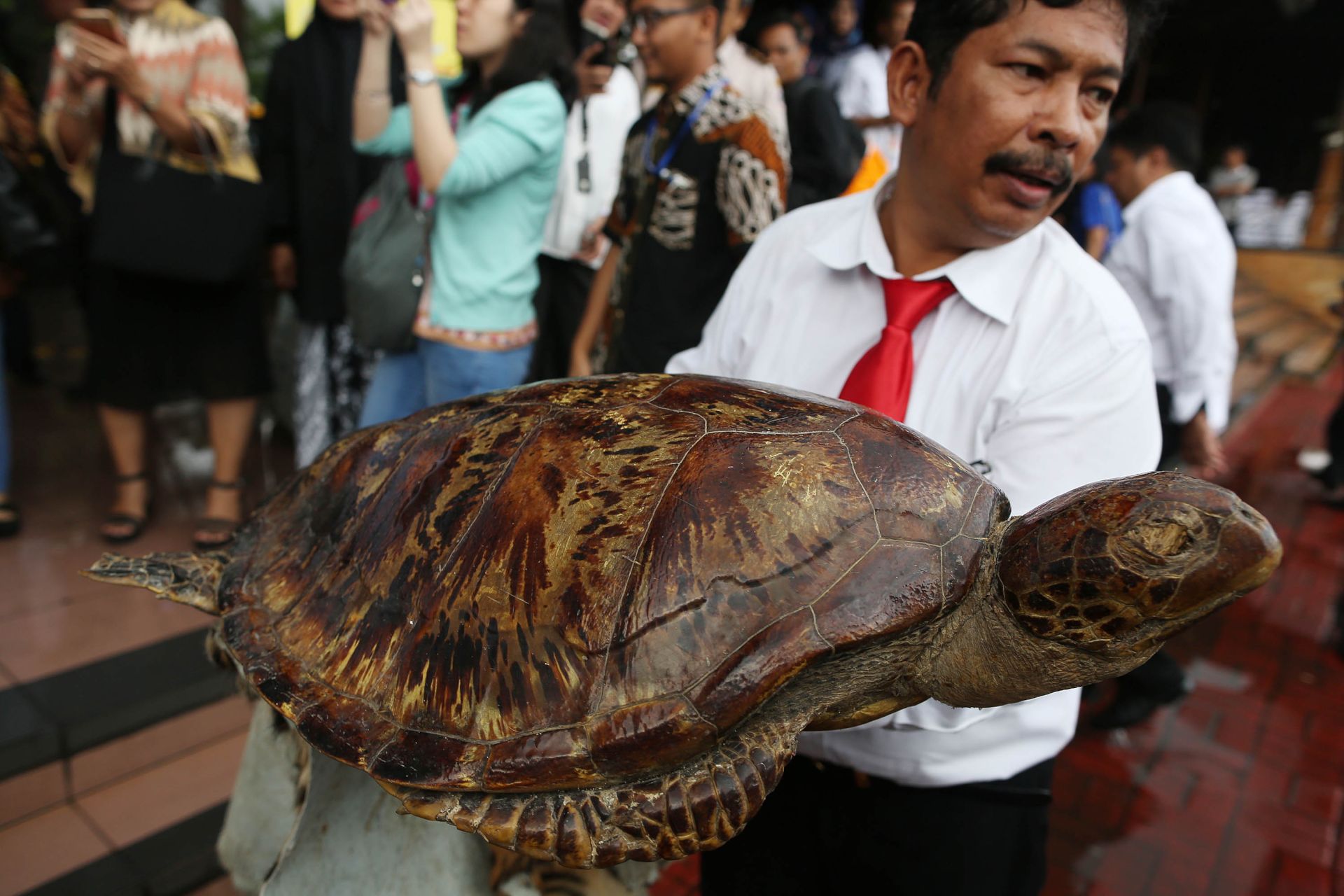
Samarkand in Uzbekistan once held a crucial place in global trade, as a key hub of the famous Silk Road, which saw everything from spices to luxury materials traded from Asia to the markets of Europe. In late 2025, it played a key role in international trade once again, hosting the 20th CITES Conference of the Parties, which ran for two weeks from Nov. 24.
Every three years, the world’s governments convene for this conference — short for the Convention on International Trade in Endangered Species of Wild Flora and Fauna — to make decisions that affect everyone with a stake in the international trade in wild animals, from zoos and breeders to hunters and exotic pet owners.
Last November, delegates undertook tough negotiations on 51 proposals covering 50 species, including dozens of shark species and national icons like Galapagos iguanas. Proposals are submitted by countries, with a two-thirds majority vote required for success.
Proposals seek to add species to, or remove them from, CITES Appendix I or Appendix II. The former makes international commercial trade in a species illegal, with exceptions for things like zoo transfers, scientific research and emergency evacuation. Listing in Appendix II means the species may become threatened with extinction “unless trade is closely controlled.” This means that species on this list can only be sold with a valid export permit, although some countries also insist on an import permit.
In theory, the conference is a stage for measured scientific discussions and clear-eyed, conservation-focused decisions. In reality, it is a battleground of political intrigue, vested interests and economic pressures.
Consider what happened in Doha in 2010. Japan hosted a dinner for government officials from around the world, serving one of its signature dishes: bluefin tuna. The next day, many of those same guests voted against proposals to afford the species additional protections — a significant victory for Japan’s lobbying efforts. More than a quarter of the world’s tuna is consumed in Japan, and a CITES listing would have heavily restricted how much of the fish could be legally traded overseas.
The Washington Convention, as CITES is also known, was ratified 50 years ago in 1975 by 21 countries, including the United States. Its main purpose is to regulate the international trade in wild animals, placing restrictions on how frequently species can be bought and sold across international borders. The number of signatories now stands at 185, the vast majority of countries worldwide.
The U.S. was one of the earliest champions of the treaty and of international conservation. There are signs, however, that this leadership could be on the decline. The Trump administration issued only four proposals for discussion at the latest meeting, its lowest number in 25 years. None were for additional protections for animal species.
More than 40,000 species are currently listed on CITES’ appendices, from conservation icons like elephants and rhinos to much more obscure species like the Honduran white bat and the binturong, a bear-like cat native to south and southeast Asia. Plants are also covered, with regulated species including certain types of South American hardwood and South African succulents.
In Samarkand, gulper sharks — a deep-sea species fished for its swim bladder — were included on Appendix II, while the proposal to include iguanas from the Galapagos Islands on Appendix I was approved. A bid by Argentina, Bolivia and Paraguay to improve protections for South American tarantulas was rejected. But the conference is not only about strengthening regulations. Some proposals aim to downlist species, thereby easing restrictions on them.
CITES is an important part of the conservationist’s toolkit. A 2023 paper published in the Journal of Environmental Economics and Management (JEEM) suggested that the population of listed animals increased by around 66% 20 years after listing. A 2025 study in Marine Policy specifically on shark and ray listings found that the majority of nations take the agreement seriously, implementing regulations as a result.
The sheer amount of money involved in the legal trade of animals means these events can attract intense levels of lobbying, such as those carried out by Japan in 2010. This can influence voting at the event, but also which animals are proposed for protections at all.
As in any multinational forum, power matters. Some countries, like the U.S. and China, as well as the EU (which votes as a bloc), wield outsized influence on smaller nations. There have been occasions when officials from a large country like China or Japan “worked the room,” apparently pressuring delegates from smaller nations that rely on economic links with their larger neighbors to vote a certain way.
“It would be nice to think the parties are making decisions based on the best available science, but some decisions are inherently political,” Dan Challender, a researcher at the University of Oxford, told New Lines.
Although some countries are motivated by genuine conservation goals when making proposals, according to Matt Collis, policy director at the International Fund for Animal Welfare (IFAW), sometimes these are influenced by economics or geopolitics. A nation may want to be able to trade in animal products from a species that is plentiful within their borders — even if its population is threatened elsewhere.
Nations engage in “horse trading” to achieve their goals, Sarah Ferguson, policy director at the Trade Records Analysis of Flora and Fauna in Commerce (TRAFFIC), told New Lines. “Sometimes there’s a bit of ‘if you vote for this, I’ll vote for that’ going on.”
Mark Jones, head of policy at the nongovernmental organization Born Free, told New Lines: “A lot of people criticize CITES because it is highly politicized. Discussions can be very highly charged. [The decisions] come down to countries voting, so, whatever the evidence might be, it ultimately comes down to political decision-making.”
CITES is attended by a number of bodies with an interest in the trade in plants or animals. This year’s list of attendees includes representatives from the League of American Orchestras, the European Pet Organization and the Safari Club, which is a hunting organization. The attendance of so many private sector organizations is an indication of the amount of money at stake.
Svein Fosså, president of the European Pet Organization, told New Lines that delegates are swayed by large-scale economic interests or powerful conservation organizations at the expense of smaller, more sustainable businesses. But he was particularly frustrated with conservation “populism,” by which he meant the impulse to protect beautiful or “charismatic” species even if regulations are likely to bring few conservation benefits. “There is more and more a tendency among parties to vote to list something because they don’t like the commercialization of wildlife.”
He offered the 2010 conference as evidence. Minutes after only a few delegates “dared” to vote for bluefin tuna regulations, the majority approved protections for a colorful frog popular in the pet trade with “practically no debate,” he claimed. The discrepancy, he suggested, was down to aesthetics: conservationists can sell a photogenic species as an easy win, while, in his view, “sustainable” businesses (such as the pet trade) struggle to make their case for fewer regulations. “The customers of the pet trade naturally love animals. And the majority have a deep understanding of the need to help nature in conserving species, and we want to avoid restrictions on trade that bring nothing to conservation,” he added.
In contrast to the economic lobbying of delegates, much of the lobbying from civil society — particularly the large, science-driven NGOs — takes on a more colorful form. Collis uses the term “soft toy diplomacy” to refer to some of these efforts, inspired by many NGOs’ favorite tactic of bombarding the conference with cuddly toys to promote the cause of a specific animal. In Panama in 2022, this was sharks. This year, it was the Galapagos iguana.
A 2024 study co-authored by Challender warned that CITES “can be gamed by special interest groups.” In this context, ‘soft toy diplomacy’ plays a critical role. There was a split between animal welfare organizations running an uncompromising, “winner-takes-all” strategy to prohibit all animal trade and those arguing for more nuance in trade decisions, the study said. The former seeks to hold the “moral high ground,” Challender concluded, creating a risk of CITES “becoming a vehicle for coalitions of well-resourced non-state actors” to achieve their goals, regardless of the conservation outcomes. A large NGO, for instance, might successfully lobby for a total ban to get more funding, even when evidence suggests that other conservation approaches might be more effective.
Collis, from IFAW, said it might be easier to get interest and public support for species considered charismatic, but that does not necessarily translate into votes. “Telling people we need to save elephants is a much easier message than talking about sea cucumbers for sure, but those charismatic species are often also the ones being trophy hunted, so there are strong economic interests,” he told New Lines.
The focus on these “charismatic” species can sometimes frustrate civil society organizations too. There can be a tendency at CITES events for discussions to become dominated by the “big grey things,” Collis said: elephants, rhinos and sharks. “They do tend to dominate every meeting and there is frustration [from some] that they take up so much time despite not necessarily being the things most in need of protection,” he explained. Much of the discussion in Uzbekistan was dominated by shark species, many of which were already protected.
Huge fishing firms, trophy hunters, and pet breeders and traders all have an economic interest in the trade of wild animals. But impacts on local and Indigenous communities are often neglected. These communities have complex but important relationships with their local wildlife — protecting it, but also using it as a source of income.
Allowing for limited “use” of an animal species can sometimes lead to better conservation outcomes than an outright ban, according to the International Union for Conservation of Nature. In Pakistan, for example, hunting permits for the markhor, a species of goat with majestic horns that make popular trophies, are sold for millions of dollars, with the money used to conserve the species, which is thriving.
According to some observers, local or Indigenous communities are rarely consulted as a matter of course. This is despite them being crucial to the success of any conservation efforts that may follow a listing. Challender pointed out that regulating trade through CITES may not always be the best approach, depending on what is causing the species’ decline: “In a scenario where the main threats to species are things like habitat loss, you’ve got to incentivize conservation. The use of species is a really important way of doing that,” he explained.
There have been calls in recent years to include socioeconomic factors in CITES decision-making, which is officially only driven by conservation science.
While NGOs like Born Free support involving local communities in discussions, Jones, its policy director, argued that such a move could detract from the treaty’s goal to prevent trade that threatens a species’ survival. He said that Indigenous communities have sometimes been used by governments as part of controversial tactics to encourage, for instance, the sale of ivory. Indeed, many local communities earn a living via activities related to the “use” of wildlife — small-scale hunting or the sale of animal products. This could make them predisposed to oppose stronger regulations.
“If you consider the socioeconomic value of continued trade, then it could override the biological and trade-related issues,” Jones explained. “If Indigenous or local communities rely on that trade, then in the long term that’s not to their benefit.”
Some countries have also grown frustrated with some of CITES’ inflexibilities. Increased polarization linked to these issues even risks tearing CITES apart, according to Challender. A bloc of countries in southern Africa has threatened to leave the treaty because they believe they should be able to trade in elephant and rhino parts as a result of their success in conserving them. Japan left the International Whaling Commission in 2019 because it felt the organization had begun to pursue an anti-whaling agenda — as opposed to sustainable regulation — under which commercial hunting had become impossible. In a 2025 paper, Challender and others argued the same could happen to CITES, a development that would “substantially weaken the integrity, credibility, and stature of the Convention.”
Ferguson, from TRAFFIC, said this issue could be dealt with by delegates being more willing to use “split listings,” where a carve-out is agreed for animals from a certain country. Although there are several examples of such listings — one being the decision in Samarkand to delist Kazakhstan’s population of saiga antelopes — delegates are cautious about doing so. This is because of complications such as the fact that animals do not recognize and obey international borders, and the potential for traffickers to “launder” illegally caught species into another country’s populations, as happens with Colombian tortoises sold via Peru.
Asked what the biggest challenge is when it comes to the success of CITES, nearly every expert will give you the same answer: funding.
The convention relies on national governments, which will have varying levels of funding for enforcement. Trade permits issued by individual nations can be faked and wild-caught animals can be laundered into legal trade — all while CITES officers around the world, who are supposed to assess wildlife shipments at borders and scrutinize paperwork, struggle for funding and resources.
“I’ve seen images of handwritten CITES permits, fake permits where you just copy them and change the number,” said Alex Kennaugh, from Humane World for Animals. “Wildlife trafficking networks are exploiting every single loophole there is.”
A 2024 survey carried out in Kenya found that 60% of officials from government agencies and NGOs reported only moderate capacity to carry out CITES enforcement. Awareness of the rules is another problem. A 2022 study of Bangladeshi fishers found that none were aware of CITES regulations relating to sharks. The JEEM article recommended “re-focusing discussions away from whether CITES should partially restrict trade or impose a complete trade ban, and towards better enforcement.”
A CITES listing can also lead to unintended consequences by sending a signal to criminal networks that a certain animal is in short supply. “You can actually incentivize the overexploitation of a species and potentially accelerate their extinction,” said Challender. “The best example is black rhinos. They went into Appendix I in 1977, and there were extinctions locally in 18 countries. People were like, ‘this thing is worth a lot of money, let’s go get some rhino horns.’”
Some also criticize CITES because it entirely ignores domestic or illegal trade in wildlife, and even for those animals listed in the treaty’s appendices, it is not concerned with their welfare. Kennaugh pointed out that even animals moved and sold legally can be subject to very poor conditions.
But for John Scanlon, who served as secretary-general of CITES from 2010 to 2018, the treaty’s narrow focus on international trade is one of its key strengths. Few people understand the complexities of the treaty and its implementation better than him. While he concedes that CITES has little to say about animals not listed on its appendices or those trafficked illegally, Scanlon argued that it is exactly this “narrow intersection” that has allowed it to remain so influential after 50 years. “I think that’s one of the reasons it’s been relatively successful,” he told New Lines.
While CITES might not be perfect, it is one of the most important tools the world currently has in fighting the biodiversity crisis.
“It’s certainly better to have it than to not,” Ferguson said. “It has required parties to start to move together on conservation efforts.” Collis pointed out that it has remained widely used since it was introduced. “People wouldn’t keep coming back to using it if they didn’t think it was effective.”
Scanlon places it in the context of the more than a thousand international agreements struck in 50 years. “If you look at it in the context of international environmental law, it’s been a successful convention,” he explained. “Does it have flaws? Yes. Is there more to be done? Yes.” But the important question, he suggested, is whether it has helped to ensure that the survival of species is not threatened by international trade. “I would say yes.”
Studies have found that nations take CITES seriously, changing their national laws to accommodate new listings and ceasing trade with nations found to be in breach of the rules.
For all its scientific language and technical machinery, CITES decisions are ultimately shaped in stuffy conference rooms where political and economic power and influence are brought together. Decisions that determine the fate of a species are not made in a sanitized laboratory but in a packed hall full of competing interests. But for all of its flaws, the treaty remains one of the few global levers capable of slowing biodiversity loss. Instead of asking whether it has worked, maybe it’s best to ask where we would be without it.
Become a member today to receive access to all our paywalled essays and the best of New Lines delivered to your inbox through our newsletters.