

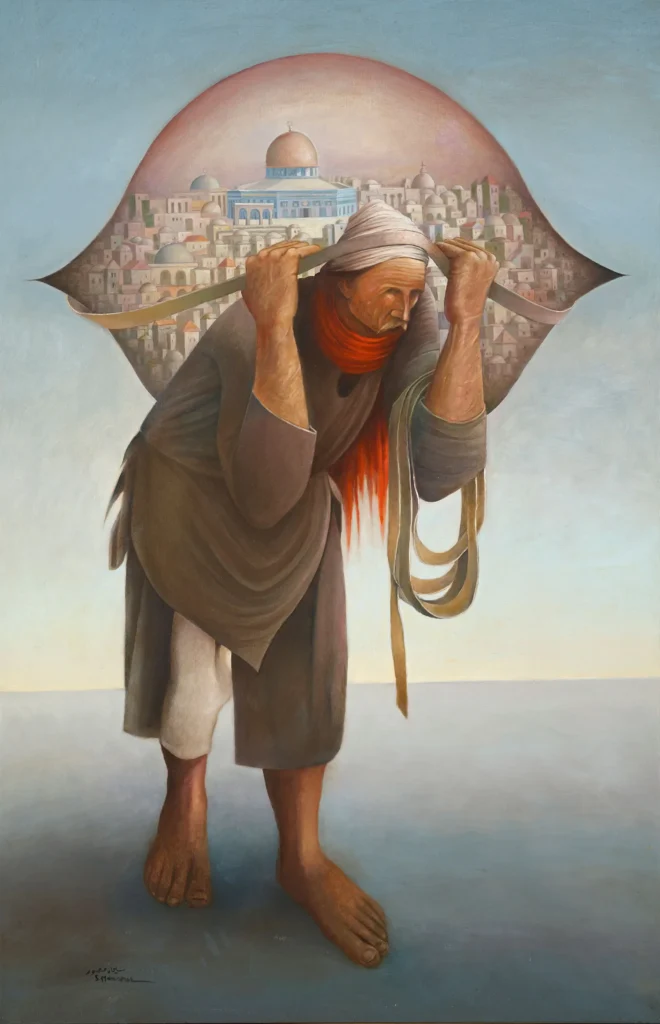
When we speak of the Palestinian artist Sliman Mansour, the conversation too often narrows to a single painting, his “Camel of Hardships” (1973).
It was through this painting that Mansour became known in Palestine and the Arab world. “Camel of Hardships” was inspired by the porters he saw on the streets of Jerusalem, when he passed through the Old City. It depicts an old man with traditional Palestinian clothes carrying the city of Jerusalem, as a heavy load, on his shoulder. The painting’s influence exploded with the decision to reproduce it as a poster, distributing and selling it at affordable prices for people to purchase and display in their homes. Seemingly every Palestinian home displayed “Camel of Hardships” on its walls. But while many were familiar with the poster, far fewer knew the artist who created it.
That iconic painting has also dominated discussions since Mansour’s death on Aug. 24, at the age of 79, overshadowing the breadth of a career spanning more than five decades.
Perhaps this is what made Mansour dislike that particular painting for such a long time. For him, although it was iconic and marked a phase in which he became more aware of his identity as a Palestinian artist, it nevertheless overshadowed much of his other work, work that people did not know much about until recent years, when he became active on social media.
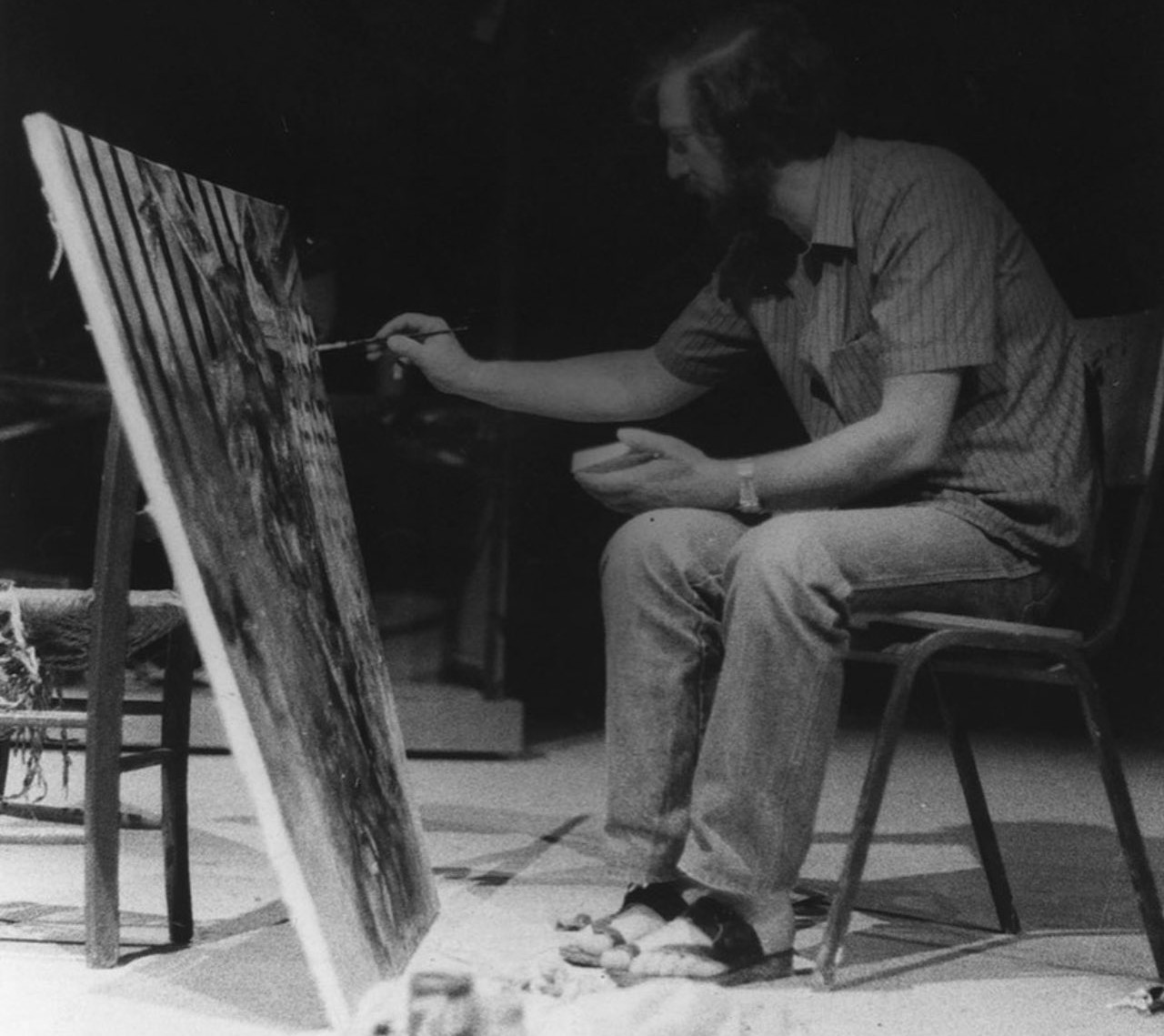
I knew Mansour as my father’s lifelong friend from my childhood onward. He was a gentle, humble man who frequented our home as if he were a member of the family. He was courteous, with a blond beard, a commanding presence and a cheerful soul. I remember him as a regular attendee of the League of Palestinian Artists meetings held on the long glass balcony at our home on Nablus Street in al-Bireh. I remember him sitting with my father for hours in our garden beneath the walnut tree on summer evenings, discussing art, exhibitions, artists’ meetings and elections.
As a child, I would overhear the heated debates that punctuated these gatherings, along with the laughter and conversations fueled by boundless passion. The meetings often left behind clouds of white smoke tinged with the sweet aroma of pipe tobacco some artists favored, and ashtrays filled with ash and cigarette butts.
Mansour and Nabil Anani met in the early 1970s, a few years after the 1967 war and occupation of all of historic Palestine. Along with other artists, they decided to form a body that would unite Palestinian artists and give them space to meet, converse and work together.
In 1973, they applied for official registration with the Israeli authorities responsible for the Palestinian civil administration at the time. Approval never came. Rather than being discouraged, the artists decided to operate anyway under the name that became the League of Palestinian Artists.
Without permission, they organized exhibitions under the banner of the league in different Palestinian cities, inviting political leaders to inaugurate them, with wide attendance among the Palestinian public. The consequences were severe, as exhibitions were raided and shut down, paintings and posters confiscated, and artists arrested.
In 1980, Mansour, Anani and another artist, Issam Bader, were summoned to the Israeli military governor based in Ramallah. He ordered them specifically not to produce “provocative art” that represented the keffiyeh or the colors of the Palestinian flag, and not to draw prisoners or martyrs.
Mansour himself was arrested in 1981 while photographing the village of Silwad near Ramallah. He was interrogated and imprisoned for four weeks, accused of being a German spy on the ludicrous grounds that he carried a German-made camera. A year earlier, his exhibition at Gallery 79 — the first art space dedicated to organizing exhibitions for Palestinian artists locally — had been closed, and some of his paintings were confiscated. Gallery 79 was established in Ramallah by Mansour, Bader and Anani. It opened in 1979 with an exhibition marathon featuring 15 artists, though the event was not completed. In 1980, the gallery was closed by the Israeli authorities.
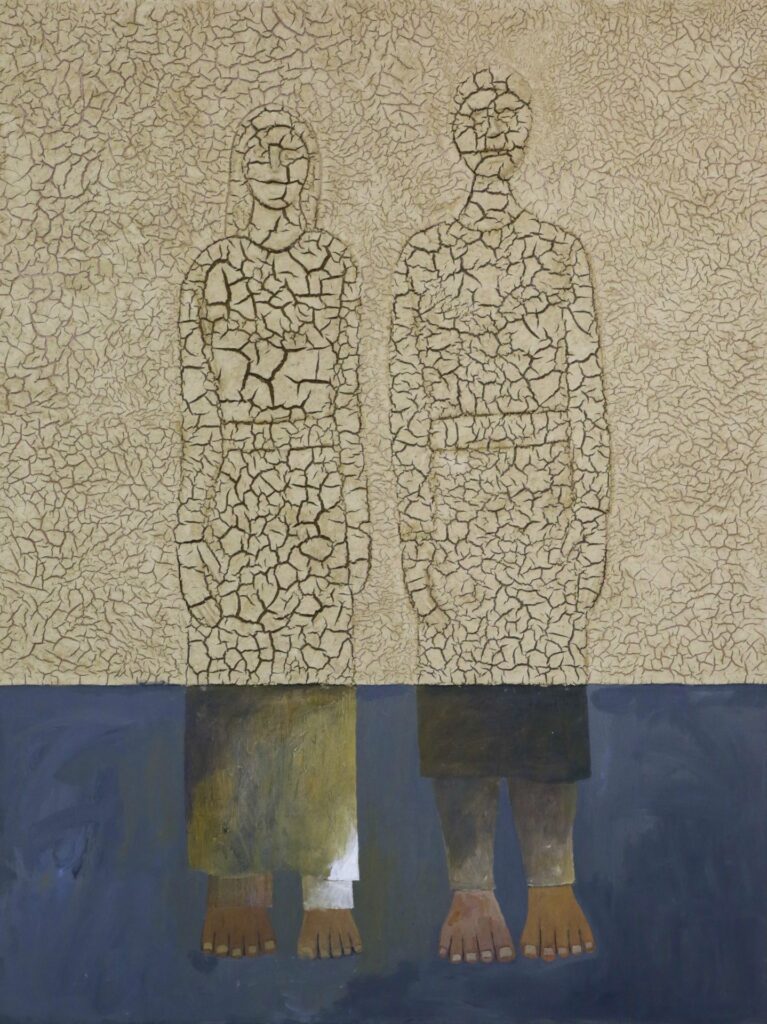
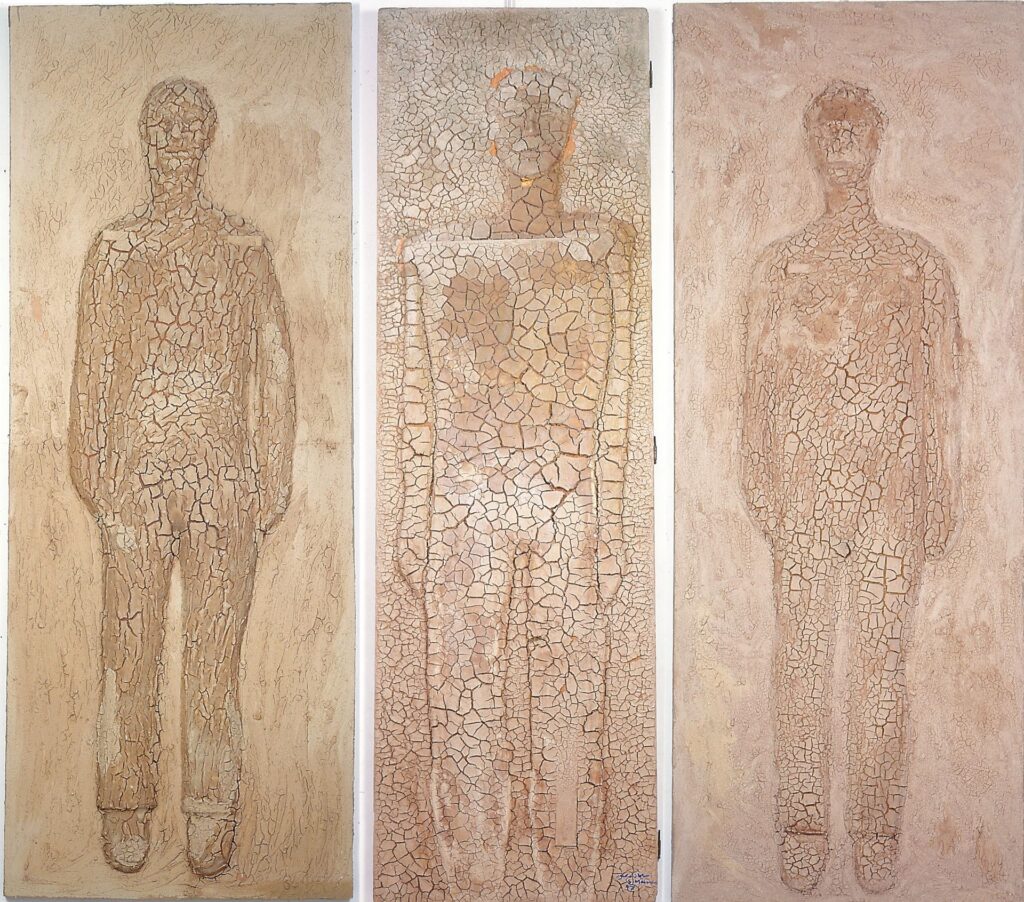
Mansour headed the League of Palestinian Artists throughout much of the 1980s. In 1989, he founded the New Visions group with Anani, Vera Tamari and Tayseer Barakat. This was during the First Intifada, and his work with the group became a milestone in his career, focused on experimenting with materials. The group emerged in response to a call from the national leadership of the intifada to boycott Israeli products. For Mansour, it launched more than a decade of work in mud, an approach that came from a childhood memory of his grandmother in Birzeit.
Like all Palestinian women at that time, his grandmother made her own pottery for use at home. He remembered watching her make beehives out of clay, using mud from the land, shaping it with her hands, and piercing a hole in the middle for bees as he played with mud and water nearby.
“I began visiting sites where new homes were being built on empty land, or places where the occupation was cutting through hills to create roads,” he told me. “There, along the edges, I would find layers of yellow clay. … I would gather it into bags to take back with me.”
In his studio, he would go through an elaborate process to turn the clay into mud bricks that could be stacked for storage: “I worked with the material lovingly, finding joy each time I successfully extracted the clay from the earth,” he told me. “One could speak at length about clay and its symbolism … rather than painting a landscape, I began to create art using the very material of the landscape itself.”
The cracks that appeared in Mansour’s work carried their own symbolism, signifying aging, the disappearance of people, the fragmentation of Palestinian geography by occupation. This was best expressed in “Shrinking Object,” a work that Mansour created in 1996, in the shadow of the Oslo II Accords. In this painting, the map of historic Palestine appears at the center, hollow with a smaller cracked map of Palestine inside it, as if the original had shrunk into a smaller version, a reference to the land loss brought about by the Oslo Agreement. The painting summed up much of the Palestinian criticism of a political agreement that, in reality, helped to shrink the dream of an independent Palestine and became a tool in the hands of Israel for land grabs and the maintenance of occupation.
Mansour worked for over a decade using mud and straw, going through several phases. His work with New Visions influenced a whole new generation of young Palestinian artists who followed in their footsteps.
Beyond the League of Palestinian Artists and Gallery 79, Mansour was among the founders of other art institutions in Palestine, including Al Wasiti Art Center in Jerusalem, which was established in 1993 with Anani, Vera Tamari and Tayseer Barakat. It ran a number of art exhibitions, including the first art exhibition by Palestinian artists in exile. He was also a founding member of the International Academy of Art Palestine (IAAP), which played a significant role in training several young Palestinian artists who later became renowned internationally.
But Mansour’s journey as an artist began long before he became a symbol. His childhood was marked by the loss of his father and grandfather in the same week. Mansour’s father had been ill with leukemia for some time. His grandfather, the main provider for the family, was so upset about his son’s illness and so worried about the fate of his son’s children that he had a stroke. Mansour’s mother, who was a housewife, became a tailor to provide for her children.
One of six siblings, Mansour was sent away to boarding school at the age of 4. One of his first memories was clinging hard to his grandmother, refusing to let go. He longed for the warmth of his family and felt severed from it at school. A year later, he was sent to another boarding school in Bethlehem, where he joined his older siblings.
It was on the rooftop of one of the school’s buildings that he discovered art. What began as a curiosity led him to a secluded spot where his German teacher was rendering a beautiful scene of Bethlehem onto paper using watercolors. Mansour observed with fascination, and from then on, that was all he wanted to do. He joined the after-school art club, where his teacher recognized and nurtured his talent, taking Mansour and other students to the old city of Jerusalem to observe scenes in the souk of people buying and selling, porters, carts and other details, and then draw them. His famous iconic work “Camel of Hardships” is rooted in these scenes.
His path to higher education was fraught with obstacles. He wanted to study art in the United States but lacked the money. Eventually, he accepted a scholarship at Bezalel Academy in West Jerusalem, just after the 1967 war and occupation. Mansour was the first Palestinian from East Jerusalem to study art at the Israeli college.
As a young man, he did not think about this much, because he was not yet fully aware of his identity as a Palestinian. He did not enjoy the college’s approach, which leaned toward abstract expressionism. He wanted to draw people and scenes from his surroundings, sketching images of refugees he found in U.N. publications, but his teachers were not keen on his approach or his skills. Mansour encountered subtle racism and hostility, which he only fully recognized at a later stage.
In his third year, he was falsely accused of burning the school’s library, a charge that led to him being summoned and thoroughly investigated by the Israeli police, before the administration determined that an electrical fault had caused the fire. This incident forced him to leave college a year before graduation — an episode that was all too emblematic of the ordeal Palestinians have faced since the beginning of the occupation. Rather than succumb to despair, Mansour chose to continue drawing on his own, displaying the resilience that would define his life and work.
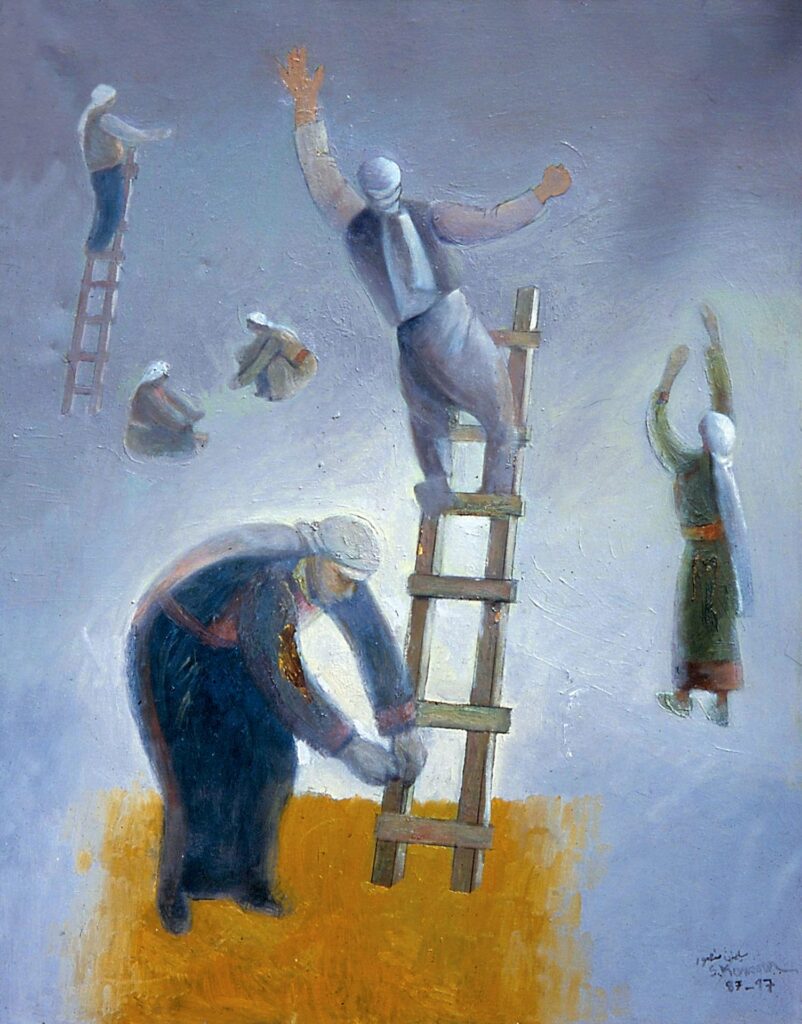
Mansour’s mother was a tailor who could hardly secure her children’s needs at school, and he realized early that he needed to earn money. He began sketching portraits for students and their families and drawing Christmas postcards to sell. These early experiences were instrumental in developing his skills and his understanding of art as a means of survival, while summer holidays spent in the lush fields of Birzeit between olive, almond and fig trees shaped his work.
Mansour longed to live in his grandfather’s house in al-Saqi, an area in Birzeit that has been under Israeli control since 1967. His dream was to live in that house with its colorful tiled flooring, amid the fields — a place that is still difficult to access because it remains under Israeli occupation. Renovating the house and creating a road for vehicles to access it are not permitted. Just weeks after Mansour’s death, Israel bulldozed two large buildings in the area.
His grandfather, a teacher in Jerusalem, decided in the 1930s to buy land and work in agriculture, seeking food independence. That legacy of self-sufficiency and connection to the land is evident in Mansour’s work. In his earlier works, he presented the fellahin, Palestinian farmers, with pride and honor: their big, strong hands and their long, strong necks, heads held high, while working hard in the fields. The colorful thobes of the women, embroidered in fine detail, reflect his attachment to tatreez (a traditional Palestinian cross-stitch hand embroidery). He dreamed of a free Palestine, which took center stage in his work, as he painted the oranges of the Palestinian coast and the olives of the Palestinian hills, celebrating all of Palestine’s geographies.
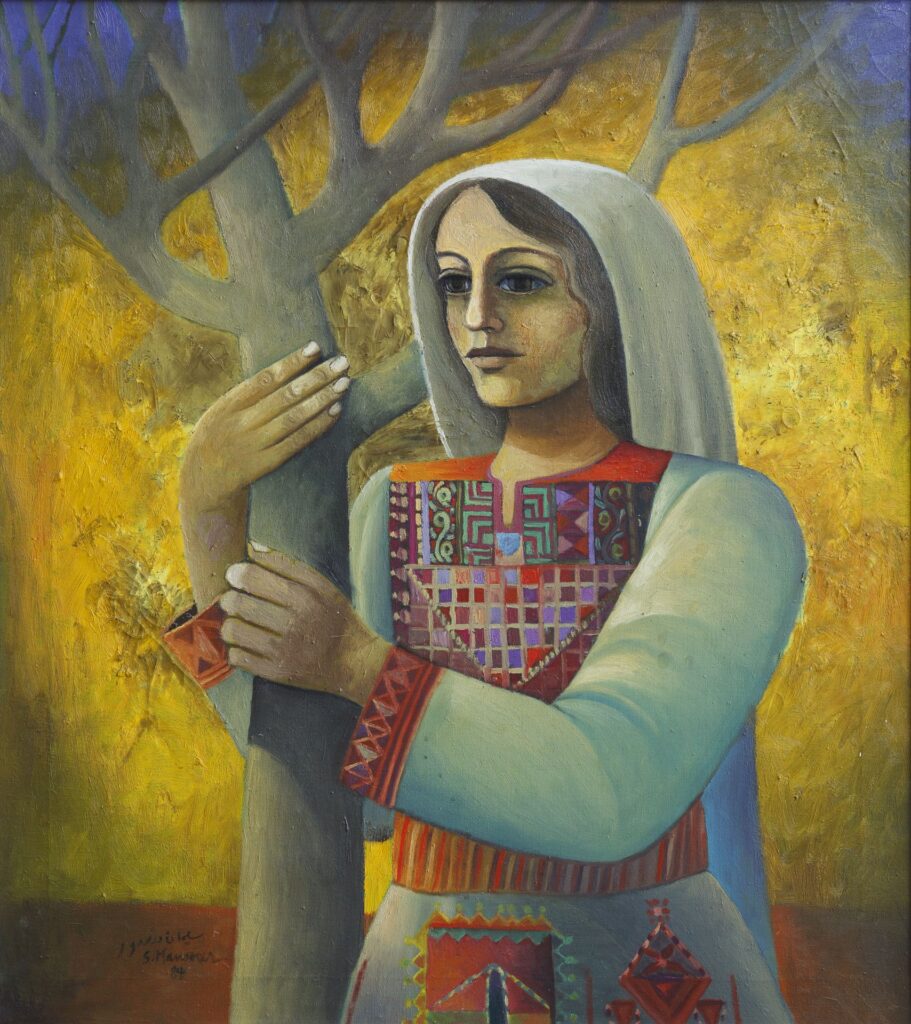
To write about Sliman Mansour is to write about a man who was more than a painter. His legacy is not only in the paintings he created but in the paths he opened for others, the identity he helped preserve, the dreams he kept alive and the inspiration of a whole new generation of artists. In writing about all of it, we honor not just the artist but the man and the Palestine he represents.
Become a member today to receive access to all our paywalled essays and the best of New Lines delivered to your inbox through our newsletters.