


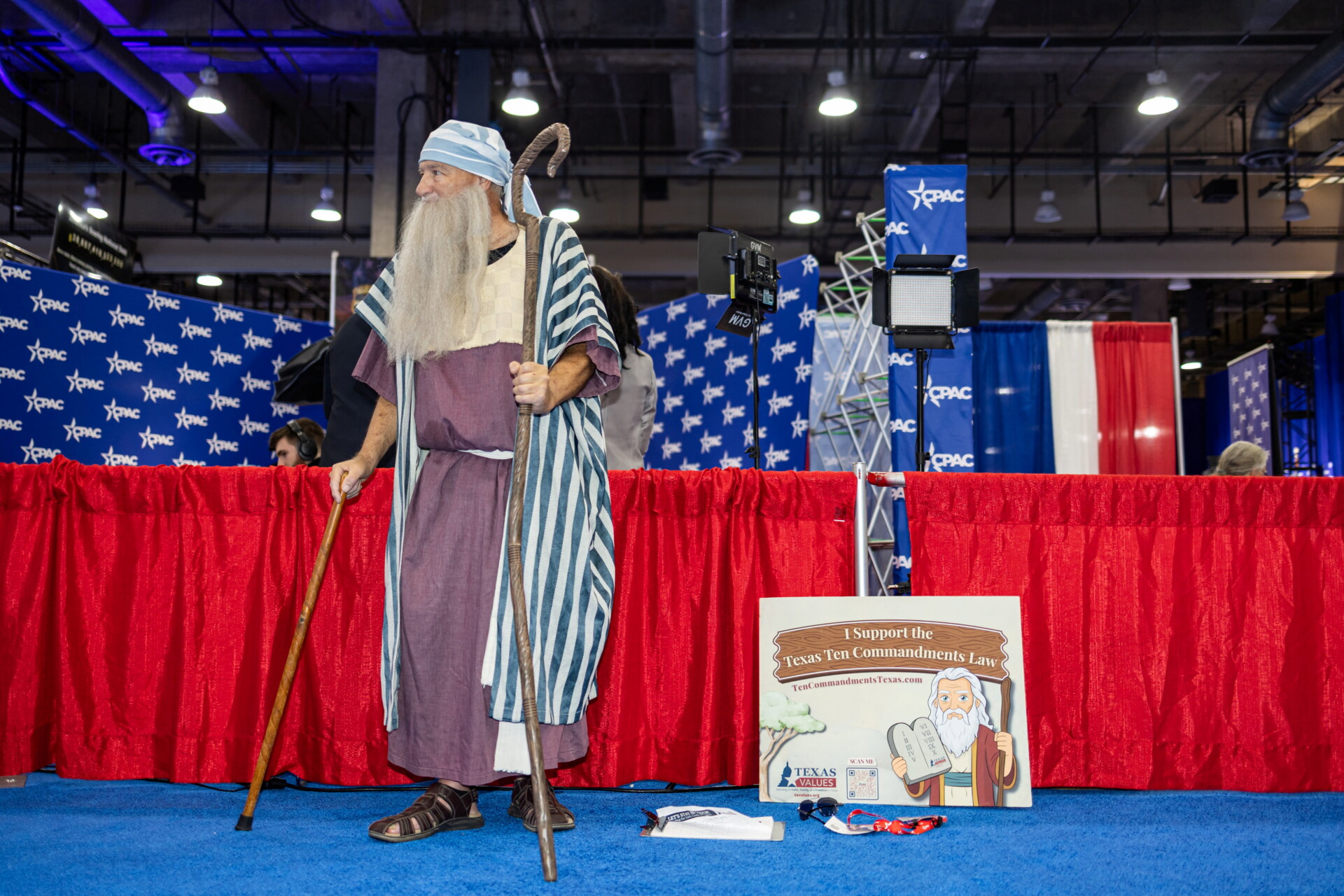
America prides itself on religious freedom, a principle that atheist Nichole Manning passionately believes Texas refuses to extend to her family. Earlier this year, Texas passed a law requiring schools to prominently display posters of the Ten Commandments. (These posters were donated by private organizations, so U.S. tax dollars would not pay for them outright.) Manning joined Christian, Jewish, Hindu and other families in challenging the law as unconstitutional. The 5th U.S. Circuit Court of Appeals found the law constitutional in April, so it remains in effect. A petition to review the case is pending before the U.S. Supreme Court.
There is a serious possibility that the court, with its conservative majority, will allow the law to stand. But if justices weigh history as heavily as they have in other major cases, the historical record actually gives the plaintiffs a strong argument of their own.
Behind the constitutional dispute lies an older question. How should public schools handle religion? Americans have argued for centuries over what role, if any, religion should play in public education and whose religion public schools should emphasize. Whatever the Supreme Court eventually decides about the Ten Commandments, that debate will continue.
Existing Supreme Court precedent about Ten Commandments displays is muddled. For many years, the Supreme Court relied on the framework from Lemon v. Kurtzman to decide whether a state had violated the First Amendment’s prohibition on laws “respecting an establishment of religion.” That framework famously focused on avoiding an “excessive government entanglement with religion.” Applying this test, the U.S. Supreme Court found it unconstitutional to use public money to pay for certain expenses at private religious schools, including supplements to teachers’ salaries.
In 1980, the Supreme Court used the Lemon v. Kurtzman framework to evaluate a Kentucky law mandating that every public school classroom post the Ten Commandments. In a short opinion, the court concluded that the law violated the First Amendment’s Establishment Clause because the “pre-eminent purpose for posting the Ten Commandments on schoolroom walls is plainly religious in nature.” It acknowledged that public schools could include study of the Ten Commandments and other portions of the Bible as part of a curriculum to help students better understand history or literature. But the court found that the real purpose behind posting the Ten Commandments — which include explicit references to God — was to “induce the schoolchildren to read, meditate upon, perhaps to venerate and obey, the Commandments.”
In 2005, the Supreme Court complicated matters. That year, it retreated from Lemon v. Kurtzman and permitted Texas to include a monument with the Ten Commandments on the state grounds alongside many other monuments deemed relevant to Texas history. That same day, it applied the Lemon v. Kurtzman framework and held that it was unconstitutional for two Kentucky counties to post the Ten Commandments in courthouses. The big difference? Justice Stephen Breyer sided with Texas in the first case and against Kentucky in the second. Justices Antonin Scalia and Clarence Thomas voted to allow display of the Ten Commandments in both cases.
A majority of the current justices now follow the originalist philosophy both men advocated. Originalism is both a way that judges interpret constitutional provisions and a philosophy about how constitutions should change. Originalists believe judges should interpret provisions of the U.S. Constitution — most of which was written in 1787 — by asking what meaning the relevant text had to those who drafted and voted to ratify it. The U.S. Supreme Court has used an originalist framework to find that the Second Amendment secures an individual right to firearms and forbids modern gun regulations if they are too dissimilar to traditional gun regulations. It also used an originalist framework to overrule Roe v. Wade and find that the 14th Amendment did not protect a right to abortion. In Kennedy v. Bremerton, in which the court declared Lemon v. Kurtzman dead and found that the First Amendment protected a high school football coach’s postgame prayers, it said that it would use history and tradition going forward to decide whether the Establishment Clause was violated.
Of course, this raises difficult questions. Does it make sense to follow an 18th-century understanding of a constitution in a very different 21st-century world, when we face problems the founding generation could never have anticipated? For example, how should a Second Amendment adopted in a world of primitive muzzle-loading muskets apply to modern semiautomatic rifles that the founding generation could never have encountered? And how much weight should we give the constitutional understandings of an era in which women, enslaved people and many other Americans had no meaningful voice in the political process?
Thoughtful originalists do not disregard these objections. They respond that historic constitutional principles can apply to circumstances and technologies the founding generation never encountered without allowing judges to change the meaning of the Constitution itself. They also insist that if we think the Constitution is outdated, we should use the formal amendment process to change it rather than have judges update its meaning through court decisions. Article 5 of the Constitution requires two-thirds of both houses of Congress to propose a constitutional amendment and three-quarters of the states to vote to ratify, or two-thirds of state legislatures to apply to Congress to call a constitutional convention and then three-quarters of states to vote to ratify. Originalists argue that relying on the formal amendment process keeps judges from abusing their power by imposing their own views of what a constitution should say on the public. They argue that doing so respects the will of the people by reserving to them the ultimate power to change a constitution.
An originalist framework plausibly supports Texas posting the Ten Commandments in its public schools, as the Fifth Circuit held earlier this year. At the founding, America privileged (Protestant) Christianity. Many states had established churches that taxpayers supported. For example, Massachusetts law treated the Congregationalist church as the state’s official religion until 1833, well after the First Amendment was adopted in 1791. The legal system prosecuted citizens for blasphemy — defined as “speaking, writing, or acting in an insulting or mocking way about [Christianity]” — until the 20th century, despite the First Amendment’s guarantee of free exercise of religion and similar state constitutional guarantees. Early state constitutions sometimes limited voting or officeholding to Protestant Christians. The school system, such as it was, also frequently used the Bible to teach students how to read.
An important takeaway for many originalists might be that states had broad authority to privilege Christianity over other religions and to infuse Christianity into public schools at the founding. In fact, before the Civil War, the Bill of Rights was traditionally understood not to apply against the states. Although the Supreme Court has since applied most of the Bill of Rights against the states, Thomas has questioned whether the First Amendment’s Establishment Clause should apply against the states. As a matter of text and history, he may have a point. The First Amendment provides that “Congress shall make no law respecting an establishment of religion.” Read literally, that prevents Congress from establishing a national religion, but it also prevents Congress from disestablishing state churches. The fact that states ratified the First Amendment while retaining established churches lends initial credence to this reading.
Even if the U.S. Supreme Court refuses to hold the Establishment Clause inapplicable to states, it will still have plausible historical grounds to uphold Texas’ law. Eighteenth-century “establishments” of religion allowed states to require citizens to attend a particular church and to use tax money to support it. A majority of Supreme Court justices may find, as the Fifth Circuit did, that simply posting the Ten Commandments in a classroom is not something that the founding generation would have recognized as an “establishment,” since children are not required to affirm that they believe the commandments or excluded from public schools for refusing to affirm them.
But the better originalist analysis may actually support those challenging Texas’ law. After the Civil War left over 600,000 dead, Americans ratified the 13th, 14th and 15th amendments. These amendments did more than end slavery and allow Black men to participate in the nation’s political life. In securing the “privileges and immunities of citizens of the United States” against states and requiring governments to provide “equal protection of the laws,” the 14th Amendment reshaped America’s constitutional order when it went into effect in 1868. In particular, it gave the federal government more authority to protect citizens from state-level violations of their fundamental rights.
After the 14th Amendment, the U.S. Supreme Court began applying the Bill of Rights against the states. That has raised a recurring question for originalists: In determining the original meaning of, say, the First Amendment, do we consider how Americans understood it in 1791, when it did not apply against the states, or do we consider how the Americans who transformed our constitutional order understood the First Amendment in 1868, when they began applying it against the states? In several Second Amendment decisions, the Supreme Court has refused to say whether we should look to 1791 or 1868, and has insisted that history from either period supports its decisions.
But whether we use 1791 or 1868 might matter enormously here. By 1868, every state had eliminated its established church; Massachusetts, the last state, did so in 1833. By 1868, historical practice suggests Americans were coming to believe that privileging one variant of Christianity over another was improper. And by 1868, some Americans were challenging practices like mandatory Bible reading through lawsuits in state court. This was not always because parents objected to religion wholesale. Rather, they often disagreed with the specific version of the Bible public schools used. The Bible was originally written thousands of years ago in Hebrew, Aramaic and Greek. Since then, it has been translated many times, and different traditions have even included different books. For example, Roman Catholics use a version of the Bible with 46 books in the Old Testament, while Protestants use a version with only 39 books in the Old Testament. Roman Catholics also tend to number the Ten Commandments differently than other Christians. For example, a Protestant listing of the Ten Commandments that former Chief Justice Roy Moore installed outside Alabama’s Supreme Court in 2001 listed the Second Commandment as “Thou shalt not make unto thee any graven image.” But Roman Catholics have traditionally listed the Second Commandment as “You shall not take the name of the Lord your God in vain.” When ordering classrooms to display donated posters of the Ten Commandments, schools will likely have to choose between Roman Catholic and Protestant understandings.
In the 1840s, Roman Catholic Bishop John Hughes challenged New York City Public Schools’ decision to use the King James Bible (favored by Protestants). He sought to make schools more welcoming to Roman Catholic students. When this failed, he attempted to get public money for Roman Catholic schools so Roman Catholic children could learn from the Catholic Bible. When this too failed, he finally began working to eliminate Bible reading from public schools. His journey illustrates the difficulty of finding a truly neutral way to teach religious texts that feels fair to all citizens. Controversy between Roman Catholics and Protestants over how to use the Bible in public schools even played a role in an 1844 Philadelphia riot that left several dead. The riot occurred amid growing anxiety among some native-born Protestants that increasing Roman Catholic immigration would change the country’s religious and cultural character.
My reading of Kennedy v. Bremerton — in which the Court sided with a football coach praying after games ended and was unmoved by concerns that students would feel uncomfortable by being exposed to religious expression — suggests that the majority of the current Supreme Court may not be especially sympathetic to an atheist like Manning who objects to religion playing such a major role in her child’s education. But the justices may be more receptive to an objection that takes the diversity within Christianity seriously and explains why the texts of the First Amendment and the 14th Amendment make it improper for government to side with one school of thought within Christianity over others when it picks a version of the Ten Commandments and the Bible to display. The ideal plaintiff might be a devoted Christian parent who can explain how the version of the Bible the state promotes in its classroom differs from how they teach their child at home, and what they see as the spiritual consequences of the state openly endorsing what they regard as an incorrect version of Christianity. That plaintiff might be able to invoke the disestablishment of churches and challenges to mandatory Bible readings in a way that most clearly parallels the history before the 14th Amendment’s adoption, and avoid giving the impression that they are acting out of hostility to religion.
Whatever the Supreme Court decides, this episode reveals a long-running debate about why we have public schools and what role religion should play. We have wrestled with that since before the United States was an independent country. In 1647, Massachusetts Puritans mandated that towns over a certain size establish public schools specifically so that students could learn to read the Bible and ensure their salvation. The Massachusetts Constitution of 1780, written primarily by John Adams, insisted that “good order and preservation of civil government, essentially depend upon piety, religion and morality” and that “these cannot be generally diffused through a community, but by the institution of the public worship of God, and of public instructions in piety, religion and morality.” Ohio’s Constitution still says: “Religion, morality, and knowledge, however, being essential to good government, it shall be the duty of the general assembly to pass suitable laws to protect every religious denomination in the peaceable enjoyment of its own mode of public worship, and to encourage schools and the means of instruction.” This testifies to the fact that many Americans continue to link religious observance with morality and good citizenship and think that the education system should encourage religion. That raises questions at the heart of this case: What about Americans like Nichole Manning who believe the opposite? How should public schools treat them, especially as the country potentially becomes less religious?
On the other hand, religion has not always been so central to public education. In designing the University of Virginia, founding father Thomas Jefferson did not put a chapel at the center of campus, as many private universities did at the time. Instead, he put a library at the center of campus. In 1779, Jefferson wrote the Virginia Statute for Religious Liberty, guaranteeing “that no man shall be compelled to frequent or support any religious worship, place, or ministry whatsoever, nor shall be enforced, restrained, molested, or burthened in his body or goods, nor shall otherwise suffer, on account of his religious opinions or belief.” As U.S. president, Jefferson wrote a letter asserting that “religion is a matter which lies solely between man and his God, that he owes account to none other for his faith or his worship,” and claimed that the First Amendment had established a “wall of separation between church and State.” In his later years, Jefferson also wrote his own version of the Bible, which removed stories about Jesus’ miracles and focused on his moral teachings. On his tombstone, Jefferson chose to mention his authorship of the Virginia Statute for Religious Liberty and his role in creating the University of Virginia, but not his time as president of the United States. Many state constitutions today do not discuss religion as a purpose for their public school systems.
Even if we agreed tomorrow that public schools should not promote religion or any particular variant of it, Texas’ defenders might still have a leg to stand on. The law’s sponsor, Republican State Sen. Phil King, asserted that requiring public schools to post the Ten Commandments “will help ensure our students understand and appreciate the role of the Ten Commandments in our heritage, our system of law, and their impact throughout Western Civilization.” I suspect most Americans would agree that students should learn not to steal as the commandments state. Many Americans would also agree that developing students into moral and virtuous citizens is just as important as teaching them to read and write. But do you need to believe in God and the truth of the Bible to be virtuous? Are morality and ethics possible without God? As recently as 2011, a Pew Research Center poll found that a majority of Americans agreed you need to believe in God to be a good person. The numbers have since trended downward. In states where religious believers who hold steadfastly to the view that God is fundamental to morality hold political power, they may continue using public schools to inculcate that belief in the next generation.
And surely, learning about the Bible can give students an understanding of literature they would otherwise lack. The opening line of the American classic “Moby Dick” is: “Call me Ishmael.” Giving the protagonist that name will mean nothing to students who have not read the Book of Genesis in the Bible and learned about the travails of Ishmael and his mother Hagar. Would we really object to having students learn the story so they can actually understand the allusion “Moby Dick” makes throughout? If not, how do we teach students from different religious backgrounds about particular religions with sensitivity and respect?
The rub comes in posting the commandments prominently in classrooms. It would be one thing if Texas mandated that they be included in a world history textbook teaching students about major world religions. Or if it included them in a history textbook explaining how New England Puritans sometimes explicitly used the Bible as a basis for their legal system. Or if it explained that there have historically been different versions of the Bible and the often violent conflicts among different groups of Christians.
Texas could choose from countless texts to publicly display on classroom walls. If it believes the Bible is important, why not the Sermon on the Mount or excerpts from Jefferson’s version of the Bible? Why not the Bill of Rights or the Declaration of Independence? Why not an excerpt from Martin Luther King Jr.’s “Letter from Birmingham Jail”? In choosing a particular version of the Ten Commandments over all these other possibilities, what exactly is Texas trying to teach, and why?
Become a member today to receive access to all our paywalled essays and the best of New Lines delivered to your inbox through our newsletters.