


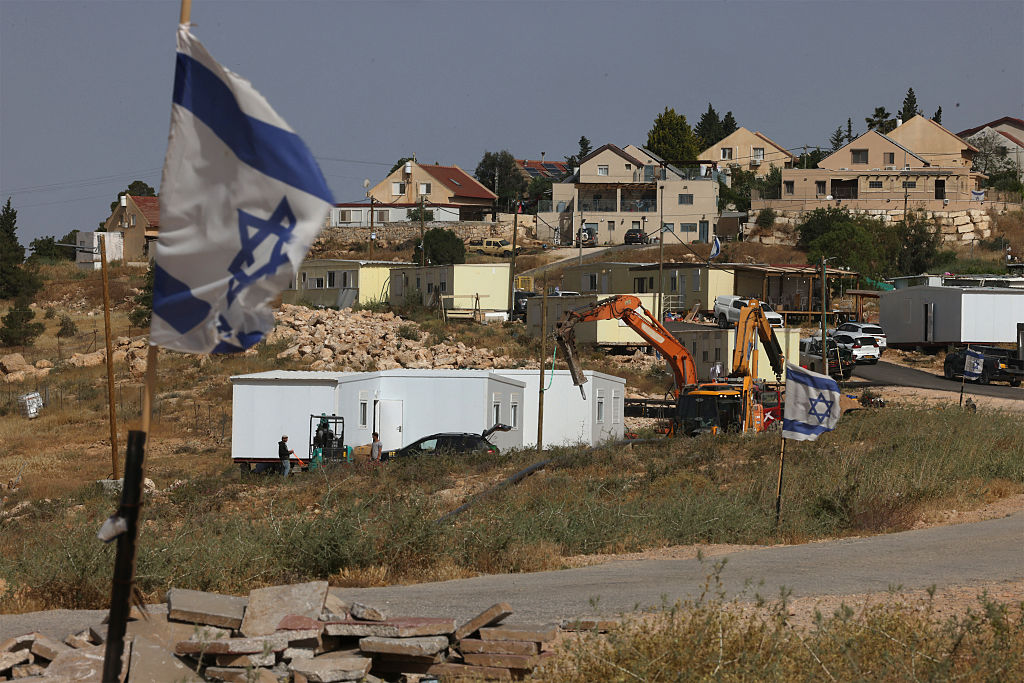
In May 1992, I went on a real estate tour of suburban West Bank settlements. I had no intention of buying, and neither did my ostensible shopping companion, who was in fact the photographer from the Israeli news magazine where I worked. The tour was part of the government-sponsored “Operation Populate Judea and Samaria,” which referred to the biblical name of the territory known by most of the world as the West Bank. Most of the passengers on our bus were young couples trying to figure out how to afford a first home. In one settlement, they were offered 680-square-foot homes, with the legal right to expand their houses as their families grew, for a fraction of the price of a similar-sized city flat. An official told us, while we stood outside another settlement, that we could obtain a government mortgage for 95% of the house’s value, and that some of its value could be turned into a grant.
In short, it was a giveaway. A crucial election was a month away. The ruling right-wing Likud Party, led by Yitzhak Shamir, feared that Yitzhak Rabin’s Labor Party would win, and would be willing to trade pieces of the occupied West Bank for peace with the Palestinians. Once Israeli citizens bought homes, though, it would be hard to keep them from moving in. Once they moved in, the political price of forcing them to leave would be too high to pay. “What if Rabin wins? What if they give it back?” a young man with a visibly pregnant wife asked our guide. “We don’t build here to give it back,” the guide answered.
Rabin did win. He went on to sign the Oslo Accords, a supposedly interim agreement that turned over part of the West Bank to limited Palestinian rule — and which left all the settlements and much land between them under full Israeli control, their fate awaiting a final peace agreement that has yet to come. The “interim” arrangement has lasted ever since. Settlement building achieved its goal, which was to leave future Israeli governments fewer options for peacemaking.
Today, Israel has a right-wing government more extreme and less inhibited than Shamir’s. Given current polling numbers, it has even more reason to be fearful about an election two months away. This fear is driving a frenzy of settlement activity in the West Bank.
With the caveat that polling can be unreliable, most professional, credible surveys consistently show Netanyahu’s Likud and its allies losing to a loose bloc of opposition parties. The candidate who appears most likely to lead a new government is Gadi Eisenkot; like Rabin, he is a former military chief of staff.
Unlike Rabin, Eisenkot is not running on a platform of trading occupied territory for peace. In his effort to attract what could be described as “never-Netanyahu” rightists, he recently reiterated that, under his government, “no Palestinian state will be established.” The manifesto of his newly formed party, Yashar (Straightforward), is very vague on the subject of peace.
It does, however, say the party will ensure that Israel has a “stable Jewish majority,” which implies that it would explore some way to relinquish Israel’s control over the 3 million Palestinians in the West Bank. It’s hard to imagine Eisenkot creating a ruling coalition that includes the Likud or the far-right Religious Zionist Party, whose leader, Finance Minister Bezalel Smotrich, is the current government’s settlement tsar. Eisenkot’s flagrant ambiguity does make it just possible to imagine him placing restrictions on settlement building, or even giving up territory, on pragmatic security grounds.
The response of the Netanyahu government and their settlement movement allies has been to escalate their already intense efforts to expand the Israeli presence in the West Bank and to create realities that will tie the next government’s hands.
The haste shows in the Housing Ministry’s sudden call on Aug. 18 for bids from contractors to build over 1,200 housing units at the controversial site known as E1, a small strip of land in the West Bank just east of Jerusalem. The development is intended to create an urban expanse joining Jerusalem with Maaleh Adumim, one of the largest West Bank settlements, on the desert slopes to the city’s east. The result will be a suburban salient nearly cutting the West Bank in half, dividing the major Palestinian cities to its north and its south, and isolating them from East Jerusalem. The deadline for bids is before the election, so that the outgoing government can lock in contracts before it leaves office.
“Marketing has begun for the neighborhood that will bury a Palestinian state,” a right-wing website, Olam Katan (Small World), crowed after the ministry move. Advocates of a two-state agreement, in Israel and abroad, oppose the construction for just that reason. A year ago, a planning committee of Israel’s Civil Administration in the West Bank approved the new development in principle, but under international pressure, especially from key European countries, the government held off on further moves.
Meanwhile, Israeli anti-occupation groups went to court to block the development. In response, the State Attorney’s Office promised to give them advance notice of a call for bids, so that they could seek an injunction against it. No such notice was given, reportedly because the Housing Ministry violated its legal obligation to inform the state’s lawyers. But the move forward on E1, along with escalating settler violence, prompted the long-expected sharp international reaction. Twelve countries, including France, the U.K. and Canada, announced on Sept. 8 that they would act to ban the import of goods produced in settlements. Directly targeting the E1 project, British Foreign Secretary Ed Miliband declared that the U.K. would enact sanctions against “companies and individuals who provide services such as construction, infrastructure, financing or real estate for settlement expansion.” It remains to be seen how Israeli courts will rule on the project, or whether developers will submit bids despite the sanctions threat. What’s clear is that the Netanyahu government cares about neither the law nor diplomatic fallout in its hurry to lock in settlement growth.
The same dynamic drives the actions of Israeli settlers, especially from the so-called outposts, against Palestinians. An outpost typically consists of a few structures on a hilltop, populated by a single family, some teenage volunteers and livestock that is grazed widely, often on Palestinian-owned land. At first glance, the outpost settlers appear to be maverick extremists that the government has failed to rein in. In reality, they are the partners of the government in a policy aimed at pushing Palestinians off pasture and farming land between larger settlements and bringing it under settler control. The current government established 85 new outposts during its first three years, according to a recent report by researchers Hagit Ofran of Peace Now and Dror Etkes of the Kerem Navot organization. As their previous report detailed, the government supports the outposts through multiple channels, including funds for road building, generators, off-road vehicles often used to harass Palestinians and financial support for the young volunteers.
In recent weeks, outpost settlers have become more audacious. At the village of Qusra near Nablus, for instance, settlers besieged three Palestinian homes in early August, establishing an outpost virtually on their doorsteps. After several days of public outcry, the army removed the makeshift structures. But it issued an order declaring the immediate vicinity of the houses a closed military area, drastically restricting access to journalists and left-wing activists who came to help the still-besieged Palestinian families.
At the same time, flatbed trucks navigated the narrow roads of the northern West Bank to deliver mobile homes to a site known as Kadim, near the Palestinian town of Jenin. Kadim was one of four small, isolated and difficult-to-defend Israeli settlements in the area that were evacuated in the summer of 2005, along with the more numerous and populous settlements of the Gaza Strip, under then-Prime Minister Ariel Sharon’s unilateral withdrawal plan. For the radical right now represented by Smotrich and the Religious Zionist Party, the pullback was not just a political defeat but also a crisis of faith. In their distorted version of Judaism, Israel’s conquests in 1967 were part of God’s plan to fulfill biblical prophecies of redemption, and settling the conquered land is a fundamental commandment. In 2005, prominent far-right rabbis confidently predicted that God would not allow the withdrawal to take place.
Before this summer, the Netanyahu government had repopulated two of the settlements. Settlers moved into a third, Ganim, in early August. The ceremony resurrecting Kadim took place on Aug. 20, as 30 families moved into the mobile homes. Smotrich gave a speech, as did Likud Justice Minister Yariv Levin, the architect of the Netanyahu government’s antidemocratic “reform” of the judiciary. The back-to-back reestablishment of the evacuated settlements is one more sign of the government’s desperation to establish facts while it still can.
The return to Kadim, though, is pregnant with conflicting symbolism. For the theological right, it can easily be read as proof that settlement is the divine will and history is back on track. On the other hand, Kadim is a reminder that a settlement can be removed, just as those in Gaza were and, for that matter, those in Sinai evacuated under the 1979 peace treaty with Egypt were.
Indeed, this may be the deeper worry that underlies the entire settlement enterprise, not just the latest push: Its proponents seek to create an Israeli hold on the West Bank that is irreversible, but they know that history contains reversals. So no extent of settlement is enough to erase the angst.
The political constellation that would enable an Israeli pullout from occupied land would require not just a victory for the anti-Netanyahu bloc in October but also a strong role for the left within that bloc. It would require, with international help, the disarming of Hamas and the rebuilding of the Palestinian Authority as a strong partner, one that enjoys the trust of the Palestinian population,for negotiation. and it would require intense diplomatic pressure, similar to that wielded by Washington in the negotiations with Egypt. It would also need Israeli public opinion to shift — but such shifts have taken place in the past. Support for giving up the Sinai in return for peace with Egypt rose drastically after Egyptian President Anwar al-Sadat’s visit to Israel in 1977, and backing for peace talks with the Palestinians became mainstream in the early 1990s, due both to the First Intifada and U.S. diplomatic efforts. Treating the post-Oct. 7 swing to the right in Israel as an unchangeable fact defies history.
This is why the right is so desperate to close options for peace while it still can, and why the approaching election is so fateful.
Become a member today to receive access to all our paywalled essays and the best of New Lines delivered to your inbox through our newsletters.