


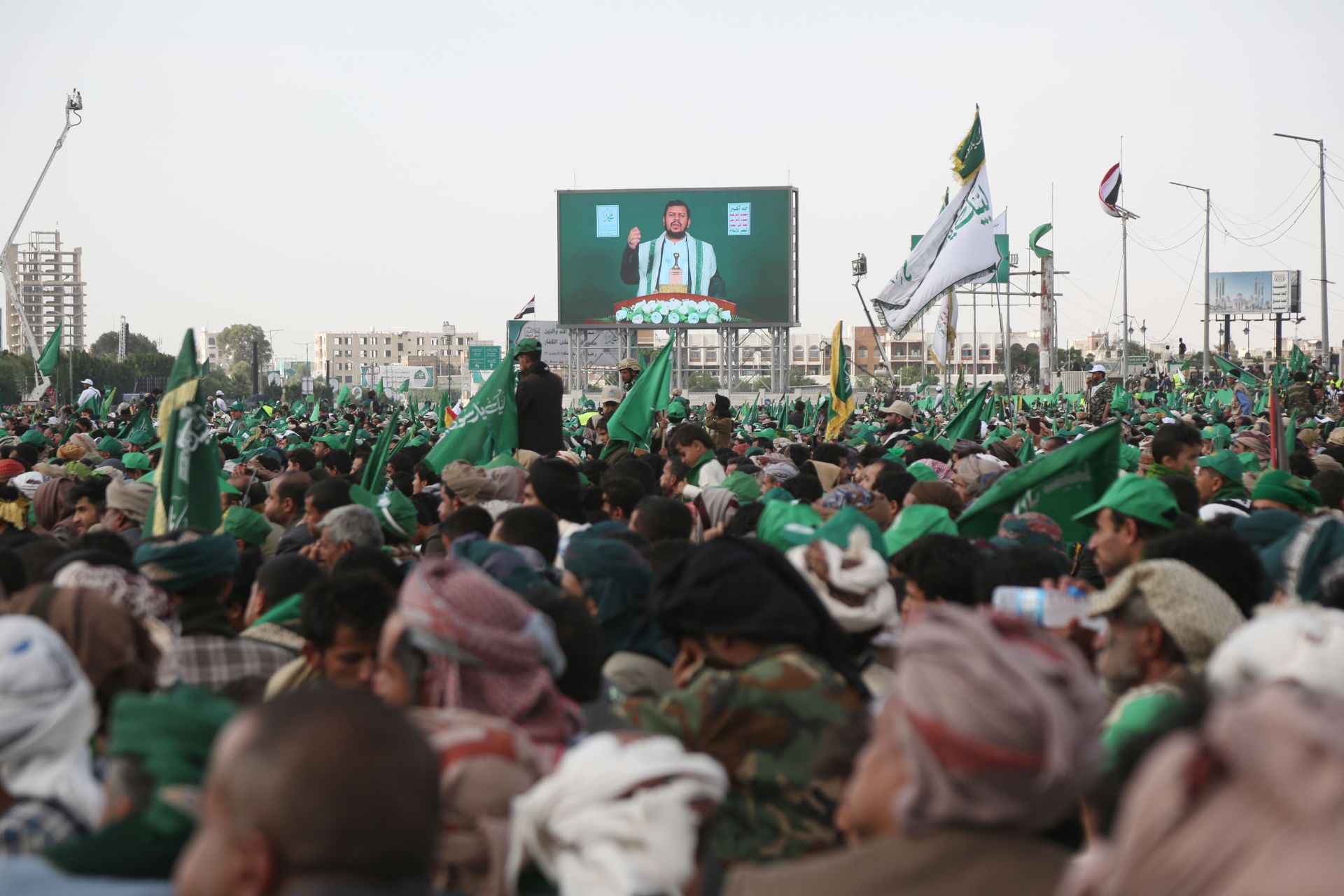
Twenty-two years since their emergence as a rebel group in Yemen, the Houthis have become arguably the most powerful nonstate actor in the world. How and why did they manage such a feat?
There is no doubt that Iran was significant in empowering and strengthening the movement and its military capabilities. Yet Iranian support, and the Yemeni army arsenal they seized, are not the only factors behind the Houthis’ strength.
Their enemies’ strategic mistakes, miscalculations, and absence of coherent strategies and policies — along with incompetence, inefficiency and divisions among local rivals — also boosted and emboldened them. There was a strategic myopia among all actors — local, regional and international. The Houthis are often described as lucky to have had such irrational and fragmented enemies.
Even Yemen’s rugged terrain worked to their advantage. And in the end, they emerged as such a powerful force that their ambitions are no longer confined by geographic boundaries.
In 2004, a group of fighters in the mountainous terrain of Saada governorate, bordering Saudi Arabia, began challenging the authority of the government of former President Ali Abdullah Saleh. The group gradually transformed from al-Shabab al-Mumin (“The Faithful Youth”), as they were first known in the 1990s, into Ansar Allah, better known as the Houthi movement, led by Hussein al-Houthi. They began chanting slogans similar to those of the Islamic Republic of Iran, such as “Death to America” and “Death to Israel.”
Their behavior angered Saleh. At that time, few were even aware of the Houthis’ existence, though in small numbers they were chanting these slogans as early as 2002, according to some reports.
Hussein al-Houthi was a member of Parliament at the time. Saleh considered him and his supporters a challenge to his authority in Saada. Mediation efforts aimed at convincing them to hand themselves over to the police were unsuccessful, and clashes erupted on June 18, 2004, as government forces attempted to arrest the Houthi leader.
Mediation continued even after the clashes, but al-Houthi refused to surrender. On Sept. 10, the government announced the killing of the rebel leader and the end of the insurgency. Yet the latter would survive, even outlasting Saleh’s regime.
After Hussein al-Houthi was killed, his father Badreddine took over for several months before being succeeded by Abdul-Malik, Hussein’s elder brother and the current leader. Abdul-Malik led the movement for six intermittent rounds of battles with the government between 2004 and 2010, usurping power by force in 2014 and bringing the group to the attention of the world. They have since acted to disrupt regional security and international business.
Marginalization, local grievances, religious freedoms and victimhood were the headlines around the Houthi rebellion in Saada, attracting local and international human rights attention and media reporting. The Houthis were falsely presented as a Zaidi minority group in a Sunni-dominated government, whereas in fact Saleh himself was a Zaidi, and it was the Zaidis who were mostly in control of the decision-making core. Many of the politicians and civil society activists who were sympathetic to the Houthis during the Saada wars were among the diaspora.
Zaidism is an offshoot of Shiite Islam, named after Zaid ibn Ali, the great-great-grandson of the Prophet Muhammad. Zaidism became deeply rooted in northern Yemen from the ninth century on, and a Zaidi imamate ruled parts of Yemen for more than a thousand years, with interruptions. Zaidis believe that the imam should be a qualified descendant of Hassan or Hussein, grandsons of Muhammad. The imamate was overthrown by a military coup in 1962, supported by Egypt.
The Houthis have cleverly exploited this narrative to reinforce their sense of religious victimhood. Saleh also exploited this war in Saada to exhaust the forces loyal to his main aide, Gen. Ali Mohsen al-Ahmar, commander of the 1st Armored Division. Saleh was preparing the ground for his son Ahmed, then commander of the Republican Guard, to succeed him.
The succession plan was fueling opposition to Saleh, including from the Houthis, though there were reports that Saleh went so far as to provide weaponry to the Houthis in a bid to weaken al-Ahmar, and that he used to declare and end campaigns against the movement with a single phone call. These actions indicated that Saleh was not serious about settling the problem, whether by peace or war, according to a mediator who took part in negotiations around the Saada wars. Still, these machinations presented an opportunity for the Houthis to exploit this division and rivalry.
In 2007, Qatar jumped in to mediate between the Houthis and the government, culminating in a Doha peace agreement in 2008 that was not implemented. The Qatari mediation was not merely a bid to end the war; it allowed the Houthis to engage with a regional actor and gain broader international attention. It effectively recognized them as a party to negotiations with the state, leading to their empowerment.
On March 13, 2008, I spoke with Abdul-Malik al-Houthi on the phone for the first and last time, quoting him in an interview for the Saudi Al Riyadh newspaper. He accused some parties in the government of preparing for another round of fighting, and, a few days later, another round of fighting did indeed break out.
In November 2009, during the sixth round of the battle between the Yemeni government and the Houthis, Saudi Arabia became embroiled in Yemen’s turmoil. The conflict represented a national security issue for Riyadh. Three months earlier, Saleh had launched a new offensive called Operation Scorched Land and, in November, clashes occurred near al-Dokhan mountain, leaving one Saudi border guard dead, prompting Riyadh to launch airstrikes and artillery shelling on Houthi targets.
Nobody was mindful of the Houthis’ growing influence and connections with Iran at that time, nor even for years afterward. Riyadh seemed to have relaxed after that clash. There were even reports that Saleh was using the Houthis as a tool to blackmail Riyadh, much as he blackmailed the United States with Yemen’s al Qaeda branch, al Qaeda in the Arabian Peninsula (AQIP), using the insurgency, according to some reports, to gain Saudi support. Saleh was politically astute in navigating competing interests and exploiting their contradictions to his advantage, yet such tactics would ultimately lead to the collapse of his regime and the country at large. Again, this served the Houthis.
Driven by their political opposition to Saleh and his attempts to groom his son as his successor in a republican country, the then-opposition parties, including leftists and the Islah party — a congregation of the Muslim Brotherhood, tribal leaders and business owners — rejected the wars against the Houthis and used this as political leverage against Saleh.
During the popular uprising against Saleh in 2011, the Houthis joined the protests in the capital, Sanaa, and elsewhere, demanding the ouster of Saleh and an end to his 33-year rule. This step was welcomed by other opposition parties. They took full control of Saada in March 2011, a month after the uprising started. Some of the opposition leaders hailed the step. They did not realize Sanaa could be next.
By 2013, after Saleh stepped down, a National Dialogue Conference (NDC) was underway, with broad participation from all forces, including the Houthis, to pave the way for the transfer of power away from the former president, after two years of protests. While participating in a dialogue to establish a civic state, the Houthis were also engaged in a separate, high-profile battle with Salafists in Dammaj, home to the prominent Salafi religious school, Dar al-Hadith. The Houthis besieged the Salafists and ultimately forced them out of Saada in January 2014. That marked the beginning of the state’s collapse, according to many observers. After that, political party leaders went to negotiate with the Houthi leader in his hideout in Saada. The Jews of Saada had already been expelled from the province in 2007, as they were later out of Yemen altogether, after many centuries of living in harmony with their Muslims neighbors.
To the NDC, the Houthis presented a progressive vision for building a civic, secular state, telling Yemen’s southern separatists that they understood their grievances and would stand with them. They spoke about freedom of thought and belief, freedom of expression and equal citizenship. They even said the state should not adopt any religious dogma.
These pledges would come crashing down in 2015, when the movement stormed the southern capital of Aden.
Once the Houthis gained control of Sanaa, they started consolidating their ideology, built on a religious conception of authority that grants them an inherited right to rule: They claim they are descendants of the Prophet Muhammad and thus have the divine right to govern. They imposed a tax known as the “khums” (meaning “one-fifth,” a 20% levy on certain incomes and resources), institutionalizing a system of revenue extraction that serves their ideological and political agenda. This, in addition to other forms of taxation, empowered them economically.
After Saleh agreed to step down, on Feb. 27, 2012, he formally handed over the presidency to his vice president, Abd Rabbuh Mansur Hadi, following an uncontested election. However, Saleh remained as head of the General People’s Congress, which was the ruling party before the uprising in 2011. He acquired legal immunity through the deal and became an opposition leader, though his party held half of the Cabinet seats.
Saleh was driven by a desire for revenge against his opponents, foremost among them Gen. al-Ahmar, who had defected from his ranks, supported the uprising against him and joined the opposition, as well as the Islah party, and Hadi. Accordingly, he allied with the Houthis to undermine the authority of the new government. Saleh had accused al-Ahmar and Islah of plotting to assassinate him on June 3, 2011, when an explosive device went off in the presidential palace mosque, killing a few of his officials while he sustained serious injuries.
Having once been bitter adversaries, Saleh and the Houthis became tactical allies in 2014, united by a shared antagonism to Hadi and the transitional government. After fighting six wars against the Houthis between 2004 and 2010, Saleh was accused by his rivals of using his influence within the military, security services and state institutions to facilitate their takeover of Sanaa on Sept. 21, 2014. However, allies argue that he handed over everything to Hadi, and it was the latter’s responsibility to act and defend the capital and the state.
Following the end of the NDC, the Houthis started their campaign against Hadi, who lacked competence, charisma and any clear political agenda. They mobilized forces and took over Amran governorate. They blew up the houses of their enemies. I went to report from that area, in al-Khamri, and interviewed a Houthi fighter with a rifle on his right shoulder at the scene of one of these destroyed houses.
“We are liberators, and we will reach everywhere. … We will liberate even America and Russia,” he said.
After they conquered Amran and crushed the commander of Brigade 310, Hameed al-Qushaibi, Hadi went to the city under heavy security in a visit approved by the Houthis. I was one of only three reporters for international media with him. Paradoxically, he announced, “Amran returned to the fold of the state.”
After that, the Houthis started encircling Sanaa. Abdul-Malik al-Houthi was intensifying his rhetoric against the government after it raised fuel prices and forced them to reconsider the increase, but this was not enough for him. His demands for the cancellation of fuel price increases, the implementation of the outcomes of the NDC and a change of Cabinet struck a chord among the people. His supporters dubbed him a leader of the revolt. These demands are believed to have brought about Yemen’s collapse.
Tension was very high, and Defense Minister Mohammed Nasser Ahmed said the army was maintaining a “neutral position,” while Interior Minister Abdu al-Tareb welcomed the Houthi fighters in Sanaa, calling on the police to collaborate with them, describing them as “friends of the police.” Hadi held only one National Defense Council meeting, and the military units were left in a state of professional disarray.
Some imagined the Houthis would crush their opponents, including Gen. al-Ahmar, finish the job and then leave the capital. Saleh thought he would use them and then get rid of them, but this is not what happened. Al-Ahmar fled Sanaa on a military helicopter to Saudi Arabia following clashes with the Houthis. After that, all political actors, except the Nasserites, signed the Peace and Partnership Agreement on Sept. 21, 2014, accepting the Houthi takeover.
The Houthis went on to seize the Red Sea city of Hodeidah, and they purportedly went into al-Bayda to fight al Qaeda militants. The U.S. probably mistakenly thought they could be its main ally in countering terrorism. They were later accused of forging relations with the militants in al-Bayda and other areas, as well as with al-Shabab in Somalia.
Afterward, the Houthis refused to accept the outcome of the NDC, primarily the federal system it envisioned that divided Yemen into six regions. Hadi mistakenly thought the Houthis would not target him and, according to a senior official who worked with him, used to say that he was assured by Tehran that “the president would be a red line” for the Houthis and that they would leave Sanaa. When asked by his senior official if he trusted Tehran, Hadi said, “Do you think that Tehran would forsake the president for those rogues?”
The Houthis later put him and his Cabinet under house arrest, after he refused to issue several appointments, including a vice president from the movement, which would have offered a pathway for transferring power away from Hadi. The situation was at boiling point. Under house arrest, Hadi and his Cabinet resigned on Jan. 22, 2015, putting the Houthis in a bind. They filled the power vacuum by announcing a constitutional communique on Feb. 6 to complete their coup, after seizing all government institutions.
Hadi fled Sanaa on Feb. 21 to the port city of Aden, with the help of some tribal figures. His Defense Minister Mahmoud al-Subaihi later joined him. He announced on March 7 that Aden would be an interim seat for his government.
Saleh was encouraging the Houthis to go after him, and fighter jets flew from Sanaa to strike the presidential palace in Aden, while troops moved to invade Lahj and Aden. Saleh and Abdul-Malik al-Houthi were both using mobilizing rhetoric. As the Houthis advanced toward Aden, Hadi fled by car on March 25 to Oman and then to Riyadh, while his defense minister was captured by the Houthis, who were aided by forces loyal to Saleh. Hadi later appointed al-Ahmar as his deputy.
The next day, Saudi Arabia announced the launch of a major air campaign, Operation Decisive Storm, in a bid to reinstate Hadi and his Cabinet in Sanaa. It would take eight years from the start of the campaign for the Saudis to reach Sanaa — but as negotiators suing for peace, instead of military victors.
Hadi had vowed he would raise Yemen’s flag on the mountains of Maran, the main hideout of the Houthi leader. Instead, he passed away in Riyadh on May 28 this year, having transferred his power, on April 7, 2022, to a presidential council composed of eight people who had nothing in common, save their opposition to the Houthis. It was part of a Saudi bid to contain the Houthis through a peace road map.
Then the Houthis latched on to the conflict in Gaza and used it to become a regional force.
It was this decision that saved the fragmented anti-Houthi bloc in Yemen. International attitudes toward the Houthis shifted as a consequence of the group’s strikes on Israel and disruption of maritime activity in the Red Sea.
Tensions increased between Saleh and the Houthis as they consolidated power and marginalized the former president’s allies. Saleh called for an uprising against the Houthis, who moved rapidly to suppress what they described as “sedition.” In December 2017, Saleh publicly called for confrontation with the Houthis and opening a new page with the Saudi-led coalition. But it was too late. Riyadh no longer trusted Saleh, and he was killed by the Houthis on Dec. 4, 2017.
During the Saudi-Houthi truce between 2022 and 2026, the anti-Houthi bloc and their regional allies relaxed, and were busy settling their own internecine conflicts. Riyadh wanted to exit Yemen’s protracted war to focus on its economic ambitions, but without a clear strategy prioritizing its security and the interests of its allies. That logic was flawed — the Houthis might take financial concessions but never forsake their overambitious and transnational ideology. On the contrary, the Houthis used the truce to build up more military and telecommunication capabilities. It was during that truce that they acquired sophisticated hypersonic missiles. The Houthis’ enemies did nothing in the meantime, save for fighting over the appointment of incompetent officials. They bet on a truce that never translated into peace.
Riyadh and Abu Dhabi remained the two pillars of the Saudi-led coalition. They had managed to recapture Aden in July 2015, along with other areas in the south. The United Arab Emirates proved to be more effective in the fight against the Houthis. In 2017, it led the campaign to seize the Red Sea port city of Mokha in Taiz governorate, and parts of Hodeidah, though disagreements started to intensify.
Since 2016, Saudi Arabia and the UAE have gradually shifted from being partners in the war against the Houthis to rivals pursuing competing visions for Yemen. While Riyadh has prioritized restoring the internationally recognized government and protecting its borders, Abu Dhabi has built a network of local armed forces, particularly the Southern Transitional Council (STC), which seeks southern independence.
This rivalry became increasingly visible after the STC seized Aden in 2019, and deepened following the formation of the Presidential Leadership Council in 2022, which brought together groups with conflicting agendas. Riyadh increasingly prioritized de-escalation and a negotiated settlement with the Houthis, and went on to form loyalist Salafist forces, while the UAE maintained its influence through local allies, including Salafists and strategic positions along the southern coast. Abu Dhabi was not happy that it was excluded from the peace talks with the Houthis.
In December 2025, the STC’s expansion into Hadramawt and Mahra brought these tensions to a head, triggering a direct confrontation between Saudi Arabia and the UAE.
That rift further weakened the Yemeni government, deepening divisions within the anti-Houthi camp, to the advantage of the Houthis. This fragmentation of armed forces with different loyalties was one of the grave mistakes and miscalculations of the two allies in dealing with Yemen, along with the underestimation of the Houthis’ growing power and subsequent threat to their security and that of the region.
This did not help the government build a good model for governance in the territories it controlled, which again ceded the advantage to the Houthis. A significant symptom of this fragmentation was clear in the rapid collapse of the government forces in September and October this year on the western coast, around Bab al-Mandab and the Taiz countryside. It also appeared to many, including its enemies, that the departure of the UAE left a substantial vacuum.
The Houthis were empowered through sophisticated weapons, training, building indigenous industrial and technical capabilities, and transferring and embedding expertise within their military structure.
In 2018, the UAE led an offensive to recapture the strategic port city of Hodeidah from the Houthis, but was stopped after intense pressure from the U.S., European governments, the United Nations and international humanitarian organizations, which warned that a battle for the port could trigger a humanitarian catastrophe and disrupt Yemen’s main lifeline port. The outcome was the Stockholm Agreement, signed on Dec. 13, 2018, which established a ceasefire in Hodeidah and envisaged the redeployment of forces from the city and its ports. While it prevented an immediate escalation, implementation stalled, the Houthis retained control of the governorate, and government-aligned forces lost the opportunity to complete their offensive.
Now, some Western governments acknowledge their strategic mistake, recognizing that the Houthis leveraged it to expand their maritime power and attack vessels across the Red Sea and Gulf of Aden, along with weapons smuggling.
In November 2023, the Houthis became involved in the Gaza conflict. Between then and October 2025, they carried out more than 100 attacks on commercial vessels in the Red Sea, Bab al-Mandab Strait and the Gulf of Aden, sinking at least four ships.
The international response to Houthi attacks exposed the limits of the global maritime order, and the inability of major powers to introduce collective deterrence or resolve; they pursued divergent individual approaches. China and Russia avoided confrontation and chose to strike deals with the Houthis. Europe launched Operation Aspides but confined itself largely to defensive measures. The U.S. moved from initial restraint to military strikes for 52 days, from March 15 to May 6, 2025, under Operation Rough Ride, before reaching a separate deal with the Houthis. These fragmented responses reflected a collective miscalculation. They failed to end the risk, and that emboldened the Houthis. In short, these actions normalized the threats rather than working toward a solution.
President Donald Trump had designated the Houthis as a “foreign terrorist organization” by the end of his first term, on Jan. 19, 2021. Yet one of the first decisions by his successor, President Joe Biden, was to revoke the designation. Despite this, the U.S. later conducted strikes against them in 2024, along with the United Kingdom, in a bid to degrade their ability to attack international shipping and U.S. naval forces. Israel also attacked the Houthis in 2024 and 2025, following their missile and drone strikes on Israeli territory. Trump redesignated them as a terrorist organization in January 2025 and, between March and May 2025, the U.S. launched an intensive military campaign against the Houthis before agreeing to halt strikes following an Oman-mediated ceasefire. This is another recognition the group extracted, emboldening their position domestically and internationally.
Their involvement in the Gaza war, though ineffective, brought them broader regional exposure as the most important element in the so-called “Axis of Resistance.”
It took Yemenis 22 years to truly know the Houthis, and it took regional and international actors 12 years to realize how their military power could affect regional security and maritime commerce. It may take them all collectively another decade to develop an understanding of the Houthis and their deep strategies, and how to deal with them, after they, through their individual and collective mistakes and faulty tactics, helped create their own nightmare.
But it is clear that it is not Iran’s support alone that made and empowered the Houthis, but also these misguided policies, a lack of strategy, and the repeated underestimation of the group, which has now reshaped regional security architecture and the global maritime order.
Saudi Arabia is currently under Houthi strikes that have disrupted its airports. It needs to revisit its policies in Yemen and stop depending on people whose failures drove the situation to this point. That includes having a strong Yemeni Cabinet with competent officials serving the country’s national interests. All Gulf actors need to develop a collective approach or strategy for how to deal with Yemen and end its conflict. Merely managing it is no longer viable.
There is a need to revisit the roots of Yemen’s spiraling conflict. Without a realistic deep dive into its causes and a sounder understanding of the Houthis and their broader strategies, it will be difficult to create an off-ramp for Yemen and the region. And international actors will have to stop underestimating the threats posed by this conflict, and acknowledge Yemeni stability as essential to the global maritime order.
Become a member today to receive access to all our paywalled essays and the best of New Lines delivered to your inbox through our newsletters.