


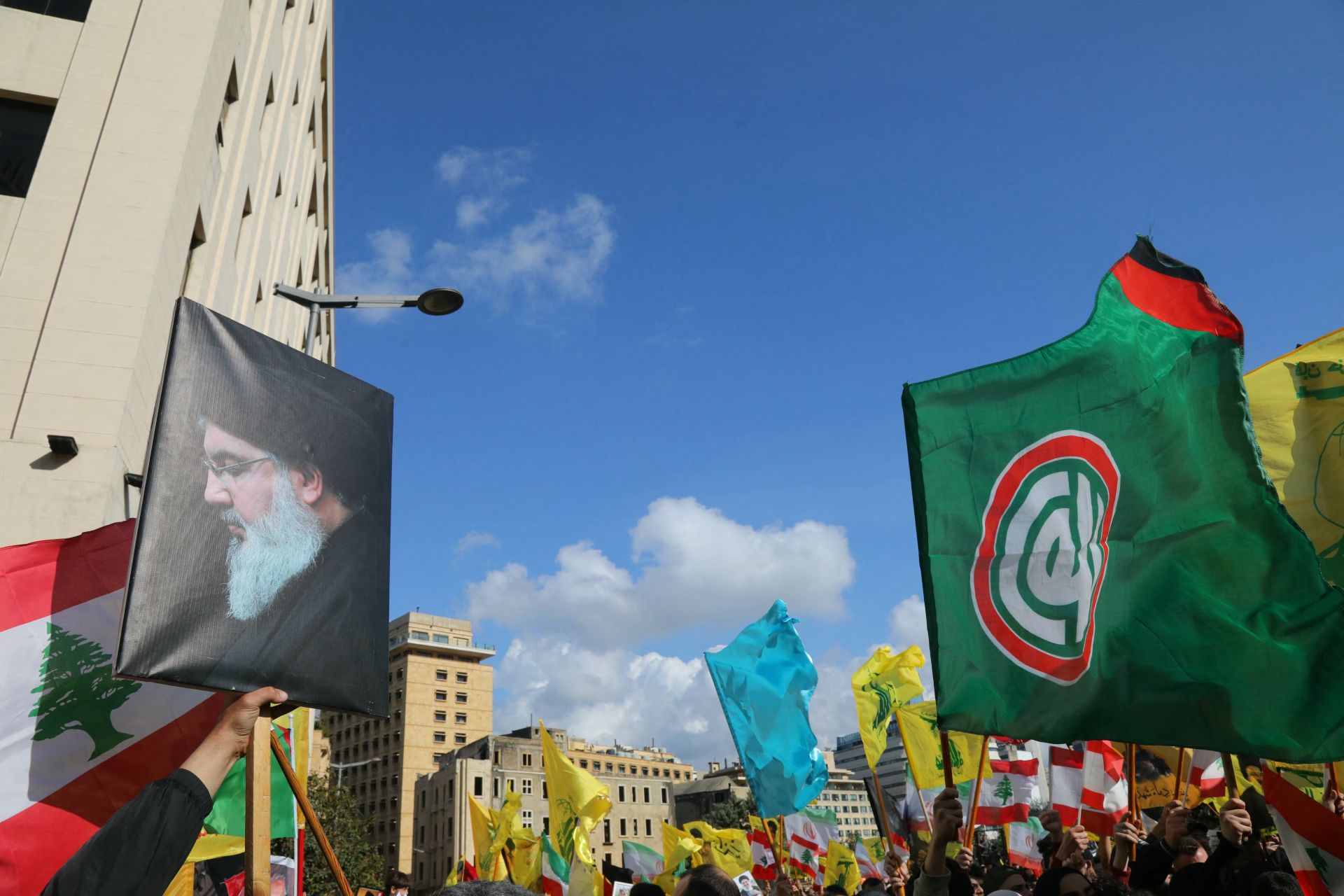
This August, on the 48th anniversary of the disappearance of Musa al-Sadr — a revered figure in the modern history of Lebanese Shiism — Lebanon’s Speaker of Parliament Nabih Berri paid homage to the vanished cleric, while referring to his own warnings to the current government against direct negotiations with Israel.
“We warned of the consequences of negotiating under fire in the absence of national consensus. Seven rounds of negotiations and what has been the result? The occupied lands have expanded, destruction has increased, the number of martyrs has risen, and Israel has continued its war.”
Berri leads the Amal Movement, which was founded by Sadr in the 1970s, and which today forms one half of Lebanon’s so-called “Shiite duo” alongside Hezbollah — an alliance between the country’s two largest parties from the Shiite Muslim community. Amal, unlike Hezbollah, is deeply embedded in the institutions of the state, and amid an ongoing war and occupation that have destroyed much of southern Lebanon — the heartland of the country’s Shiite population — it could emerge as a critical interlocutor in ongoing talks aimed at ending the conflict.
At a moment when the Lebanese government needs someone capable of talking simultaneously to Washington, Tehran, anti-Hezbollah groups in Lebanon and Hezbollah itself, Amal may be one of the only actors positioned to do so.
Recently, Lebanese officials have, for the first time in decades, engaged in direct talks with Israel under U.S. mediation, signing a so-called “framework agreement” in June. In theory, per this framework agreement, the Lebanese military is tasked with restoring authority over the entirety of the country’s territory — beginning with several “pilot zones” — while Hezbollah disarms. In exchange, Israel has agreed in theory to renounce any territorial ambitions in Lebanon, though senior officials, including the Israeli Defense Minister Israel Katz, continue to rule out withdrawing troops from Lebanon.
Although the talks continue, Amal officials who spoke with New Lines expressed skepticism about their ability to bring a durable solution to the people of the south.
A member of Amal’s political bureau, who asked for anonymity to discuss sensitive matters, said: “Israel has not given up anything, so there is no real balance in the negotiations. They occupy land and oblige you to sign your surrender.” At the current pace, they added, “we would need decades for Israel to withdraw from just a bit of Lebanese territory.” In July, Israel did withdraw from the town of Zawtar al-Gharbiyeh, where the Lebanese army then deployed and some residents returned — the first and, to date, only significant implementation of the “pilot zone” scheme.
Amal also objected that the agreement was presented to the government as a fait accompli rather than something to be debated. Describing how the party learned of the negotiations, a member of the party’s political bureau stated that “the matter was not brought before the government for discussion, since the negotiations had already begun. The government was just made aware that negotiations were already taking place in Washington.”
While expressing reservations about the current process, Amal officials are not, however, opposed to negotiations in general. The same official said, “Negotiations should be indirect and lead to the Israeli enemy’s withdrawal to the international border and the deployment of the Lebanese army south of the Litani River.” Given that, unlike Hezbollah, the party also supports a state monopoly on weapons after an Israeli withdrawal, the demands of Amal put it far closer to other factions in the Lebanese government.
Berri himself has also made clear that he is open to a settlement. Before the framework agreement was signed, he had proposed an alternative approach to Lebanese President Joseph Aoun: a simultaneous Israeli and Hezbollah withdrawal from south of the Litani, coupled with bringing Hezbollah’s weapons under state control. To Amal, this approach would be more capable of securing the domestic consensus that the party views as essential to any durable settlement. As one Amal official put it, “Lebanon needs a national dialogue that everyone is prepared for and that everyone complies with.”
The Amal Movement was founded by Sadr in 1974 as the “Movement of the Deprived.” It sought social, political and economic justice for Lebanon’s marginalized, particularly Shiite, populations. Sadr believed that many of the problems and inequalities in Lebanese society were due not to sectarian differences, but rather to the lack of a strong central state. To push for his idea of a strong state, Sadr reached out across sectarian lines, both before and after the Lebanese Civil War broke out in 1975. This cross-sectarian dialogue quickly became an important part of Amal’s institutional culture.
In 1978, Sadr traveled to Libya to discuss the deteriorating situation in Lebanon with Moammar Gadhafi, whose regime subsequently disappeared him. Since then, he has become something of a legend in Lebanon’s Shiite community. Spending time in Beirut’s southern suburbs or in cities in the country’s south, one sees his picture almost everywhere. In some he is smiling, while in others he is standing tall in his clerical robes. Sometimes his posters appear alone; sometimes they appear alongside those of Hezbollah or Iranian leaders, such as the late Ruhollah Khomeini and Ali Khamenei. His omnipresence is a visible reminder that, decades after his disappearance, he remains a powerful figure in the imagination of Lebanon’s Shiite community.
Sadr is also present in the minds of Amal officials today. Members of the party’s political bureau and presidency council — two of its most important institutions — often give interviews and write articles invoking Sadr’s legacy as a guide to navigating Lebanon’s political crises. One member of the political bureau who spoke to New Lines emphasized the applicability of Sadr’s insistence on dialogue and national cohesion. “He was a man who grounded himself in principles focused on uniting rather than dividing,” he said. Those principles were just as relevant to the Lebanese Civil War that Sadr witnessed as they are to Lebanon today. “He believed that a lack of national unity only serves the Zionist enemy and said that Lebanon’s peace is the best form of war against Israel.” (Sadr was not above participation in the civil war, however: The name Amal itself, which means “hope” in Arabic, is also an acronym for “Afwaj al-Muqawama al-Lubnaniya” — “the Lebanese Resistance Battalions” — as Sadr called the militia he founded in 1975. One of his oft-quoted sayings was “Weapons are the adornment of men.”)
This organizational culture persisted after Sadr disappeared. In 1980, Berri took over the movement and, during the civil war, continued pursuing dialogue with other Lebanese and international actors while simultaneously consolidating Amal’s position within the country.
With the rise of Hezbollah in the mid-1980s, Amal acquired a formidable rival that could erode part of its support base. From 1988 to 1990, during the final phase of the civil war, the two became embroiled in bitter fighting, in what became known as the “War of Brothers.” Hezbollah, backed by Iran, rejected the Lebanese political order while Amal, backed by Syria, wanted to participate in it. Hundreds were killed.
After the war, Amal and Hezbollah realized that continued infighting would weaken them both. So they patched things up and settled into a division of labor. Amal entrenched itself in Lebanon’s political institutions. In 1992, Berri became Lebanon’s speaker of Parliament, the highest political office available to Shiite Muslims in the country’s system, a position he has held ever since. This office gives him considerable political leverage, including control over a key parliamentary bloc and influence over Cabinet appointments.
On the other hand, Hezbollah — the only Lebanese militia permitted to retain its weapons after the civil war — assumed the leading role in fighting Israel, which continued to occupy parts of southern Lebanon until 2000.
Though the relationship between the two was once characterized by bloodshed, Amal officials stress that this has long been overcome. As one put it, “Although our relationship with Hezbollah has been in decline in the past, it has stabilized into a comprehensive alliance.” He added that “Amal and Hezbollah are at the forefront of the resistance in Lebanon. While we sometimes differ, we agree on the broad strategic direction. This alliance allows us to put our own house in order, so as to protect the Shia community and facilitate engagement with Lebanon’s other communities.”
The emphasis on engagement with other communities — a legacy of Sadr — continues to guide how Amal views itself. The same official told me that “our relationship with other sectarian communities is very important.” He continued: “Even Amal’s political opponents in Lebanon regard Nabih Berri as a safety valve, because of his ability to bring different people together.” Berri demonstrated this role last year, when tensions rose between Hezbollah and Prime Minister Nawaf Salam. The latter had criticized Hezbollah’s ties to Iran and demanded that it fully end its military activities. At the height of this tension, Berri met with Salam and successfully defused it.
Berri and Amal have also played this intermediary role in periods of international crisis. Amal can, at times, act as a point of entry for governments to indirectly negotiate with Hezbollah. During the 2006 Israeli invasion of Lebanon, Berri met U.S. Secretary of State Condoleezza Rice informally on behalf of Hezbollah. In 2024, when Hezbollah was still recovering from the assassination of its longtime leader, Hassan Nasrallah, his successor Naim Qassem endorsed Berri, whom he referred to as Hezbollah’s “big brother,” to negotiate with the U.S. Though the 2024 ceasefire failed to produce a lasting settlement, it demonstrated that Amal’s organizational culture, focused on dialogue, could lead it to play an important role in a process acceptable to both Hezbollah and the Lebanese government.
It is in this context of Amal’s history of dialogue across the Lebanese political spectrum and with international interlocutors that Berri proposed his alternative approach to negotiations. The Lebanese negotiators, under intense pressure from the U.S., did not accept Berri’s proposal. Amal has nonetheless decided to voice its disagreements from within the Salam government rather than withdrawing from it and confronting it from the outside. Mustafa al-Fouani, the head of Amal’s Executive Council, stated in recent public comments that Amal’s foremost responsibility is to prevent instability and safeguard state institutions — even if many within those institutions are taking decisions anathema to Amal.
This stance has had practical implications in the current crisis. For instance, an Amal official, asked about the March Cabinet decision to prohibit Hezbollah’s armed activities, told New Lines that “our ministers in this session completely refused this approach,” since it was not conditioned on prior Israeli withdrawal. But when the council went ahead with their decision, their opposition to it did not translate into resignation from Salam’s government. (Nor, for that matter, did Hezbollah’s own ministers withdraw from the Cabinet.) More broadly, Berri and Amal frame their criticisms of the government’s decisions as regrets that their warnings have gone unheeded, rather than as open antagonism.
In articulating an alternative vision to negotiations, Amal has even accepted the necessity of a central U.S. role in the process. Weeks ago, Berri said that “the United States and President Donald Trump are the only ones capable of obliging Israel to withdraw.” Through their participation in talks with the U.S. in both 2006 and 2024, Amal’s leaders have come to appreciate the importance of Washington in mediating between Israel and Hezbollah.
Though it views the U.S. as having a key role in stabilizing Lebanon’s political crisis, this does not take away from Amal’s relationship with that country’s archnemesis, Iran. An Amal official told me that “our relationship with the Islamic Republic of Iran is excellent.” The relationship has historic roots. In the mid-1970s, many Iranian revolutionaries formed ties with the Amal Movement and even traveled to Jabal Amel, the region in southern Lebanon where Amal was born. Referring to this history, the same official went as far as to state that “the seeds of Iran’s Islamic Revolution under Imam Khomeini have their origins in Jabal Amel, which hosted the Iranian leaders who opposed the shah.”
Even though Iran’s primary ally in Lebanon is Hezbollah, Amal has maintained deep ties to Iran to the present day: “Today, Amal has an official representative office in Tehran that handles the principal coordination between the two sides. There is also a member of Amal’s Presidency Council who is responsible specifically for the portfolio of relations with Iran.”
Amal’s ties to both Washington and Tehran matter because the party sees Lebanon’s future as inseparable from wider regional developments. Another Amal official told New Lines that “any purely local initiative would be completely ineffective.” Instead, he argued that “an American-Iranian agreement will be able to best guarantee Lebanon’s rights. Only the United States would be able to oblige Israel to withdraw.”
Referring to the April negotiations in Pakistan led by U.S. Vice President JD Vance and Iranian Parliament Speaker Mohammad Bagher Ghalibaf, which resulted in calls to end fighting in Lebanon, the official added that “we are betting on the efforts to revive the Pakistan agreement again.” He also told me that the party conveyed this view — that an American-Iranian agreement would be the best way to ensure Lebanon’s security — directly to Ghalibaf himself.
Amal and Hezbollah have their own disagreements, though Amal has generally tried to play these down. One Amal official said, “On the condition that the enemy [Israel] retreats to the internationally recognized borders, Hezbollah has said that they’re ready to work with the Lebanese army in the region south of the Litani.” Where Hezbollah and Amal diverge is on the question of disarmament, because Hezbollah opposes full disarmament north of the Litani. The gap between the government’s (and Amal’s) advocacy for eventual full state control over Hezbollah’s weapons and Hezbollah’s rejection of disarmament remains significant, particularly given Israel’s insistence that its withdrawal depends on Hezbollah fully laying down its arms.
Whether that gap can be narrowed is uncertain. Yet Berri’s intervention to calm tensions between Salam and Hezbollah over that very question last year suggests that Amal has the capability to facilitate dialogue between the government and Hezbollah on this issue. Whether the current political environment will allow Amal to exercise that capability is a different question.
Conditions are very different to 2024, when Amal had room to shape both relations between Hezbollah and the government and Lebanon’s engagement with the international community. Then, Berri presented himself as a figure palatable to the U.S. who could help protect the interests of a Shiite community still reeling from the assassination of Nasrallah and Hezbollah’s subsequent disarray. Israel also seemed to be willing to sign a ceasefire in 2024 centered on moving Hezbollah’s forces away from its northern border, but now it seems unwilling to settle for anything short of Hezbollah’s complete destruction.
Amal also seems less intent on placing itself at the center of the negotiating process today than on previous occasions. Its officials stressed to me that, for now, given the balance of power in the region, they do not see themselves as mediators in the way that they were in 2024 and 2006, but rather as actors whose ability to shape developments in Lebanon will depend largely on the progress of the broader U.S.-Iran talks.
Despite these challenges, few actors occupy Amal’s position: trusted by Hezbollah, embedded in the state, able to engage across the country’s political spectrum and connected to key international actors. Whether Amal can — or wants to — turn that position into influence will depend partly on developments in Iran and partly on the negotiations surrounding the framework agreement between Israel and the Lebanese government.
If Lebanon is to find a way out of its current political and security crises, it is difficult to see how Amal can be left out.
Become a member today to receive access to all our paywalled essays and the best of New Lines delivered to your inbox through our newsletters.