

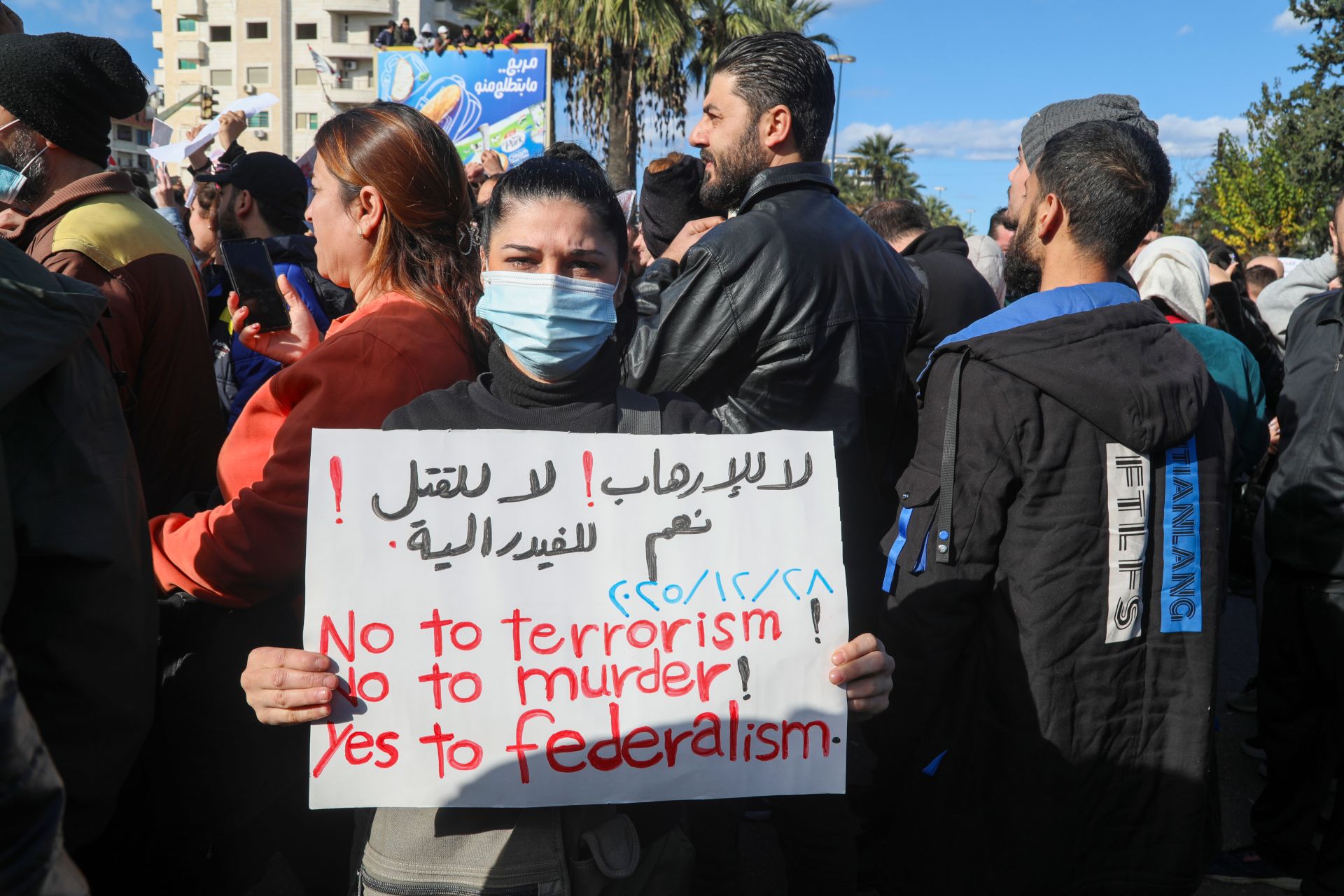
As Syria underwent a wave of celebrations marking the first anniversary of the fall of the Bashar al-Assad regime, called “a year of liberation,” Sheikh Ghazal Ghazal, the leader of the Alawite Islamic Council in Syria and the diaspora, issued a very different call. On Dec. 5, 2025, he urged Alawites across Syria to boycott the festivities and remain in their homes, declaring a strike that would span the full duration of the celebrations, from Dec. 8 to 12.
Ghazal, the former mufti of Latakia, framed the strike as a “peaceful response” to what he described as ongoing violations against the Alawite community, and a refusal to relinquish what he called its “legitimate demands.” Among them, he listed the right to self-determination, federalism, an end to sectarian killings and the release of civilian and military detainees.
By the fourth day of the strike, the Syrian Observatory for Human Rights reported “unprecedented and widespread participation” in Alawite-majority areas along the Syrian coast. Latakia, Jableh, Tartus, Safita and Dreikish all saw broad involvement, as did western Hama and the city of Masyaf. According to the group, the call for a strike came in the wake of a series of incidents that Alawites themselves described as a “humiliation,” turning the action into a collective expression of popular anger and an extension of a social movement that has been gaining momentum within the community in recent months.
This wave of strikes and protests did not emerge in isolation. In the final week of November 2024, the Alawite council had already called for mass sit-ins. Monitoring groups reported that several thousand Alawites took part in demonstrations along the Syrian coast and in Homs that drew attention to the community’s conditions since the fall of the Assad regime. That period, they noted, has been marked by persistent violations, including massacres in March 2025 that left several thousand civilians dead.
It may have been this apparent success that pushed Ghazal and the council to take the rhetoric a step further, describing the developments as a “peaceful resistance to a de facto authority.” The shift was made easier by the fact that the authorities were, in practice, forced to monitor the demonstrations without suppressing them by force, a direct consequence of United Nations Resolution 2799, which subjects the government to international oversight regarding its obligation to protect religious and national minorities.
Yet even as it refrained from opening fire, the new authority moved on another front. It mobilized its own supporters to confront the peaceful demonstrators and conducted a military show of force in their presence, as happened at al-Azhari roundabout in Latakia, where as many as four people reportedly were killed and 100 injured. What followed were pro-government demonstrations in various other parts of Syria, adding to the sense of marginalization felt by the Alawite community.
Two days before the strikes were set to begin, the call itself took a heavy, if indirect, hit. Saudi-owned Al-Arabiya aired a video from 2018 showing the fugitive Assad alongside his now-slain adviser, Luna al-Shibl, during a visit to Eastern Ghouta near Damascus. In the clip, Assad laughs, mocks his own country and army, and hurls a barrage of insults at the people of Ghouta, a suburb of Damascus. There was concern that the footage — an especially grotesque reminder of an old regime whose name remains associated with the Alawite community in the minds of many Syrians — would derail the strike. It did not.
Alawites rejected the idea that their current misery should be linked to the actions of a regime in which, as they put it, all Syrians had been implicated; they were only one part, no different from others. Yet this narrative is flatly rejected by supporters of the new order, even those who themselves engaged enthusiastically in the crimes of the Assad regime.
In this congested atmosphere of dissent and protest, Alawites do not stand alone. Other groups, too, shied away from the celebrations for reasons that closely echo Alawite grievances. In Sweida, Druze who once supported the uprising and the promise of change now find themselves, after the massacres of July 2025, in open confrontation with the new authority. Their issue was not with the idea of liberating Syria from Assad, but with what followed. The autonomous administration in the northeast of the country has its own reasons. A year after Assad’s fall, these positions, taken together, paint a picture of a fractured country.
A year on, many of these dissenters see the new Syrian government as having failed to act as an impartial arbiter, and instead having become a party to the conflict with the Alawites. The result is a social contract in such deep disarray that some Syrians now believe that remaining part of the state amounts to a collective suicide. This perception is increasingly widespread.
The Alawite question carries implications unlike those facing Syria’s other minority groups. Alawites are assigned collective responsibility for the crimes of the past and are subjected to collective punishment by a new authority that they repeatedly tried to reassure, primarily by surrendering their weapons immediately after the Assad regime collapsed. In return, they were denied the most basic of rights: security, and a sense of safety. Today, almost any incident — a fabricated audio recording, a doctored image, a rumor — can trigger fears of communal vulnerability, of being exposed to attack by other Syrian groups. What unfolded in Homs at the end of 2025 only deepened that sense of dread. After a murder in which the perpetrator scrawled a sectarian slogan on a wall at the crime scene, accusations were quickly directed at the Alawites as a whole, not at specific individuals. The episode fed an existential anxiety that pushed the community to close ranks behind any symbol that might offer a way out of the fog. Days later, official security investigations confirmed that the killer was related to the victims, and that no Alawite had any connection to the crime. By then, the damage had already been done.
The call for strikes is the second in a long series of events that the Alawite council and its supporters on the ground are determined to pursue, as they search for a clearer political settlement in the post-Assad period. The community’s situation is grim by any measure: victim to the former regime, victim to its collapse and among the first victims of the new political order taking shape in Syria. The protests and sit-ins are an attempt to rise from the ashes, slowly and painfully. And while the capacity for recovery exists, the path ahead remains long.
The success of the sit-ins, along with the pride they generated within the community and its councils, reveals a belief in the possibility of action despite deep internal fractures and a lingering sense of disintegration. The ensuing sense of empowerment among Alawites offered a moment to breathe, a chance to edge back toward a form of political presence rooted in survival itself, even before worrying about how the protest message might resonate beyond the community. It is telling, in this regard, that the transitional president’s remarks at the Doha Forum in December marked the first direct presidential address to a community that the Islamists who backed him often considered heretical. Ahmad al-Sharaa’s words struck a conciliatory tone, but they stopped short of outlining any concrete plan for engagement. At the same time, they left the door open to “decentralization,” while firmly rejecting calls for partition or federalism as “separatism.”
At a deeper level, the success of the November 2025 sit-ins, the strikes and the refusal to take part in the anniversary celebrations point to something more ambitious: an attempt at political action, even if it is being spearheaded by the Alawite Islamic Council. Such an effort is unmistakably risky. The authorities continue to monitor every Alawite protest, while internal dissent persists within the community itself, particularly over the choice of religious leadership in place of more conventionally political mobilization.
The new regime’s determination to block the emergence of any Alawite organizational structure surfaced early. Barely a month after the fall of the former regime, pressure mounted to dismantle nascent efforts to establish an Alawite council inside Syria, using threats, intimidation and arrests. By the spring of 2025, the authorities compelled a large number of Alawite clerics in Latakia and Tartus to publicly withdraw from the council, despite having signed and helped draft its founding declaration. After the sit-ins gained momentum, similar pressure was applied to the remaining clerics from Homs, who were likewise forced to announce their withdrawal. Against this backdrop, public Alawite protest begins to look less like a choice than a last resort, a solitary channel through which an Alawite voice might still be heard, mediated by an institution operating in part from outside the country.
The authorities in Damascus, for their part, moved quickly to demonize the Alawite Islamic Council through a highly active army of online trolls. The campaign accused the council’s head of being a remnant of the former regime, claimed he had called for the killing of Syrians during his tenure as mufti of Latakia and cast him as an “Iranian proxy.” Yet amid the Alawite community’s inability to produce widely trusted leadership figures untainted by association with the old order, a workable consensus has nonetheless emerged around the role of the council and its leader, Sheikh Ghazal.
Sheikh Ghazal comes from a family well known in recent Alawite history. Several members of the family belong to the Alawite religious establishment. Some studied in Shiite seminaries in Iraq and Iran and specialized in jurisprudence and philosophy, although this did not place them neatly on the Iranian Shiite path. The lineage carries religious authority, but in no sense a default political alignment.
Born in 1962, Sheikh Ghazal stands at the center of the Alawites’ political and religious contradictions. He currently serves as the interim head of the Alawite Islamic Council and hails from the village of Talla in the Latakia countryside, part of a deeply rooted religious family that once formed a pillar of the former regime’s Alawite religious legitimacy. His brother, Sheikh Fadl Ghazal, served as mufti of Latakia and led prayers at the funeral of Bassel al-Assad, Bashar’s older brother, in 1994. A cousin, Sheikh Muwaffaq, was accused of taking part in combat alongside Ali Kayali (aka Miraj Ural), one of those implicated in the 2013 al-Bayda massacre in coastal Baniyas. Yet the same family also paid a brutal price in blood. In 2014, Sheikh Badr Ghazal, another of Ghazal’s brothers, was slaughtered by fighters from Jaysh al-Islam during the massacres in the northern Latakia countryside.
Today, Sheikh Ghazal Ghazal finds himself in a deeply paradoxical position. On the one hand, he carries the burden of his family’s historical entanglement with the former regime — a legacy he does not even deny. On the other hand, he now leads, from exile, a peaceful protest movement against a new authority that, in his telling, is subjecting his community to collective punishment. This reversal of roles echoes similar shifts among other sheikhs and religious figures in the Syrian context, particularly their opposition to a new power that has deliberately foregrounded religion and religiosity, according to its own logic and on its own terms, in the face of Syrians who reject both its methods and its claims.
That Sheikh Ghazal has become the most prominent voice of Alawite dissent exposes another layer of the community’s predicament. He is neither a conventional political leader drawn from party structures or parliamentary life, nor a military commander presiding over an armed force or militia. He is a religious figure who has been compelled to shoulder the weight of politics at a moment when his community’s traditional political and military instruments have collapsed. His call for peaceful strikes and passive resistance reads less like strategy than confession, an open acknowledgment of his community’s fragility. It is the weapon of the weak: a politics that has been reduced to bodies and to absence.
The Sheikh Ghazal phenomenon, in all its complexity, extends beyond the rise of a new spiritual or political figure. It is a symptom of a deeper ailment within the Alawite community itself. It marks a missed historical moment, one in which the community has been forced to compress its voice into that of a religious leader who commands no full consensus because the political class has receded, and because politics itself has been expropriated and redirected toward the construction of imagined sects, ringed by ever-higher walls. In the absence of social reconciliation, the new regime has invested in these divisions, and the cost is now being paid in silence, fracture and enforced retreat.
Throughout its history, the Alawite community has never developed a structured religious leadership. Therefore, its current turn toward religious authority raises more questions than it answers. It is, at its core, an organic response to a double tragedy. First, the collapse of the old regime left behind a vast and terrifying vacuum, felt most acutely within the Alawite community itself, where political and military elites, both loyal to the regime and opposed to it, simply vanished. Second, the community now confronts a new authority in Damascus that it says speaks the language of religion rather than citizenship, and governs through inverted sectarian networks rather than inclusive civic structures.
For five decades, under the rule of Hafez al-Assad and his son, the Baath Party dominated the lives of Alawites much as it dominated Syrian life more broadly, reaching into the minute details of everyday existence. Then, almost overnight, the party and its instruments — above all, the security services — disappeared. Alawites were left staring into an open-ended void. Within their social environments, there were no institutions bearing an openly Alawite identity, no civil society organizations, no charities, no political frameworks, not even religious institutions in the conventional sense. Since the founding of the modern Syrian state, Alawites had lived in near-total fusion with the state apparatus. They inhabited modernity and its social and political lexicon, from the early nationalist and leftist parties to legal proceedings conducted under Sunni rather than Shiite law. Over decades, this strategy of “dissolution” into the state, the army and a homogenizing national discourse prevented the development of a distinct collective identity for the Alawites, or any independent institutions to represent them. When the regime eventually turned against them, this history left Alawites as what might be called the orphans of the Second Syrian Republic, meaning the era of Assad (father and son) from 1970 to 2024. Earlier still, during the First Syrian Republic (1946-1970), Alawite feudal elites participated in the structures of the nascent state, but without any real political weight or lasting influence.
The long-standing Alawite opposition to the Assad regime, which was largely leftist in orientation, has hardly fared better under the new order. Having paid a heavy price under the rule of the two Assads, through arrests, repression and liquidation, it now finds itself no better off. Despite the fact that it articulates a vision of a modern civic state, this opposition is largely absent from the Alawite base, and scarcely visible elsewhere except in narrow, ineffective pockets. And since the fall of Assad, political experiments in Syria have made only limited progress in breaking free from such sectarian enclosures. All of this has unfolded against a backdrop of general disengagement from politics among Syrians, and a tacit willingness to relinquish the defense of democratic values and freedoms. Compounding this, the new government shows little tolerance for such opposition — or for any opposition that might present itself as genuinely national — aware that it could one day pull the rug from beneath its feet should Syrians ever be allowed to elect themselves, and their future, freely.
In this stark confrontation between Alawite existence and erasure, the “religionization” of Alawite demands becomes a last refuge, a defensive turn toward identity under siege. These demands are, in large measure, specific to the community, even as they intersect with the grievances of other Syrians. Today, the adversary names you and judges you as a “sect,” a fully formed and legible collective. Faced with that gaze, turning inward becomes a way of consolidating existence itself, of articulating grievance in a language the other side already speaks. It is a mirror language: Both sides draw from religiously rooted frameworks.
The cost, however, is steep. This discourse is a retreat from the language of the modern state and its narratives, tools and promises. When al-Sharaa declared from the pulpit of the Umayyad Mosque, “Obey us so long as we obey God in you,” he was speaking from history, not from modernity, and certainly not from the lexicon of citizenship.
This Alawite protest strategy carries its own deep contradictions and dangers. Most Alawites, particularly the generations shaped under Baathist rule, are unfamiliar, and often uncomfortable, with religious leadership in the political sphere. Alawite faith largely remained a private matter; politics flowed instead through the state, popular secularism, trade unions and political parties. Ghazal’s discourse, for all its declared commitment to peaceful action, risks reinforcing the very narrative promoted by the new authority and its followers: that any Alawite mobilization is inherently “sectarian,” inward-looking and animated by nostalgia for the old oligarchy.
Herein lies the near-impossible task before Sheikh Ghazal: How does one persuade a fearful, fragmented community to risk protest actions that may deepen its economic isolation, while simultaneously convincing the outside world that this movement is not an expression of sectarianism, but a protest against its consequences? The contradiction is not easily managed. It borders on the insoluble.
So far, federalism as it appears in Ghazal’s discourse cannot be treated as a settled Alawite position. In reality, the issue has exposed deep internal divergence, visible in dozens of protests — both on the ground and online — rejecting the idea of creating a separate entity or breaking away from the national whole. In the Syrian context, calls for federalism are less an expression of genuine separatist desire than a symptom of profound despair: a loss of faith in the central state’s capacity to protect its citizens. Still, the question lingers: Is the federalism being floated today a viable political project, or merely a cry of alarm, an articulation of existential danger rather than a roadmap forward?
Beyond idealized thinking among the Alawites lies a set of hard realities that define the bounds of possibility. They set the rules of the game, delimit the field of maneuver — and will shape whatever change may yet come.
First, in the wake of the sit-ins and strikes, and against their visible impact, al-Sharaa spoke with striking clarity at the Doha Forum. He acknowledged the legitimacy of certain demands being made by Alawites and signaled openness to administrative decentralization, while drawing an uncompromising line against partition or federalism. This was not a matter of mere rhetoric. It is state policy, underwritten by the unyielding military readiness demonstrated earlier in the fighting in Sweida and the massacres along the coast, and more recently in the assault on the Kurdish self-administration areas and the dismantling of their institutions. In this calculus, the Syrian coast, with its resources and strategic position, constitutes a vital artery for al-Sharaa’s Syria. Any attempt to sever it would be met with a military response that the new regime would frame as a struggle for survival.
Second, the Alawite Council does not hold the same cards as other Syrian actors. The Kurds still possess the Syrian Democratic Forces, and the Druze in Sweida have formed a National Guard — formations that, if internationally backed, could translate into levers at the negotiating table, or at least constitute a deterrent presence. By contrast, Alawites are stripped of such instruments. With the collapse of the old army, the surrender of their weapons to the new state, the spread of dozens of new army bases (or rather factional formations) across their regions, and the inability of any actor to form a unified, independent Alawite force, they are left without that decisive bargaining chip. It is a familiar rule of Syrian politics: A movement that lacks the means of armed self-protection becomes vulnerable, quickly, to repression, persecution and political suffocation.
Third, the Syrian coast, with its complex demographic makeup, roughly evenly divided between Alawites and Sunnis in Latakia, and with an Alawite tilt across most other coastal towns and villages, is a geo-economic lifeline for all Syrians, not only for the old regime or the new one. The ports of Latakia and Tartus are the last remaining gateways through which the new regime could connect to the world. Control over these facilities — state control or, in more candid terms, al-Sharaa’s control — is not a policy choice. It is a matter of economic survival. From this perspective, the purge of Alawite employees from sensitive positions in ports and oil facilities is not incidental. It forms part of a broader strategy to secure control and reconfigure the ruling economic circles, particularly through the General Authority for Ports and Customs, which reports directly to al-Sharaa. As the regime accelerates toward an unrestrained liberalized economy, there is growing fear that Alawites will be pushed from their former position as a class of civil servants and military employees into a condition of economic dependency, living off scraps within a new system of business alliances dominated by emerging elites.
Taken together, these realities suggest that the federalism proposed by the Alawite council does not figure in the calculations of the authorities, or of other key actors. Russia, Assad’s principal ally, has swiftly realigned itself with the new order, making clear, in the blunt language of all major powers, that its priorities lie in safeguarding its military and economic interests. This realignment does not fit neatly with the narrative circulating within the Alawite community about a “Russian betrayal.”
Turkey follows close behind. Ankara categorically rejects any move toward autonomous entities in Syria, fearing an Alawite domino effect within its own borders. Any attempt to articulate a distinct Alawite political identity would likely be met with rapid Turkish-backed “Turkmen” mobilization against the Alawite region. Turning westward offers little relief: Western bureaucracies promise, at best, a slow political death, while prevailing narratives continue to bind Alawites to the legacy of Assad’s repressive rule. That heavy inheritance obstructs any serious effort to elevate their current predicament into a diplomatic or humanitarian priority.
Finally, any flirtation with Israeli support — even hypothetical, and even limited to fringe actors — would amount to political suicide. It would hand the regime a ready-made pretext to discredit the entire movement and collapse its claims under the weight of a single, fatal accusation.
The relative success of the Alawite protest movement exposes a deeper fault line in the making of Syria’s new state: its failure to articulate a credible model of citizenship capable of rising above sectarian and fractured identities. Caught between a central authority that continues to reject any form of federalism, a local community deprived of meaningful bargaining power and an international community wary of entanglement in an issue deemed politically toxic, Alawites today find themselves at a decisive crossroads. What lies ahead will depend, in no small part, on their ability to cultivate new forms of leadership and representation that are viable and capable of navigating a political moment fundamentally unlike the one that preceded it.
Yet the choice between dissolving into a state premised on equal citizenship or retreating into a defensive, inward-looking identity will not be decided by the Alawites alone. It will emerge from an uneasy interplay between internal will, external pressure and the broader reconfiguration of Syria’s political order.
One certainty remains: The systematic neglect of legitimate grievances — Alawite or otherwise — does not resolve conflict. It merely postpones it, and in so doing deepens social fractures in a country that stands in urgent need, not of further deferral, but of reckoning, healing and the delicate work of peace.
Become a member today to receive access to all our paywalled essays and the best of New Lines delivered to your inbox through our newsletters.