


In June 2019, on the eve of a state visit to Russia, China’s President Xi Jinping made an unusual remark about his Russian counterpart, Vladimir Putin. In an interview with local media, he noted that Russia was the country he had visited most often, and added that Putin was his “best friend.” The phrasing matters. Xi was not addressing Putin directly, but speaking about him, by name, for the public record. The statement was extraordinary: Chinese diplomacy operates in abstractions, not intimacies. Personal confessions are reserved for private audiences, not state occasions. Yet here was the general secretary of the Chinese Communist Party speaking as if recalling a comrade from his youth, which in a sense he was.
Western analysts filed the moment under diplomatic theater, but they should have placed it under memory. The relationship between China and Russia is not a tactical arrangement between autocrats who happen to share an adversary. It is something more durable: a structure of recognition built over a century, with each layer hardening into the next. Between the late Qing period in the 19th century and the Sino-Soviet split, China reconfigured its intellectual and political architecture along Russian and Soviet lines, absorbing identities, values and moral vocabularies that remain load-bearing today. This inheritance explains Beijing’s willingness to absorb extraordinary costs on Moscow’s behalf, costs that make little sense if one assumes the partnership is purely instrumental.
While the Sino-Russian partnership is typically viewed through the lens of hard power, there is also a quieter, more enduring layer: a cultural enmeshment. From literary affinities to architectural imitation, from fashion trends to shared pedagogical models, Russia’s imprint on modern China is deeper than headlines suggest. At its core is a lingering “Russian complex” (“eluosi qingjie” in Mandarin), rooted in the formative period from the 1890s to the 1960s, when Russian thought, aesthetics and political ideals defined China’s approach to modernity.
The affinity predates ideological convergences. After the Second Opium War brought the Qing dynasty to terms in 1860, Russian officers along the Amur frontier, then the contested border region, appeared less disdainful than their British counterparts. They conquered, certainly, but with a melancholy and plainspokenness that suggested shared suffering rather than triumphalism. When Tsar Alexander II was assassinated in 1881, for instance, Qing officials proposed, with mordant humor, dispatching advisers to instruct the Russians in statecraft. Grief, it seemed, required pedagogy.
After the Boxer Rebellion in 1899-1901 — when eight foreign armies occupied Beijing — Russian intellectuals were among the first to condemn their own government’s role. The Russian writer Leo Tolstoy, in his letters, wrote that “the Orient was called to recover that liberty which the peoples of the Occident had lost.” Others shared the sentiment.
For Chinese intellectuals at the turn of the century, Russia offered something Europe could not: a vocabulary of moral suffering that felt compelling. When Lu Xun, the writer who would become modern China’s most scathing critic of its moral inheritance, encountered Nikolai Gogol’s 1835 short story “Diary of a Madman,” and rewrote it as an indictment of Confucian ossification, he was not merely translating.
In Gogol’s story, the narrator’s growing awareness of the absurdity and cruelty of the social order registers as madness: Moral insight appears indistinguishable from psychological collapse. Lu seized on this conceit, recasting Gogol’s inward spiral as a diagnosis of Confucian society itself, where ethical awakening meant recognizing one’s own complicity in a system sustained by ritualized violence.
As Lu put it in a 1918 letter, written while he was translating “Diary of a Madman,” one should imagine “an iron house without windows, absolutely indestructible, filled with people fast asleep who will soon die of suffocation.” To write, he worried, was to risk waking a few, condemning them to conscious suffering without hope of escape. He returned to the image in the preface to “Call to Arms,” his own collection of short stories, in which he framed modern literature as precisely this cruel obligation: to awaken, even if awakening offered no redemption.
He was importing a habit of thought — the Russian capacity for self-accusation, for turning inward with ferocity. The “superfluous man” of Russian fiction — idealistic, paralyzed, doomed by introspection — became a template for Chinese reformers estranged from their own society. This was not fashion so much as a way of thinking about transformation.
What was being forged is best described by the Chinese term “rentong,” meaning recognition. This is not sympathy, but identification: the sense that another occupies equivalent moral coordinates. Both societies understood themselves as victims of Western encroachment, heirs to historical humiliation and custodians of civilizational dignity. Rentong arises when one’s grievances are mirrored in another’s experience — not kinship, exactly — but alignment. The conviction that one belongs, in some essential sense, to the same side. This recognition would prove more durable than ideology, more sticky than interest.
This recognition didn’t happen automatically, and it wasn’t always accepted. For much of the late Qing dynasty and the republican era, Russians held a complicated place in how Chinese people thought about foreigners; they were admired in some ways but also mocked. Words like “da bizi” (“big nose”), “maozi” (“hairy”), sometimes combined with “sha” (“stupid”) and “ermaozi,” referring to the “hairy ones’ offspring,” the children of mixed Russian-Chinese heritage, show that many Chinese viewed Russians as rough, backward or not fully civilized. Yet these negative stereotypes existed alongside genuine admiration. Appreciating or identifying with another culture — rentong — didn’t necessarily erase feelings of superiority.
“Cultural recognition (rentong) is the deepest form of recognition; it is the root of national unity and the soul of ethnic harmony,” Xi said in 2021, when referring to China’s ethnic minority groups.
Yet long before Beijing framed unity primarily in cultural terms, Chinese revolutionaries had looked beyond their borders for models of political cohesion and state-building. After 1917, Moscow institutionalized the relationship, training the revolutionaries and demonstrating what upheaval looked like in practice. “Learning from the Soviet Union” ceased to be a slogan and became an orientation.
When Mao Zedong proclaimed the People’s Republic in 1949, he announced that China would “lean to one side.” The side was Moscow, and the tilt was absolute.
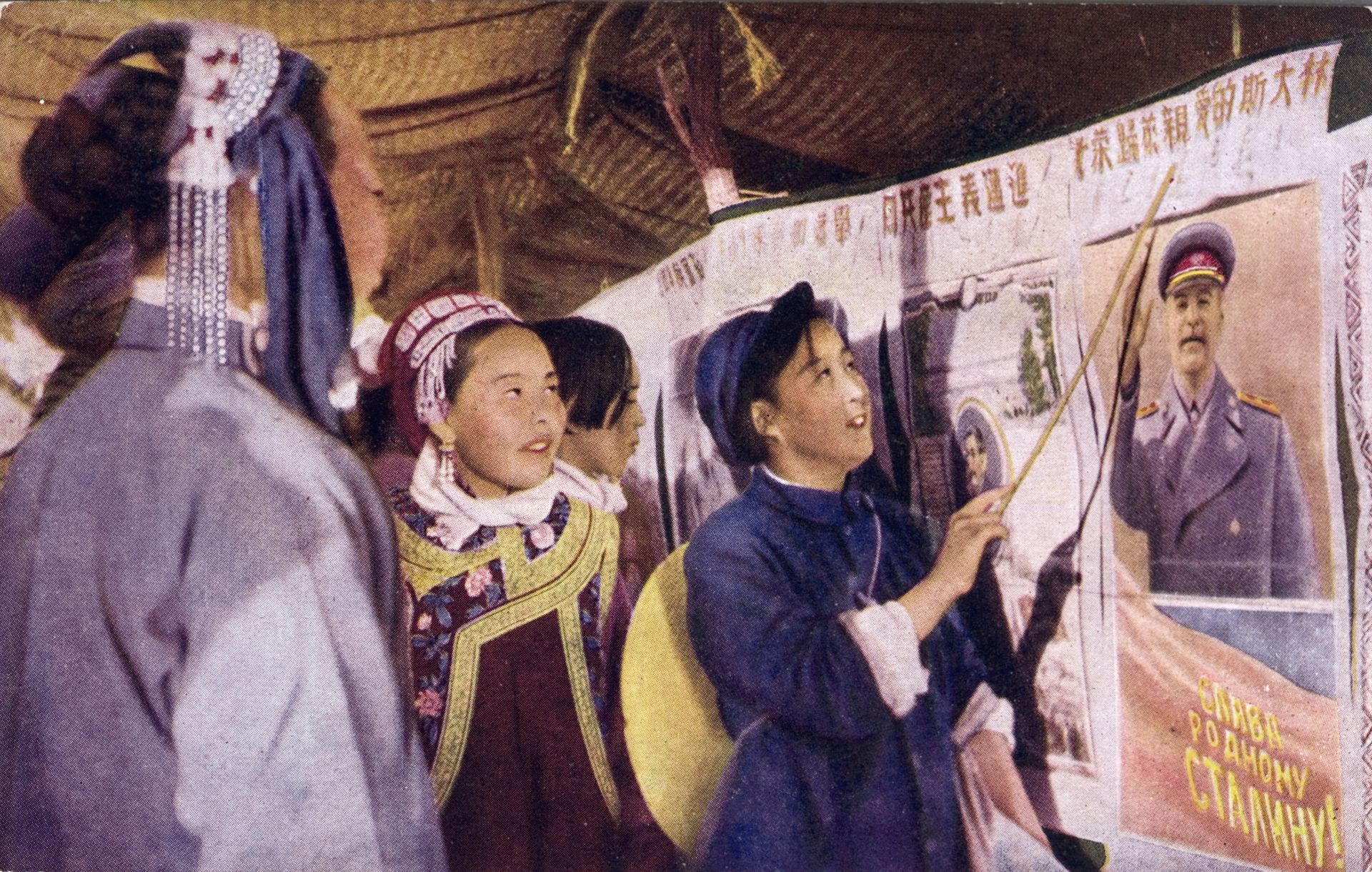
Between 1950 and 1957, Beijing signed agreements for 156 industrial projects ranging from a flagship iron and steel complex to China’s first modern auto plant, designed to Soviet specifications. These cost roughly $80 billion in today’s terms, and nearly half of China’s GDP in 1949. Approximately 10,000 Soviet advisers arrived and, meanwhile, 15,000 Chinese students departed for Soviet universities. China imported, wholesale, an entire model of modernity.
The transformation was also material. Lenin suits, the high-collared, buttoned jackets that later became known in English as “Mao suits,” replaced traditional dress. Russian-cut fashions displaced the “qipao,” a form-fitting traditional Chinese dress. Soviet cinema dominated theaters. Black bread appeared in state canteens, replacing white bread and dumplings, introducing a coarse, Soviet staple that signaled austerity rather than abundance. The Moscow Restaurant opened in Beijing in 1955 and still serves borscht (though sweetened with tomatoes for local taste), a minor monument to the era. On weekends, elderly patrons gather there speaking Chinese laced with Russian loanwords that younger staff struggle to recognize. Vodka is “futejia,” bread became “lieba,” a variation of the Russian word “khleb.” The words naturalized themselves into daily speech, markers of modernity rendered invisible by repetition.
Language absorbed the deepest changes. Official prose took on Soviet characteristics — abstract, iterative and hostile to irony. Russian literature accounted for more than half of all fiction published in China by the mid-1950s. The protagonists of Nikolai Ostrovsky’s 1934 revolutionary novel “How the Steel Was Tempered” became moral exemplars, tireless, selfless and radiant.
In short, to be modern was to be Soviet. To be Soviet was to be virtuous. “The Soviet Union’s today is our tomorrow,” went the propaganda maxim from the early 1950s.
The relationship was not frictionless. When Mao attended Josef Stalin’s 70th birthday celebration in Moscow, in December 1949, the Soviet dictator did not meet him at the train station — unlike the reception he had extended to other foreign dignitaries earlier in the war years — a slight that Chinese officials understood as damaging to Beijing’s prestige. Moreover, aid often came with conditions resembling colonial extraction. Mao later remarked that following Stalin’s counsel consistently would have resulted in his death. Yet dependency had its compensations, not least the fact that the Soviet Union remained the sole major power willing to treat China as something other than a nuisance to be contained. Gratitude and resentment coexisted, as they often do in asymmetric partnerships.
During the late 1950s and 1960s, the alliance between the two major communist powers began to gradually break down. Two countries that both claimed to represent socialism ended up treating each other as rivals and even potential enemies. The slow divorce reached its climax in 1961, when they openly broke their alliance. Mao never forgave Nikita Khrushchev’s denunciation of Stalin, which implicitly challenged the foundations of his own authority, while Khrushchev regarded Mao as reckless and unmanageable. Nuclear cooperation was withdrawn, aid programs wound down and border tensions escalated.
Yet the political divorce remained emotionally incomplete. During the Cultural Revolution of 1966-1976, when the country purged its bourgeois elements by mobilizing students and workers to attack teachers and cultural elites — a phenomenon devoted to extirpating foreign contamination — Soviet literature continued to circulate in restricted editions. Party elites procured them for their children, understanding that serious education required access to forbidden knowledge. Literary clubs convened in secret to read Mikhail Sholokhov and Boris Pasternak.
Where Eastern Europeans came to associate Soviet culture with occupation, China’s anti-Soviet turn produced wistfulness. Renouncing Moscow resembled revisiting one’s youth with indulgence. A sentiment circulated: “Yesterday’s teacher, today’s heretic, tomorrow’s memory.” Though not directly about Moscow, the phrase became a broader way of describing how authority metabolized over time, especially in the Mao era.
That memory was not abstract. Between 1945 and 1969, a majority of China’s top leadership had lived or studied in Moscow. Among them was Xi Zhongxun, father of the current leader, who managed Soviet advisers during the 1950s. By 1962, Mao had grown obsessed with Soviet-style revisionism. When a biographical novel about Xi’s revolutionary mentor appeared to challenge Mao’s authority and praise purged figures, Xi Zhongxun was accused of leading an “anti-party clique.” Among the charges: He had contracted Khrushchev’s “revisionist virus” through excessive contact with Moscow.
Xi Jinping was 9 years old when his father disappeared into 16 years of political exile, beaten during the Cultural Revolution until he lost hearing in one ear. His mother was blacklisted and attacked. One of his half-sisters was tormented until she committed suicide. Yet when Xi Zhongxun was finally released in 1978, his devotion to the party had not wavered. According to family recollections, he reread the Chinese classic “Red Crag,” his favorite revolutionary novel, to rekindle his commitment to the cause.
The irony is instructive. Xi Zhongxun was destroyed partly for alleged Soviet sympathies, yet remained faithful to a party shaped by Soviet models. The son appears to have internalized endurance rather than disillusionment. Years later, Xi Jinping would criticize the last Soviet leader, Mikhail Gorbachev, not for liberalizing, but for lacking the will to preserve what his predecessors had built. His affection for Russia represented a restoration of what had been interrupted.
Even after the Soviet Union’s breakup in 1991, Russian cultural literacy retained its prestige. Pushkin, Tolstoy, Gorky, Chekhov and Tarkovsky remain fixtures of Chinese curricula. The formulaic warmth of Chinese diplomatic language — a friendship described as “firm as steel” — lives on in the people and language, even when no longer talking about Russia.
Hierarchy has transmuted into symmetry. Russians, once caricatured as barbaric, are now framed as fellow civilizational guardians. The image of China and Russia as two tigers defending their mountain against Western predators circulates widely online, inverting the Chinese proverb that one mountain cannot contain two tigers. This aesthetic reversal matters because it structures the metaphors through which elites apprehend the world, and metaphors, in turn, constrain the realm of acceptable policy.
When Xi Jinping told Putin in 2013 that “you and I treat each other as open souls; our characters are alike,” he was invoking the vocabulary of comradeship learned in childhood. His 2019 confession in the Kremlin — that Russia was the country he had visited most and Putin his best friend — was not diplomatic theater. It was rentong made manifest: the expression of a recognition so deeply internalized it could override the usual (formal) protocols of Chinese statecraft.
Since 2022, that recognition has been tested and validated. China has provided Russia with diplomatic cover at the United Nations, satellite imagery and dual-use data that U.S. and Ukrainian officials say support Russian targeting, and an economic lifeline by supplying roughly three-quarters of Russia’s imports of key “battlefield goods,” from drones to machine tools. Bilateral trade reached $245 billion in 2024, double its 2020 level. Beijing bypassed SWIFT restrictions through yuan-ruble payment channels. It extended visa-free entry to Russian citizens while the West expelled them. By 2035, Chinese planners project that up to 40% of China’s natural gas will come from Russian fields — a dependency willingly assumed.
These are not the choices of a purely transactional partnership. Each decision carries great costs: The visa-free travel and payment channels carry the risk of being accused of evading sanctions, and the gas dependency locks China into long-term reliance on a declining power. Most revealing is the decision to supply battlefield goods — not weapons but still the industrial sinews of war. This is rentong in action: supporting Russia’s capacity to resist Western pressure without crossing the threshold that would invite direct Western retaliation against China itself.
The reputational costs have been steeper still. In 2023, China’s ambassador to France declared that former Soviet republics lacked “effective status in international law.” The statement reverberated across the Global South, where dozens of states had exited colonial rule under precisely the legal framework Beijing appeared to dismiss. China’s cultivation of developing-world solidarity, decades in the making, was subordinated to Russian territorial claims. The price was paid knowingly because rentong with Russia superseded rentong with postcolonial states.
None of this coheres with interest narrowly defined. Russia’s economy — roughly $2 trillion and stagnant — is dwarfed by China’s industrial output. Moreover, the historical ledger offers little encouragement: Moscow took vast swaths of Manchurian territory through unequal treaties in the 19th century, treated Mao as a provincial subordinate, floated nuclear strikes against China in 1969 and invited American forces into Central Asia after the 9/11 attacks without consultation — a reminder that partnership does not necessarily entail coordination, and that Moscow, when pressed, has historically prioritized its own calculations over Chinese sensitivities.
Yet the friendship persists. What Western observers interpret as opportunism is fidelity to something older and more constraining than strategy.
In brief, Western analysts, habituated to tracking trade flows and pipeline routes, perceive tactics where there exists only geology.
The formation of China’s modern elite occurred through Russian conceptual filters. Revolution as moral purification, art as didactic realism, bureaucracy as pedagogy and civilization as something to be defended against Western universalism — these remain operative assumptions. Rentong is mental furniture: It inheres in Beijing’s urban layout, in the syntax of official discourse, in provincial school curricula, in the muscle memory of how Chinese officials conceive their place in the world.
This differs fundamentally from China’s engagement with other powers. With the West, recognition has never been reciprocated — China seeks acknowledgment as a civilizational equal, while the West offers conditional acceptance contingent on liberalization. With developing nations, sympathy exists, but without the accumulated weight of mutual formation. The Anglo-American relationship offers the nearest parallel — itself so anomalous it requires the qualifier “special” — yet even that analogy fails. Anglo-American elites share ethnic, linguistic and cultural infrastructure, the power asymmetry is pronounced and longevity depends partly on British accommodation. None of these conditions holds between Moscow and Beijing, and yet the relationship endures.
This is because rentong establishes both the foundation and ceiling of what is possible. China and Russia will dispute gas contracts and Central Asian influence. But those disputes unfold within a shared conceptual space — one in which history instructs, suffering confers legitimacy and order constitutes virtue. When Xi Jinping criticizes Western “hegemony,” he is speaking a language learned partly from Soviet critiques of American imperialism. When Chinese diplomats invoke “sovereign equality” and “multipolarity,” they are deploying concepts inherited from Soviet international relations theory. The vocabulary itself constrains imagination.
China’s commitment to Russia may indeed reflect strategic anxiety — fear that a weakened Moscow could be turned against Beijing, undermining resistance to American hegemony. Yet the mechanisms of alliance have always been contingent. What matters is the accumulated weight of shared historical positioning, a weight that is rare among powers of consequence.
Predictions that the partnership will “crash and burn” by 2030, as one analyst, Lily Otinger, claimed in ChinaTalk, the podcast and newsletter, confuse surface turbulence with foundational erosion. The relationship has already survived catastrophic rupture once. It survived because the Soviet period represented, for an entire generation of Chinese leaders, the first promise that backwardness could be overcome through knowledge rather than fortune. That promise failed politically but succeeded culturally, and what was absorbed cannot be easily expelled.
China and Russia are not allies in the conventional sense. They are co-heirs to a particular century — one in which both concluded that imitating another civilization was the surest way to preserve their own. The inheritance has become fundamental, and it shapes what Chinese elites perceive as natural, possible and necessary.
This is what Western analysts miss when they predict the partnership’s collapse based on diverging interests. Interests operate in shallower strata. Beneath them lies something more obdurate: the accumulated sediment of recognition, the conviction that Russia occupies equivalent moral coordinates, and the muscle memory built over a century of learning to imagine progress through Russian categories. In moments of embarrassment or diplomatic cost, what matters less is the misstep itself than the ranking of shame. Reputational damage counts for less than the moral failure of withholding solidarity from a perceived civilizational peer.
Politics may shift and markets may realign, but the aftershocks of that century — the habits of thought, the reflexes of identification, the vocabulary of legitimacy — will constrain Chinese statecraft long after current trade figures have been forgotten. Beijing’s support for Moscow is not calculation dressed as sentiment, but sentiment that hardened into structure.
That is the Russian complex.
Become a member today to receive access to all our paywalled essays and the best of New Lines delivered to your inbox through our newsletters.