





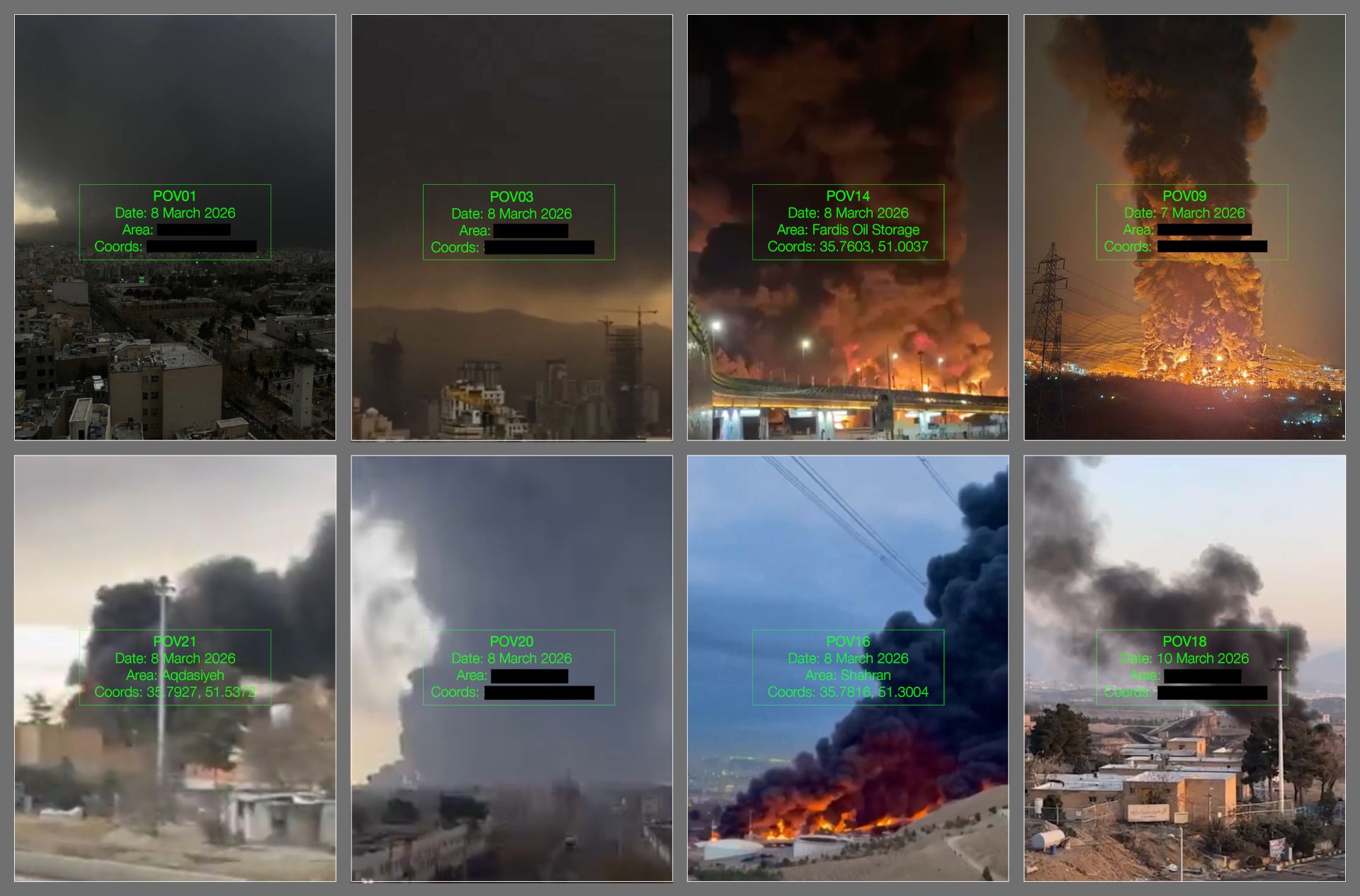
On the evening of March 7, the Israeli military confirmed that a new set of strikes on Iran was underway. This time, it was targeting fuel storage sites across the capital, Tehran.
“Guided by IDF intelligence, the IAF struck these complexes, where the Iranian terrorist regime would distribute fuel to multiple military entities in Iran. The strike significantly deepens the damage to the military infrastructure of the Iranian terrorist regime,” the military stated on X.
Despite the state-imposed communications blackout since the conflict began, some Iranians were able to bypass the shutdown and share the dramatic scenes of these strikes online.
A photo posted to X, verified by New Lines and located to the Shahran oil depot in the eponymous neighborhood in the northwest of Tehran, shows a glow of flames growing into a massive plume of deep orange, then black smoke stretching up into the sky. This depot was also struck in June 2025 during a previous wave of Israeli strikes, Reuters reported.
The strike on the Shahran oil depot was the first of several on various facilities throughout Tehran. New Lines verified attacks on four different sites in the city. For safety and ethical reasons, including the risk of reprisals against individuals in Iran who recorded the footage, we have decided not to publish all of the footage used in this analysis, and have withheld the identities of eyewitnesses.
Despite Israel’s claims that these strikes damaged military infrastructure, oil experts said that this was not wholly the case.
“Facilities linked to the [Islamic Revolutionary Guard Corps (IRGC)] frequently serve both military and civilian needs, which makes purely military targets relatively rare,” said Umud Shokri, an energy strategist and senior foreign policy adviser based in Washington, D.C.
Interviews with Tehran residents, combined with satellite imagery and atmospheric modeling, indicate how strikes on oil storage infrastructure affected people across Tehran. By reconstructing plume movement in the hours following the strikes, New Lines identified a pattern of dispersion extending across the majority of the city. This analysis focuses on the first 12 hours after ignition, when plume transport is most consistent, and compares modeled movement with observed smoke patterns and accounts from residents.
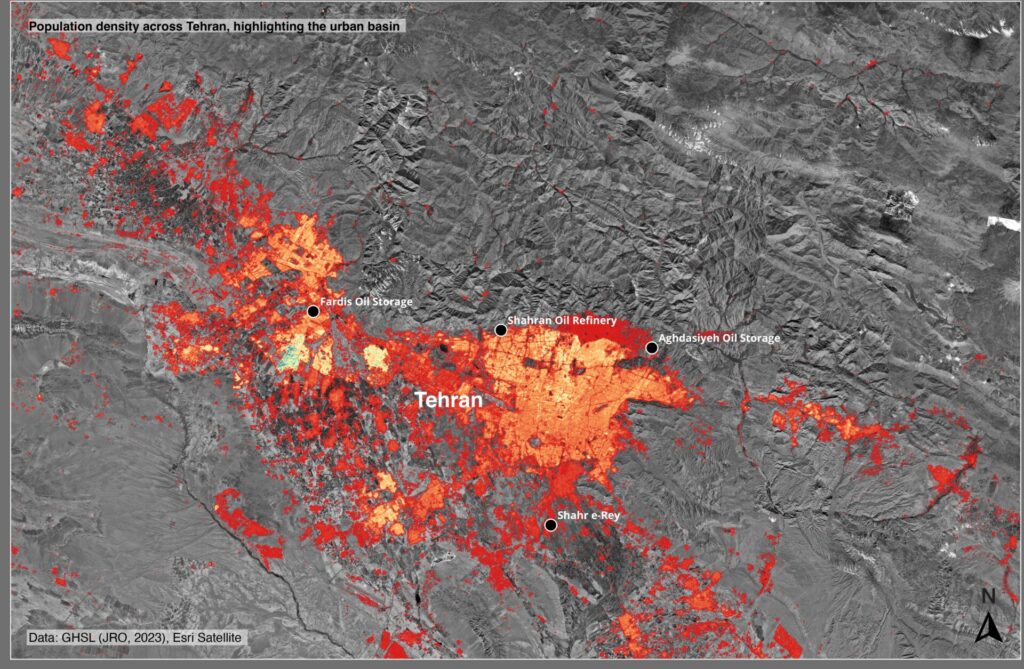
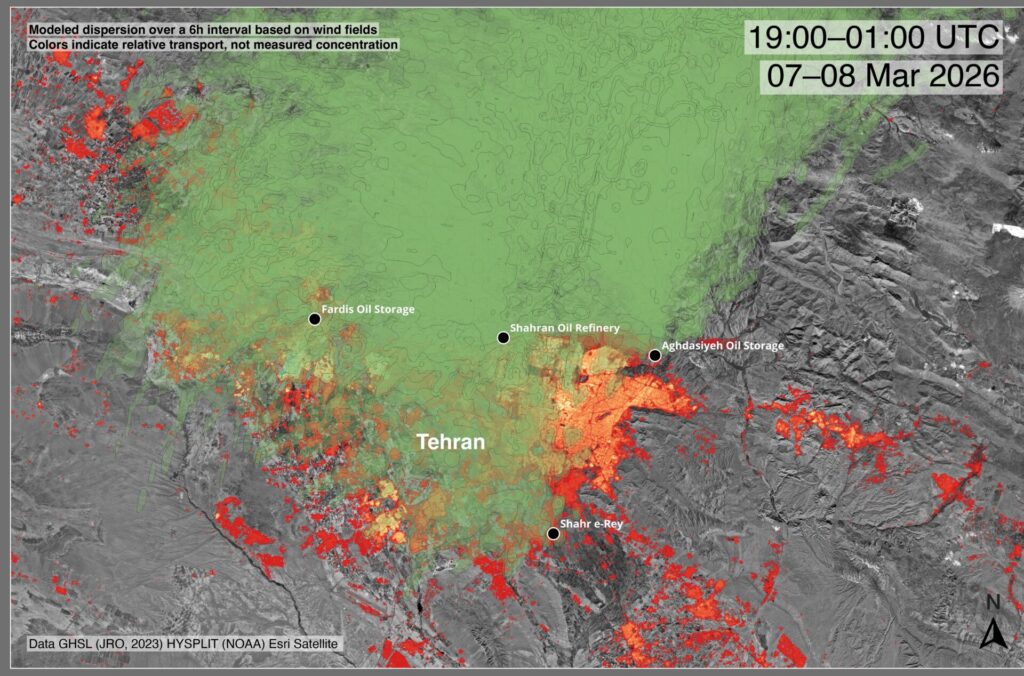
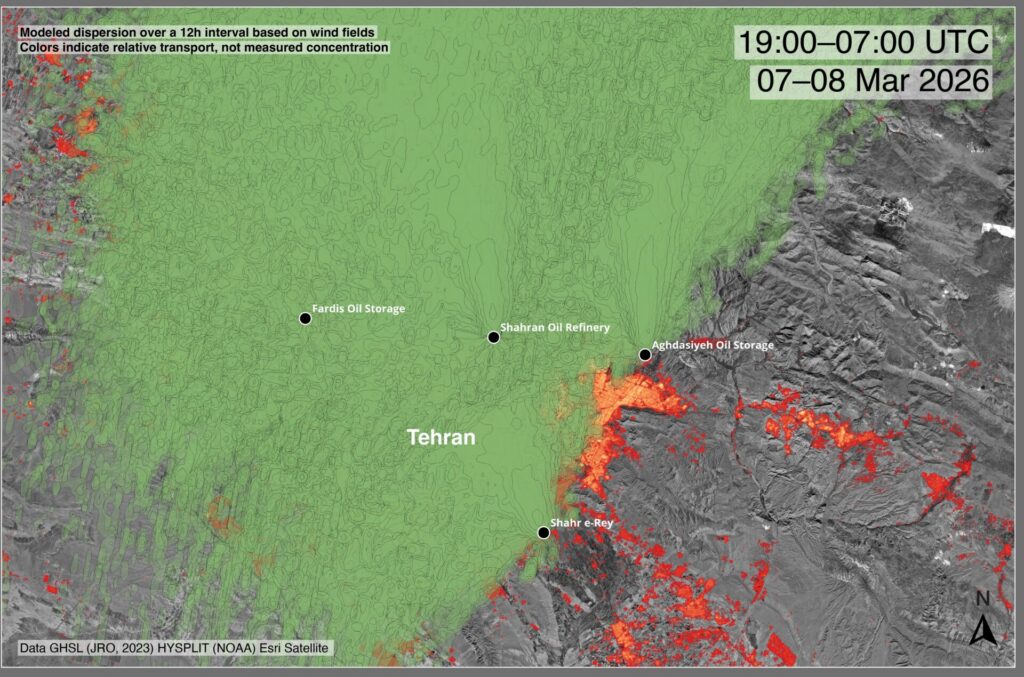
Four oil storage facilities were struck on Saturday — Shahran, Aqdasiyeh in northeastern Tehran, Shahr-e Rey in the south of the capital, and Fardis in Karaj, a city northwest of Tehran in Alborz province.
Residents who spoke to New Lines reported heavy pollution immediately following the strikes. Analysis of the fires and spread of smoke plumes gives insight into how far air pollution spread across Tehran. To understand more, we geolocated publicly available footage that surfaced on social media. By placing camera perspectives on satellite imagery to reconstruct how exactly these were filmed, we were able to observe the direction in which the smoke plumes moved from each location.
New Lines analyzed atmospheric conditions at the time of the strikes using smoke plume dispersion, based on the National Oceanic and Atmospheric Administration’s HYSPLIT model for the Tehran region, including wind direction at different altitudes. The model simulated how particles released into the atmosphere from the fires would disperse under the recorded wind conditions.
In the first moments after ignition, hot gases from large fires rose vertically due to buoyancy. During this phase, wind conditions have limited influence on plume direction. As plumes rise and begin to cool, winds at higher altitudes increasingly determine the direction in which the smoke travels.
“I couldn’t breathe, and I had to get nasal spray,” one resident said. “My eyes and throat have been burning. This is not defending human rights. What the U.S. and Israel are doing is inhumane. [The U.S. and Israel] have problems with the Islamic Republic, not ordinary Iranian people.”
One video filmed on Sunday in Tehran and verified by New Lines shows an individual wiping his finger over the window of a car parked on a street, showing black residue. In an interview, a resident also confirmed the presence of contaminants. “The air was really polluted. People were out with N95 masks,” they said. “There was black residue left on the cars. And on the ledge of my terrace, there were small particles of black residue, as if it had just rained, but instead of rainwater [being left behind], it was black residue.”
Interviews with oil experts confirmed that these facilities play an important role in daily life in Tehran and Alborz province.
Shokri said that perhaps 80% of their use came from ordinary people, and 20% from the government or companies related to the IRGC. “The population of these provinces consume about 22 million liters [5.8 million gallons] of gasoline every day, and [the] oil facility you mentioned, it’s very critical and very important for energy security and energy supply.”
Moreover, these facilities are known to use stored oil to generate power. Iran faces a significant electricity shortfall, often around 20% at its peak, which has led to frequent outages. In response, many businesses have increasingly relied on backup generators, though this is more of a coping mechanism than a structural shift in the energy system.
“A key thing to note is that these were fuel tanks, not necessarily gasoline or diesel, but for oil that’s used to generate power,” said Gregory Brew, an Iran analyst for Eurasia Group. “Given that dual-use fuel depots are actually pretty common parts of Iran’s energy infrastructure, it’s not that unusual that they would be used for both civilian purposes and also by IRGC or other military units.” Dual-use fuel depots are also the norm elsewhere throughout the Gulf region.
As a result of the recent Israeli airstrikes, at least 13 tanks at Fardis, seven at Shahran, seven at Aqdasiyeh and 51 at Shahr-e Rey were damaged.
“There’s smoke all over the city. I’ve had severe shortness of breath and my eyes and throat are burning,” said one Tehran resident. “In many places, the fires are still going. From where I am, I can see that there’s another explosion and smoke coming from the west of Tehran. Unfortunately, things are terrible.”
Residents in Tehran have long had to deal with major air pollution issues. As well as living under heavy bombardments, the explosive violence from bombs has added another layer to environmental issues. Leftover chemical particles from explosions also linger in the air.
“All the dust, debris, all of those things are pollution, and they can have lasting impacts,” said Kaveh Madani, the director of the United Nations University’s Institute for Water, Environment and Health and a former Iranian environmental official. Madani also underscored the contribution of missiles to air pollution.
“What we don’t know is whether there would be long-term impacts,” Madani said of the effects of the strikes on the oil storage facilities. “And the long-term impacts actually would not be air-related, mostly, they would be related to the other components [of] that leftover pollution. So that’s something we don’t know enough about, because we haven’t experienced something of this magnitude before.”
The strikes on these fuel depots represent a compounding effect for Iranians. Aside from air pollution, Madani stressed the future unknown pollutants in the water and soil.
“What I’m more concerned about is the deposit, essentially what returns to the ground; the acid rain brought the particles back. That’s what we’ve got to be worried about,” Madani said.
“That water is polluted and would remain polluted. So if now, later on, you want to use it for irrigation, you might have it back into the food supply chain, and then eventually back to your plate.”
While the long-term impacts of these strikes remain to be seen, civilians are shouldering the immediate effects. In interviews, Iranians spoke about the necessity of airstrikes to change the country’s leadership. But the oil storage sites that many rely on were not expected to be targets.
“What are people in Tehran supposed to do with this poisonous smoke?” said a resident of the capital. “It’s inhumane.”
“For people who are cheering ‘Trump, bomb [Iran], Trump, bomb [Iran],’ would they still say this if they were here?”
Methodology
To analyze how smoke from the strikes on oil storage facilities spread across the Tehran region, New Lines combined atmospheric dispersion modeling, satellite imagery, geolocated visual evidence and eyewitness testimony.
Plume Modeling and Wind Analysis
New Lines conducted atmospheric dispersion modeling using HYSPLIT, based on meteorological data from the National Oceanic and Atmospheric Administration (NOAA) for the Tehran region. The model generated a potential transport field, showing how airborne particles released from the fires may have moved under recorded wind conditions.
The analysis focused on wind movement at altitudes between 300 and 800 meters (roughly 1,000 to 2,600 feet) above ground level. This range reflects the early phase of large fires, when hot gases rise rapidly, and plumes reach higher altitudes before dispersing. During this initial phase, vertical movement dominates. As the plume stabilizes, wind at these altitudes determines the direction of transport.
New Lines modeled plume dispersion beginning at 11 p.m. local time on March 7, 2026, and analyzed movement over the following 12 hours using hourly intervals. The analysis focuses on this period because plume height decreases after the initial phase, requiring a different modeling approach.
Satellite Imagery and Plume Observation
Satellite imagery from Meteosat, Sentinel-3 and NASA Worldview was used to observe the movement of smoke following the strikes. These datasets captured large smoke plumes extending across the Tehran region in the hours and days after the attacks.
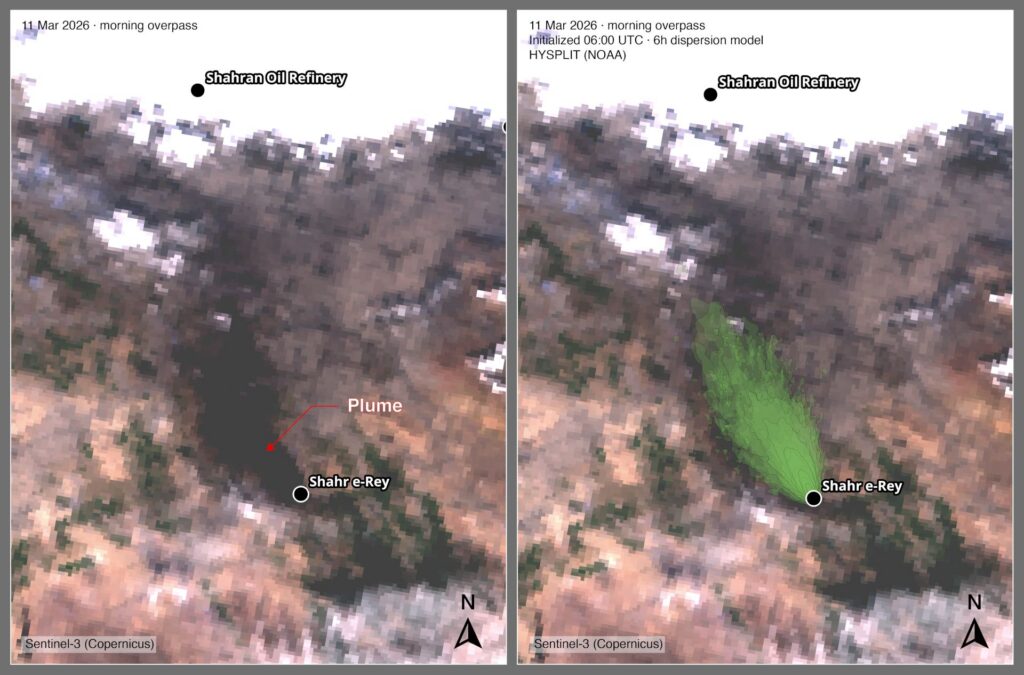
For the 12 hours after ignition, the direction of smoke plume movement observed in satellite imagery corresponded with the modeled transport field. After this period, when plume height decreased, plume direction was assessed primarily using satellite imagery and geolocated footage.
In the days following the initial phase, plume height decreased as buoyancy weakened and emissions remained closer to the ground. Under these conditions, transport becomes increasingly influenced by near-surface winds. To account for this, an additional HYSPLIT simulation was conducted using wind fields between 0 and 100 meters above ground level.
Observations from March 11, 2026, show smoke moving northwest. Modeled plume dispersion for this period shows a similar shift in direction, corresponding with the movement observed in satellite imagery.
Geolocated Footage and Eyewitness Accounts
New Lines geolocated content related to the fires and analyzed smoke plume movement using camera perspectives. To protect individuals in Iran who recorded this material, these videos and the verified information are not published.
Eyewitness accounts from residents across Tehran described reduced air quality, visible smoke and airborne residue in the hours and days following the strikes. These accounts correspond with both satellite observations and the modeled plume direction, particularly during the first 12 hours after ignition. Identifying details have been withheld to ensure the safety of those involved.
Damage Assessment of Storage Facilities
New Lines analyzed satellite imagery to identify damaged oil storage tanks at each site. This assessment excluded tanks previously damaged during the 12-day war between Israel and Iran in June 2025, in order to isolate damage associated with the March 2026 strikes.
The analysis showed that not all tanks at each facility were affected, and the extent of damage varied by location. Public reporting does not provide a precise breakdown of the type or volume of fuel stored in each tank. Based on available information, these facilities stored a mix of refined petroleum products used for civilian supply and, in some cases, for military or government activities.
Limitations
Several factors limit the precision of this analysis:
- Cloud cover obscured some satellite imagery in the immediate aftermath of the strikes.
- The exact volume and type of fuel burning at each site could not be determined.
- The duration of fires is uncertain, as internet disruptions in Iran limited the ability to reliably timestamp videos and images. We’ve used available satellite imagery to give a strong indication, however.
To address these limitations, New Lines compared multiple data sources — including satellite imagery, geolocated footage, eyewitness testimony and atmospheric modeling — to identify consistent patterns in plume direction and spread.
Become a member today to receive access to all our paywalled essays and the best of New Lines delivered to your inbox through our newsletters.