


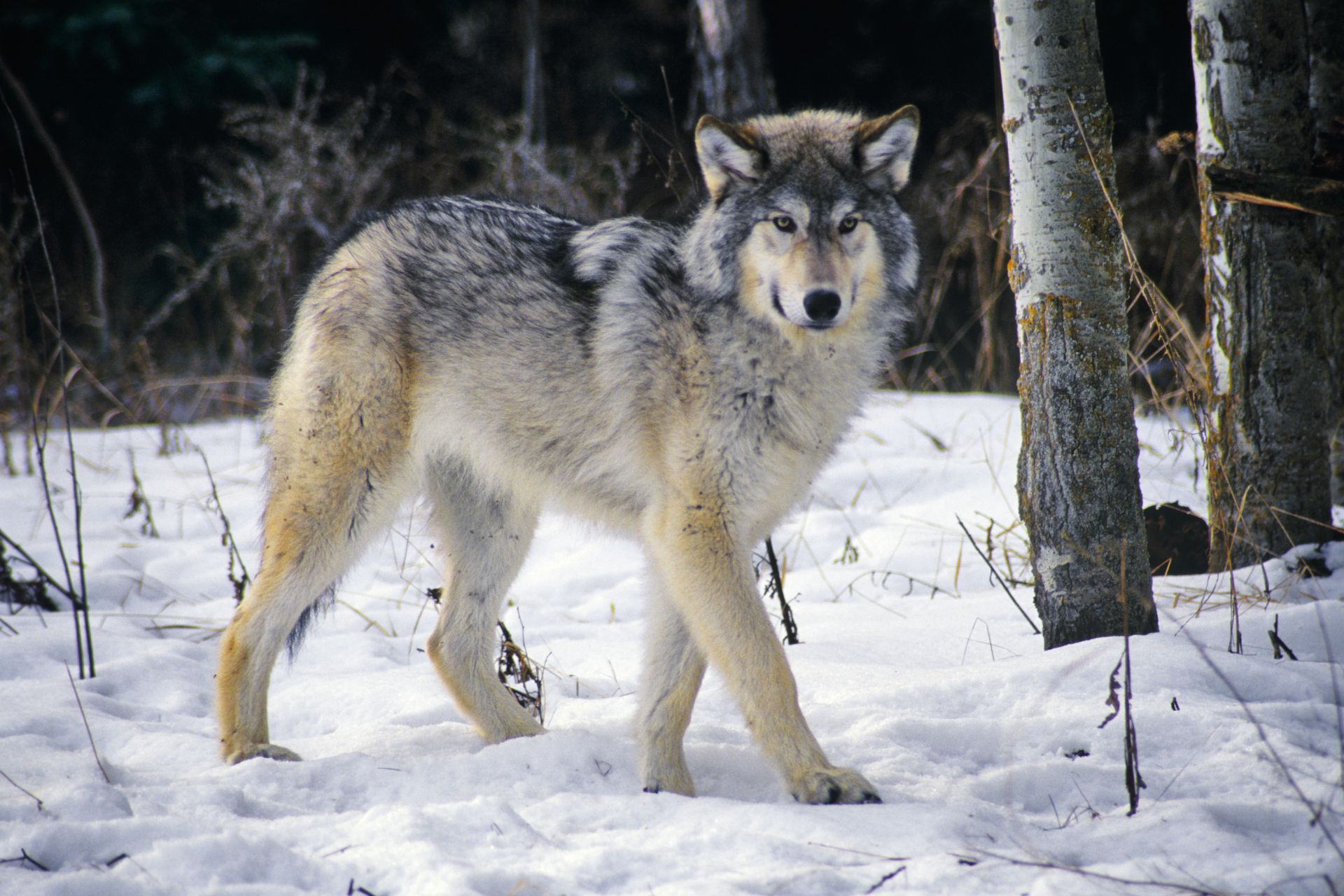
On a snowy winter morning, Michael Wiggins Jr., former chair of the Bad River Band of Lake Superior Ojibwe, carved out a few hours between meetings to speak with me about the Ojibwe tribe’s fight to protect the region’s wolves. He was seated inside Chief Blackbird Center, the tribal government building in New Odanah, in the Bad River Reservation in northern Wisconsin. A museum dedicated to the widely revered elder Joe Rose, who campaigned for the environment throughout his life, stood in front, the image of a rising red sun illuminating its entrance. Steps away, two flags flickered in the wind: the stars and stripes and the tribal flag with an eagle motif.
“This is the Thunder Bay Nest: the freshwater stronghold of North America,” said Wiggins, as he drew a map of the Great Lakes region, its outline resembling an eagle mid-flight. “It’s the ancestral home of our people, the Anishinaabeg (including the Boodewaadamiig, Odawaag and Ojibweg). Water people,” he added.
The reservation itself was established in 1854, after Ojibwe chiefs and headsmen were coerced into entering a land cession treaty with the United States in exchange for permanent homes and the right to hunt, fish and gather on ceded territories. Negotiated under pressure from timber and mining companies, the agreement opened the region up to large-scale industrial logging that transformed dense forests into cutover terrain. By the early 20th century, lumber barons and trespassers cut or burned down so many trees that people standing at Old Odanah said they could spot Madeline Island, the tribe’s spiritual center, about 20 miles away.
Today, more than 70% of reservation land has been restored to wilderness, with forests and wetlands fertile enough to welcome the return of wolves. Wolves, or “ma’iingan,” are culturally important to the tribe because they appear in the Anishinaabe story of creation, sent by the Great Spirit as a sibling to the tribe, recognized for their ecological value long before wildlife biologists identified them as keystone predators. “A long time ago, the animals said, ‘I’ll take care of you, I’ll teach you how to be a good person,’” Edith Leoso, a cultural consultant who has served as the tribal historic preservation officer at Bad River, told me. “Wolves teach us how to take care of our families, how to be a community, how to look out for one another.”
Since 1997, the Bad River Natural Resources Department has tracked the presence of wolves through radio telemetry, trail cameras and field observations, and found several packs regularly using parts of the reservation as their home.
The hunting and trapping of wolves, which are classified as a “tribally protected species,” is prohibited within the exterior boundaries of the reservation, even as their fate is debated everywhere else. In 2021, a rushed court-ordered wolf hunt in Wisconsin following federal delisting opened up questions about who has the authority to decide that fate. This has only intensified; the U.S. House of Representatives recently passed a bill that would remove federal protections for gray wolves under the Endangered Species Act (ESA), which is now awaiting Senate consideration.
As that national conflict pits Indigenous sovereignty and ecological knowledge against a federal framework, the tribe offers a different model, one in which the wolf was never a problem to be solved in the first place.
By the mid-20th century, gray wolves had been eliminated across the Lower 48 states, save for small populations that had survived in northeastern Minnesota and the Isle Royale National Park in Michigan.
Early Euro-Americans viewed wolves as rivals for resources, outlaws or “folk villains,” Jon T. Coleman, a historian at the University of Notre Dame, told me in a phone interview.
Having depleted the wolves’ traditional prey — bison, elk and whitetail deer, mostly through overhunting — settlers viewed the canines as a threat to the livestock they brought with them to the continent. Consequently, some of the earliest colonial legislation comprised wolf bounty laws, with Massachusetts Bay Colony setting the precedent in 1630.
In the settlers’ imagination, the continent they claimed to have “discovered” was terra nullius: nobody’s land, or an unsettled wilderness, “the habitation of savages and wild beasts,” as the Kentucky pioneer John Filson wrote in his 1784 book “The Discovery, Settlement and Present State of Kentucke.” Puritan writers frequently depicted the “howling wilderness” as an antithesis to Eden, while wolves became symbols: “an expression of anger against nature, or proxy for groups of people that were despised,” said Coleman, who explored this history in his 2004 book “Vicious: Wolves and Men in America.”
The historian was also struck by how often colonizers projected their own sense of vulnerability, “however delusional and convenient,” by likening themselves to their livestock, as if they shared their animals’ innocence and bewilderment. Drawing on pastoral imagery from the Bible — of shepherds, sheep, lambs and wolves — settlers imagined themselves to be a “spiritual flock” adrift in the wilderness of the New World. “In the course of becoming the most dominant predator on the continent, Euro-Americans often conceived themselves as prey,” Coleman observed in his book.
As animals that provided little economic value or use as food, wolves were widely regarded as “vermin” and officially classified as “injurious animals,” along with other top predators like mountain lions and bears, none of which were as reviled as the wolves. Their reputation had been shaped by medieval European interpretations of Christianity and folklore that cast them as Satan’s accomplices on Earth, preying on the meek and God-fearing, or ravenous creatures that stalked children in the woods.
Benjamin Corbin, the 19th-century bounty hunter who claimed to have killed more than 4,000 wolves across the Old Northwest, put it plainly: “The wolf is the enemy of civilization, and I want to exterminate him,” he wrote in his book “Corbin’s Advice; Or, The Wolf Hunter’s Guide” (1900).
In 1865, Wisconsin passed its own wolf bounty law, proposing a $5 reward for every kill, which was later revised to $10 for pups and $20 for adults. Later, under pressure from national livestock associations, the federal government intervened. It deployed teams of scientists alongside professional hunters and trappers to accelerate extermination efforts under the Bureau of Biological Survey, which would later merge with the Bureau of Fisheries to form what is now the U.S. Fish and Wildlife Service (USFWS), the agency responsible for overseeing endangered species protection, including wolves.
Methods used to kill wolves included strychnine-laced bait, snares, steel-jaw traps, cyanide guns, pursuit hounds and den hunting, in which pups were dug out and clubbed, knifed or shot to death. “In my research, I found many instances of people torturing wolves that went beyond simply eliminating them to making statements. I don’t know how much fear there was of wolves as much as hatred,” Coleman said.
Yet many Indigenous tribes regarded wolves as teachers and guides, relatives or mirrors of their own societies. For the Anishinaabeg, in particular, the wolves’ fate is understood to have been intertwined with their own. “Both have had their land taken from them. Both have been hunted for their wee-nes’-si-see’ (hair). And both have been pushed very close to destruction,” wrote Edward Benton-Banai, one of the founders of the American Indian Movement, in “The Mishomis Book” (1979).
“They put bounties on wolves; they put bounties on us,” Mic Isham, a natural resources specialist and former executive director of the Great Lakes Indian Fish and Wildlife Commission (GLIFWC), told me. The commission is an intertribal agency representing 11 Ojibwe governments across Wisconsin, Michigan and Minnesota, working to protect their off-reservation rights guaranteed under several treaties from the 19th century.
Beliefs about the wolves’ place in Anishinaabe life were passed down through generations, often in secret, as the U.S. government pursued centuries of forced assimilation, removal and termination policies that steadily eroded Indigenous lifeways. “Even a lot of my own people don’t know about the wolves’ importance, especially the ones who moved to the cities under the government’s urban relocation programmes,” Isham explained. “Moving to the cities, that’s how my dad met my mom,” he added.
Originally from Lac Courte Oreilles Reservation, about 70 miles southwest of Bad River, Isham was born to an Anishinaabe father and a “non-Indian mother” from Milwaukee. “My mother was Catholic, from the sheepherder religion,” he said. His father fought in the Vietnam War, returning home “a devastated man,” and his parents divorced soon after. So Isham spent his childhood summers on the reservation with his father’s side of the family and attended school in Milwaukee. “It was a Catholic school, so I’d hear about the ‘devils-red-lurking-in-the-woods’ — and I’d be like, ‘Sister, you mean the Native Americans?’” he recounted with a shrug.
In Milwaukee, there were no real woods or wildlife. “You’d walk the railroad tracks and see pigeons and rabbits, throw rocks at them, or you’d go to a park and see fat city squirrels,” Isham recalled. By contrast, on the reservation, he and his brother once killed a porcupine with rocks and were chastised for it. “My grandma was so mad. That’s when we started getting the indoctrination on how everything’s equal and sacred, how porcupines kept our people alive during the depression. She told us to clean it and eat it. Throw it on the fire, eat some chunks. So, I was always aware of the differences. In the Catholic religion, you have dominion over everything. In our religion, you’re a small, humble part of it all.”
Isham went on to study at Northland College, a small liberal arts school in Ashland, where he was mentored by Joe Rose, the widely revered elder who was an associate professor of Native American Studies. Among other things, Rose taught him about the importance of wolves and their place in Ojibwe ways of understanding land, kinship and responsibility. He carried those lessons with him when he was hired to lead GLIFWC between 2018 and 2023.
The commission was formed after brothers Mike and Fred Tribble from Lac Courte Oreilles purposely went off-reservation to harvest fish, using the resulting court case against them to reassert a principle that had long been forgotten: that treaties, under the Constitution, remain “the supreme law of the land.” The case forced a reckoning over where state jurisdiction ended and tribal sovereignty began, a boundary that had grown increasingly blurred as hunting and fishing management was gradually transferred to the states.
“There were a lot of people going off-reservation all the time, you just had to hide from the wardens,” Isham said. “So, these guys decided they’re gonna go off and get busted and take it all the way through the court system. That’s what they did. They got busted on Chief Lake — right by my house — and took it all the way up.”
In 1983, a federal court ruled in the Tribbles’ favor in what became known as the Voigt Decision, reaffirming the tribe’s off-reservation treaty rights and establishing that all animals legal to hunt and fish were shared resources.
Today, GLIFWC works with state agencies to devise hunting seasons and management plans. “We don’t say management,” Isham clarified. “Management is what you do to something you have dominion over. But we’re not above or outside the natural world. We’re part of it.” He prefers the term “stewardship,” since it implies a system of reciprocal relations among human, animal and plant life. “Now we’re consumers too, like everyone else. We drive a lot of Priuses around here. But people who live the traditional Ojibwe lifestyle are more connected to the earth,” he added.
“We use traditional ecological knowledge from thousands of years of observation,” Isham said. “We don’t hunt deer till the fireflies come out. We don’t spear certain lakes until the pussy willows are budding, or the frogs are chirping. But because we have to work with the state, we had to learn the Western science ways. With the state, we have to develop seasons, you know? On-reservation, it’s fireflies. Off-reservation, it’s the — what is it? — first Monday after Labor Day.”
Wiggins had only seen wolves in the wild on three occasions. “The first two times were from afar, they’re very skittish,” he recalled. Then, some years ago, while he was out hunting in the woods, a young wolf galloped up to him. “He was in rough shape, didn’t look good, but it was incredible to see him up close. We just looked at each other and never broke stride,” he said with a smile.
That such an encounter could happen at all would have been unthinkable some decades ago. In 1960, wolves were officially declared extinct in the state — though by then mainstream American attitudes had already begun to shift, as postwar industrialization and urbanization transformed both the landscape and people living in it. “Wage earners living in apartments own goldfish, not cows,” wrote Coleman in his book, “and as the sting of livestock depredation faded from many Americans’ lives, so did their hatred of wolves.”
That change paved the way for the passage of the landmark Endangered Species Act (ESA) of 1973, which prohibited the import, export, hunting and killing of all fish and wildlife species considered at risk of extinction, including wolves, which the USFWS added to the ESA list in 1974. Violations of the act could result in criminal penalties of up to one year in prison, along with substantial fines.
As wolf populations rebounded under federal protections in Minnesota — and as forests regenerated and deer populations returned — a handful of them began wandering across the border into neighboring Wisconsin. “The couple hundred or so wolves that had survived in northeastern Minnesota started recolonizing much of Minnesota, one-third of Wisconsin, and the Upper Peninsula of Michigan without direct human intervention,” Adrian Treves, an environmental studies professor who set up the Carnivore Coexistence Lab at the University of Wisconsin-Madison, told me.
By the mid-1970s, Wisconsin had been “recolonized,” a term used by scientists to describe wild animal populations naturally reclaiming landscapes from which they have been extirpated. From 1979-80, the Wisconsin Department of Natural Resources (DNR) started formally monitoring the population and estimated that around 25 wolves in five breeding packs had formed in the state.
Around the same time, a broader Indigenous resurgence was taking shape, marked by the Red Power movement, the introduction of Native American studies in universities, the establishment of dozens of tribal museums and the passage of foundational legislation including the Indian Civil Rights Act (1968), the Indian Education Act (1972), the American Indian Self-Determination and Educational Assistance Act (1975) and the American Indian Religious Freedom Act (1978).
For some Anishinaabeg, the timing was not coincidental. Among those who maintain traditional teachings, the wolf’s return and the renewal of Indigenous political and cultural life affirmed a long-held understanding that their lives unfolded in parallel.
“In European territories, the wolf was associated with danger; it was seen as a pariah,” said Wiggins, who grew up Catholic before reverting to Ojibwe beliefs. “I don’t subscribe to that. I believe what Aldo Leopold wrote: ‘When you alter the land, you alter the people,’” he said, paraphrasing Leopold, the renowned conservationist and professor of game management at the University of Wisconsin-Madison, who had famously recounted shooting a wolf and being changed by watching “a fierce green fire dying in her eyes” in “A Sand County Almanac” (1949).
By April 2020, an estimated 1,034 wolves roamed Wisconsin, excluding the small percentage living on tribal reservations.
Over the past two decades, however, as wolf populations have begun to recover, there have been repeated efforts to roll back their legal protections, amid lobbying from hunting and livestock associations. Each time, federal agencies have justified these moves by pointing to what they call the species’ “successful recovery” — a claim that remains contentious, with some biologists arguing that numbers are beside the point.
“Beware of the numbers game,” Treves cautioned. “Interest group rhetoric and some political declarations make it seem like the number of individual wolves is an essential datum, but it’s not a biologically relevant measure of how self-sustaining a wolf population might be relative to the number of packs that successfully reproduce.”
In 2012, the USFWS lifted federal protections for gray wolves in Wisconsin, Minnesota and Michigan, citing that the Western Great Lakes wolf populations had surpassed ESA recovery thresholds. Then-Gov. Scott Kevin Walker approved the Wisconsin Act 169, which authorized a wolf hunting and trapping season from mid-November until the end of February.
The DNR distributed hunting permits, set quotas and marked harvesting zones. Although the Wisconsin DNR allocated half of the ceded-territory harvest quota to Ojibwe tribes, the tribal governments chose not to exercise it.
Instead, the Mashkiiziibii Tribal Council and others approved emergency rules prohibiting the hunting and trapping of wolves within reservation boundaries, formally reaffirming long-held beliefs that wolves should be left alone to determine their own population levels.
That year, 117 wolves were killed; the next year, 257. In 2014, another 154 wolves were killed before protections were once again restored under pressure from environmental groups.
Toward the tail end of the first Donald Trump administration in October 2020, the government announced it would delist gray wolves in the Lower 48 states. In a press release, then-Secretary of the Interior David L. Bernhardt called this the result of a “successful recovery.”
“After more than 45 years as a listed species, the gray wolf has exceeded all conservation goals for recovery,” he said. “Today’s announcement simply reflects the determination that this species is neither a threatened nor endangered species based on the specific factors Congress has laid out in the law.”
When news of the delisting reached Mashkiiziibiing, the tribal leadership was dismayed but not surprised. “Nothing shocks me anymore,” Wiggins said. “I just took it as a threat.”
In the weeks leading up to the February 2021 hunt, GLIFWC warned that the state lacked the scientific basis and legal footing to proceed so quickly after the federal delisting, and that authorizing a hunt without meaningful consultation with the tribes would violate treaty obligations. Initially, the DNR refused to hold the November-to-February hunt, since the decision came in the middle of the season and experts said they needed time to revise the Wolf Management Plan.
But the Wisconsin legislature disagreed. On Feb. 11, Jefferson County Circuit Court Judge Bennett J. Brantmeier said the DNR had violated state law with its “refusal to immediately establish an open season for the hunting and trapping of wolves” and ruled that a hunt should be held before the end of the month.
Yet no one could have anticipated what followed. “A horror show,” Isham called it.
In less than three days, an estimated 216 wolves were killed. Hunters put up photos of themselves with their kills on social media, posing with rifles on top of piles of dead wolves. They grinned beside carcasses dangling from chains, leaving blood trails in the snow. Some didn’t have licences; others were convicted poachers. Many used outlawed methods like snares, chaser dogs and leg traps, relics of the 19th century.
Not only did the February hunt exceed the state-sanctioned quota of 119 kills, forcing the department to bring it to an early end, but it took place in the middle of the wolves’ breeding season. “It’s not as simple as going into the woods and killing one wolf. The ripple effect is something that needs to be taken into account,” Wiggins said. “These are highly regimented societies we’re talking about. You kill an alpha, it causes chaos within the pack. There’s infighting and power struggles. Pups die of starvation.”
Later estimates by the Carnivore Coexistence Lab found that 313 to 323 wolves had been killed, including pregnant females. In other words, in less than 72 hours, an estimated one-third of Wisconsin’s wolf population had been wiped out.
In response, Wisconsin’s six Ojibwe governments came together to sue the state to stop the next hunt, scheduled to start that November. The lawsuit was filed on the basis of what Wiggins described as the “clear and very provocative violation” of the treaties of 1837 and 1842 (also known as the Pine Tree and Copper treaties).
The tribes argued that these hunting rights carried an implied conservation right and that by authorizing a rushed wolf hunt in February 2021, without adequate consultation with the tribes, the state had undermined their treaty-protected role as co-managers of the land.
The tribal governments viewed the case as a “fundamental responsibility to try and protect our relatives,” Wiggins explained. “The Spirit put us on different paths, but we were told that what happens to one happens to the other — and the Garden of Eden is here. We’re sitting in it.”
Peter David, a wildlife biologist at GLIFWC, was seated behind his desk, papers scattered around him. In the corner, a laptop bag bore the etched image of a wolf and the words “Aldo Leopold’s Wolves.”
“If you’ve ever been to Washburn — small community, about 2,000 people, the kind of town tourists drive through and barely notice — and you take that population, divide it in half, and spread it over the entire northern third of the state, that’s sort of comparable to the density of wolves in Wisconsin,” he told me.
This is the example the wildlife biologist offers when confronted with the claim that wolf numbers are too high. “Wolves are so good at self-limiting their own population that the number never gets very high, compared to a lot of other species,” he explained.
David was just weeks away from retirement when the February 2021 hunt took place, forcing him to postpone his plans. When he started out three decades ago, there were even fewer wolves in Wisconsin. “I’m 60-some years old and — by God! — there were no wolves in the Wisconsin I was born into. Even as late as 1999, there were only about 200 wolves in the state. So, it’s a pretty remarkable recovery,” he said with a smile.
A few years ago, while he was out conducting a wolf survey in Bayfield County, he heard coyotes howling in the night. Within a minute, a wolf pack responded in kind. “To be out there — in that remote spot, in the dark, hearing these two cousins call out to each other — it sends shivers down the spine,” he added.
The tribes believe wolves are an important factor in keeping the large herbivore population healthy, because they typically hunt the sick animals. “There’s a need for more science on this, but science also needs to catch up,” David added.
Studies conducted over the past 20 years in Yellowstone National Park have shown that the reintroduction of wolves has led to the stabilization of wild elk populations, as wolf packs took out the weak and diseased, leaving more resources for the healthy members of the herds.
There have also been studies on scavenger species, such as ravens and other smaller predators, showing how they, too, benefit from the presence of wolves on the land, as they feed on the carcasses left behind.
“Biological systems are complicated,” David said. “Where you have populations of large animals — like deer or moose or elk, or others in the ungulate family — the ecology of those systems is much healthier if you have effective predators present.”
When deer populations are high and nothing is threatening them, they devour many species of plants. When wolves are present (as documented in Yellowstone, as well as in north-central Wisconsin), the diversity of plants is greater. “Some of those plants are important medicinal plants for the tribes, so it’s important to keep them on the landscape. And they tend to provide all kinds of habitat benefits for various species of wildlife as well,” David added.
There has also been some modeling work done that suggests wolves may help human health through a process called trophic cascades. “The theory is that wolves reduce the number of coyotes in an area. Without wolves, the coyote population could get very high, and coyotes tend to keep fox populations down, which are what we call the best mousers,” said David.
“They’re the ones feeding on the small rodents that carry many of these ticks that carry diseases,” he said, referring to illnesses like Lyme, anaplasmosis, ehrlichiosis, Borrelia and Rocky Mountain spotted fever.
In February 2022, a federal judge in the Northern District of California reversed the USFWS decision and ordered the restoration of federal protections for gray wolves in the Lower 48 states, barring the Northern Rockies.
The threat of delisting, however, did not go away. Within weeks of the ruling, some Republican lawmakers tried to have it overturned, urging Joe Biden’s administration to appeal the decision.
Now, the U.S. House of Representatives has passed a bill that would remove federal protections for gray wolves under the ESA. This is now pending Senate consideration, and a vote was recently postponed. If it passes, the tribes might lose the right to refile their lawsuit, which had been dismissed without prejudice.
For Wiggins, though, the fight for wolves will always be tied to Rose, who passed away from COVID-19-related complications during the February 2021 hunt. He was 85. “Joe always said that if the wolf should ever vanish from the landscape, the Anishinaabeg will die. We will die. From the loss of spirit, the loneliness of spirit,” he said.
“I’m not sure how much of the relisting was because of our efforts, but he would’ve been so happy. He would’ve given me a stern handshake and a clap on the back — he was a big, strapping dude, you know? — and probably added a little ceremony with the pipes to say ‘thank you.’”
After a short pause for reflection, Wiggins added: “Sometimes I think Joe died to escort all those wolves across to the other side. Other times, I think hundreds of them showed up to help him cross over. Either way I look at it, I find it beautiful.”
Become a member today to receive access to all our paywalled essays and the best of New Lines delivered to your inbox through our newsletters.