

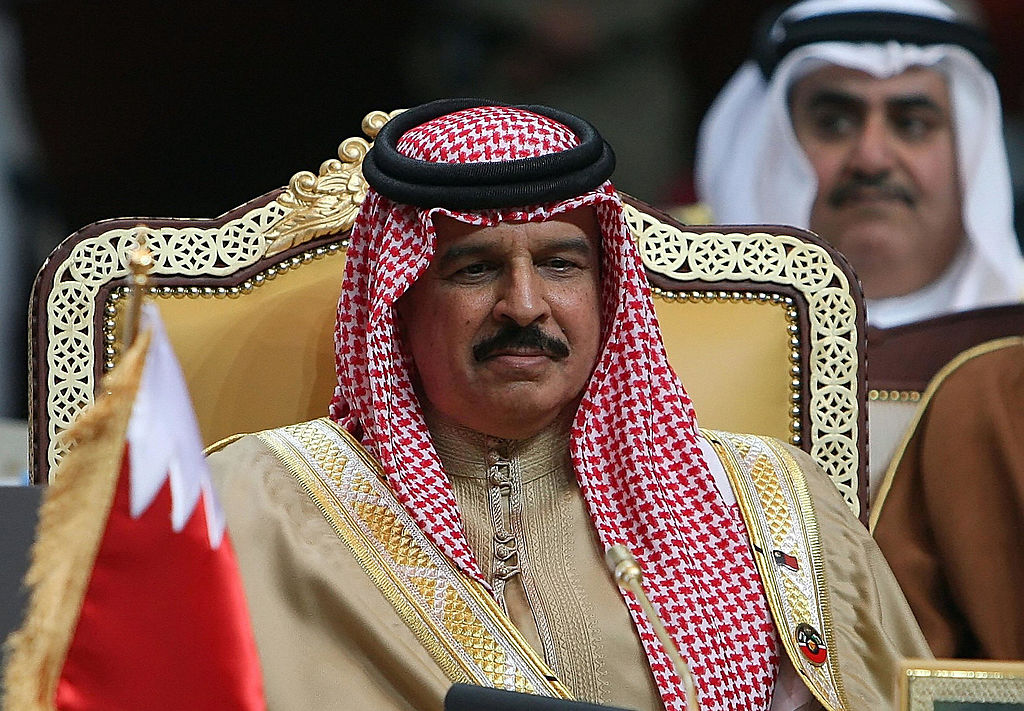
Three Bahraini parliamentarians could be removed from their positions this week for alleged disloyalty to the kingdom, after they questioned the legality of revoking citizenship without due process.
On April 27, Bahrain revoked the citizenship of 69 individuals, alleging that they had sympathized with the Iranian attacks on the kingdom during the ongoing war on Iran by the U.S. and Israel. Also affected by the decision were family members of those directly charged with treason.
Last Tuesday, during the weekly parliamentary session, members reacted to the revocations by revisiting Decree-Law No. 13 of 2024. The measure amended Article 7 of the Judiciary Authority Law, which had given the High Civil Court responsibility for adjudicating, among other matters, issues of passports and immigration, including citizenship revocations. Under the amendment, nationality disputes were removed from the court’s jurisdiction and redefined as sovereign acts. Essentially, this gave Bahrain’s King Hamad bin Isa Al Khalifa and his royal court the authority to revoke citizenship and nationality without providing evidence or following due process for those who wish to appeal the decision.
During parliamentary discussions, First Deputy Speaker Abdulnabi Salman Nasser voiced concerns about the measure. “The concern is that removing the judiciary from cases touching a fundamental legal status such as citizenship is an enormously significant matter. It may open the door to a wider discretionary space that could sometimes be crossed, and this affects the flow of justice in specific cases,” he said.
“The citizenship file, no doubt, needs to be organized as a sovereign matter,” he added. “But that may touch on the very essence of the right to litigation, and may affect the rule of law — especially when the necessary guarantees for protecting individuals and families from potentially arbitrary decisions are absent.”
Nasser went on to call for “oversight” of a matter as sensitive as naturalization, saying that, in the event of errors, individuals and families may not have legal recourse. He still agreed, overall, with the spirit of the law, given its national security context.
Services Committee Chairman Mamdouh Al Saleh also voiced concerns, citing the potential impact on families. Nevertheless, he asserted his support for the king’s right to exercise sovereign power over matters of citizenship.
“We understand that justice knows no favoritism. But the punishment does not extend beyond the offender,” Al Saleh said. “The law is clear, and the Sharia is clearer. And reason says: If I make a mistake, why should my children be punished? If I sin, why should my family carry my burden? I say this — and I say again — this is not an objection to the state. On the contrary, I am a son of the state. I am saying this as a champion of the state’s justice.”
“Today, we are not demanding the suspension of the law, nor are we asking for leniency toward those who threaten the security of the homeland,” he added. “Rather, we say: Apply the law — yes. Hold the wrongdoer to account — yes. But do not let others who have no guilt bear it. I ask for explicit affirmation, through this decree, of the principle of individual criminal responsibility — protecting children and families from any consequences they are not guilty of.”
Parliamentarian Mahdi Abdulaziz Al Showaikh also echoed these concerns. Justice and Islamic Affairs Minister Nawaf bin Mohammed Al Maawda responded, noting that the change in law was in accordance with global norms around the issuance of citizenships, and that “the purpose of this decree is to give the state sovereignty over citizenship.”
“In such matters, the judiciary does not intervene in any country,” the minister said. “These are matters related to security and the higher interest of the country. They are not presented to the judiciary, not discussed before the judiciary and not disclosed to the judiciary at all. This is a sovereign matter, and it is so in every country — it is not something strange.”
“This is not a punishment,” he added. “A punishment is different — a punishment is a penalty for violating a provision of the law. But citizenship is not of that nature. Citizenship is granted by a sovereign act of the state, just as in every other country.”
The amendment was passed with 34 of 40 parliamentarians in favor, three against and three absent.
Disagreement over the law snowballed into something larger and murkier on Thursday, after King Hamad delivered a speech warning Tehran not to intervene in Bahrain’s internal affairs — a reference to the Iranian Foreign Ministry spokesperson, Esmail Baghaei, calling the revocation of citizenship “discriminatory.”
In his speech, the king also denounced those “whom the people had elected to represent them standing alongside traitors,” and issued a veiled threat to impose martial law in case of further dissent.
“His Majesty stressed that these deterrent measures are not vindictive, but rather a mercy to the vast majority of the loyal sons of the nation, and a safety valve that prevents the leadership of the valiant armed forces from having to take over matters according to military rulings,” according to a transcript of the speech posted on the kingdom’s national news agency website.
In the following days, not only did the three parliamentarians — Nasser, Al Saleh and Al Showaikh — apologize profusely, but pledges of allegiance began pouring in from royal family members, government leaders and the heads of powerful tribes, acknowledging the “validity” of the citizenship revocations as well as pledging fealty to the sovereign.
Even other Gulf Cooperation Council (GCC) states and GCC Secretary-General Jasem Mohamed Al Budaiwi stepped in to endorse the king’s decision.
For the three parliamentarians, however, the matter did not end there, as the rest of the body turned on them, demanding their resignation. The 37 other members signed a letter calling for their dismissal, and a “vote” on the matter is expected on Thursday, May 7.
Arbitrary arrests, disproportionately targeted at Bahrain’s Shiite Muslim majority, have ramped up in the wake of the Iran war, under the pretext of punishing “treason” and pro-Iranian sentiment.
The Interior Ministry was given extraordinary powers to strip citizenship and thereby deny individuals and families the right to free or subsidized housing, health care and employment benefits. The restrictions have relied on Article 10 of the Bahraini Citizenship Law, which provides for the revocation of citizenship “in the event of causing damage to the interests of the Kingdom or acting in a manner that contradicts the duty of loyalty to it.”
Citing vague anti-terrorism measures, the government has stripped hundreds of people of their citizenship since 2011. While there used to be some semblance of a legal process to appeal against such revocations, that is now gone, replaced with a law that allows the king to leave alleged traitors — and their families — stateless.
“Spotlight” is a newsletter about underreported cultural trends and news from around the world, emailed to subscribers twice a week. Sign up here.