


I was sitting in my barber’s chair in Beirut on a hot August afternoon, the hum of the clippers blending with the shuffle of a YouTube playlist on the screen. As he trimmed my hair, a song began to play. It was a rare, pure “tarab” melody, a kind of Arabic music that literally means “enchantment” and that feels almost extinct in today’s pop landscape. Impatient to move my head just to glimpse the screen, I caught the name: Fadel Chaker’s newest single, “Sahhak il Sho’” (“Desire Woke You Up”).
It was an unpleasant surprise. I had promised myself I wouldn’t seek out his music, that I wouldn’t willingly listen to him. But with eight songs on the 100 Billboard Arabia chart, and a number of new singles, he was inescapable. His recent collaboration with his son Mohamed, “Kifek ‘a Fra’ee” (“How Are You Now That We’re Apart?”), had already amassed over 100 million views on YouTube in two months, securing a top spot in the music video category. The song was everywhere: cafes, taxis, TikTok reels, countless covers. And yes, it was undeniably catchy. “But it’s Fadel Chaker,” I’d scold myself. A few days later, I found myself folding (after barely any resistance), listening to his new songs on repeat, caught in the strange, familiar pull of his voice.
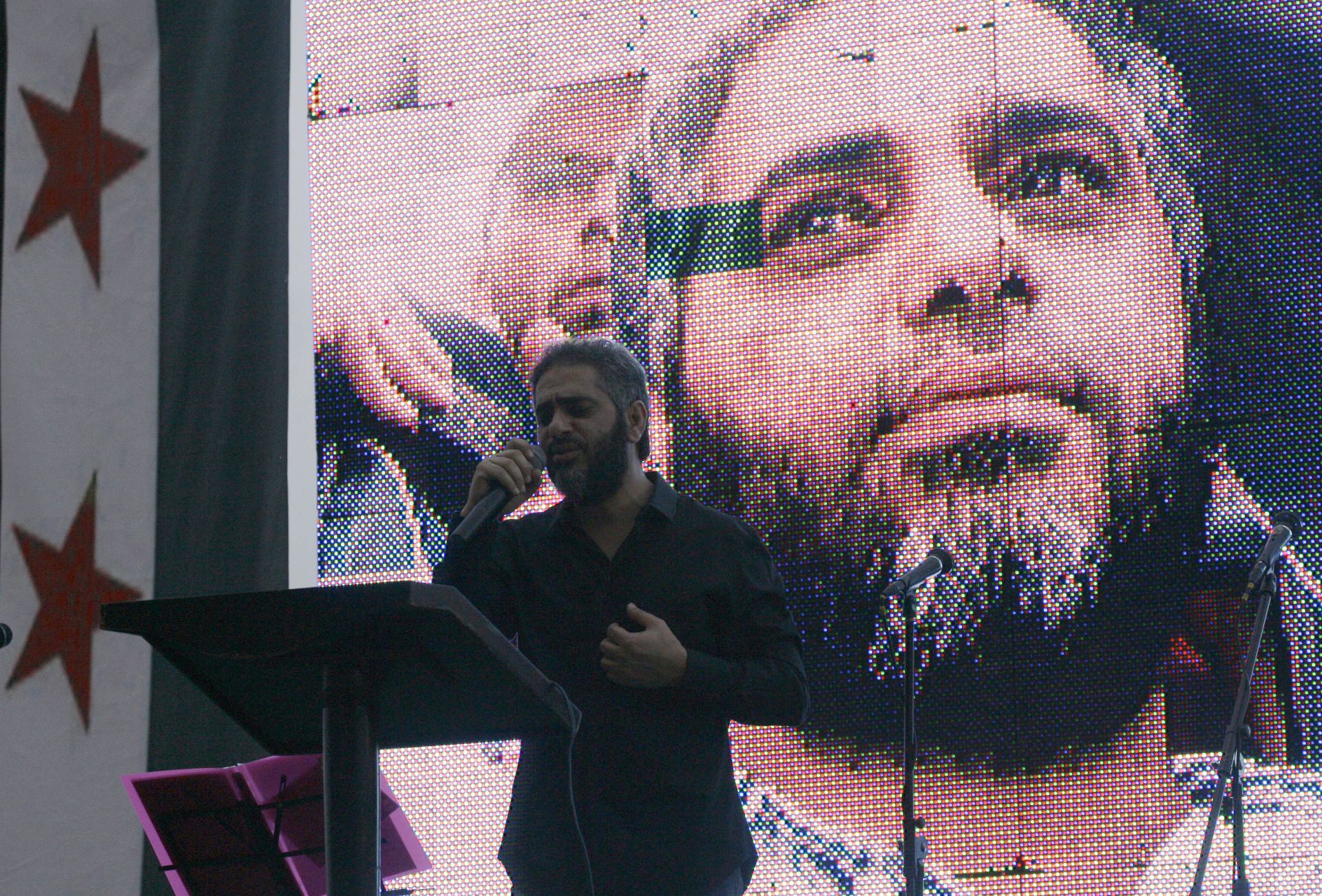
If you don’t know Chaker’s full story, my reaction might read as simple disdain. But it’s more complicated than that. Chaker was once one of Lebanon’s most beloved male singers. He rose to fame in the early 2000s alongside Wael Kfoury, Ramy Ayach and others. His voice was so soothing and his songs so romantic that he earned the nickname “Malek el Ihsas” (“the King of Emotion”). His rise was steady until 2012, when thoughts of retiring from music coincided with the targeting of Sunnis in the war in neighboring Syria, a period that profoundly impacted him. This prompted a dramatic reinvention: He aligned himself with the radical Islamist cleric Sheikh Ahmad al-Assir in Sidon, publicly denounced his music as haram (sinful) and grew a scruffy beard.
In June 2013, armed clashes in Sidon’s eastern suburb of Abra resulted in significant casualties, including 18 Lebanese army soldiers killed along with over 20 of Assir’s supporters. Following these events, Chaker and Assir both became fugitives. Chaker reportedly fled to the Ein el-Hilweh Palestinian refugee camp near Sidon, where he had been raised. Lebanese security forces generally do not enter the camp, making his arrest unlikely and the camp a perfect refuge spot. Despite his fugitive status, Chaker continued to release music, using the camp’s internet infrastructure to distribute his songs, up until he surrendered to the Lebanese military last weekend.
Chaker’s seemingly spiritual transformation was politically charged. A viral video from the time of the clashes captured him saying, “We sent home two corpses for you yesterday,” a statement some interpreted as an admission that he had participated in the killing of Lebanese soldiers. He denies taking part in violence against soldiers and denies being present during the Abra clashes, but in the Lebanese collective imagination, fueled by misinformation about his whereabouts, he has betrayed the nation. A quick Google search will display the extremes Chaker has lived through: images from his lover-boy era, his bearded Salafi years and his recent return, always sporting sunglasses, even indoors.
His attempted comebacks over the years have been polarizing. In 2021, when he released a song called “Fostan al-Helwa” (“The Beauty’s Dress”), I asked in a post on X (then Twitter) how anyone could listen to him. The response was swift and hostile: Fans defended him fiercely, attacking me instead. The same year, controversies like Rania Youssef’s dress scandal, which saw her dragged through the courts and plloried online for “inciting debauchery,” and Saad Lamjarred’s ongoing sexual assault allegations showed a striking contrast. Where women and queer artists were publicly scrutinized, male artists, even with criminal or morally questionable pasts, continued to thrive.
Lamjarred, for instance, faced multiple rape allegations in France, yet continued to release chart-topping music and perform sold-out concerts. Cheb Mami, convicted in France for drugging a woman and attempting to force an abortion, served less than two years, and remains a major figure in Algeria and across the Arab world. It’s worth mentioning that both of those cases were in France, involving North African artists, which adds another layer of complication. The geographical distance, combined with the sense of standing as an Arab or North African against France, seems to make it easier for audiences to emotionally distance themselves and, perhaps, forgive.
Yet even domestic incidents, like Kfoury’s and Fares Karam’s alleged abuse, or Egyptian singer Amr Diab slapping his driver on camera, barely dented these male artists’ standing with the public. Perhaps this selective forgiveness is tied to identity and proximity. Many Arab men see themselves in these artists, or want to. Patriarchy, nostalgia, religious ethics and collective memory all play a role.
While Chaker’s exact departure date from Assir’s group is not publicly documented, he has tried to get back into music since 2018 with little to no success. Until now. What has changed since?
Shahid, the streaming service, released the docufiction “Ya Ghayeb” (“O Absent One”), which traces Chaker’s journey, from his upbringing in a poor household, to fame and stardom, and finally to his Abra phase. The nine-episode series clumsily jumps across timelines, blending dramatized reenactments with actors playing his wife and children, real-life concert and interview footage, and interviews of Chaker himself narrating his story.
The first episode addresses his whereabouts during the Abra clashes, revealing that he was hiding in a music shop. Yet his profound transformation is barely explored, reduced to two surface-level scenes of him watching videos from Syria, followed by the sudden appearance of a beard. In these interviews, he questions the accusations against him, asking if standing up for the rights of children and women, praying “too much” and growing a beard make him a terrorist, and proudly declares that if it does, he embraces the label. He frames his change as humanitarian rather than strictly religious or political.
The documentary series attempts to humanize Chaker without delving too deeply, portraying him as a loving, caring father, a role reinforced again in his duet with his son, Mohamed.
Political and religious dynamics matter, too: With Sunni influence strengthening and regional shifts in Lebanon and Syria, his alignment against Hezbollah and Bashar al-Assad resonates with big audiences. Religion can’t not be part of the conversation. There’s been a clear Islamization funnel of Arab pop artists. They leave music, denounce it as haram and take down their YouTube videos, yet their religious turn is welcomed, applauded and framed as spiritual growth. Examples include the Jordanian musician Adham Nabulsi and Lebanese singers Nina Abdel Malak and Amal Hijazi (who recently faced criticism for revealing her curly hair in an Instagram post after taking off her hijab).
Chaker’s return, however, wasn’t framed as a rejection of Islam. He rebranded himself as the family man, the devout, the docuseries-ready figure. Does religiosity make redemption easier in the Arab imagination? Why are we so forgiving? Why do we, as Arabs, more easily separate the art from the artist? Because we’re emotional and nostalgic, and songs like “Ya Ghayeb” are part of our personal histories?
Arabs thrive on memories of the past, finding comfort and refuge in them — a temporary escape from the chaos that surrounds us, both on our screens and in the world. Chaker’s songs feel like discovering forgotten money in the pocket of old jeans, melodies that slipped out of the good old days and into our streaming libraries.
Do we see enough of ourselves in his songs and persona to forgive Chaker? Maybe his struggles mirror collective contradictions between piety, rebellion and art in a politically charged region. Or is it simply because cancel culture doesn’t exist here?
Ignorance plays a role, too. Many people, especially non-Lebanese, don’t know exactly what happened, or don’t care enough to find out. One thing is clear: Chaker held weapons, funded an armed group, incited violence against the Lebanese army and faced a money laundering case. Across the Arab world, the image of someone holding weapons is neither instantaneously nor inherently tied to “terrorism.” Armed militias, resistance groups and political factions exist for countless reasons, and many households even keep guns. We’ve grown accustomed to weapons, and those who carry them are not automatically labeled as terrorists. In Chaker’s case, the main controversy has always been whether he killed someone, specifically in the Lebanese army, or not.
But more than 10 years later, what if his return has meaning? What if he genuinely repented? Technically, he already served time in the camp and will now serve time in a Lebanese prison. To many, he’s already paid his dues. Why not give him a second chance? Most artists and peers seem to have done so.
How do we judge him as Arabs? Do Chaker’s artistic legacy and cultural relevance outweigh his crimes? Must art always be bigger than the wrongdoing? How severe does a crime have to be, if not forced abortion, rape, domestic abuse, armed rebellion, for us to “cancel” an artist? It seems to be a mix of everything: We don’t want our Arabs to fail, we see ourselves in them and we simply know or care too little.
Before his arrest on Saturday, Chaker continued recording songs and filming music videos from Ein el-Hilweh camp, reaching the ears of millions without stepping outside. “I ask the Lebanese jurisdiction system to judge me as a person, not an artist,” he said in an Al Jazeera interview. This was a plea to separate the man from the celebrity.
Arabs, in general, don’t have the headspace, or perhaps the societal structures, to act as fair judges. We live in a politically charged region with different priorities. In a world where convicted men top the charts and often escape the accusations against them, status becomes untouchable. Patriarchy lets men, especially those with influence and power, get away with far more than they should. Are all Arab men, somehow, Arab idols?
Whether in the fictional characters of television shows, like the popular Syrian series Bab al-Hara, or the real-life artists mentioned above, we have a tendency to romanticize “aggressive” and flawed men. Last week, Lamjarred shared a video of Chaker performing his 2019 hit “Enti Baghia Wahed” (“You Want Someone”), prompting fans to gush over both men and call for a collaboration. Similar reactions appear across Lamjarred’s posts, overwhelmingly from female followers. In another Instagram clip of an angry Assir-era Chakir, a fan commented that the singer is “cute even when he’s angry.”
In a patriarchal society shaped by conflict, steeped in nostalgia and suffused with sentiment, even when we try to suppress it, it almost feels as though every Arab man is idolized, admired as much for his flaws as for his charms.
“Spotlight” is a newsletter about underreported cultural trends and news from around the world, emailed to subscribers twice a week. Sign up here.