


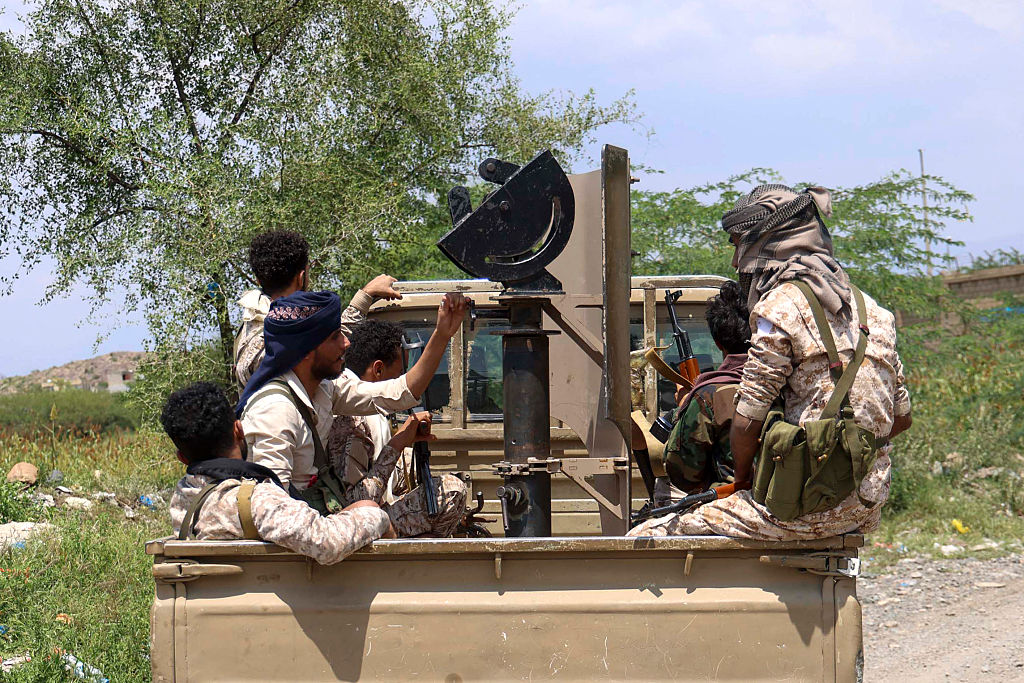
Saudi media appears to be celebrating major victories against the Houthis in Yemen. On Oct. 5, forces aligned with Yemen’s internationally recognized government said they had retaken key positions around Bab al-Mandab and the port city of Mokha from the Houthis, with substantial air support from a Saudi-led coalition. The Giants Brigades were among the forces involved on the ground.
Yet many details that will be important in determining what happens in the coming days remain unclear.
Yemen has historically been an arena of long-term conflict, where wars are not won or lost overnight. The latest Saudi achievement should not be understood simply as part of a bilateral Saudi-Houthi confrontation. And without diminishing the significance of the Saudi-backed advance, these recent events deserve closer attention if we want to understand what is happening and how the different parties may respond to the latest developments.
The Saudi conflict with the Houthis is not bilateral but multidimensional, and the spillover effect from conflicts elsewhere in the region is clear. Saudi Arabia has been fighting the Houthis for more than a decade, though the acceleration of events following the war with Iran has been significant, as events over the last week have emphasized.
On Sept. 28, Saudi Defense Minister Prince Khalid bin Salman invited UAE Vice President Sheikh Mansour bin Zayed Al Nahyan to visit Saudi Arabia the following day. Mansour arrived in Riyadh on Sept. 29, where he met Crown Prince Mohammed bin Salman in a meeting also attended by the defense minister.
Given the differences that have emerged between the two allies, the timing was notable. The visit came amid two important developments: the Houthis’ advances around Bab al-Mandab and Mokha, and Israeli Prime Minister Benjamin Netanyahu’s visit to Abu Dhabi on Sept. 27, where he met UAE President Sheikh Mohammed bin Zayed.
More important were the Israeli media reports that followed, claiming that officials from Israel had met representatives of several Arab and Muslim states, including countries without diplomatic relations with Israel. Saudi Arabia was named in some of these reports.
These successive events produced several interpretations. Some suggested that Saudi Arabia was finally preparing to normalize relations with Israel and join the Abraham Accords in exchange for access to Israeli defense technologies that could help counter the Houthi threat. Others argued that Saudi Arabia and the UAE were trying to move beyond their differences because they now face a common threat: Iran and, by extension, the Houthis. From this perspective, Yemen is the most immediate arena in which Riyadh and Abu Dhabi would need to put their disagreements aside.
On the ground, the Saudi-led coalition subsequently announced a major air campaign in support of the Yemeni government’s new offensive. The Giants Brigades, led by Abdulrahman al-Mahrami, known as Abu Zaraa, participated alongside other government-aligned forces. Saudi-led air power provided extensive support, while government forces announced gains around Dhubab, Bab al-Mandab and Mokha. Saudi Arabia therefore achieved something that had appeared extremely difficult only days earlier.
The sequence makes it reasonable to ask whether the Saudi-Emirati invitation and meeting were primarily about coordination in Yemen. The normalization hypothesis, by contrast, still lacks sufficient evidence. It is also difficult to imagine President Donald Trump allowing an achievement as significant as Saudi-Israeli normalization to emerge primarily through Emirati mediation rather than presenting it as a major political achievement by his own administration. So far, Saudi Arabia does not appear to be preparing to enter the Abraham Accords, which also means that there is still no evidence that Riyadh has accepted Israeli defense cooperation of the kind suggested by some of the speculation.
The immediate objective appears to have been Bab al-Mandab and Mokha. Forces aligned with the internationally recognized Yemeni government have managed to regain important positions in these maritime areas, although some battlefield claims remain disputed by the Houthis. But this raises an even more important question.
The Giants Brigades owe much of their development to the UAE. They were trained and backed by Abu Dhabi for years, and their commander, al-Mahrami, is simultaneously a member of Yemen’s Presidential Leadership Council and a senior figure associated with the southern camp. Does their participation now indicate broader Saudi-Emirati coordination over Yemen? And if so, how will that coordination coexist with the southern separatist project, which ultimately conflicts with the principle of a unified Yemen represented by the internationally recognized government?
We can hope that the Saudi-Emirati disagreements have been overcome, but there are still many reasons to watch carefully what comes next. Saudi Arabia has reasserted its influence through the internationally recognized government, whose forces are now claiming significant victories against the Houthis. At the same time, many Emirati and southern accounts emphasize that some of the most important battlefield gains were achieved by the Giants Brigades, a force that was built and supported by the UAE over many years of war.
More strikingly, images circulated after the advance at Bab al-Mandab showing southern forces raising the flag associated with the Southern Transitional Council rather than the flag of the Republic of Yemen. The military achievement may be officially recorded in the name of the internationally recognized government, but some of the forces carrying it out continue to present themselves through a distinctly southern political identity.
The Giants Brigades can fight under the broader umbrella of the internationally recognized government while also remaining closely connected to the southern political project. That creates a basic question over who ultimately benefits politically from their military success: the unified Yemeni state supported by Riyadh, or the southern project supported by Abu Dhabi.
Was this puzzle already discussed and managed during the latest Saudi-Emirati meeting, meaning that much of what is being said in the public sphere is simply speculation? Or is it the beginning of another, deeper disagreement between the internationally recognized government and southern forces that ultimately seek to restore an independent South Yemen?
Following the latest operation, the Houthis claimed missile and drone attacks against a range of Saudi targets, including King Khalid International Airport in Riyadh and targets in Jizan and Najran. At the same time, Saudi Arabia, Pakistan and Turkey convened an emergency meeting under the Mecca Joint Defense Agreement on Oct. 5 and agreed to move immediately toward implementing their collective defense commitments and preparing the rapid deployment of agreed military forces and capabilities in the kingdom.
For now, the Houthis appear to have lost this round, while the internationally recognized Yemeni government — even if its success depended on cooperation with the Giants Brigades — is being counted as the victor. And it is that government that Saudi Arabia has backed for more than a decade.