


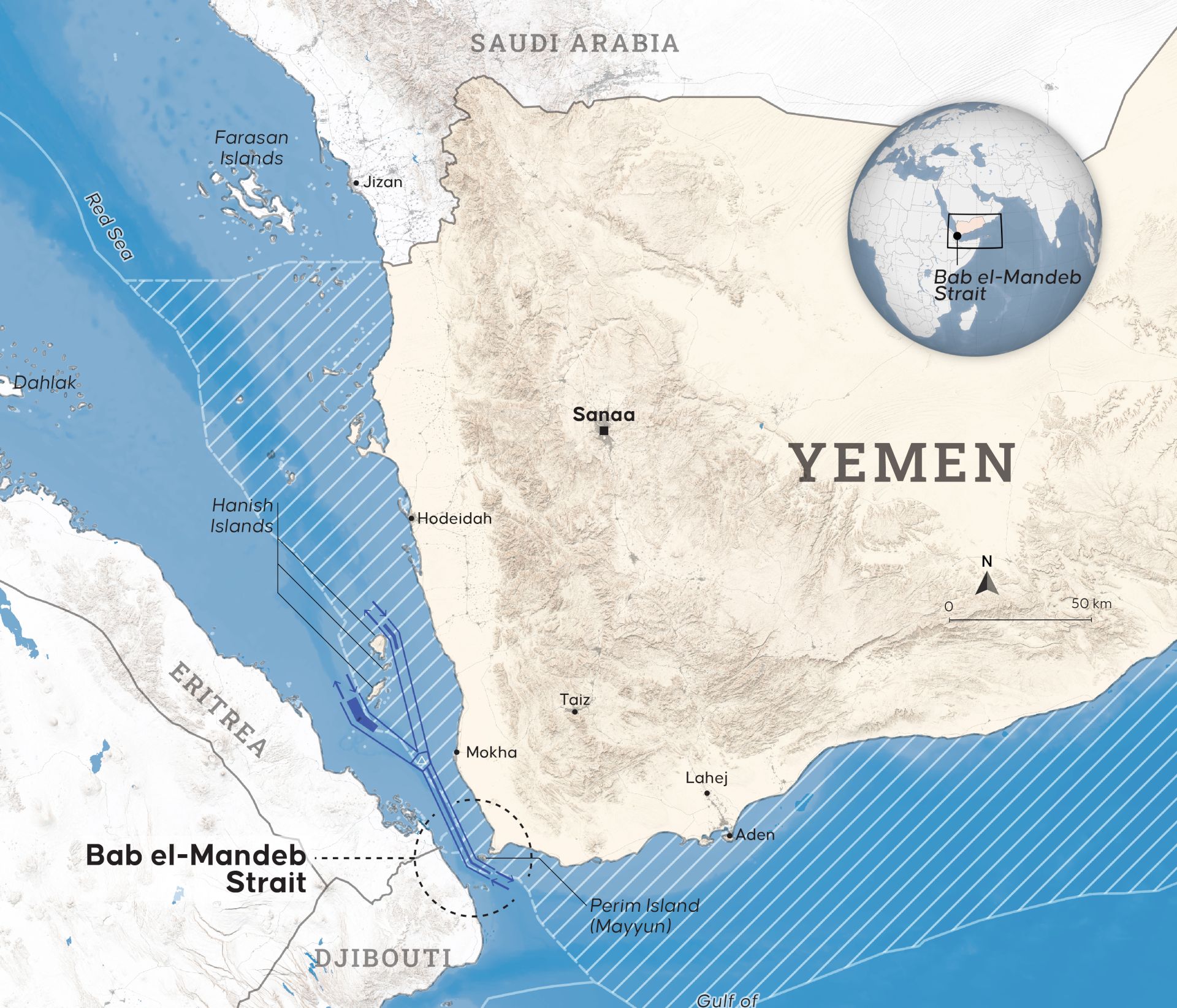
Wars do not alter the balance of power only when cities fall; it also shifts when geography acquires new value. This is precisely what has happened in Yemen, on its western coast in particular. Twelve years of war and conflict have transformed the Houthis’ fight from a Yemeni struggle for power into a geopolitical dilemma centered on one of the world’s most important maritime choke points.
The Houthi recapture of the areas alongside the Bab al-Mandab Strait sent shock waves through global markets and prompted a range of reactions and concerns. Yet it took less than a month for the Yemeni government, backed by a Saudi-led coalition, to launch a major counteroffensive, dubbed “Operation Yemen Dawn.” The speed of the response, which demonstrates the concern not only of the Saudis but of other international actors, left the Houthis with little time to consolidate their gains or capitalize on their advances into the rural areas of Taiz governorate.
Although the operation’s declared strategic objective is to recapture Sanaa, its opening phase began primarily on Yemen’s western coast. The counteroffensive is, in essence, an attempt to retake territory whose continued control by the Houthis would pose a serious strategic headache for global trade and maritime security. At the same time, the latest developments could provide an opportunity for international actors to redefine Yemen’s protracted conflict and to reshape the internal military and political dynamics that have sustained it for years.
For 12 years, the prevailing understanding was that Yemen’s conflict was about central control: Whoever held Sanaa held the levers of the state, commanded the army and could shape the country’s future. The Houthis were one actor in that contest: an armed group that seized Sanaa and parts of the country’s north by force, cultivated deep ties with Iran and acquired the strength and capability to threaten its adversaries inside and outside Yemen. But their recent advance and seizure of the western coast and the areas surrounding Bab al-Mandab have upended that equation.
The question is no longer who controls Sanaa, or which faction holds this or that city. It is who can project power over one of the world’s most important maritime choke points, and through it affect international trade, Red Sea security and the calculations of regional and global powers.
The Houthis’ geopolitical leverage, then, has not risen because they have become more politically acceptable. It has risen because the geography over which they exert control has made them more valued to the powers seeking to contain them, negotiate with them or exploit their position. The Houthis’ value is now bound up with the value of Bab al-Mandab, a vital strait that links the Red Sea with the Gulf of Aden and the Indian Ocean, forming a corridor between Asia and Europe. That is what makes their military presence in the areas around it entirely different from that in any other part of Yemen. It now appears that the Houthis are losing control of Bab al-Mandab, as government forces claim to have recaptured it.
Those who can threaten Bab al-Mandab do not merely control a piece of Yemen, but hold a valuable card in the game of international trade and Red Sea security, with implications for the interests of Washington, Moscow, Beijing, European capitals, Riyadh, Tehran, Tel Aviv and the states of the Horn of Africa.
The roots of this reconfiguration of power lie in Yemen’s domestic conflicts. Since 2011, the divisions among Yemen’s political factions and their pursuit of short-term interests have created an environment that the Houthis exploited to expand. Regional and international powers viewed the conflict as a Saudi-Iranian struggle waged on Yemeni soil, refusing to see Yemen’s domestic conflict in terms of its internal motives and dynamics.
While Yemenis were mired in that conflict, the strategic value of Yemen’s geography was changing by the day.
The Houthis’ transformation of Bab al-Mandab, and the coastline at large, into a strategic card began before they joined the Gaza conflict and started attacking vessels in the Red Sea and the Gulf of Aden in 2023. In 2015, the coast became the center of the Yemeni conflict. There were attacks on U.S. warships in 2016, and on a Saudi warship and a UAE vessel in 2017. The same year saw an expansion of attacks on commercial and energy targets. Maritime security became particularly visible as a threat to commercial and energy shipping in 2018, with attacks on Saudi commercial vessels and a Saudi oil tanker.
What changed in 2023 was not the Houthis’ discovery of the maritime card but the scale at which they were able to play it, turning their tactic in the Yemeni war into a source of leverage over global shipping. In July of this year, the Houthis declared what they called a blockade on Saudi vessels and started attacking ships. The wider rivalry among Washington, Moscow, Beijing and Europe had taken another turn. The war in Ukraine and the expanding relationship between Iran and Russia opened new room for the Houthis to maneuver. The Houthis seem to grasp something their adversaries do not: that Bab al-Mandab’s value is not confined to Yemen.
Washington, therefore, cannot separate the Houthis from the Bab al-Mandab and treat them simply as one more party to Yemen’s internal conflict. When an armed group can threaten international shipping, the matter rises to another level altogether. Washington’s dilemma, then, is how to protect shipping without turning the Red Sea into an open battlefield.
At the Houthis’ request, Washington moved toward direct, secret understandings with the group, including arrangements for the two sides not to target each other. As a result, Washington’s position on the latest developments in Yemen appears unclear, and its refusal to help Saudi Arabia strike the Houthis is seen in Riyadh as the abandonment of a traditional ally.
Yet Washington’s withdrawal should not be read as acceptance of Houthi dominance over Bab al-Mandab. The United States understands that allowing the strait to become a settled Houthi sphere of influence could be strategically irreversible. Yet entering an open-ended war would be a political and military burden that Washington is unwilling to shoulder. President Trump’s statement that the counteroffensive against the Houthis is going well, however, shows U.S. support for the operation, even if the Americans are not involved directly in strikes against the Houthis. “The United States has a defense and security agreement with Saudi Arabia, and we intend to live by it,” U.S. Secretary of State Marco Rubio told reporters, which signals that U.S. involvement might increase.
This tension has expanded the influence of the Houthis, who do not need to become an international power to be of international consequence. But to retain that influence, they have no option but to focus on control of the geography that confers this leverage.
Moscow looks at matters through a wider geopolitical lens. The relationship between Russia and the Houthis has evolved gradually from political dialogue into geopolitical, security and military understandings, driven by Russia’s ties with Iran and by Moscow’s broader confrontation with the United States and the West.
For Russia, the Houthis serve as a regional bargaining chip around the Red Sea and Bab al-Mandab, one that neither requires nor obliges Moscow to declare any alliance with them. Reports are circulating about growing military cooperation between the two. For the Houthis, Russia offers potential diplomatic cover and access to advanced military capabilities. For Moscow, the relationship provides another tool for unsettling Western calculations.
China’s stance is different. Beijing’s main concerns lie in commercial interests, maritime security and political contacts, and it has hosted Houthi leaders. China has a fundamental interest in protecting trade and energy flows through Bab al-Mandab, and it has therefore kept channels open to the Houthis while maintaining its relations with the Yemeni government, Saudi Arabia and Iran.
It is a relationship of managed interests more than an alliance, although there are reports that Chinese companies are supplying the Houthis with dual-use technology, including guidance systems and drones. There are also media reports that the U.S. sanctioned those Chinese firms and the Yemeni businesspeople involved.
Iran remains the Houthis’ most important military and technological backer. While Russia offers potential geopolitical and diplomatic support, China has commercial interests that require engagement with any party able to influence the waterway. Bab al-Mandab emerges as the common denominator among them all.
European governments and the United States both face a similar dilemma over how to deal with the Houthis. They want to keep the Red Sea open to trade, but have no appetite for another open-ended war. The result is a posture that combines protecting shipping, containing the threat and keeping political channels open.
The Gaza war undoubtedly changed European perceptions of the Houthis. Before the attacks on Red Sea shipping, some European governments largely aligned themselves with the Houthi narrative that this is a Saudi war against Yemen, or at least displayed sympathy with it. That narrative is not accurate: It is a war between Yemeni government parties and the Houthis. In 2018, European governments fronted the international pressure to halt the Saudi-led operation to retake the city of Hodeidah, reflecting that broader approach.
Since the Houthis began attacking ships, however, the calculus has changed. Some believed the attacks were tied to Gaza and would end when the war did; instead, the Red Sea has become a strategic arena in its own right.
The question before Europe is thus no longer simply how to end the disruption, but how to preserve maritime security while dealing with a group that has acquired powerful leverage over a strategic waterway.
Saudi Arabia is the regional party most directly affected by this shift. Riyadh wanted out of the Yemen war; it sought to normalize relations with Iran and the Houthis and to pivot away from Yemen. The formation of the Presidential Leadership Council (PLC) in April 2022 and the move toward a “road map” reflected this attempt to find a way out of the conflict, even if a comprehensive strategy was lacking. But none of that produced the outcomes Riyadh expected: The Houthis walked away from the road map and the concessions it entailed and threw themselves into the Gaza conflict instead.
The problem is no longer about the Houthis; it is a geographic challenge. For Saudi Arabia, every area under Houthi control represents a security threat. But the areas around Bab al-Mandab add a further strategic anxiety to Saudi calculations, given their implications for the kingdom’s national security and economy.
Recent Saudi rhetoric has therefore focused, strikingly and increasingly, on recasting the Houthi question as a regional and international issue at the intersection of conflict with Iran, maritime security and Bab al-Mandab, rather than a problem for Saudi Arabia alone. Although the battlefield losses on the western coast and around the strait may be severe, Riyadh understands the importance of making the international community see what the new geographic reality means. It is seeking to rally international opinion and build a global coalition that takes a broader view of how to deal with the issue.
Israel’s concerns appear clear and direct. The Houthis have shown they can threaten Israel-linked shipping and help paralyze traffic at the vital port of Eilat, the only Israeli port on the Red Sea. Moreover, their long-range missiles have reached Israeli territory. Israeli decision-makers now regard the Houthis as a serious threat. The Houthi presence around Bab al-Mandab turns this distant threat, for Israel, into a tangible reality.
Yet the matter is not Israel’s alone. Bab al-Mandab poses an international challenge to maritime security, and the call for an international coalition reflects a broader recognition that any sustainable response requires the combined efforts of many states. Geography forces an unusual convergence of views: Israel sees a direct security threat; Saudi Arabia, a strategic challenge; Europe, a problem of maritime security; and Washington, a dilemma it does not want to resolve by fighting another open-ended war. All are looking at the same waterway, and at the same danger the Houthis pose there.
On the other side of Bab al-Mandab lies the Horn of Africa, where growing ties between the Houthis and Somalia’s al-Shabab further complicate the picture. Reports indicate that the relationship has involved contacts, training and the supply of weapons and drones, as well as smuggling networks and links to clans such as the Isaaq and to other actors, including Somali pirates.
The Horn of Africa gives the Houthis an additional arena in which to operate and build networks and relationships, while the relationship with the Houthis may give al-Shabab access to weapons and a significant web of contacts on the opposite shore of the Red Sea.
The movement of African migrants across the Red Sea has long been a chronic and troubling problem, especially for Yemen, but it is now acquiring a new dimension. Thousands still arrive in Yemen every month — a pattern that predates the current war, with roots in the collapse of the Somali state in the early 1990s and in conflicts elsewhere in the region.
The concern stems not from migration as such but from the possible emergence of networks linking armed groups, smugglers and other actors across the Red Sea. An armed movement that possesses ballistic missiles and drones while cultivating ties with armed groups on the opposite shore poses a challenge that is hard to confine to Yemen alone.
Will the Houthis give up the Bab al-Mandab card? This was the most pressing question before the current counterattack, given the tension in the region and the reactions to recent developments. When the Houthis began attacking ships in the wake of the Gaza war, many assumed the attacks would stop once the war ended. Instead, the Red Sea acquired added strategic value.
Even if a settlement with Saudi Arabia were reached — which seems unlikely now, given the current battles and the clashes on the ground — would the Houthis voluntarily give up a tool that has raised their standing with the world’s major powers? That is hard to imagine. According to informed sources, international mediators asked the Houthis whether they would be willing to relinquish the city of Mokha and the other areas they recently seized in exchange for entering political negotiations. Their answer was blunt and direct: no.
The Houthis were seeking a settlement based on the new facts on the ground the war had created. They wanted to return, from a position of strength, to the road map and begin implementing arrangements concerning ports, airports and other issues, while at the same time seeking an end to Saudi intervention. The counteroffensive has changed the equation and killed the prospect for talks, at least for now.
That is fundamentally different from a return to the situation that prevailed before the latest confrontation. For Saudi Arabia, accepting such terms amid the changes around Bab al-Mandab would mean negotiating under an entirely different balance of power. For international mediators, the challenge is greater still: Can military gains be converted into a political settlement without those gains hardening into permanent recognition of a new strategic reality? This is why there was no other choice for Riyadh and its allies but to launch a major offensive to stop the Houthis, who wanted to use Bab al-Mandab as a weapon on multiple levels.
Iran’s continued weaponization of maritime geography is central to this equation. The Strait of Hormuz has long been one of Tehran’s principal strategic cards. With the Houthis able to exert influence over Bab al-Mandab, Iran would effectively hold another card at the region’s opposite end. Although the two waterways are not symmetrical, together they underscore the strategic importance of maritime geography in the Middle East. This counteroffensive would undermine Tehran’s plans and might prompt its proxies in Iraq to strike Saudi Arabia.
As Abdulmalik al-Ejri, a senior Houthi leader and member of the group’s peace negotiating delegation, has stressed, any renewed U.S. attack on Iran would turn the region into a “powder keg,” with repercussions for oil, security, stability and infrastructure. Nor would the consequences be confined to Iran: If the Houthis’ relationships and influence continue to expand around the Red Sea and the Horn of Africa, the confrontation could spread beyond Yemen’s shores.
Perhaps the most striking feature of the present moment is that some Yemeni parties still view Bab al-Mandab primarily through the old lens of Yemen’s internal conflict. While regional and international powers are thinking about maritime security, global trade and geopolitics, some Yemeni factions are preoccupied with what comes after the fight for Mokha and who will end up governing the city. Therein lies the paradox: The world sees Bab al-Mandab as an international strategic asset, while many Yemenis continue to regard it, first and foremost, as a prize in a domestic struggle.
The Houthis have grasped an essential lesson: They do not need to close Bab al-Mandab to profit from it; merely threatening to do so is enough. Announcing that they are targeting Israeli vessels as in 2024, or Saudi vessels as of this year, was enough to make shipping companies want to avoid the strait. A movement capable of disrupting global shipping need not shut the strait entirely to extract political gains. It is enough to make governments, militaries, shipping companies and markets factor in the cost of passage. This is how geography becomes power, and how a local war becomes an international problem.
The issue, therefore, is not simply whether the world can live with a new reality imposed by the Houthis, but whether it can accept one in which the security of international shipping through Bab al-Mandab remains hostage to the leverage of an armed movement whose ambitions extend beyond Yemen’s borders. And the events of the past 24 hours suggest that it cannot. Western countries back Operation Yemen Dawn, as do Pakistan and Turkey. Sources said that even drone experts from Syria are backing the government forces on the ground.
The Yemeni government army announced that the forces backed dozens of fighter jet strikes, managed to encircle the Houthis and restored these strategic locations. This counterattack, which seems to have been as fast as the Houthis’ offensive to capture Bab al-Mandab last month, might take a few days to regain all the areas the government forces lost and end the Houthis’ direct control of the maritime choke point and strategic islands in the Red Sea.
Yet the Houthis’ ability to undermine maritime activities across the southern part of the Red Sea would remain. The Houthis’ continued ability to threaten and disrupt the strategic strait directly or indirectly will maintain their geopolitical relevance for at least as long as they control the strategic port city of Hodeidah and the remaining coastline.
The question is not, in fact, who controls the land around the strait, but who controls the “risks” attached to it, and that is the Houthis’ new value. Yet the most important and most complicated question remains: Can the world live with these risks indefinitely?
The coming days will reveal how far the struggle for control of the coastline will go, and what its significance will be for the stability of the global business environment. The key question is how far the counteroffensive will advance. Will it stop at Mokha, or will it seek to retake the entire stretch of coastline currently under Houthi control? It is not only this area, but the Houthis’ ability to launch missiles from any region they control at the vessels passing through the strait that will continue to pose a threat to maritime trade. And that prospect will also determine how long Riyadh can live with a perceived existential threat.
Become a member today to receive access to all our paywalled essays and the best of New Lines delivered to your inbox through our newsletters.