


To Londoners, everything outside of the capital is in the middle of nowhere, and so it was with me. I was soaking wet after a downpour, somewhere in southeast England, on a stretch of road with a petrol station that charged 3 pounds and 5 pence (about $4) for a packet of spicy Thai crisps, and a one-star hotel which had been turned into a government-run asylum hotel. I was trying to persuade one of the residents, just one of them, to talk to me, open up to me, maybe even give me their phone number for stories that would no doubt crop up in the future.
Standing there in the drizzle, I thought about the odd tribe I belong to in the newsroom — the ones sent to report on people who look like us. You see, in newsrooms there is always someone like me, with a particular set of skills that, though undefined, usually involves a mixture of languages, travel, conflict experience or something like that: a set of skills gained outside of university. Usually, the person is deployed to do the sort of work that a run-of-the-mill journalist can’t pull off simply due to the circumstances of their birth. I could wear a shirt and tie and mix it up with them, but I could also grow my beard a tad longer, put on a pakol and mix it up in the Middle East. I don’t know if it’s code-switching or hypocrisy, but over the years I have developed a chameleon-like set of qualities that made me a producer, fixer, investigator, talker, back watcher — and everything in between. I was often the guy you sent to work the migrant camps in Calais or to hotspots where migrants hopped on and off trucks. And so here I was in the countryside, having traveled all over the country visiting these asylum hotels.
I wasn’t having much luck trying to coax the asylum-seekers into talking to me until I met Amol (whose name has been changed to preserve anonymity). He was far from what the Reform UK leader and possible future prime minister, Nigel Farage, has described as a military-age male. He was a walking tragedy, short and dark with yellowing teeth. Curiously, he spoke fluent, near-native English. So much so that I asked him if he was a staff member. He replied that he was an asylum-seeker.
“How come your English is so good, bro?”
“I came here when I was 26,” he said, “I’m now 46.”
“What? You’re still an asylum-seeker?”
He nodded. He explained that he had fled the war in Sri Lanka when Colombo was fighting Tamil Tiger separatists. He was still waiting for his papers. I had no way of checking his assertions.
“No one will give me a job because of my status.”
“Kids?”
“No!” He laughed bitterly, “No one will marry me, why should they? I have no prospects.”
It broke my heart. This man had wasted half his life in limbo. He could have become naturalized by now. He was living on 5 pounds a day, in a one-star hotel where they served badly defrosted food, and that was his existence. This is how it had been for years. He couldn’t even hold a conversation with the rest of the asylum-seekers because they spoke broken English. And yet, if he returned to Sri Lanka, would he not feel estranged there? I could not imagine how this miserable little man could threaten the security of this disunited kingdom.
Listening to Amol, I realized how thin the line was between his story and mine. For I, too, am a migrant of sorts. I was 11 when my mother decided to leave the country of my birth, Sweden, and join my grandfather in London. I came on a ship that docked at Harwich in the ’90s. My grandfather, a South Asian lascar, had jumped ship in 1919 and landed in Tilbury docks when he was very young. He was a grafter and quickly established himself in the East End. By the time of the Blitz, he was mingling with all the leading lights of the Indian independence movement training to be lawyers in London.
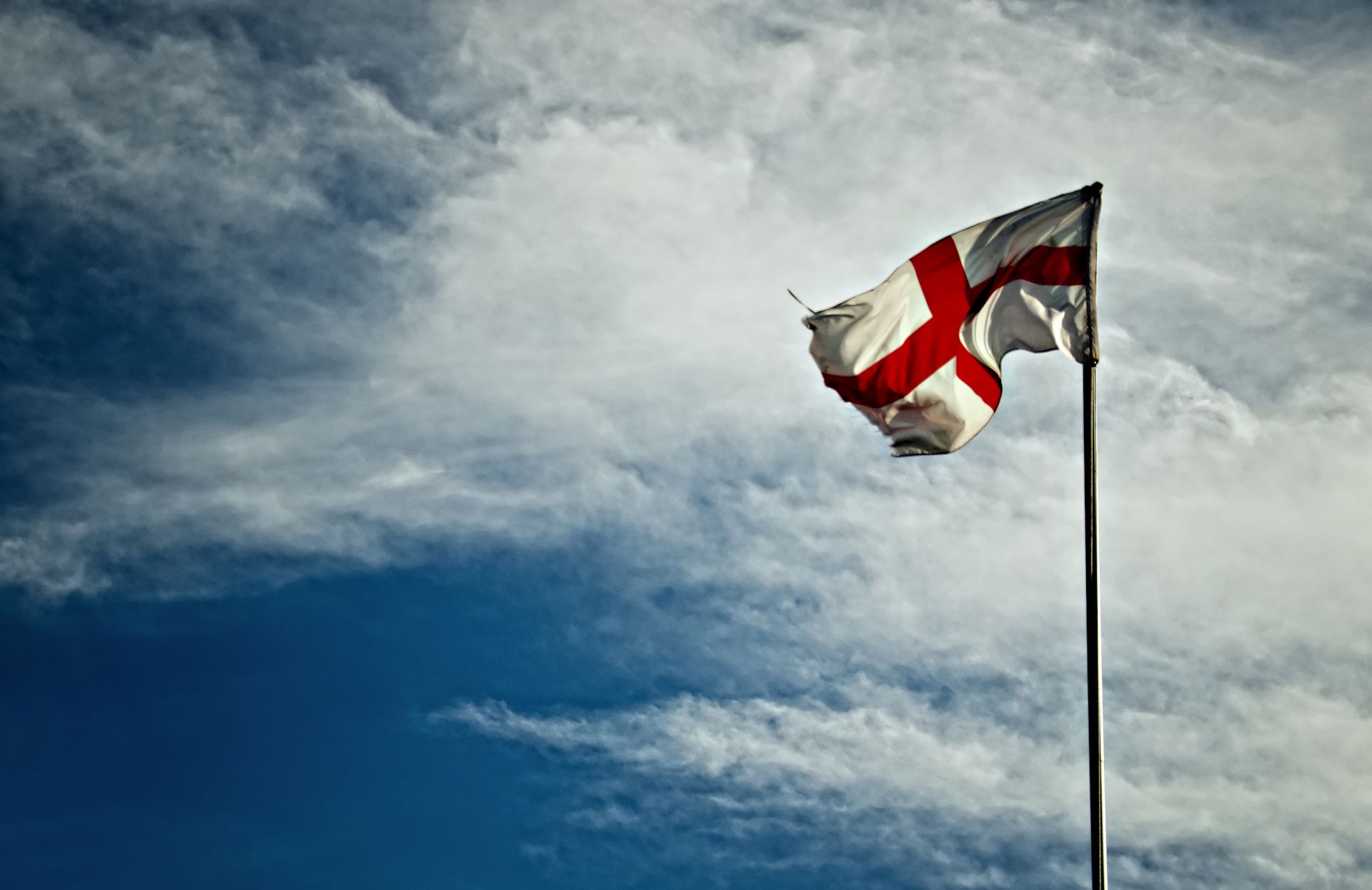
As for me, there was none of that glory. I grew up in and around Fulham in the days before Ruud Gullit, the dreadlocked Dutch football manager, arrived and transformed Chelsea football club from a bastion of white English people waving flags to the multicultural club of today. I have still never attended a football match in the U.K. because I associate the sport and the English flag with the neo-Nazi group Combat 18 and skinheads. So, of course, visiting Horley, a town next to Gatwick Airport, was an odd feeling. Every other lamppost had an English flag, as if a British bulldog had marked out its territory. If Fulham was where I learned what Englishness meant, Horley showed me what it had become.
In Oxford, I saw local working-class residents hoisting up English flags opposite a migrant hotel as if to tell the Yemenis, Sudanese and Syrians, in case they didn’t know, that they were in England, and that this England didn’t belong to them. It struck me that the poorest English people were being exploited to stomp on the even poorer one-fifth of 1% of the population who seemed to be in a worse position than them.
But as a foreigner, someone who retained the passport of his birth, I had enough distance to be philosophical. These English people, I reasoned, had been living on a decade of inflammatory media reports and misinformation that demonized the Other. Their imaginations fed off 20 years of terror stories like the Manchester and London Bridge attacks and played on the grooming gang scandal that had rocked the country, about the abuse of vulnerable white girls by mostly Pakistani British men. They read misinformation about schools being taken over by Islamists in Birmingham in 2013. Far-right activists claimed that there were Sharia courts running alongside the British judiciary. And more recently, the case of an Eritrean man who was convicted of sexual assault against a 14-year-old girl in Epping sparked nationwide protests. Watching those flags flutter, I thought of a 14th-century North African scholar who would have understood what I was seeing.
In his book “Al-Muqaddimah” (“The Prolegomena”), Ibn Khaldun argues that “asabiyyah,” or group solidarity, is achieved through blood ties or common struggle. When these ties weaken, a new order takes over with a stronger group solidarity. Ibn Khaldun’s theory is essentially the modern meme: Hard times create strong men, strong men create good times, and good times create weak men, until they get hard times and the cycle begins anew. This kind of thought process is probably why the replacement theory pushed by the far-right finds so many adherents: The brown and Black population representing the new order is replacing the old order vis-a-vis the white population.
And if we were to apply this Khaldunian theory, the U.K. is at the tail end of this cycle. The country has been at peace for a long time and produced generations raised on good times. And now the economy is in tatters, and society is coming loose at the seams. The presence of these foreigners has become a focal point for identity politics, because what do English people, if you will, have in common with them exactly? Group solidarity, to apply Ibn Khaldun, is fraying because these migrants look different, speak differently, have different cultures, etc. Forget, for a moment, history and Britain’s colonial legacy — the fact is that the “indigenous” population cannot deal with this apparent influx of outsiders, even if they are just a fraction of 1% of the population. There is no great war or world war that glues your average English person to, say, an Afghan or an Eritrean living in the country. The only thing that inspires this group solidarity, as Orwell rightly pointed out, is football.
It is easy to treat this as a theory until it lands on your doorstep. If Farage becomes prime minister, I can no longer afford to be philosophical. If there were elections today, Reform would be the largest party in the U.K. It has already made clear that, if it gets into power, it will start mass deportations and do away with those with “indefinite leave to remain” status — the equivalent of a green card in the U.S. That policy will affect me and my kids. I have Swedish nationality with indefinite leave status, and my children, though born in the U.K., are Italian. Will I have to reapply for the right to stay like I did after Brexit? Will the Farage administration accept my application, given the crazy income threshold Reform has demanded from its non-British residents?
To blame this wholly on Farage is unfair, though. He has set out his stall on a decade of racist rhetoric. But over the last 10 years, it has been spearheaded by Britain’s immigrant children, such as Zia Yusuf, the former chair of Reform, and former home secretaries like Priti Patel and Suella Braverman, both famous for stoking racial tension. Perhaps now we will see the same playbook applied by the Labour Home Secretary Shabana Mahmood, who will demand voluntary service to prove one’s “British” credentials. I can’t help wondering whether their choices are a legacy of the subservience that colonial subjects showed their masters. Or have I been reading too much postcolonial theory and need to put Frantz Fanon away? It’s hard not to notice how often Black and brown politicians end up fronting policies that would once have excluded their own parents.
Perhaps the solution is to apply for British nationality? Should I endure the citizenship test exam, which demands that I answer questions such as: “Who developed ideas about economics during the Enlightenment period which are still referred to today?” Is it a) Isaac Newton, b) Adam Smith, c) James Watt or d) David Hume? I wonder how many British citizens know the answer to that question and whether knowing it makes them any more “British?” I wonder if those who put up English flags on lampposts in Horley know the answer.
I’d like to think that I have, in my own small way, contributed to the cultural and intellectual life of this country. If not that, then at best, my taxes have helped to build society, and at worst, they have helped finance a war or two and sustained the country’s debt obligations. But does naturalization give me security, given that the U.K. has little problem in citizenship-stripping its own citizens of the brown and Black variety? I saw up close how differently the state and, indeed, the media treated “ISIS brides” who had joined the Islamic State group, like Shamima Begum and others. And perhaps more importantly for me, what does it mean to belong to a country that doesn’t want you, even if you know that the answer is b) Adam Smith? And that is the problem here. To apply for British citizenship now would not only cost me around 6,000 pounds (roughly $8,000) for my whole family, it would also be a bit undignifying given the number of hoops I have to jump through.
I have tried to call Amol back to build on the connection we established. I had hoped that maybe, being immigrants or foreigners, we would be able to connect. But he’s not responding to my texts. Maybe he thinks that I am part of the native population. And he’s probably right: The reality is that, in many ways, I am different from him. Unlike him, I have the privilege of a Swedish passport. If I wanted, I could apply for a British one and an Italian one, too. Amol has none of those privileges.
At the very least, he can’t afford to be philosophical while I can. And yet, when I think of Amol, he sparks emotions that disturb me. I see in him some of the struggles that my grandfather endured while he carried carpets in Petticoat Lane under German bombing, all those decades ago. Although my grandfather made something of himself, Amol cannot because he’s stuck in asylum purgatory. I lament how cruel the world has become. I think about how immigrant children are facilitating the divisive politics of the country, when they should know better. I see the far-right marches, the mosques being attacked and the nearly 20% rise in anti-Muslim hate crimes. It makes me fear for my kids.
There is a part of me that says, hang on a minute, this is my country, my kids were born here. My family has been here for a hundred years; the East End is marked with their achievements. I want to go back to the old days, when Black and brown — politically Black — activists marched down Whitechapel protesting against the racist violence that led to the murder of a Bangladeshi textile worker, Altab Ali, in the ’70s. There is a part of the anti-colonial rebel within that declares: We are here because you were there, and I’m not going anywhere.
Yet there is another part of me that tells me to accept this state of affairs, that nothing in life is permanent, not even your attachments, and think about looking elsewhere. After all, you can’t stop the march of history. I have studied history long enough to realize that human nature has changed little over time. And I don’t put it beyond human nature that Muslims and foreigners can be forcibly pushed out of the U.K. Maybe it is time to leave in dignity before that happens. And now that there are other shores that do welcome my particular skill set, perhaps one should follow in the footsteps of American authors like James Baldwin, Richard Wright and Chester Himes, who left the country that didn’t want them. They still enrich the world with their works. These men were not victims but masters of their own fate. When the Muslims of Spain were expelled from their homes, they went to Sale and Algiers and offered their knowledge of the Spanish coast to the Barbary princes, finding their way into the works of Shakespeare.
I don’t want to play the victim, nor do I want to be considered thus. I want to be able to leave with a semblance of dignity before those patriotic marchers in Trafalgar Square turn into a murderous mob, as has befallen Europe in the past. I don’t want to be like the last king of Granada, Boabdil, who wept when he looked at the Alhambra as he left it forever, only for a woman to pour scorn on his tears. “Why do you cry like a woman when you couldn’t defend it like a man?” I don’t want anyone’s pity, only the strength and courage to leave with dignity when the time comes — and to use my particular set of skills wherever they’re still wanted.
“Spotlight” is a newsletter about underreported cultural trends and news from around the world, emailed to subscribers twice a week. Sign up here.