

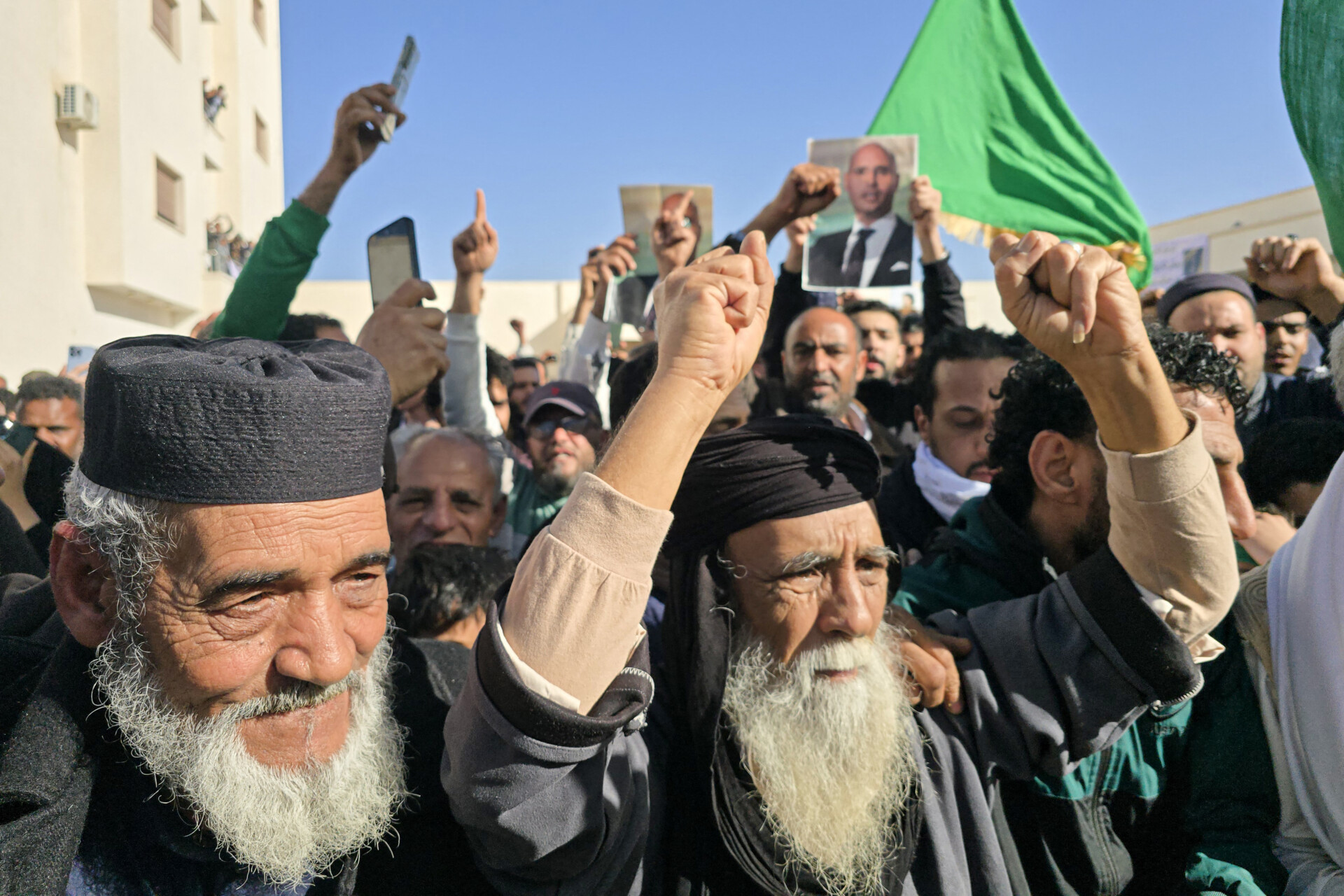
Nearly three months have passed since Saif al-Islam Gadhafi, the son of Libya’s longtime dictator and a powerful political figure in his own right, was killed by a hit squad on the afternoon of Feb. 3 at his residence in Zintan, in the northwest of the country.
The hit shook Libya profoundly: In many ways, Gadhafi had long been a ghost. Captured in 2011 during the uprising that saw his father killed, he spent six years in prison before transitioning into a kind of house arrest. Though still wanted by the International Criminal Court for alleged crimes against humanity, including murder and persecution during the 2011 uprising, he was released in 2017 under a general amnesty law. His return to the political chessboard culminated in 2021, when Libyan courts cleared him to run in the presidential election that was slated for that December, though the poll was scuttled when the ruling classes could not agree on the legal framework for it. Had the vote proceeded, his massive grassroots following could even have secured a victory, despite his reputation as his father’s right-hand man. That terrified the country’s new political elite. After that, Gadhafi lived a more subdued existence.
When the hit squad struck, Gadhafi was on the phone with an associate in the United Kingdom. Hearing gunfire over the line, the caller immediately hung up and alerted Abdalla Othmane, the head of Gadhafi’s political team in the Libyan capital, Tripoli, sounding the alarm before the smoke had even cleared.
The state’s initial response showed rare institutional urgency. The attorney general in Tripoli, Al-Siddiq Al-Sour, launched a formal investigation, dispatching forensic teams to Zintan to identify the body and collect ballistic evidence. Yet this rapid start has since hit a dead end. Despite the forensic evidence gathered, the subsequent silence from official channels regarding the perpetrators suggests the trail went “cold” once it became too hot to handle.
This report is authored by a veteran Libyan journalist with over three decades of experience in the country’s complex tribal maze and its geopolitical manifestations. It is based on weeks of intensive field reporting, drawing on exclusive access to six sources within Gadhafi’s inner circle and a diverse pool of officials directly embedded within the investigation. Given the sensitivity of the forensic data and the volatile tribal and political implications of the findings, it is being published anonymously to ensure the safety of the sources and the author while navigating the severe legal and security risks inherent in reporting on Libya’s state-level impunity.
Information from several sources shows that the hit was executed with a precise understanding of Gadhafi’s vulnerabilities in his new, relatively domestic existence. During the incursion, his only companion was his cook. His head of security, Ahmed, had just left the premises to buy milk for the sunset meal — a trek, given the residence’s isolation, far from local shops, though one that Gadhafi himself had likely sanctioned. This apparent security lapse, compounded by Gadhafi’s refusal of tougher protection, stemmed from 14 years of near-total immunity. Over time, Gadhafi had grown too comfortable, often dismissing guards as an unnecessary intrusion.
This sense of security became his ultimate vulnerability. Before Ahmed could even reach the shop, his phone rang. It was the associate in London who had been speaking to Gadhafi just moments before. The caller was panicked. “I heard shots,” he told Ahmed. He had been mid-sentence when the line was punctuated by the sharp rhythm of gunfire.
While the official narrative, echoed in early statements from Gadhafi’s political team on the evening of Feb. 3 and reinforced by the attorney general’s office on Feb. 5, suggested the four assailants disabled the compound’s security cameras, at least two sources within the attorney general’s forensic team have confirmed to New Lines that the surveillance system remained fully operational throughout the incursion. The cameras captured the approach of three four-wheel-drive vehicles before they reached the residence, enabling investigators to identify the registration of two of them. The squad’s use of the “River Road” — the unpaved maintenance track for the Great Man-Made River, Libya’s main water infrastructure — was a calculated tactical choice. It allowed them to bypass checkpoints, maintain high speeds and utilize a specialized route strictly off-limits to unauthorized traffic, hardly reinforced nowadays, ensuring they reached the residence undetected.
The operation was fueled by a massive cash bounty, the existence of which surfaced accidentally. The breakthrough came not from an official audit, but through a “hawala” (informal money transfer) operator in the Sabha region — a traditional stronghold for the former regime. Driven by anger over the hit, he disclosed to the deputy attorney general in Sabha that, just two days prior, he had processed the transfer of 70 million Libyan dinars (approximately $11 million) to the town of Qaryat. By physically verifying transactions at the town’s only two transfer offices, investigators confirmed the funds arrived just before the hit.
Investigators soon discovered this first transfer was merely one piece of a fragmented 250 million dinar (roughly $39 million) total bounty, with 120 million dinars arriving in the Qaryat area alone. Crucially, the probe unmasked the geographic origin of the funds: The entire sum was sent from eastern Libya. While the recipients are identifiable through the collection records, the senders remain shielded, because the informal system typically requires no identification from those depositing the cash. Yet the scale of the payout implies high-level coordination; in a territory where such vast financial flows are tightly monitored by authorities in the east, a sum of this magnitude is unlikely to move without raising significant flags. The possibility remains that the funds were deliberately routed from the east to leave a “signature” and implicate the regional leadership, suggesting a calculated move to cast suspicion on the eastern camp rather than providing definitive proof of their direct involvement.
The discrepancies between the official public statements and the forensic reality suggest a deliberate strategy of obfuscation by both Gadhafi’s political team and the attorney general’s office. Sources close to the investigation indicate that this misinformation was a calculated move to manage the volatile aftermath of the hit. In the hypersensitive landscape of western Libya, naming specific actors or identifying military units is never a purely legal act; it is a spark in a dry forest.
In early March, the attorney general’s office, in a rare step, announced that it had formally identified three of the four suspects and issued secret arrest warrants. Yet those warrants have remained sealed. By identifying the men, the state has technically “solved” the crime, yet it has not arrested the suspects. One possible reason is the tribal fallout that could follow the arrests. Moving from a legal indictment to a physical arrest risks triggering a firestorm the attorney general would rather avoid.
In his private briefings with tribal dignitaries and Gadhafi’s own political circle, the attorney general was remarkably candid about the limits of his office’s reach. Sources say that while he pledged to deliver a comprehensive dossier containing every forensic detail and identified suspect, he stopped short of promising the actual arrest of the perpetrators. He made it clear that while his office could solve the crime, the physical act of apprehending the suspects fell under the jurisdiction of the Ministry of Interior, headed by Emad Al-Trabelsi, who comes from the Zintani tribe and is a former militia leader. At least three sources associated with the ministry told New Lines that their boss knows about the warrants but has not yet authorized their implementation. His reticence may stem, if not from a desire to protect members of his clan, then from a reluctance to be seen as betraying his tribe more largely by the many former militia members who now work for him in the ministry, on whose loyalty he depends.
Beyond the legal hurdles, there are the unwritten tribal codes of honor that govern Libyan society. No tribe can easily accept being branded as the home of the perpetrators, because such a designation carries a stain of “tribal shame” that can endure for generations. Given the gravity of the crime, once a suspect is publicly identified, the tribe finds itself in a paralyzing position: While custom dictates they should hand the criminal over to the authorities to clear the collective name, doing so is seen as an internal betrayal of their own kin.
The details shared with New Lines from those inside Gadhafi’s inner circle were nonetheless explosive: Of the four primary suspects, three were revealed to be from the Zintan tribe — the very community hosting Gadhafi — while the fourth was identified as a member of the Magarha tribe. To an outsider, these names are meaningless; to a Libyan, if true, they represent the collapse of the tribal covenant. The Magarha were the backbone of the Gadhafi security apparatus, while the Zintani were the son’s captors-turned-protectors. For members of these specific tribes to be implicated in the murder suggests that the high-level coordination behind the hit succeeded in piercing Gadhafi’s most ironclad circles of traditional loyalty. Such details carry immense weight in the Libyan loyalist psyche, particularly for the Magarha, who were synonymous with loyalty to the former regime, most notably through the figure of Abdullah Senussi. Often described as the “black box” of the former regime, Senussi was also Gadhafi’s uncle and a brother-in-law of his late father, Moammar. This claim suggested that the “ghost team” was composed not of outside mercenaries but of individuals drawn from the victim’s own traditional support base and immediate surroundings. If true, it transforms an act of political assassination into a profound and irreversible tribal betrayal.
As the weak judiciary now holds the names, the routes and the receipts, a grim question hangs over Tripoli: Will there ever be justice, or will this case simply join the growing archive of impunity in Libya? For years, the state has watched mutely as activists, influencers and even elected parliamentarians have been forcibly disappeared or killed; their cases remain frozen in a cycle of silence and official paralysis. While the majority of the public praises the attorney general for his diligence and forensic rigor, there is a widespread, sober recognition of the limitations of his office when confronted by the reality of armed power.
In the country’s deeply polarized climate, the attorney general’s reach stops where the tribal and militia interests begin. For many within the establishment, Gadhafi’s assassination has achieved what years of political maneuvering could not. His presence was the primary reason the 2021 elections were aborted; he was a candidate whose popularity threatened to upend the existing power structures. With his removal, the “force majeure” — as the legal obstacle was obliquely described five years ago — that paralyzed the electoral process has been violently removed. In this cynical arena, the “Saif problem” has been solved not through the ballot box, but rather through the permanent silence promised by the gun.
This dark chapter serves as a stark reminder that Libya’s era of shadow politics is far from over. The assumption that a “new Libya” would emerge as a sanctuary of law and order, where power is peacefully contested through elections, remains a distant dream. For the generation of young Libyans who once viewed the 2011 “revolution” as their ticket to a more dignified future, the reality of political assassination and systemic impunity is a bitter inheritance. It suggests that while the names in power may shift, the underlying mechanics of force remain unchanged, leaving a nation to wonder if its transition was ever a journey toward democracy, or merely a reorganization of its tragedies.
“Spotlight” is a newsletter about underreported cultural trends and news from around the world, emailed to subscribers twice a week. Sign up here.