

This Ramadan, we did not wake to roosters or the call to prayer. We woke to jets.
For the first time in years, the blue roof of sky stretching over Kabul’s dark mountains was torn open again. Not by the British, not by the Soviets, not by the Americans, not by NATO. This time, the planes belong to Pakistan.
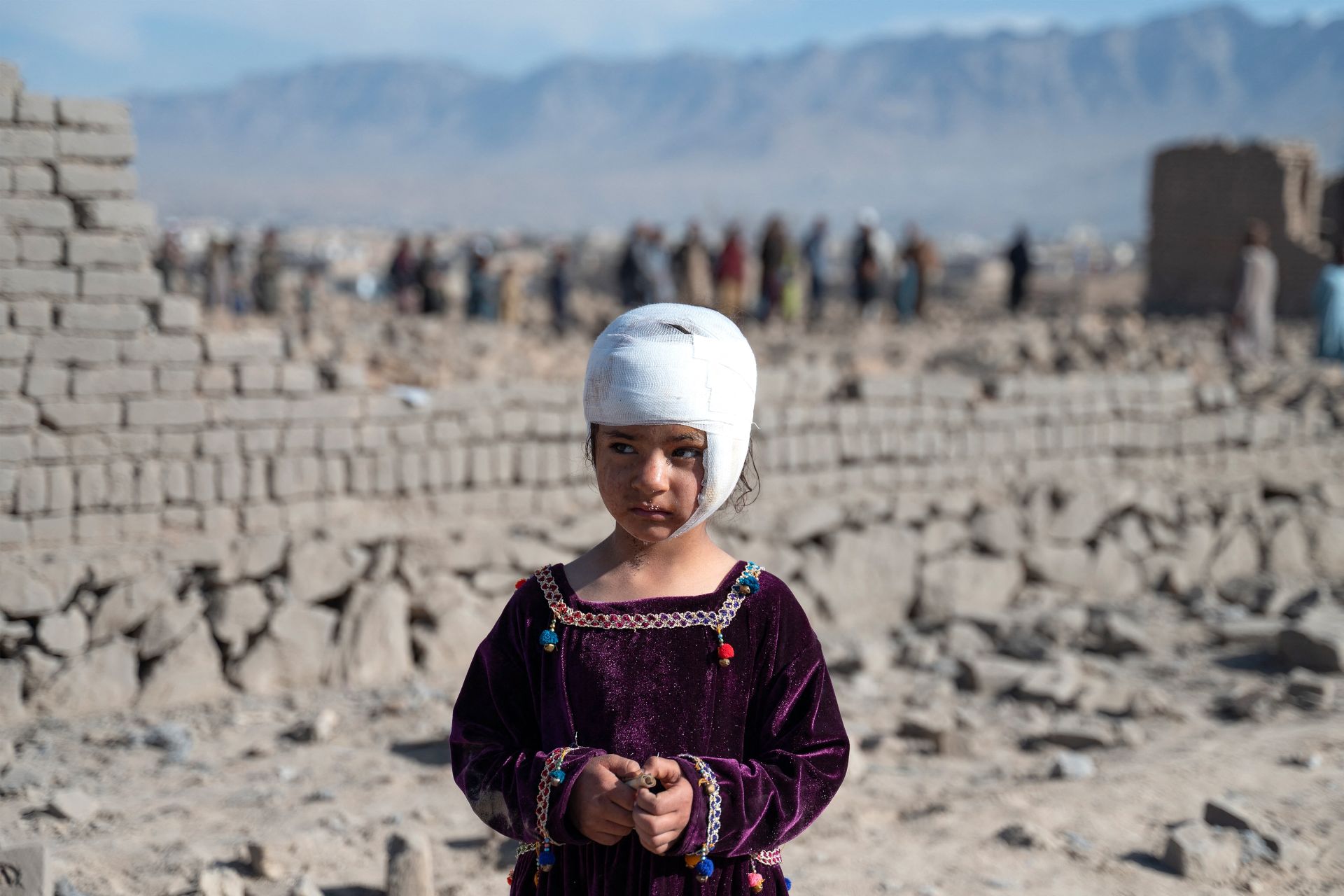
The first strike came in the dead of night on Feb. 22, when families across Afghanistan were sleeping before suhoor, the predawn meal. Seven sites were hit simultaneously. None was a military installation. None had blast walls or armed guards. They were homes, the kind of low mud houses that seem to lean into the earth, as if asking the ground to hold them. Mothers who would normally be in their kitchens in the early hours instead found themselves pulling children from wreckage or lining graves before iftar, the evening meal that breaks the daily fast.
One of those houses belonged to a resident called Shahabuddin, in Behsud on the outskirts of Jalalabad in eastern Nangarhar province.
“The bomb came and took everything,” he said, standing before the rubble of what had been a furnished home, a life. Behind him, in the early dark, villagers and excavators worked through the debris, searching for those still missing. “My sister-in-law and her children were sleeping in that room. My father was here. My daughters and sons.” He paused. “Four of us are still alive, I think. The rest — all gone.”
Pakistan’s government acknowledged the strikes, claiming they had targeted militants in the border areas who posed a threat to their country.
But in Behsud, there was only rubble, and a man who could not understand why his family was dead.
Taliban forces launched coordinated retaliatory midnight attacks along the disputed Durand Line dividing the two countries, targeting Pakistani military posts and watchtowers. On Feb. 26, Pakistani jets returned, this time hitting not the frontier but the cities: Kabul, Kandahar, Kunar.
The war had now left the mountains and widened out. Pakistan was not only striking military installations, as its officials had said.
One blast struck Resh-Khor, a historic military base south of Kabul that has anchored Afghan military history for generations — a command center during a coup against the last communist president, a stronghold through the civil war of the 1990s, and later a base for U.S.-backed Afghan special forces. The base sits roughly 30 miles from my neighborhood, but the shock wave rattled windows and shook doors in their frames. Ambulance sirens started somewhere in the distance. For a few seconds, the entire city went quiet.
Afghan government officials have often locked horns with Pakistan’s security establishment. During the U.S.-led war, Pakistan backed the Afghan Taliban during its insurgency. But now Pakistan accuses the group, which returned to power after the 2021 American withdrawal, of providing sanctuary to the Islamic State Khorasan Province and the Tehreek-e-Taliban Pakistan (TTP), responsible for carrying out hundreds of attacks inside Pakistan in recent years.
Pakistan and Afghanistan have vowed to keep fighting a war that has already killed at least 75 civilians and displaced 115,000 Afghans, according to the United Nations Assistance Mission in Afghanistan.
The fighting threatens wider insecurity in the region, with Iran to the west of both countries, and China to their east. On March 16, Beijing urged both sides to return to negotiations, which had stalled late last year. Hours later, Pakistan launched its single most deadly attack yet, coming on the 27th day of Ramadan, one of the holiest nights in the Islamic calendar.
The Pakistani military bombed a rehabilitation center for drug addicts in Kabul called Omid Camp, meaning hope, a place of vulnerable souls trying to heal. The Taliban said over 400 people were killed and hundreds more wounded. By morning, families had gathered outside the camp, a once-abandoned NATO base called Camp Phoenix.
They crowded around lists nailed to walls, running their fingers down pages filled with names. Sahil, a young man from Kabul, stood among them outside the Emergency Hospital. His brother, Mohammad Yehya, 25, had been a patient there.
Sahil could not find his brother’s name on the list. “An official standing on the back of a ranger truck said: ‘If your relative’s name is not on the list here, try the Aghosh camp. If they’re not there, go to the Emergency Hospital, Wazir Akbar Khan Hospital or the military 400-bed Hospital.’”
He tried all those, and only one avenue was left: the morgue where the unidentified dead were kept. I went with him, walking down a cement path to the right of the Emergency Hospital. Beside the gate, a coffin lay on the ground, lined with cotton cloth. Inside the morgue were three metal beds. On each was a body covered in white.
One of the dead was recognized by a person who had come to search. Sahil, still a teenager, could not bring himself to uncover the others’ faces. So I did it for him. One was burned black as coal — unrecognizable. The other was also burned, but not completely. His face and head were gone. Neither was his brother.
Sahil left with sorrow and fear in his eyes. Around us, women stood with small children, calling out to one another, shouting names. Some were telling others to go inside and look at the bodies — their relatives’ names were not in the book. There was no other way to know.
As Sahil and I separated, the sky turned black. Not with night, but with clouds. It will rain soon. It looks as if the sky will cry instead of us.
What makes this conflict different from the ones before it, Afghans will tell you, is the nature of the enemy.
“The Soviets were inside our land — we could see them,” said a former guerrilla fighter in Kabul who battled both Soviet and American forces over four decades. He spoke on condition of anonymity to discuss sensitive matters. “The Americans were in our villages. We could fight them face to face. But Pakistan, their jets fly above. Their drones watch everything. But no soldier crosses the fence. There is no one to shoot at. How do you fight that?”
Much of the focus of the current war has centered on the Durand Line, both literally and metaphorically. Hastily drawn by the British during the colonial era, in 1893, the Durand line cuts directly through the heart of Pashtun and Baloch territories, dividing tribes, communities and families across both sides of the frontier.
Since 1947, when the modern state of Pakistan was formed, no Afghan government has formally recognized the Durand Line as a legitimate international boundary, and calls to remove or renegotiate it remain a deeply emotional and politically sensitive issue within the country. Many Afghans see it as an imaginary border dreamed up by colonialists.
The unresolved border question raises the specter of a larger military confrontation. In early March, the Taliban’s defense minister, Mohammad Yaqoob Mujahid, said he turned down a previous request from Pakistan to recognize the Durand Line as the official border. In an interview with Afghan broadcaster TOLONews, Mujahid said, “We told them that this is a historical issue which neither the current government nor previous governments have been able to resolve, and it should not become a cause for escalating tensions.”
Many Afghans today, especially ethnic Pashtuns, dispute the boundary. “It is not just about the Taliban or the TTP. It is about the Durand Line, about land taken from us a hundred years ago,” the former fighter said. “Fighting Pakistan feels like fighting for our nation.” He looked at the sky for a moment. “Not for the Taliban.”
This war has also done something few conflicts in recent Afghan memory have managed: It has created a message of unity.
On March 6, a Friday, massive protests filled Kabul and other cities. Crowds gathered in front of the Eidgah Mosque with its slender minarets — where King Amanullah declared independence from the British in 1919 — chanting against Pakistan. Officials who served under the previous government, ousted by the Taliban four years ago, held press conferences offering their support to the Taliban-led state. Scholars from across the provinces issued edicts calling for jihad.
A video from Badakhshan province showed a white-bearded elder named Abdul Basir sitting in an open field, green spring grass behind him, issuing a religious ruling against Pakistan. It spread across social media within hours.
“Afghanistan is the shared home of all brave Afghans,” said Mohammad Sediq Patman, a former deputy minister of education from the republic era. “Against an invasion, we stand together.”
Latfullah Azizi, an ethnic Uzbek and a former governor from Afghanistan’s north, put it more simply, comparing two places on opposite sides of the country: “If a village is bombed in Paktika, it is as if Badakhshan was bombed.”
On March 1, a 12-year-old boy was killed in the Samarkhel district, a small town just south of Jalalabad in Nangarhar. Reports followed in quick succession: Bagram airbase had been hit; a refugee camp in Kandahar was struck, killing three; airstrikes hit a bazaar in Nangarhar, igniting a fire that burned through the market. Afghan families displaced by the destruction of their homes sheltered in tents, waiting for the end of yet another war they had not started.
From eastern Kunar province came a video that has stayed with me: a father beside the wrapped body of his small child, killed in a Pakistani airstrike. His cries are the kind that do not leave you.
Yet if you walk through the markets of Kabul today, the city looks, on the surface, like itself. Fruit sellers argue over prices. Children run between carts piled with oranges and pomegranates. Traffic is snarled as always. In my alley, boys kick a soccer ball against a dust-blackened wall. The baker pulls bread from his oven, the smell warm and familiar. Women carry vegetables home before sunset.
This is something Kabul has learned over generations: how to hold war and ordinary life in the same hand.
“What can we do?” asked a fruit seller near the bustling commercial area of Mirwais Maidan. “If we run, where do we go?”
The political class in Kabul has its theories about Pakistan’s motives — that Islamabad’s army chief Asim Munir may be signaling to Washington that he can control the American military hardware left behind; that domestic political and economic pressures are driving the offensive; that this is as much about Pakistan’s internal crises as it is about Afghan militancy. No one has proof. In Afghanistan, when no one tells us what is really happening, we fill the silence with our own stories.
What people say more quietly, in the way that Afghans speak about history when they want you to really hear them, is that airpower has never solved anything here — not for the British, not for Moscow, not for the Americans across 20 years of strikes and surges. Plans drawn in distant capitals by people who do not know this land do not survive contact with it.
There is anger in Kabul, not loud, but steady — the kind that accumulates.
This morning, in the final week of Ramadan, the city woke to the now-familiar crack of antiaircraft fire. For roughly 20 minutes, the guns fired upward into the dark. Then the city settled back into itself.
Tonight, families will wake again before sunrise for suhoor. They will hope the sky stays quiet. They will pray that revenge does not only produce more revenge.
Pakistan measures power in tons of ordnance. Afghans measure it in how long we can endure. In this country, after so many years of war, we already know how long that is.
“Spotlight” is a newsletter about underreported cultural trends and news from around the world, emailed to subscribers twice a week. Sign up here.