


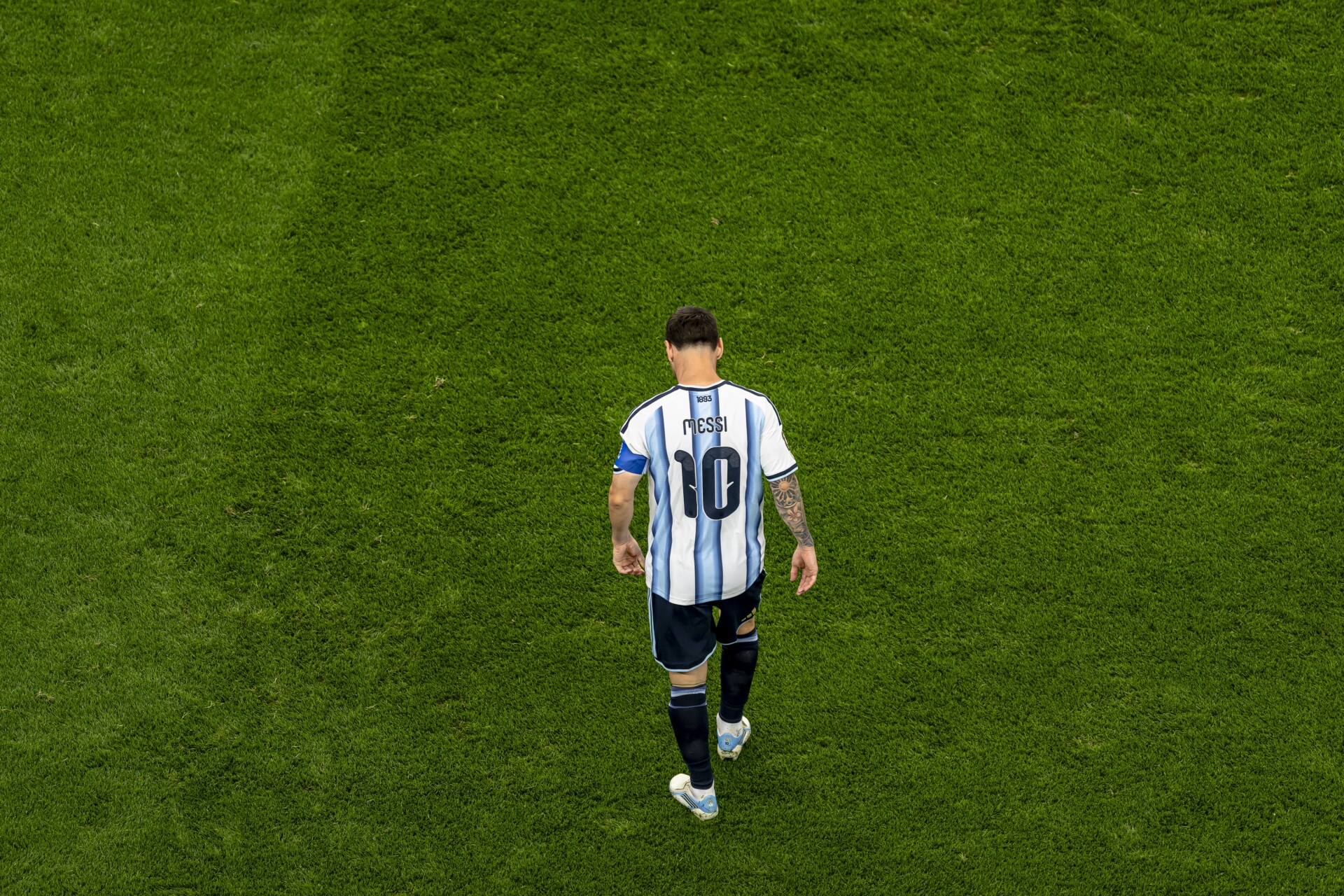
On July 3, I went with some friends to a bar to watch Colombia play Ghana. We had arrived early to claim a spot. Luckily, that meant we also caught the earlier match, Argentina vs. Cape Verde, which turned out to be the most entertaining of the World Cup so far. When Sidny Lopes Cabral scored Cape Verde’s second goal to tie the game in overtime — a beautiful twirling strike from the edge of the box — we screamed our hearts out. An Argentine fan in front of us took offense, going so far as to call us “boludos” (idiots). How could we — who were wearing Colombia jerseys — celebrate a goal against Argentina? The implication was that, as Latin Americans, we owed Argentina our support.
Until the last World Cup, he might have had good reason to think so. In Qatar 2022, the whole continent seemed to rejoice together at the prospect that Lionel Messi — and, by extension, Argentina — might finally claim the one missing achievement in his stellar career. Moreover, an Argentine victory in Qatar would be a triumph for the whole region. The last time a South American nation had lifted the trophy was two decades earlier, when Brazil won in 2002. Argentina’s win in 2022 would finally put an end to the narrative that European soccer culture was superior; it would vindicate Latin America’s distinct style of play, which in broad strokes puts less emphasis on tactical mastery and controlled pressing and more on individual talent and aggressive passion.
The mood — the vibe, some would say — has shifted decisively this time around. All over social media, Latin Americans are coming out against Argentina. Fans from Brazil, Mexico, Chile, Uruguay — the list goes on — now declare their support for whoever happens to be playing against Messi’s team. Argentina has managed to antagonize its neighbors, for reasons not entirely out of its control.
In Latin America, as anywhere else, each country carries some stereotypes. Mexicans love spicy food; Colombians are either drug dealers or dancers. Argentines are seen as arrogant, with a superiority complex. Worse still, they are cast as a racist nation that proudly foregrounds its European roots while denying any link to its Indigenous or Black heritage. Of course, these are wildly oversimplified generalizations that fail to capture the complexity and diversity of any group, let alone a country of more than 45 million people. The trouble comes when a real incident seems to confirm the caricature: Social media feeds on it, and the narrative spreads.
Take that alleged superiority complex. After England defeated Mexico in the World Cup’s round of 16, Eduardo Feinmann — a well-known Argentine journalist who hosts a popular radio show and anchors a television news program — was asked whom he was rooting for. He answered with an impromptu tirade: “I detest Mexicans, I detest them with my soul. … The envy they feel for us, not only in football but in everything.” Within hours, social media was awash with videos of Mexican content creators condemning his words and, by extension, Argentines once again. The uproar grew loud enough that even Claudia Sheinbaum, Mexico’s president, addressed it in her daily press conference, calling the remarks “appalling” and Feinmann a “pseudo-journalist.”
Consider, too, the accusations of racism. Throughout this World Cup, some Argentine fans have been accused of blatantly racist behavior. For example, during Argentina’s round-of-32 match against Cape Verde, the streamer iShowSpeed was verbally abused by an Argentine fan, who allegedly told him in Spanish to “go cry at the zoo.” Days later, during Argentina’s match against Egypt, the streamer was once again the subject of racist abuse, with another fan filmed making monkey-like gestures at him. At that same match in Atlanta, footage showed Argentine supporters taunting Egypt fans and throwing beer at them after their team’s late — and controversial — comeback.
Incidents like these are not new. Two years ago, the Argentine team was the subject of controversy after beating Colombia to win the 2024 Copa America. In a video that Argentine midfielder Enzo Fernández streamed on his Instagram profile, players could be heard singing a chant aimed at France’s national team. The lyrics mocked its Black players for their African heritage: “Listen, pass the ball: They play for France, but they’re from Angola.”
The backlash to Argentina’s perceived arrogance and its troubled racial politics has not passed unnoticed at home. Across social media, Argentine creators have responded to this widespread rejection. One of them ironically remarked that “Argentina appears to be the worst country in the world.” Often outraged, sometimes apologetic, their reactions fall into a few broad categories. Some point to moments when Argentine fans and players behaved gracefully (a large section of the crowd did, after all, give Cape Verde’s players a standing ovation as they walked off the pitch). Some insist the whole thing is a smear campaign, orchestrated by some shadowy power intent on tarnishing the country. Some concede that the accusations of racism are true, and that Argentina has some serious reckoning to do. And some acknowledge the accusations only to dismiss them. There may be racism in Argentina, they claim, but the country is hardly alone — and no worse than the U.S. and Europe when it comes to the prevalence of racist behavior.
Meanwhile, Latin American fans are increasingly turning their backs on Argentina. Scroll through TikTok and Instagram and you’ll find clips of fans chanting “América Latina menos Argentina” (“Latin America minus Argentina”). It may be inevitable: No one likes to root for a titan. In Qatar 2022, Argentina was not exactly the underdog, but it was no Goliath either. After losing its opening match against Saudi Arabia, the team seemed vulnerable, and with Messi’s legacy on the line, its run felt like the last cry of an aging legend.
Messi is still a genius at 39, but that no longer seems to matter. Latin American fans no longer yearn to see him lift the trophy — they have already seen that movie. Aside from Brazil and Uruguay, whose last title is three-quarters of a century old, no Latin American nation besides Argentina has ever won the tournament. Fans, it seems, would rather stand behind one of their own: a David trying to topple a giant.