


The early summer heat wave of 2021 was unrelentingly harsh in Afghanistan, an ominous prelude to the political turmoil that was about to engulf the nation. As foreign troops hastened their withdrawal, the Taliban, emboldened by a favorable deal with the U.S. a year earlier, pushed deep into new territories, leaving a trail of violence in their wake.
From those shifting front lines in the southern province of Kandahar, Danish Siddiqui, an Indian photojournalist with the Reuters news agency, called his father. It would be the last time they spoke.
He shared the stories he was planning to pursue, including one about displaced communities. “He wanted to follow them on their journey in search of safer places away from the war,” his father, Akhtar, told New Lines from New Delhi earlier this month. “He was really moved by stories of the sufferings of the Afghan people, which he wanted to tell. He was always very passionate about his work and the people he met along the way.”
The Pulitzer Prize-winning journalist was killed on July 16, 2021, while embedded with the Afghan National Army in the Spin Boldak district of Kandahar. “He was responsible and would not take undue risk,” his father said. Details emerged slowly from the besieged province, painting a horrifying picture of capture, torture and murder. Days later, after much negotiation with the Taliban, Siddiqui’s body was released, showing clear signs of abuse.
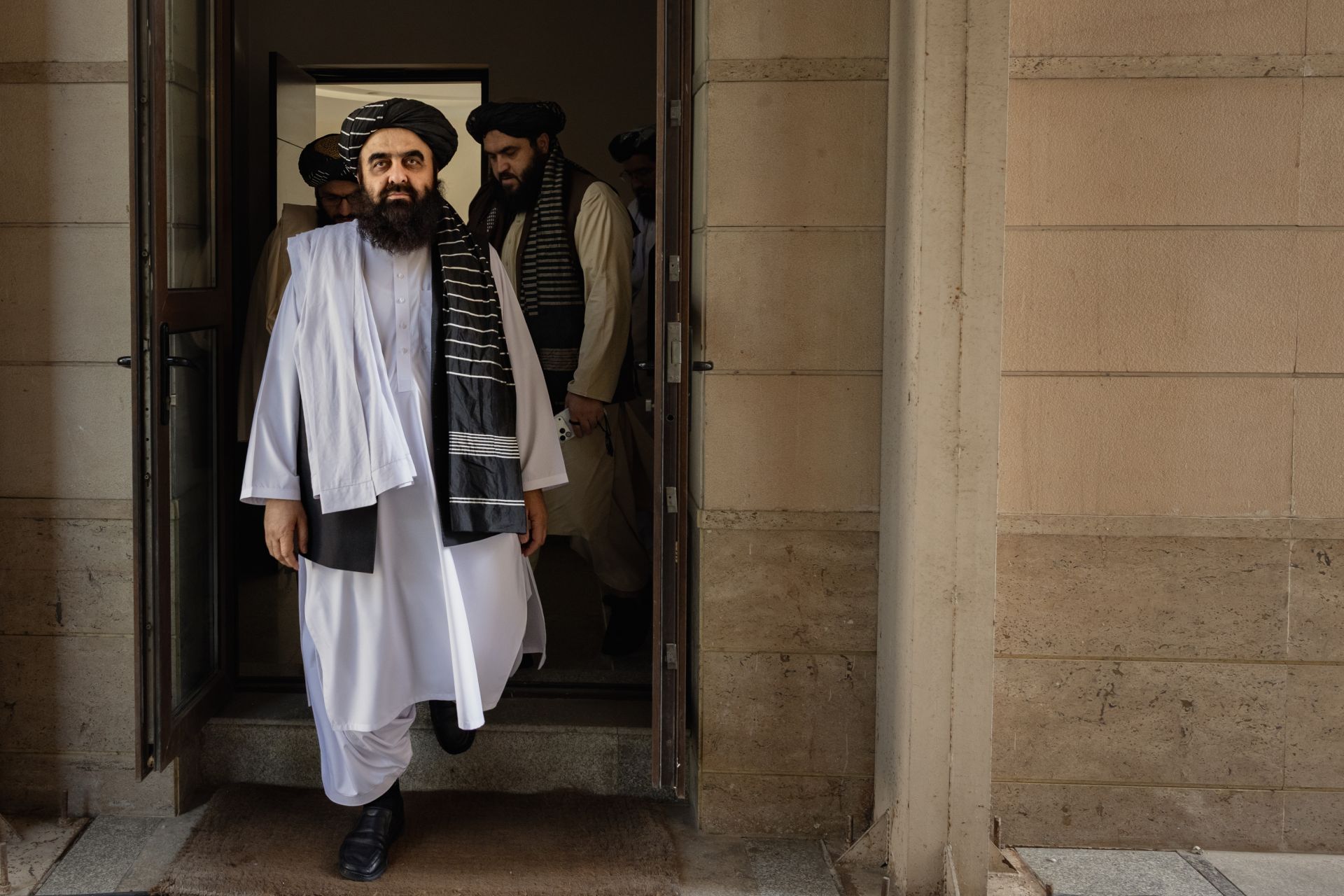
The Taliban’s foreign minister, Amir Khan Muttaqi, arrived in New Delhi on Oct. 9, marking the first-ever visit to India by a senior Taliban official. He was only allowed into the country once he had procured a waiver to a travel ban under U.N. Security Council sanctions. Over eight days, Muttaqi attended meetings, trade talks and plenty of photo ops.
For Siddiqui’s family members, the visit also offered a glimmer of hope. Through their Danish Siddiqui Foundation, established in his memory to promote values-based journalism, they appealed to the Indian government, repeating their plea for an investigation into his murder. To the Taliban, they urged justice. The visit was “an opportunity to remind the Taliban of its obligations under international humanitarian law and to encourage cooperation with independent investigations into Danish’s killing,” a statement issued by the foundation read.
More than three weeks later, they have not yet heard from either. Adding salt to their wounds, on Oct. 21, India restored its diplomatic presence in Kabul, paving the way for formal recognition of the Taliban. Later in November, the first Taliban official will be appointed to the mission in New Delhi, The Times of India reported.
The family’s quest for truth has run up against a change in India’s policy toward the new rulers of Afghanistan, who are increasingly at odds with Pakistan, their traditional ally. The shifting geopolitical landscape of the region reflects India’s ambition to strengthen its influence and compete with its regional rival, China, which has long invested in Afghanistan and Pakistan.
As an Indian reporting in Afghanistan, Siddiqui was acutely aware that his nationality placed him at greater risk of being targeted by the Taliban. The insurgents maintained close ties with Pakistan, a country with which India has long been locked in regional rivalry. A seasoned war correspondent, Siddiqui was no stranger to danger. Yet the brutality he suffered in his final moments, and even after death, shed light not only on the Taliban’s repeated targeting of journalists but also on the regional power dynamics that may have sealed his fate.
In my earlier reporting, a doctor who conducted preliminary examinations of his body, as well as video and photographic evidence that I verified, confirmed that not only had Siddiqui been injured and killed with gunshot wounds, but his body bore significant evidence of post-mortem mutilation. “It appeared they had run a vehicle over his body, after having shot and killed him, several times,” one of the sources who retrieved his body told me.
A formal investigation into Siddiqui’s murder was launched by the previous Afghan government, but could not be completed. In the chaos that followed in the region after the Taliban takeover, the Siddiqui family received neither answers nor justice. Siddiqui’s family has since approached the International Criminal Court seeking to include his murder as part of the ongoing investigation into Taliban war crimes. As the Indian government shifts its regional stance, however, there remain fewer political channels to pressure the new Afghan authorities, who are accused of his murder and other war crimes, to investigate or seek accountability.
The long-standing conflict between India and Pakistan over the disputed region of Kashmir has frequently spilled over into other arenas across South Asia. In Afghanistan, Pakistan has acknowledged providing support to militant groups, most notably the Taliban, while India, for its part, maintained a long history of backing first the Northern Alliance, an anti-Taliban mujahideen coalition in the 1990s, and later the Western-backed Afghan republic.
Similar patterns unfolded after the Afghan government’s collapse in August 2021, scarcely a month after Siddiqui’s killing. President Ashraf Ghani and many senior officials fled the country, clearing the path for the Taliban’s return to power. In the chaos that followed, foreign missions, including the Indian High Commission, shut down their operations and evacuated alongside hundreds of thousands of Afghans who feared persecution under the new regime.
For a time, to anyone following events in South Asia, it appeared that Pakistan’s proxies had triumphed. Even as India scrambled to evacuate its citizens, Faiz Hameed, then the chief of Pakistan’s intelligence agency, the ISI, was seen in Kabul alongside Taliban leaders.
But Indian policy has traveled quite some distance since its initial support of anti-Taliban groups. While part of the reason is to mitigate Pakistan’s influence in the region, India is also keen to benefit financially. At one point over the last two decades, Afghanistan was the largest recipient of India’s foreign aid, totaling over $3 billion between 2002 and 2021. Now, India is aiming to reap the rewards of that goodwill. New Delhi has shown interest in investing in Afghanistan’s vast and largely untapped mining sector, which already has investment from China and significant interest from Russia.
Since deploying a technical team to Kabul in 2022, the Indian government has resumed work on some of its development projects that were left unfinished in the hasty withdrawal the previous year, including the Chabahar Port in Iran. The facility is aimed at increasing trade with Afghanistan — particularly of agricultural produce, but also of steel and iron ore — while bypassing the land route through Pakistan.
“India gradually started recalibrating its policy, albeit rather late in the day, keeping in view the very rapidly shifting political and military ground in Afghanistan,” said Raghav Sharma, director of the Centre for Afghanistan Studies at the O.P. Jindal Global University in India.
He added that, unlike during the Taliban’s previous rule in the 1990s, when India maintained no contact with the group, this time New Delhi moved slowly and cautiously to establish a working relationship with them.
In 2022, India partially opened a technical mission in the country and kept regular channels of political dialogue with the Taliban open. Sharma pointed out that, even during India’s military strikes on Pakistan in May 2025 — dubbed Operation Sindoor — the Indian foreign minister maintained contact with his Afghan counterpart.
The Taliban’s ongoing backing of the Tehrik-e-Taliban Pakistan, which frequently targets Pakistan, has soured ties between the former allies. The rift has played out through border skirmishes and Pakistan’s deportation of over a million Afghan refugees. The Taliban-Pakistan conflict peaked when Pakistan carried out airstrikes across Afghanistan, including in the capital city of Kabul on Oct. 9, killing 37 civilians and injuring nearly 400.
India’s attempt to engage the Taliban is by no means an isolated effort. Several Western governments that fled Kabul in the days after the Taliban takeover are now attempting to find their way back into the country for a myriad of reasons. The United States, China and Russia have opened channels with the Taliban, with Moscow officially recognizing it as the legitimate government. Other countries, like Germany, have allowed a degree of Taliban control over Afghanistan’s diplomatic missions abroad, despite being strongly vocal about the group’s mistreatment of women and minorities.
It seemed only a matter of time before India would also seek to secure its interests in the region, Sharma said, even if it might come at the cost of constitutional values.
“This is a trend that has been mainstreamed now over the last couple of years. Whether it’s the Taliban in Afghanistan or the military junta in Myanmar, it’s not the first time that you would see the idea of what constitutes national interests trumping values,” he said.
While engagement with Afghanistan’s de facto authorities may appear inevitable for regional and international actors, Afghan academics and activists have expressed concern over India’s decision to exclude opposition voices from the dialogue.
“I think India’s policy of ‘my enemy’s enemy is my friend’ is very dangerous, and I’m surprised they haven’t learned from the Pakistani experience,” warned Mariam Safi, director of the Organization for Policy Research and Development Studies, a research organization led by women from Afghanistan, referring to the deterioration of Pakistan’s relations with the Taliban. “For decades, Pakistan helped support and sustain a group that harbored and nurtured terrorist organizations in Afghanistan, who are now perpetuating violence and attacks on Pakistan,” she said.
The India-Taliban bonhomie remains unusual, particularly in the eyes of activists, academics and those in Afghan civil society who are resisting the Taliban’s increasingly authoritarian regime.
Since taking over, the Taliban have imposed an increasing number of restrictions on women’s rights and freedoms, among other violations of human rights, including banning women from high schools, universities, employment across skilled sectors and even from public spaces.
“Having India support the Taliban in the face of those atrocities and their violations of international law and all the conventions and treaties that Afghanistan is bound to, was very disheartening,” Safi said.
It was particularly disappointing, she said, considering that under the previous government, India supported projects to strengthen Afghan democratic institutions and education, including thousands of scholarships each year, that were effective in developing India’s soft power in the country.
One particularly galling moment of Muttaqi’s visit to India was his refusal to allow female journalists into a press conference. To the chagrin of Indian media, civil society and members of the political opposition, the government agreed. The outcry forced him to hold a second, inclusive meeting, a privilege not offered to Afghan women in the media. “It was heartening to see female journalists in India use the opportunity to ask Muttaqi hard-hitting questions,” Safi said.
But the incident, called a “technical mistake” by New Delhi, has raised the alarm in India on engaging with a group that remains ideologically opposed to India’s identity as the world’s largest democracy.
The Taliban has, in the past, also repeatedly attacked Indian interests and nationals, such as Siddiqui. The Indian embassy in Kabul came under repeated Taliban attacks in 2008 and 2009, which resulted in the death of several Indian diplomats. In 2014 and 2016, there were also massive Taliban attacks on India’s consulates in Herat and Balkh provinces, resulting in dozens of casualties.
Ironically, many of the Taliban leaders with whom India is currently engaging operated networks that conducted these frequent attacks on Indians. While the Indian government might see some merit in strengthening its position in the region vis-a-vis Pakistan, it is unlikely that the Taliban will respond with loyalty.
The Taliban remain an ideological movement with enduring links to transnational networks of militants — groups that are not only deeply hostile to Indian influence in the region but also critical of the Indian government’s rightward shift toward Hindutva ideology over the past decade.
Although the Taliban may be exploring new regional alliances, they are unlikely to strengthen ties with India at the expense of Pakistan, with which they share a fraught border and upon which they remain heavily dependent for trade and cross-border movement.
The Taliban, Safi said, is as unpredictable as a hurricane. New Delhi’s growing proximity to the authoritarian regime could also undermine the successes of its investments in education, infrastructure and democratic institutions before the Taliban retook power.
With their lives irreparably altered since 2021, the Siddiqui family finds its fate tied to that of the people of Afghanistan and to changing geopolitical relationships.
“We very eagerly await any response from the government of India as well as from the government of Afghanistan to our request for an investigation into the brutal killing of my son,” Akhtar said. “They [the Taliban] are in power now, they are ruling the country, they can do this, look into this case.”
Like his son, Akhtar also has empathy for the suffering of the Afghan population. “But also this is an opportunity for the current leaders to provide justice to those who were wronged,” he said. “My son was there to bring the story of the suffering of the Afghan people. He deserves justice.”
“Spotlight” is a newsletter about underreported cultural trends and news from around the world, emailed to subscribers twice a week. Sign up here.