



“An hour ago, an airstrike by the Zionist regime and America hit the park. In the park there were buildings, residences, paramedics, emergency workers, firefighters, Red Crescent [personnel]. A lot of people were here,” said the person filming the video.
Posted on X by the Iranian Students’ News Agency, this video is the first piece of evidence showing the destruction of Zibashahr Park in Shiraz.
According to Iranian media, Zibashahr Park is home to a base for emergency first responders. Local officials stated that 20 people, including three medical professionals, were killed. Thirty people were injured, and the building of the 115 Emergency Base was completely destroyed in the attack on the evening of March 5.
A review of post-strike videos and images, along with satellite imagery and mapping data, shows that this civilian park was directly hit, raising questions about whether the incident was a case of mistaken targeting.
Here’s how open-source materials shed light on the strike.
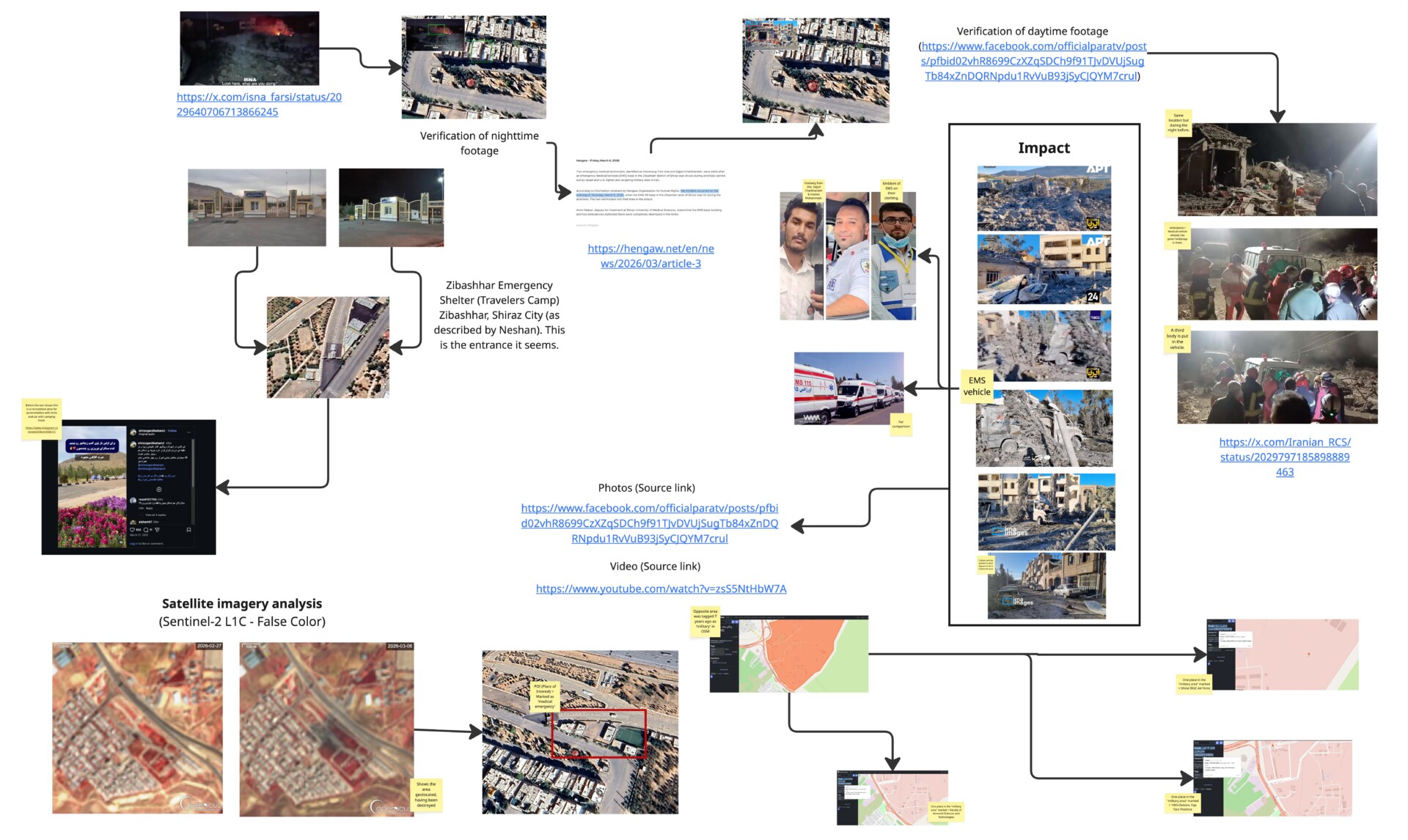
The verified coordinates of the strike place it right beside a doctor’s office for emergency medical care, according to information on Google Maps. In the same area, there’s a park where people can camp and bring their recreational vehicles.
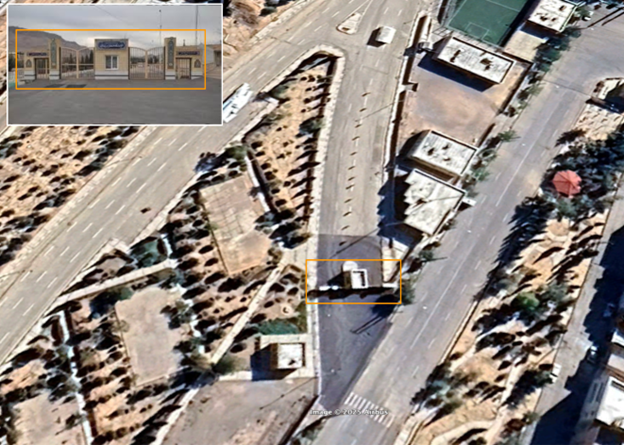
Images from the Iranian navigation app Neshan show signage that reads “Zibashahr Emergency Shelter (Traveler’s Camp).” The structure of the gates aligns with the one seen on satellite imagery from Airbus on Google Earth.
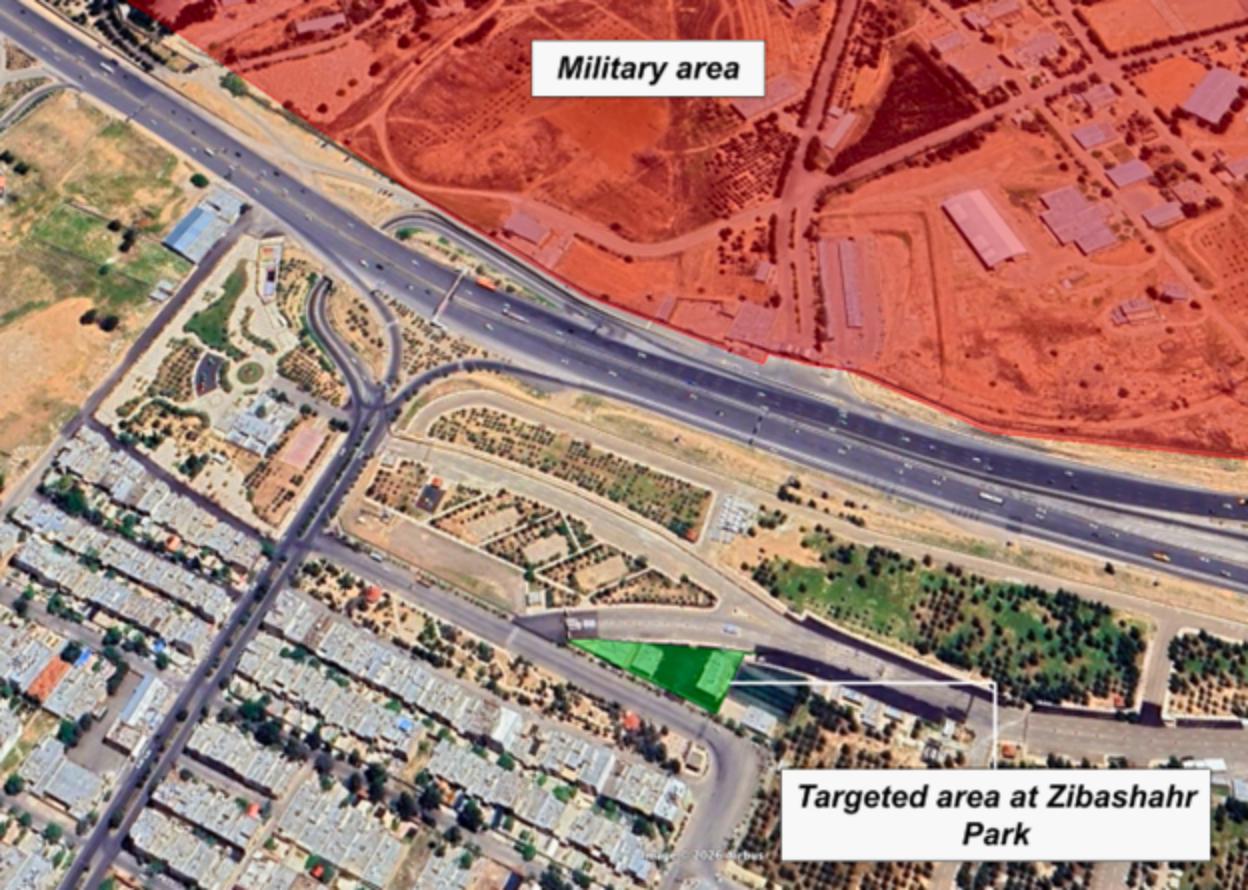
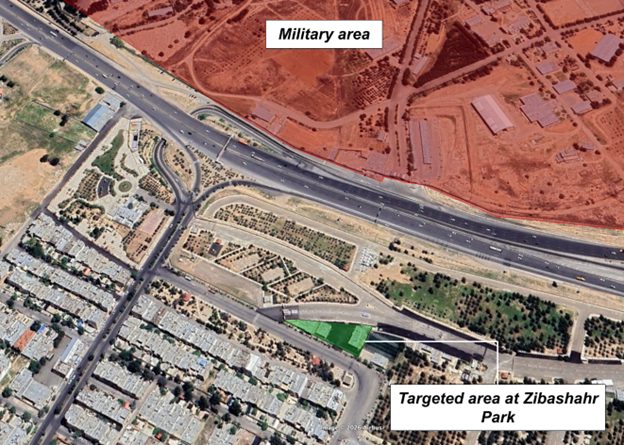
When referencing this location on OpenStreetMap to see what might be nearby, it became apparent that, as far back as 7 years ago, a user had noted the existence of a nearby military barrack. (OpenStreetMap is an editable, crowdsourced geographic database, functioning similar to Wikipedia, but for mapping.) The military area appears less than 200 meters away from the strike at the opposite side of the highway.
Data from OpenStreetMap identified the Faculty of Armored Sciences and Technologies in this area, along with the 19th Division of an Islamic Revolutionary Guard Corps (IRGC) unit known as Fajr, which is based in Fars Province, and a unit of the IRGC Air Force in Shiraz, the province’s capital. Satellite imagery by Airbus shown on Google Maps showed armored vehicles parked at this location in April 2025.
The nearby military site was not struck. In footage posted the day after the attack, the military site is visible and unscathed.
“It’s a bit inexplicable. The only identifiable military target wasn’t struck, and it’s not clear why they would think that this group of vehicles and people are military or a legitimate target,” said Adil Haque, a professor and expert on the law of armed conflict at Rutgers University.
Satellite imagery from Sentinel-2 shows that only the 115 Emergency Base in Zibashahr Park was hit. Satellite imagery shows at least three buildings that were destroyed. A video from the location shows a man walking through the wreckage. Also visible are two buildings left standing.
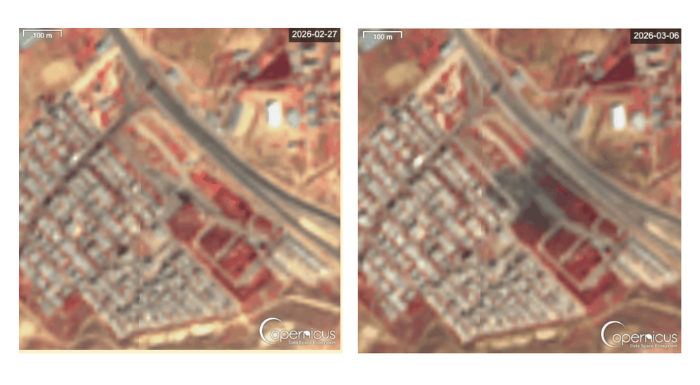
Wes Bryant, a former U.S. Air Force Special Operations targeting expert and former chief of civilian harm assessments at the Pentagon, reviewed the visual evidence. He said that a 2,000-pound bomb, or equivalent munition, was likely used on the larger building to the east, and 500-pound bombs, or equivalent munitions, were used on the two other structures to the west.
“With those precision munitions, it’s very rare to have a miss,” said Bryant, adding that a miss would be limited to a very small distance. “I’ve literally never seen one that has missed to the point of going 200 meters across the road.”
“Then to have at the very least three — because they would’ve had to have had three munitions here — miss perfectly south and all in line with these rather large structures, I would say highly improbable.”
Photos taken the following day show piles of rubble and mangled metal where buildings once stood. One photo also shows the exterior of a charred ambulance covered in gray dust. Visible on the side of the truck is a red letter E and blue Persian-language lettering. This matched with existing images of ambulances in Iran, confirming that at least one ambulance was destroyed.
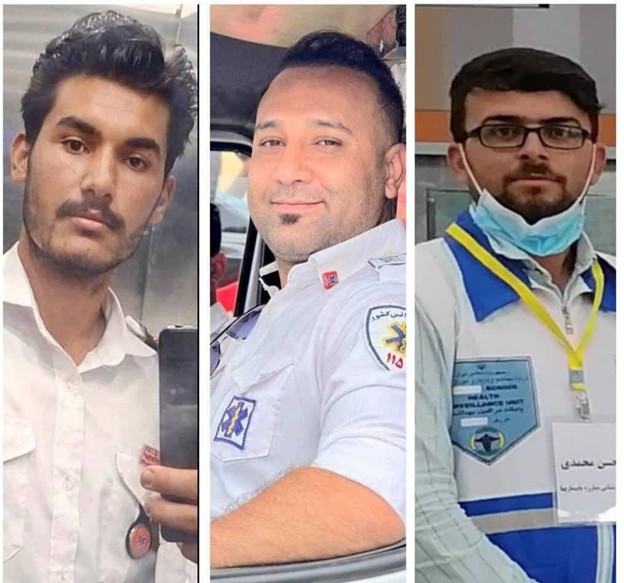
Of the reported 20 people killed in the strike, the human rights organization Hengaw identified two medical technicians who were killed — Hooshan Tork Alia and Sajjad Charkhandeh. Photos of the two medical workers show the emblem of emergency medical services (EMS) on their uniforms. A third medical worker who was killed was identified on X. His badge identifies him as Hassan Mohammadi, a member of the Health Surveillance Unit.
In this video posted online the day after the airstrike, an elderly man is looking at a destroyed car, calling out the name Hassan while wailing.
The deaths of the three medical workers were also confirmed by Hossein Kermanpour, the Head of Public Relations for the Ministry of Health and Medical Education.
A video posted to Instagram the day after the strike shows surrounding residences with damage to their facades.
“This is the blood from our countrymen that was unfairly spilled. Here lived a university professor who came out after the first strike, and the second strike killed him,” said the man in the video.
The names of 16 members of the Islamic Azad University community who were killed in the strike have been reported in Iranian media.
Without munitions remnants, on-the-ground access to researchers, or visuals of the moments of impact, it’s not immediately clear who the party responsible for the airstrike is.
U.S. Central Command published airstrike footage on the days preceding the strike in Shiraz. It confirmed that the U.S. was conducting strikes in Shiraz on March 2 at the Shahid Dastgheib International Airport and again on March 5, the same day of the strike on Zibashahr Park.
“That’s what’s most disturbing here. I mean, it’s targeting 101,” Bryant said.
Rohini Haar is co-chair of the Safeguarding Health in Conflict Coalition. She highlighted the distinct protection afforded medical facilities under International Humanitarian Law (IHL).
“The military has a positive obligation of distinction,” she said. “They have to know what they’re targeting, and what the facility is.”
She added that hospitals and other medical infrastructure such as EMS bases are “the most fundamentally protected under IHL, and so the regulations around protecting hospitals and medical neutrality are much higher, more strict.”
“Firing off on a hospital without doing the distinction and proportionality is particularly egregious.”
“Attacking forces have to do everything feasible to gather information to confirm that something is a military target and not civilian. But if, after doing everything you can to gather additional information, there is still substantial doubt then you should refrain from attack,” said Haque, adding that these rules are particularly strict in their application when there is no great urgency.
“Spotlight” is a newsletter about underreported cultural trends and news from around the world, emailed to subscribers twice a week. Sign up here.