


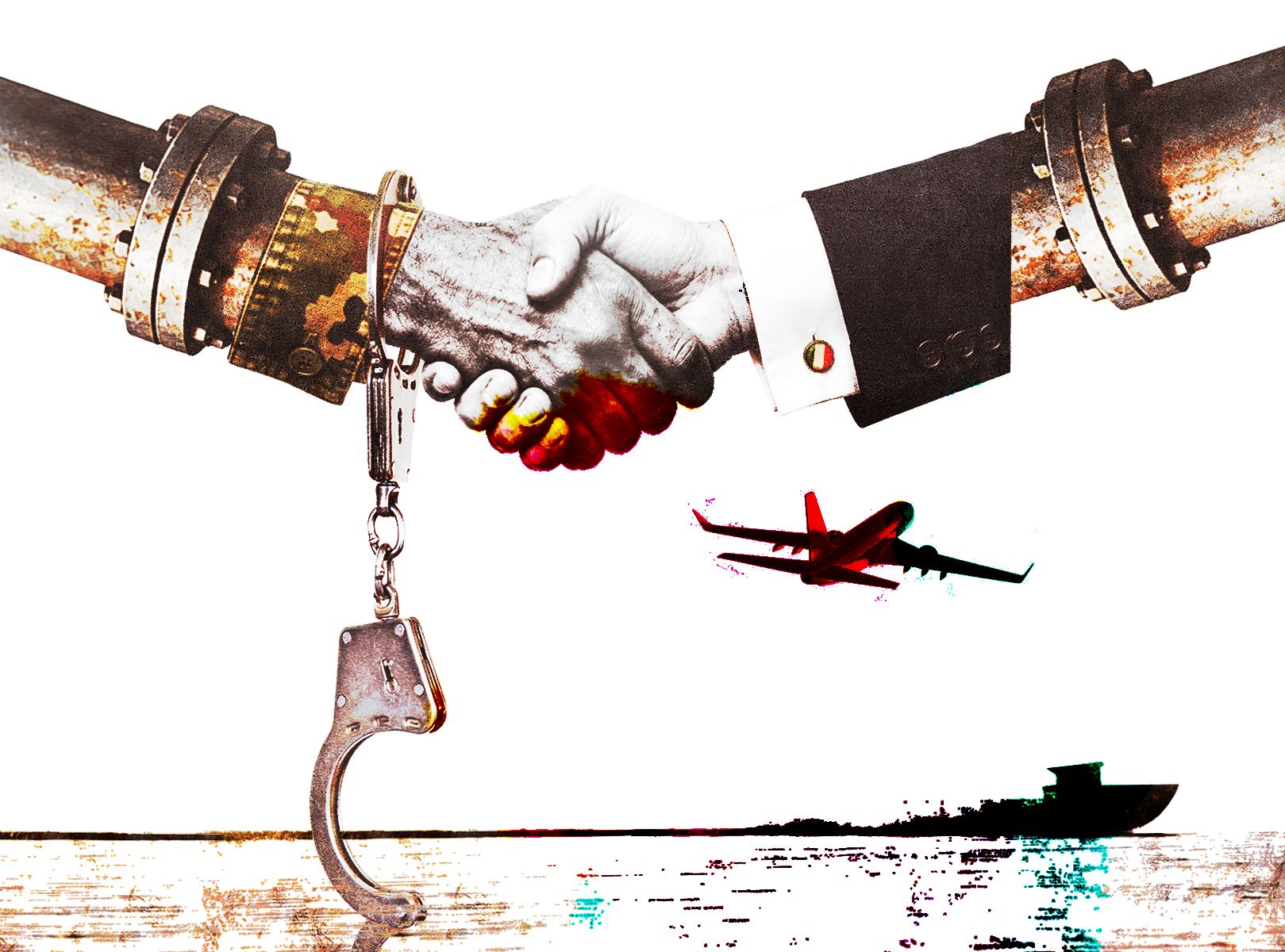
On the night of Jan. 21, 2025, dozens of people had gathered on the runway at Mitiga Airport in the Libyan capital, Tripoli, awaiting a flight from Italy. The aircraft that was about to land was an Italian government plane, organized by the country’s secret services. The man who stepped off the plane, smiling, was Gen. Osama Almasri Njeem. He had been arrested two days earlier by Italian authorities at a hotel in Turin, under a warrant issued by the International Criminal Court. The warrant charged him with the murder, torture, rape and enslavement of migrants detained at Mitiga Prison, located just a few hundred yards from the runway where he landed as a free man.
How did a man who stood accused of such horrific crimes find himself freed by one of the states that helped establish the ICC? A New Lines report reveals a complicated network of interrelated interests that helped pave the way for Njeem’s swift return home — and created a political crisis in Italy for Prime Minister Georgia Meloni’s government, both with its population and its partners at the ICC.
At the time of his arrest, Njeem had been serving as a general in the powerful autonomous armed faction called the Special Deterrence Force, or Rada. The Salafist-leaning group had been folded into the Government of National Unity (GNU) under Prime Minister Abdul Hamid Dbeibeh, and tasked with fighting organized crime and terrorism. In practice, the group largely controls Mitiga Airport and the adjacent prison, where thousands of detainees are held in brutal conditions, often without charges or a chance at legal proceedings. In reports to the United Nations Security Council, the Panel of Experts on Libya named Njeem among the commanders of an apparatus that had hijacked Tripoli’s justice system itself.
None of this was unknown to Rome. Italy knew Njeem was on its soil and was aware of exactly who he was. The ICC had alerted Rome through diplomatic channels the day before his arrest. To rule on whether Njeem should remain in Italian custody, the Rome court reviewing his case sought an opinion from the Ministry of Justice, which handles relations with the court under Italian law. No reply came. For days, the judges waited, pressing the ministry for an answer. It arrived only on the afternoon of Jan. 21, when the Rome Court of Appeal declared that the arrest had not been validly authorized. Consequently, Interior Minister Matteo Piantedosi signed an expulsion order, immediately repatriating Njeem for “national security reasons.”
The decision to free Njeem was scrutinized by the Italian Tribunal of Ministers, a specialized division of the ordinary courts with jurisdiction to try crimes committed by the prime minister and ministers in the performance of their duties. Three Italian ministers, the panel wrote, had “knowingly and deliberately” helped Njeem escape the court’s investigation. Yet in October, the committee closed the case after the lower house of the Italian Parliament rejected a request to bring the defendants to trial. Meloni herself was among the names listed by the prosecutor general as under investigation for aiding, abetting and embezzlement in relation to the Njeem affair. She denied the claim, and charges were later dropped.
Last June, the Italian Constitutional Court ruled on the case, declaring unconstitutional those parts of the law that allow the minister of justice to delay the execution of ICC arrest warrants.
Yet none of this constitutional wrangling clarifies the crucial issue at the heart of the affair: Why should a country that helped establish the ICC question the court’s authority by releasing a man wanted for crimes against humanity? The Italian government attributed the release to a procedural flaw in the arrest, but according to several people close to Italian diplomacy in Italy and Libya, who spoke to New Lines on condition of anonymity, the decision had a different logic.
Njeem’s arrest in Turin threatened Italian interests in Libya in two ways. It came at a moment when a new round of energy concessions, which stood to benefit Eni, Italy’s state-backed energy company, were being decided. At that time, Rada — Njeem’s armed group — was overseeing security for Italy’s largest oil and gas hub in Libya. Njeem also led the judicial police that intercepted migrants offshore at a time when pressure from the European Union to stem the flow of migration was mounting. That Rada also oversaw the massive detention center at Mitiga, where reports of human rights abuses were rampant, was of little consequence to the ministers.
The human cost of that bargain surfaced at The Hague in May, during the confirmation-of-charges hearings against Njeem’s second-in-command, Khaled El Hishri, the man who held the keys to the women’s wing at Mitiga. El Hishri was arrested in Germany last year and, unlike Njeem in Italy, surrendered to the court. The case rests on 945 identified victims and the statements of 63 witnesses. It charges him, along with Njeem and the Rada leadership, with running an institutionalized system of enslavement, torture and rape against women, men and children. On July 16, the pretrial chamber confirmed all 17 counts, sending him to trial.
What happened in Mitiga has been pieced together by the prosecutors through victims’ stories. One woman described the torment to which El Hishri subjected her: beatings, torture, being forced to strip, and being called a “filthy animal” and a “street whore.” She was terrified he was going to rape her. “I felt like everything was over,” she testified. “I became completely depressed by these actions.”
Another witness told the judges that hunger at Mitiga was a deliberate policy, designed to ensure prisoners thought of nothing but what they might eat that day. “Food was systematically limited, reduced to the daily ration of a small piece of bread and a liter of water,” one prisoner testified. “In winter, we were left with no clothes or heating, and in the summer no air conditioning. Skin disease spread, leaving lasting marks on my back. Tuberculosis also spread, affecting 10 people, who all died.”
The worst of it, prosecutors say, was reserved for migrants from sub-Saharan Africa. Black prisoners were singled out, beaten more than the rest and treated as slaves inside the prison, according to one detainee. A witness from the women’s wing recalled El Hishri deliberately denying medical care to an African migrant, who died from her condition.
The enslavement charge is what shifts the case’s center of gravity, because it describes detainees exploited as forced labor and as merchandise. At Mitiga, detention was not the end but the means: intercept, hold, monetize. Whoever entered generated revenue — ransoms extracted from families, according to the prosecution — and the militia squeezing people for that money was the same one stopping migrants bound for Europe. Njeem stood precisely where the two functions met, running both the prison and the judicial police. The militia that The Hague has accused of torturing migrants is the same one that Italy relies on to stop them from crossing into its territory.
Rome does not deny the relationship. According to Giovanni Caravelli, the director of Italy’s External Intelligence and Security Agency (AISE), who testified to the ministers’ tribunal, Italy had maintained relations with the militia. “AISE has enjoyed a very fruitful collaboration with Rada in combating various types of criminal activity, with particular reference to those linked to human trafficking,” he said. After the general’s arrest, those same militias leaned on Italy’s diplomats in Libya, hinting at consequences for the country’s energy infrastructure and interests if the general were sent to The Hague.
The threat was not an idle one. Since 2011, militias have hit dozens of Libyan energy facilities in retaliation for perceived slights. The Mellitah complex — the terminal of Greenstream, the strategic pipeline run by Italy’s state-backed energy giant Eni that links Libya to Sicily — was attacked in 2013, 2016, 2020 and 2021. This summer, protesters against the Dbeibeh government assaulted the complex.
As Njeem sat in custody in Turin, Tripoli was hosting the Libya Energy & Economic Summit, with a bevy of international oil giants in attendance and Eni as the event’s main sponsor. It was there that the veiled threats against Italy’s economic interests were delivered, with the Italian ambassador to Libya, Gianluca Alberini, in the room. The stakes were concrete. A licensing round for 22 new onshore and offshore blocks was underway. Among them were two concessions, later awarded to Eni, where, in February, 37 billion cubic yards of gas was discovered — roughly what Italy imports from Algeria in a year.
Eni extracts most of Libya’s oil, but much of it goes to the domestic market, and the pipeline capacity for exporting the country’s liquefied natural gas (LNG) remains largely untapped. Perhaps not for long. Meloni’s government needs a new energy partner — Qatar can no longer guarantee LNG flows after the damage from the conflict with Iran — and, in June, Eni announced $10 billion in investments to upgrade Mellitah and exploit the new fields. But the price of that energy hinges on the one thing Italy cannot control: Libya’s internal stability.
Since 2021, a process of stabilization has been underway in Tripoli. Yet any discussion of a democratic transition continues to be postponed. The primary obstacle lies in the distribution of power itself, which is fragmented among the militias. In Tripoli, power has not been consolidated under the GNU, but has evolved instead through the selective integration of armed groups. When the U.N. announced a new stabilization road map last year — an interim executive, electoral reform, elections and a citizens’ dialogue platform — some armed groups, including Rada, were renamed, repositioned or politically absorbed. Behind the shift was the guarantee of stability promised to Turkey and Europe. Rada had grown powerful enough to challenge the GNU itself, and it was cut down to size.
After a summer of ambushes and feuds in which the militia had come to control a quarter of the capital, GNU militias massed at Tajoura, near Tripoli’s airport, to threaten Rada’s headquarters at Mitiga. Although escalation was avoided, the episode revealed a familiar pattern. The government managed to negotiate and contain the tensions, but not to radically dislodge Rada from one of its main strongholds, the airport.
Even after every attempt to reshape Tripoli’s armed landscape, the Dbeibeh government still lacks the coercive authority to impose full control over strategic infrastructure. “And that is why, in a context like this one, the Italian government talks to every player involved, starting with the militias — the Almasri [Njeem] case is a textbook example,” a source close to Italian diplomacy in Libya said.
In June 2026, a Tripoli court convicted Njeem of torturing prisoners and sentenced him to seven years and four months in prison. Yet no one outside Libya knows whether he is actually serving his sentence. His whereabouts are unclear, the ICC warrant still stands, and human rights groups suspect the domestic case shields him more than it holds him.
Whether he is serving time or not, it will always be Njeem’s time inside Mitiga that defines him.
“I have not truly left the prison,” one of Njeem’s former detainees testified in The Hague last year. “I carry those memories like a wound that will never heal, searching through this pain for justice, for a sense of fairness, for a light that could dispel the darkness they planted in my depths.”
“Spotlight” is a newsletter about underreported cultural trends and news from around the world, emailed to subscribers twice a week. Sign up here.