

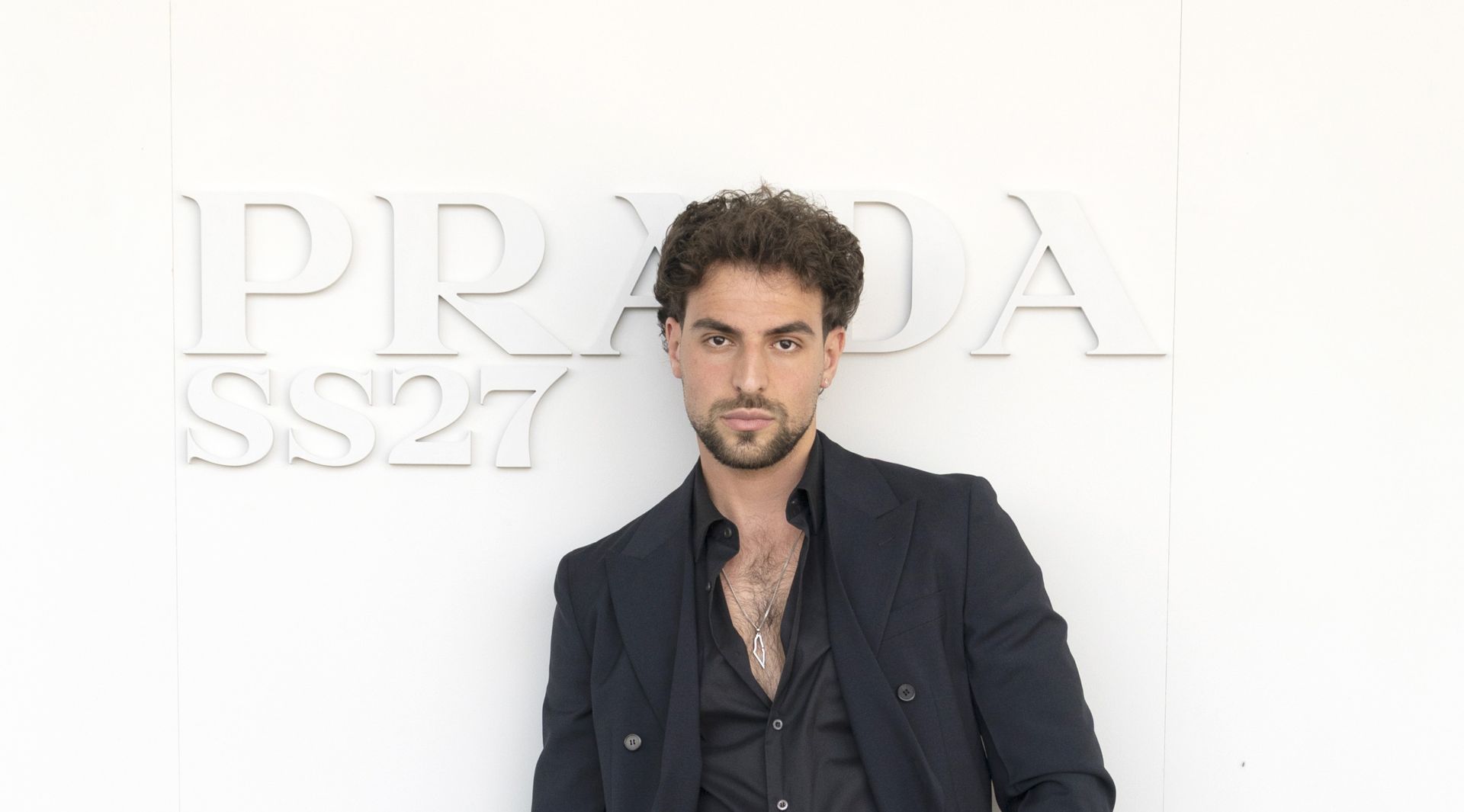
On June 24, Prada revealed that its latest brand ambassador was global music sensation Marwan Abdelhamid, known to most as Saint Levant. The post on its official Instagram page garnered over 120,000 likes in just a few days, along with heated debate over what the Jerusalem-born musician was wearing around his neck.
The silver map of historic Palestine ignited a familiar debate about who gets to claim the land between the Jordan River and the Mediterranean Sea. Many Palestinians and their allies argue for a single, secular democratic state that would be home to Jews, Muslims and Christians. Israelis, meanwhile, fear that a single state would lose its Jewish character — even though, as Israeli analyst and New Lines contributor Dahlia Scheindlin pointed out on X, Israel’s own maps of the land between the river and the sea have, for a long time, looked just like Saint Levant’s pendant.
The debate over how to visualize a slice of land that stretches for just 80 miles, give or take, at its widest point may be the least complicated of the issues facing Palestinians and Israelis. That Prada didn’t shy away from it, though, is a sure sign that the fashion house understands the wager it is making.
Choosing Saint Levant as its global ambassador for the Spring/Summer 2027 menswear collection was already a bold move, given that Arabs are rarely seen as global faces of luxury fashion. Their absence has persisted despite the Arab Gulf constituting a major dedicated market in the luxury universe — a fact that has definitely not gone unnoticed by the major brands. But if further appealing to this core customer base was its aim, Prada might have chosen a less controversial way to do it. After all, Saint Levant’s jewelry was not so much an accessory in the campaign shoot as a clearly visible centerpiece.
While the overwhelming majority of responses have celebrated the new Palestinian face of Prada, Israelis and their supporters have said they will boycott the brand.
Even if Saint Levant had decided to take off the necklace for the photoshoot, it wouldn’t have made much of a difference, considering that the Palestinian cause is intertwined with his identity. Prada made a deliberate choice and is comfortable standing behind it, something that has rarely, if ever, happened in fashion before.
Fashion brands are notorious for trying to play both sides, doing their best to stay out of politics at all costs. But what they have always loved to do is shock by doing something unexpected to get people talking: the idea that any PR is good PR. When Chloe introduced ready-to-wear fashion, it was a shock. When Yves Saint Laurent released a perfume named Opium, it was a shock. The common thread is that those daring moments created entirely new fashion avenues that persist today. If Prada has now found a way to shock through its political stance, it may well be the beginning of a new wave of fashion brands doing exactly that.
Will it hurt the brand? Unlikely. Prada’s main markets are in the Asia-Pacific (roughly a third), Europe (another third) and America (a quarter), none of which is likely to see a meaningful boycott.
And we’ve seen something similar before. In late 2023, beauty powerhouse Huda Kattan chose to speak up for Palestinians at real risk to her business, and she more than survived. Kattan, founder of Huda Beauty (which sells the best setting powder in existence), has been one of the most vocal supporters of the Palestinian cause in the fashion and beauty industry. Her public statements have prompted calls to boycott Sephora, which carries her products. But the campaign against her has backfired: Her popularity has only grown since.
Kattan, an Iraqi American, also became one of the amplifiers of Saint Levant. The two collaborated in 2025 on his song “Kalamantina,” with Huda Beauty releasing a limited-edition faux filler lip oil in a shade named after it, inspired by the color of clementines (“kalamantina” in Arabic), which, along with other citrus fruits, are a symbol of Palestinian agriculture. The lip oil sold out almost immediately, and proceeds were donated to organizations supporting Palestinian farmers.
But Saint Levant’s popularity was on the rise even before that. In 2022, he went viral on TikTok for blending Arabic, English and French seamlessly in his songs, a combination he is well known for today. The following year, he was named among GQ Middle East’s Men of the Year, and his reach into the Gen Z demographic only widened from there, partly through Kattan’s amplification. That demographic has responded strongly to the themes he explores in his songs, including colonialism, the Palestinian struggle and the question of Arab identity in the West. One song opens with a recording of Edward Said, the Palestinian-American intellectual, speaking about Orientalism and the fragmented Western image of Arabs.
Is this reading too much into Prada’s choice? Hardly. The Hadid sisters, the half-Palestinian supermodels, are known friends of the house. Bella Hadid has been the face of Prada Beauty since March of this year, while Gigi was the face of Prada in 2019, and since 2024 has been the face of Miu Miu, the younger, more accessible sister brand created by Miuccia Prada, who also serves as Prada’s creative director alongside Raf Simons.
Prada herself is a leftist, has a doctorate in political science, was a member of the Italian Communist Party and has consistently spoken about the importance of democracy and the role of fashion in shaping culture. But her corporate moves have also proved commercially smart. As broader luxury sales have slowed, Prada has reported strong profits, with Miu Miu in particular building one of the fastest-growing Gen Z audiences in the industry.
So signing Saint Levant clearly wasn’t an act of desperation. What it looks like, instead, is a house doing what fashion has always done at its most daring: using clothes, and the people wearing them, to say something that might otherwise be considered taboo in “high society.” That is why Saint Levant becoming a Prada ambassador is such a significant moment. Which brand will dare to follow suit will be interesting to see.