

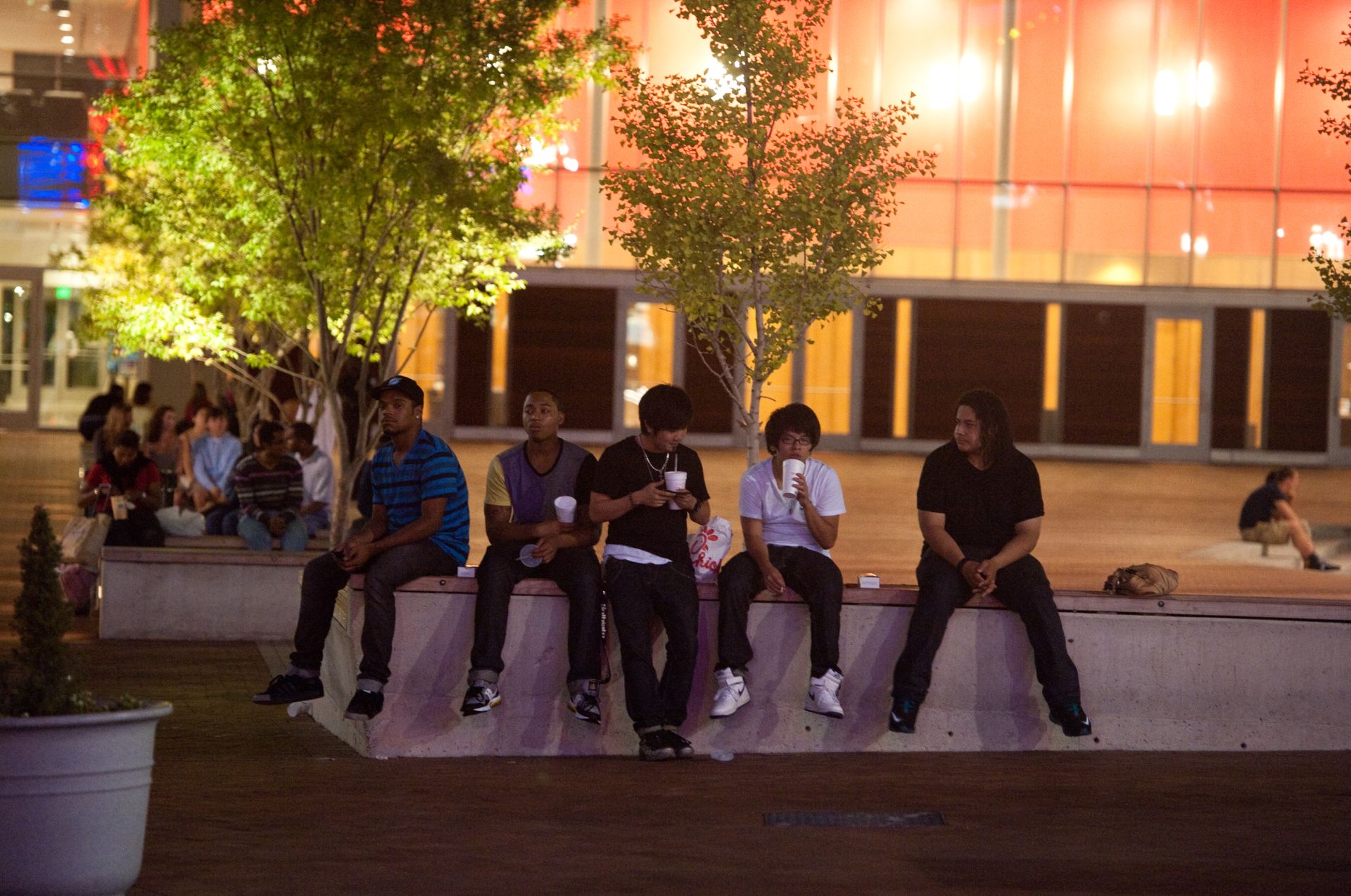
On Thursday, former D.C. councilmember Kenyan McDuffie conceded to fellow member Janeese Lewis George, a democratic socialist, after she built a double-digit lead in Washington’s Democratic mayoral primary.
One of the defining issues of the race was so-called “teen takeovers” — a term used to describe large gatherings of young people organized through social media.
The issue exploded into the campaign after a video showing teenagers brawling inside a fast-casual restaurant went viral. McDuffie seized on it and called for a teen curfew, arguing that if the city could not govern its own streets, it risked intervention from the Trump administration.
Lewis George opposed the curfew and instead emphasized youth programming and partnerships with labor unions to create jobs for young people. Trump, meanwhile, has threatened a federal takeover of the city should Lewis George become the mayor.
The debate over teen takeovers is not limited to the capital. This spring, similar scenes have unfolded across American cities, including Chicago, Portland, Cleveland and Houston, as hundreds, and sometimes thousands, of unsupervised young people have gathered in parks, parking lots, beaches, shopping districts and public squares.
Some of these gatherings turned violent, generating fresh anxieties about public safety, even as serious crime has declined in many cities.
Over Memorial Day weekend in Chicago, three teenagers were shot and 53 arrested during one such event; at another, five police officers were struck by a car driven by an 18-year-old. (Trump used the incident to attack the city’s mayor, Brandon Johnson, and Illinois governor JB Pritzker, calling them “terrible.”) In an Oklahoma City suburb, a mass shooting at one such gathering left one woman dead and 22 others injured. In Houston, shots were fired at a park.
Something that would have been dismissed as youthful mischief has now become a flashpoint in broader debates over public spaces and policing.
The political reaction is divided. Some have called for stricter curfews and consequences for both teenagers and their parents. Jeanine Pirro, a former Fox News host and U.S. attorney for D.C., declared that teen takeovers have “terrorized our neighborhoods” and warned that parents could face fines or jail time for their children’s actions. Florida Gov. Ron DeSantis struck a similar tone and said the state did not recognize “any teen takeover,” warning that anyone who attempted one did so “at their peril.”
On the other hand, progressive politicians and community leaders have argued that such measures would target young people from poorer neighborhoods, especially Black and brown teenagers. Chicago’s Mayor Johnson called the phenomenon a “teen trend,” rather than a “takeover,” to avoid framing youth gatherings as threatening.
The issue has also become a matter of public opinion. According to a Washington Post-Schar School poll, 71% of D.C. voters support curfews in certain parts of the city during nighttime hours.
Caught in the middle are the teenagers themselves, who say they are simply looking for somewhere to go.
Young people, in several media interviews and city council meetings, have shared that social life no longer looks the same for them in a post-pandemic world. They point to a widening gap between the “third spaces” that adults can access and what is available to them. As clubs remain age-restricted, familiar adolescent spaces such as malls and movie theaters no longer carry the same pull they once did.
Many young people also described feeling as though they lost formative adolescent years during the pandemic. In that context, the impulse to gather in parks, parking lots and other public spaces has become an attempt to reclaim what little social space remains available to them.
In the Chicago Sun-Times, Robert Jordan, a retired television news journalist, argued that the gatherings are less a public order problem than a reflection of deeper social neglect. Teen takeovers, he wrote, are a symptom of what he called “painful invisibility” — the feeling among many young people that society has stopped paying attention to them.
“Can you imagine just how lost, bored and hopeless children without high school diplomas can be?” Jordan wrote. “Life for many of them is a constant hustle, a daily struggle just to survive.”
In some parts of the country, local governments are beginning to acknowledge the demand for youth gathering spaces. In Tampa, the police department has partnered with community organizations to host a “Takeover With a Purpose” event and is also supporting initiatives such as midnight basketball. Other municipalities are extending recreation center hours, expanding late-night programming and hosting youth festivals.
But the teen takeovers phenomenon has become such a polarizing issue and captured the national imagination precisely because it sits at the intersection of several emotionally charged debates in American life — from public spaces and who gets to occupy them to race and policing, public safety and the place of young people in cities that feel less open to them.