

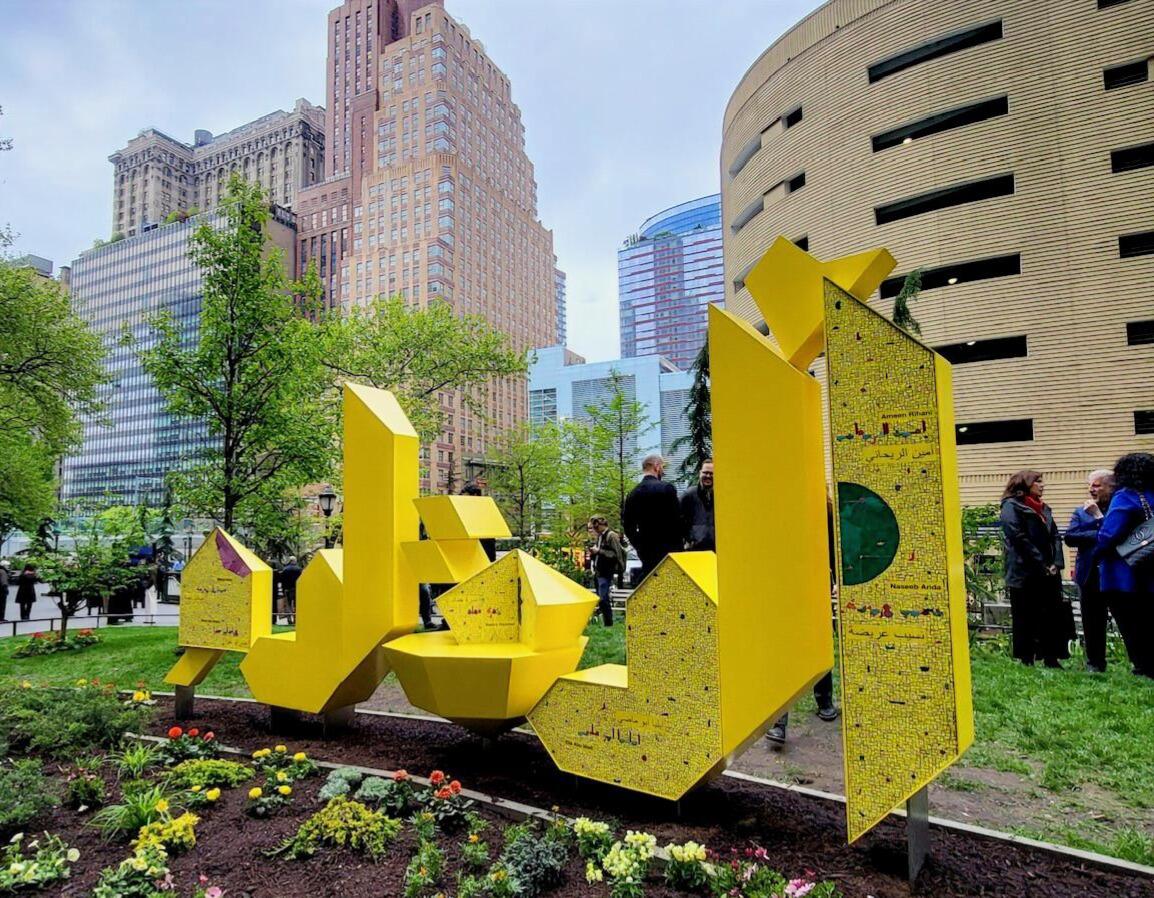
A plaque erected last month in lower Manhattan honoring New York’s first Arab quarter has become the unlikely site of a transnational political controversy and a diaspora identity war over who gets to claim some of the Arab world’s most famous writers.
Earlier this week, Lebanon’s Foreign Minister Youssef Raggi demanded changes to the text accompanying “Al Qalam: Poets in the Park,” a permanent public artwork installed at Elizabeth H. Berger Plaza. The monument, by French-Moroccan artist Sara Ouhaddou, commemorates the literary legacy of “Little Syria,” the once-thriving Arab immigrant enclave that existed in lower Manhattan from the late 19th century until it was largely demolished in the 1940s.
The monument also specifically honors Al-Rabitah al-Qalamiyah (the Pen League), the literary society founded in New York in 1916 by Gibran Kahlil Gibran (whose masterpiece, “The Prophet,” made him one of the bestselling poets of all time) and other Arab writers.
In a statement posted to X in both English and Arabic, Raggi objected to what he described as an “ambiguous description” of the identities of famed Mahjar (diaspora) writers including Gibran, Mikhail Naimy, Ameen Rihani and Elia Abu Madi. He added that he had instructed Lebanese diplomats in Washington to contact relevant authorities “with the aim of correcting the text” to affirm “the original and authentic Lebanese origins of these writers.”
At issue is the plaque’s description of Little Syria’s residents as immigrants from “Greater Syria,” which encompasses “modern-day Lebanon, Syria, and historic Palestine,” and its references to the neighborhood’s Arabic-speaking writers as part of the “Syrian” literati who emerged there in the early 20th century. The text reflects the Ottoman-era context before Lebanon and Syria existed as modern states.
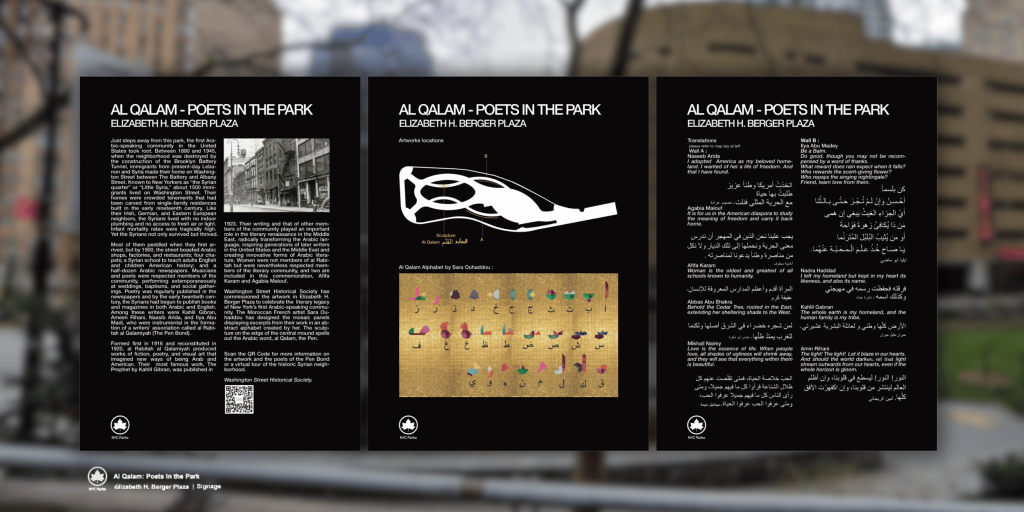
But in Lebanon, where questions of national identity remain immensely politicized, especially among factions shaped by the legacy of Syria’s long military presence in the country, the wording struck a nerve. Raggi belongs to the conservative Lebanese Forces party, which has long promoted a Lebanese national identity distinct from Greater Syria. Lebanese commentator Eli Khoury denounced the monument as “cultural robbery by woke racialist hypocrites,” writing on X: “These great poets were, and will always remain, Lebanese.”
The backlash comes amid ongoing Israeli bombardment in Lebanon and a broader crisis of Lebanese state authority. That a plaque in Manhattan could arouse such interest and anger, and even provoke diplomatic intervention from Beirut, seems surreal to some Lebanese observers. Academic Ziad Abu-Rish accused Raggi and his party of attempting to “retroactively assert an exclusivist post-1920 national identity” onto people “whose lives spanned major political transformations and whose national identification shifted with time.”
Historians of Arab migration say the plaque’s language is historically standard. “If you were an Arabic-speaking person arriving from Beirut or Jerusalem or Damascus in 1885, you would say ‘Ana Shami’ (‘I’m Syrian’),” said Asad Dandia, a New York public historian and tour guide who runs “New York Narratives,” which includes walking tours of Little Syria. “That was not a controversial thing. The plaque literally mentions modern-day Lebanon and Syria.” Even the American University of Beirut was originally named the Syrian Protestant College until 1920, the same year France formally established Greater Lebanon under the mandate system. “These identities shifted over time,” he said. “People simultaneously used the terms Lebanese, Syrian and Arab. That should be celebrated rather than condemned.”
Dandia describes Little Syria as the “mother colony” of the Arab diaspora in America, the first major Arabic-speaking enclave in the U.S. and a hub of Arab-American cultural and media innovation. Little Syria was home to some of the first Arabic-language newspapers in the United States, including Kawkab America. Through figures like Naoum Mokarzel, Arabic characters were adapted for the linotype printing machine in New York, helping to revolutionize the mass printing of Arabic-language journalism globally.
The Washington Street Historical Society, the organization behind the monument (which could not be reached at the time of publishing), has spent years trying to recover the memory of Little Syria. Its president, Linda Jacobs, is herself descended from families connected to the neighborhood and has written extensively about the community’s history. The project took nearly a decade to complete.
“Every country participates in some form of national mythmaking,” Dandia said. “But scholars have to maintain fidelity to the historical record, not to nationalist mythmaking.”
Most New Yorkers probably have no idea that an Arab neighborhood ever existed near the World Trade Center. The area’s remaining traces were bulldozed decades ago by urban development projects, in a city defined by movement, transformation and overlapping identities. The people who lived there — Syrian, Lebanese, Egyptian, Palestinian, Yemeni and others — lived through empire, migration, independence, partition and more. In a personal essay, New Lines Editorial Director Rasha Elass, whose own great-grandfather Kamel entered through Ellis Island in the late 1890s, traces more than a century of movement between Syria and the United States in her family history, documenting how migration and return became recurring features of Arab-American life across generations. The new monument was supposed to restore a recognition of their place in the American diaspora. Instead, it’s become another battleground for identity wars.