

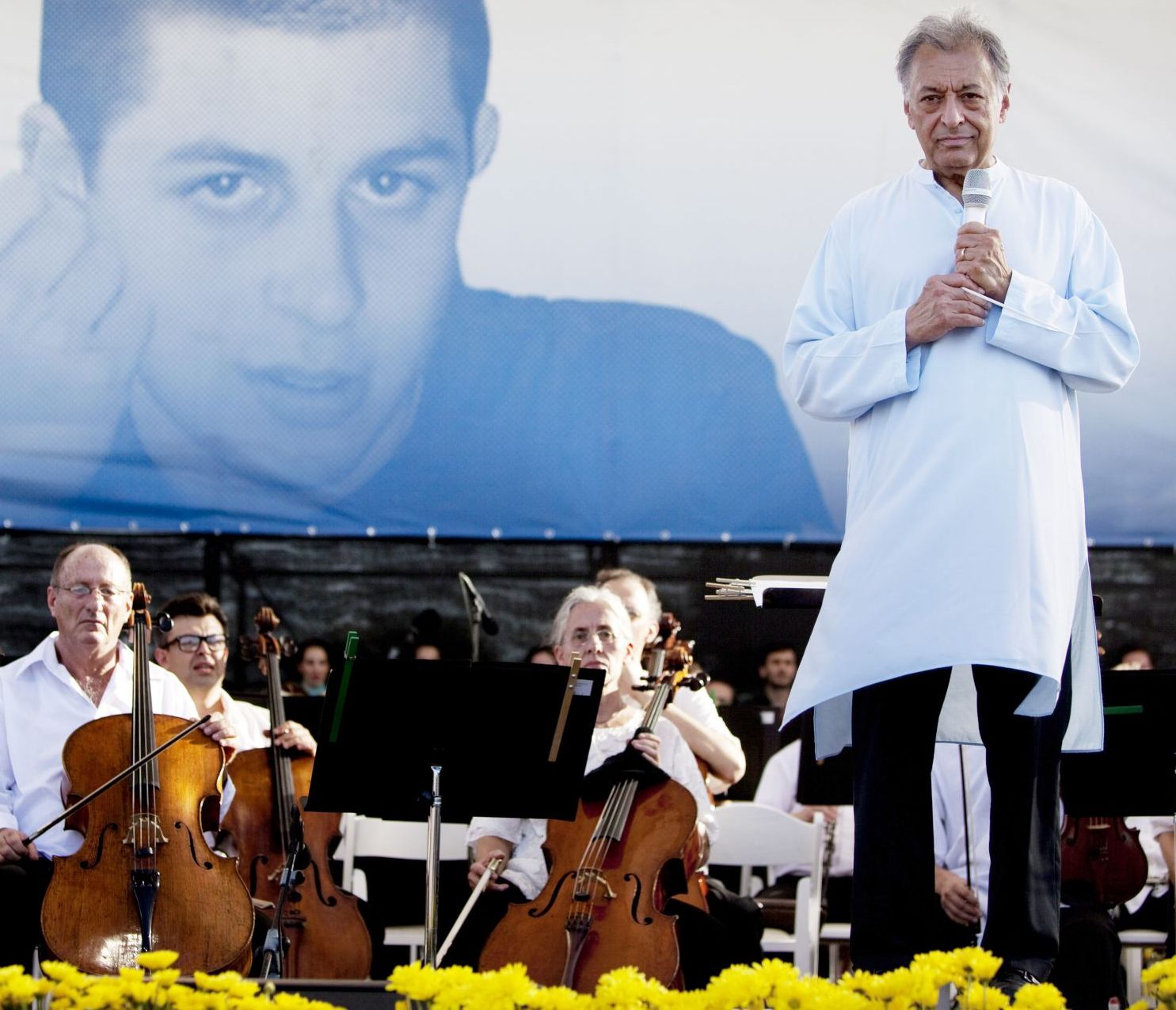
A mural of Zubin Mehta, the celebrated Indian conductor of Western classical music, was recently unveiled in New Delhi as part of the Lodhi Art District, the capital’s well-known street art initiative. Commissioned nearly a year ago by the Israeli Embassy, the mural marked Mehta’s 90th birthday on April 29 and honors one of the most celebrated cultural figures shared by India and Israel, famously dubbed “the world’s conductor.”
Born in the city then known as Bombay, the Parsi conductor has been associated with the Israel Philharmonic Orchestra (IPO) for over half a century, making his debut in 1961 at the age of 25. The orchestra appointed him music adviser in 1969, music director in 1977 and music director for life in 1981. Today, he retains the title of music director emeritus. Few conductors in modern history have had such a long and intimate relationship with a single orchestra.
In 1991, Mehta was awarded the Israel Prize, the country’s highest civilian honor, becoming one of the few non-Israelis to receive the award. He served as an important bridge between India and Israel long before the countries formally established diplomatic relations in 1992.
But this recent mural arrived amid an unexpected controversy.
Earlier this year, in a TV interview with veteran Indian journalist Rajdeep Sardesai, Mehta said he had canceled all his 2026 engagements in Israel because of his opposition to Prime Minister Benjamin Netanyahu’s handling of what he called “the Palestinian issue.”
“I hope it [Netanyahu’s policy] finishes, I hope he’s outvoted by the next election,” he said, adding that while many of his colleagues took a stand on political issues, many others turned a blind eye in a way that he couldn’t agree with.
Mehta had previously criticized the Netanyahu government in August 2023. While such criticism is hardly unusual in Israel, this latest declaration carried a different kind of weight as his first public response following the attacks of Oct. 7, 2023.
His words triggered sharp reactions, and some Israelis viewed them as a profound betrayal.
Israeli-American columnist Ruthie Blum, a former adviser to Netanyahu, called Mehta’s stance “enraging” and found his insistence on not separating music from politics ironic, given Mehta’s earlier efforts to conduct, and later defend performances of, the works of Richard Wagner in Israel, where the German composer’s music remains a cultural taboo because of its association with Nazism.
Meanwhile, Australian-Israeli violinist Noam Yaffe, writing in The Times of Israel, argued that while Mehta’s frustration was understandable, his decision to cancel his engagements is “simplistic and counterproductive,” since it “overlooks the complexity of this country” and risks alienating the liberal, cosmopolitan audiences who have participated in anti-government protests.
Following the controversy, Mehta struck a more conciliatory tone and announced that he would return to Tel Aviv for the orchestra’s 90th anniversary celebrations in 2027. “The Israel Philharmonic Orchestra is very dear to me,” he said in a statement. “For over five decades, it’s been my second home.”
For Israelis, Mehta’s withdrawal was not just about an international artist boycotting performances. He has held an integral place in Israel’s cultural life for over half a century. It’s a deeply personal relationship forged during moments of war and national crises.
In 1967, when the Six-Day War broke out and a conductor scheduled to perform with the IPO canceled, Mehta treated the situation as a musical emergency. He famously boarded an ammunition-laden aircraft from the United States to Tel Aviv, and eventually spent six days sheltered in the basement of a Jerusalem concert hall.
During the 1982 Lebanon War, he led the orchestra in a makeshift performance near the border in a Lebanese tobacco field. In 1991, after Iraq fired Scud missiles into Israel during the Gulf War, Mehta returned once again and secured special permission to conduct daytime concerts, which the audiences would sometimes attend in gas masks. Later, in 2010, he took the orchestra to perform at the Israel-Gaza border to protest Israeli soldier Gilad Shalit’s 2006 capture by Hamas.
Yaffe also described the emotional reverence surrounding Mehta’s appearances with the IPO. The orchestra, “notorious for a typically Israeli lack of decorum,” he wrote, would be silent and attentive during rehearsals. Older members skipped casual clothing and put on jackets and leather shoes. When the maestro slowly entered the stage with his walking stick, the orchestra would rise in collective applause.
“Zubin Mehta is in the IPO’s DNA,” Yaffe wrote. “He is inseparable from classical music culture in Israel.”