

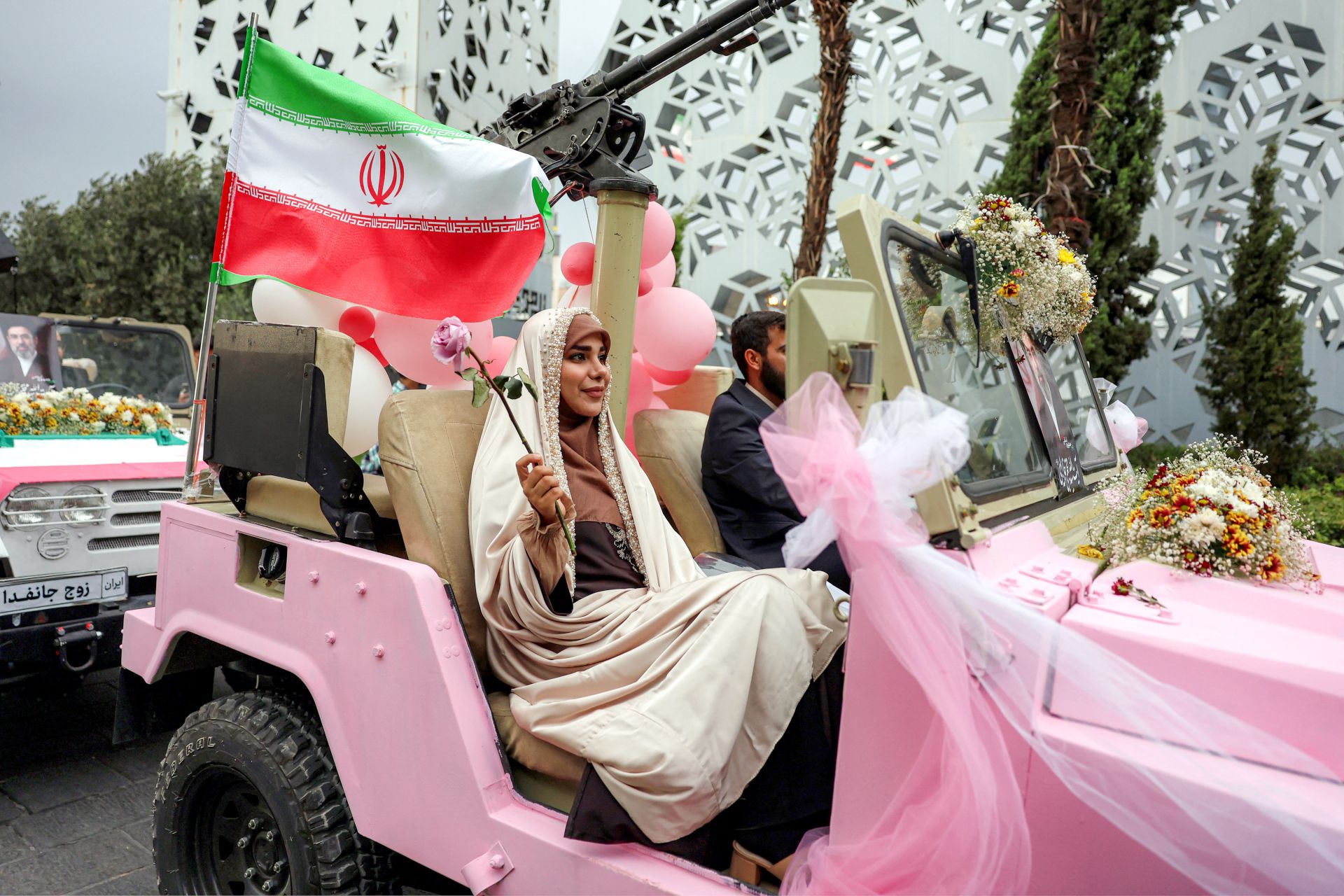
On Monday, a state-sponsored mass wedding was held for over 100 couples in Tehran’s Imam Hussein Square, timed for the anniversary of the marriage of Imam Ali and the Prophet Muhammad’s daughter Fatima, two of the most revered figures in Shiite Islam. Couples arrived to tie the knot in white and bubblegum-pink military jeeps draped in lace and tulle and flowers, mounted weapons protruding awkwardly beneath portraits of Iranian leaders. Brides in jewel-lined chadors waved Iranian flags surrounded by brightly colored balloon arches and children carrying dyed roses to mark the occasion.
To many outside observers, the spectacle appeared bizarre — another example of the Islamic Republic’s weaponization of everyday life for ideological theater and state propaganda. Much of the Western coverage framed the ceremony as evidence of a uniquely fanatical military culture. But the weddings show something more complicated about the way the state deliberately blurs the lines between civilian life, religious devotion and national defense.
As Babak Rahimi, author of “Senses of Mourning: Moharram Performances in Shiʿi Iran from the Qajar to the Covid Era” (2026), explained to New Lines, the ceremony should not be understood merely as propaganda, even if propaganda is clearly part of it. Rather, it functions as “a form of wartime intimacy” that produces collective solidarity.
Marriage ceremonies, Rahimi said, “become something more than private affairs,” turning into “spectacles of solidarity and national unity.” He explained that, historically, wartime governments have often turned family life into patriotic symbolism. Revolutionary China, for example, staged collective weddings as rituals of ideological unity. Fascist Italy and Nazi Germany glorified wartime marriage and childbirth as national duty, while Soviet wartime culture celebrated marriage as sacrifice and endurance.
What distinguishes the Iranian case is the specifically Shiite frame through which these ideas are expressed. Since 1979, the regime has grounded its political identity in the seventh-century martyrdom of Imam Hussein, grandson of Muhammad, whose death during the Battle of Karbala occupies a central place in Shiite memory. Rahimi described the Battle of Karbala as a kind of “sacred founding violence” for the Islamic Republic, one that places suffering and sacrifice within a moral framework that treats martyrdom as an aspect of devotion and righteousness.
That framing was especially powerful during the Iran-Iraq War of the 1980s, when young Basij volunteers were often depicted marrying before heading to the front. Wartime propaganda fused “images of brides, martyrdom and devotion into a single moral imaginary,” Rahimi said.
Claudia Yaghoobi, author of “Temporary Marriage in Iran: Gender and Body Politics in Modern Persian Literature and Film” (2020), similarly described the weddings as performances that blur “the boundaries between intimacy, religion and nationalism.” “These are not simply weddings in the ordinary sense,” she told New Lines, but “highly choreographed public performances that link marriage, sacrifice and loyalty to the state.”
Although couples see the ceremonies as authentic and spiritually meaningful, the issue, Yaghoobi argued, is less whether the emotions are genuine than “how political power organizes and channels those emotions toward ideological ends.”
What the mass weddings reveal is that “the old discourses and rhetorics no longer work,” Janet Afary, author of “Sexual Politics in Modern Iran” (2009), told New Lines. Iranians, she said, “are tired of drab black, gray, brown clothing, especially black veils women wear, and want to dress in colorful clothing combined with joyous music instead of requiems.” The regime “got the message and is improvising rather than abandoning its ideology.”
In Persian, the opposite of mourning is a wedding, as in the common saying “his wedding turned into mourning.” The regime, Afary noted, has swapped this. “Instead of mourning, we have weddings; instead of black clothes, we have bright pink and blue and white wedding dresses and balloons; instead of mourning music, we get wedding songs and dances.”
That complexity is often lost in outsider portrayals of Iran. Kourosh Ziabari, an Iranian journalist and contributor to New Lines, noted that mass weddings are not unusual in the country. The government has long sponsored collective ceremonies aimed at encouraging “easy marriage” and discouraging extravagant wedding expenses amid economic hardship. What has changed is the wartime aesthetic layered onto the tradition.
Ziabari noted that the couples don’t necessarily represent all of Iranian society. Many are likely conservative or aligned with the Basij paramilitary organization. “There is the impression that Iran is once again hijacking people’s weddings in order to send a political message,” he told New Lines. “But we also have to understand this in the context of a country that has experienced weeks of bombing and enormous political trauma.”