

Former Israeli Security Leaders Ask Trump To Help Rein in West Bank Settlers
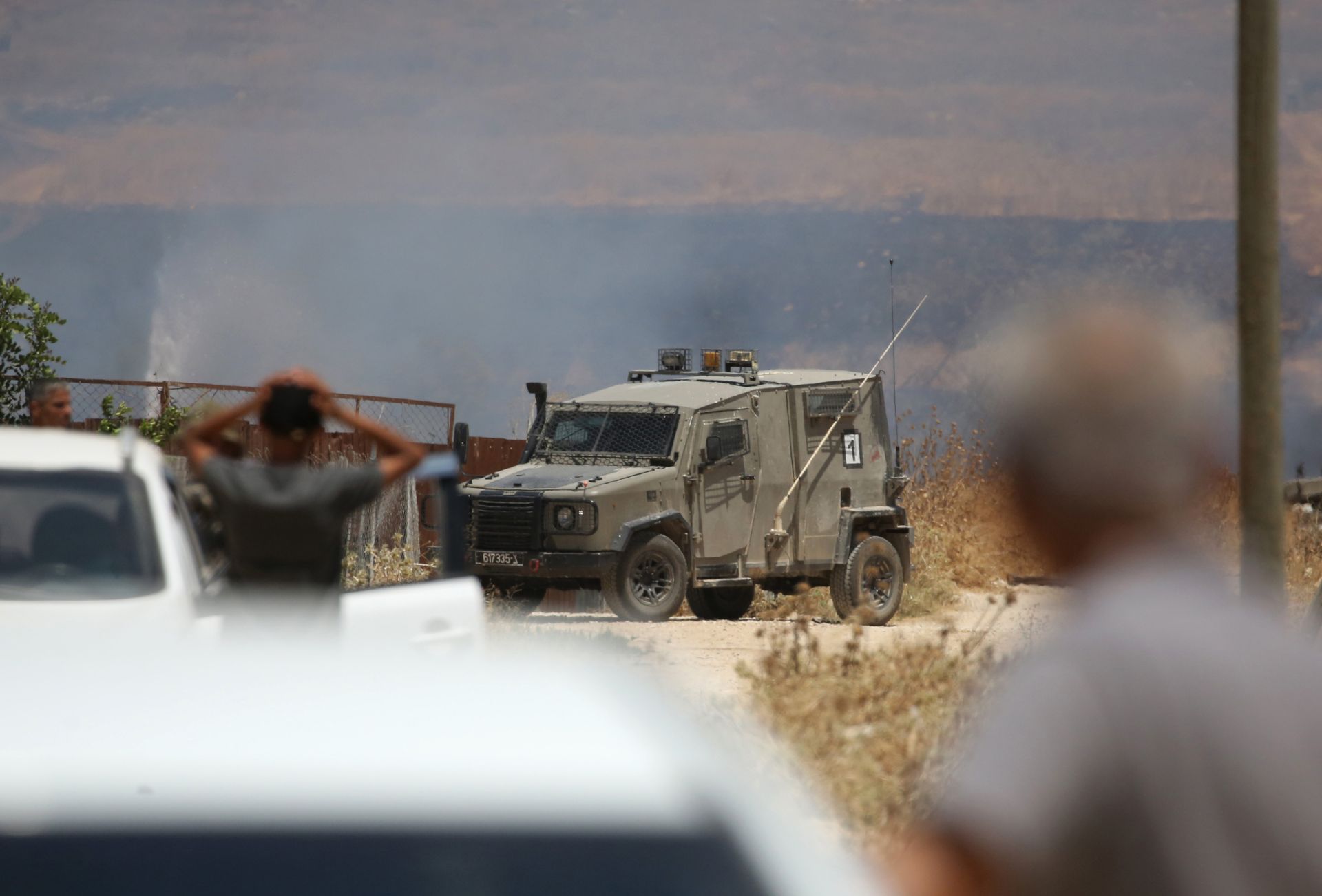
On Monday, the Israeli media reported that Matan Vilnai, a former deputy chief of staff in the army and former minister in Labor-led governments, had sent a letter to President Donald Trump, begging him to use his influence on Prime Minister Benjamin Netanyahu to stop “Jewish terrorists” in the West Bank.
“Unless arrested swiftly and decisively, escalating violence in the West Bank is poised to ignite the region and carries severe ramifications for both Israeli security and U.S. regional interests,” he wrote.
Vilnai signed the letter as chairperson of Commanders for Israel’s Security, which describes itself as a group of 550 retired officers from “the highest echelons of the security establishment and foreign service,” who are “committed to securing Israel’s future as a democratic, Jewish state.” They include a former director of the Shin Bet, a former director of the Mossad and a former chief military defense counsel.
These retired generals and intelligence officers despise the messianism and chaos-mongering of Netanyahu’s far-right ministers, and they loathe Netanyahu for empowering them. Secular, gruff and plainspoken, they represent Israel’s declining old elite.
The old guard is committed to the two-state solution not for the sake of Palestinians, but because they believe it is the only means of preserving Israel’s Jewish majority and protecting its security. These retired generals and intelligence officers have no particular love for the Palestinian people. They built their careers on enforcing Israel’s military occupation and on the never-ending hunt for Palestinian “terrorists,” real and imagined.
But now, in their 70s and 80s, they seem to be having a bit of a come-to-Moses moment — wondering, perhaps, if they should have invested more energy in preventing the clear and present danger of what they openly describe as Jewish terror.
For years, radical settlers have been rampaging through Palestinian villages and agricultural land, committing often heinous acts of murder, sabotage, arson and theft in a disorganized and irregular fashion. What’s now terrifying everyone — both the Palestinian victims and the old establishment personified by Vilnai — is not only the scale of the violence, but the fact that it is centrally organized at the governmental level. Minister of Security Itamar Ben-Gvir and Minister of Finance Bezalel Smotrich, both of the radical far right, are providing support and encouragement. Prime Minister Benjamin Netanyahu has done nothing to stop them.
Maj. General Avi Bluth, head of the Central Command, was born in a West Bank settlement and educated in the religious Zionist movement. In May, The Guardian reported that he boasted to Haaretz journalists, in a closed meeting, that the army was “killing like we haven’t killed since 1967.” He justified a policy of shooting people in the knees if they approached Israel’s security barrier by claiming that every Palestinian was a “potential terrorist.”
Mohammed Daraghmeh, the Ramallah-based bureau chief of Asharq News, has been covering the news from the West Bank for decades. On Monday, he told New Lines during a phone interview that he was experiencing an atmosphere of unprecedented hopelessness.
“I was born with the occupation, but this is the first time I feel my very existence is at serious risk,” he said. He asked: “What kind of state has Israel become? Is it crazy? What do they think they can achieve by exterminating a whole nation?” Daraghmeh said he was trapped in Ramallah. Movement between towns had never been more dangerous, “not even during the Second Intifada.”
Israel’s mainstream television news broadcasters theoretically abhor the extremist settlers, but they report little about settler attacks, unless they result in death or injury to Jews. Last week, Channel 2 reported an incident in the northern West Bank village of Tell that involved two armed settlers who encountered a Palestinian farmer. Palestinian sources said the settlers attacked first and the farmer was defending himself, while the settlers said the opposite. However it started, the incident ended with two dead Israelis and four dead Palestinians. Channel 2 broadcast some very blurry amateur video recorded from a significant distance, while the news presenter repeatedly referred to the unarmed Palestinian farmers as “terrorists” and the armed Israeli settlers as “hikers.”
The army’s response to the incident was to carry out violent raids and arrests in the area, while allowing settlers to rampage through villages, setting fire to homes and mosques.
The fear of Vilnai and the old guard, of mainstream Israeli television news and the Israeli opposition, is that the Palestinians will fight back and there will be a third intifada, with the violence spilling over into Israel’s towns and cities.
Mohammed Daraghmeh explained why there was little likelihood of a third intifada breaking out.
“Historically,” he said, “There were intifadas because people had hope they could make things better. Now, there is no hope. People know if they react to the violent settlers, they will suffer the same fate as Gaza. So they are just trying to protect their children and loved ones.”