

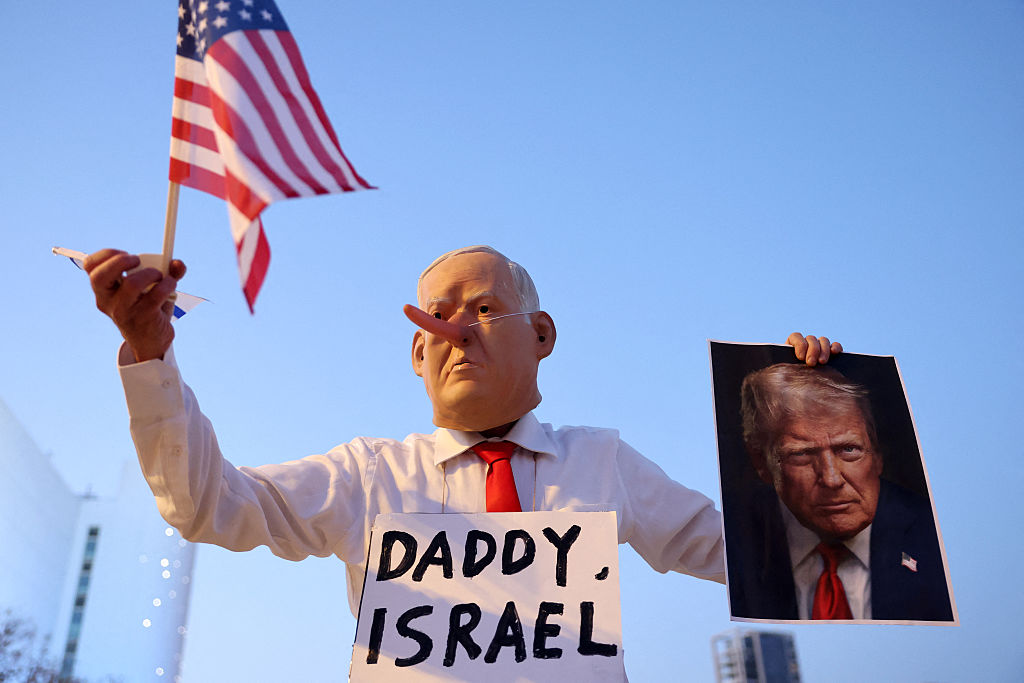
President Donald Trump threw Israel under the bus. This is the outraged reaction from commentators for Israel’s far-right media platforms, which function as a propaganda arm for Prime Minister Benjamin Netanyahu, in response to the news that the U.S. leader signed a framework agreement to end the current hostilities with Iran.
One prominent Israeli right-wing commentator, speaking angrily during a live TV broadcast on a pro-Netanyahu channel, used an antisemitic slur, a word that translates into English as one that rhymes with “mike,” to describe Jared Kushner, the president’s son-in-law, and Steve Witkoff, the U.S. special envoy to the Middle East. He said that the two men, who are Jewish, had prioritized their personal financial interests in the Gulf states over loyalty to their fellow Jews. Just a few years ago, the right-wing media celebrated Kushner’s family connection to Netanyahu, who was once an overnight guest at their New Jersey home.
The outrage is not limited to the far right. Commentators for legacy centrist media outlets and leaders of the major opposition parties are also angry that the war ended with a fizz instead of a bang.
But whereas Netanyahu’s supporters say Trump betrayed Israel, the opposition blames the prime minister for weakness. They say he should not have acceded to the U.S. president’s demand that Israel end its war against both the Iranian regime and its proxy Hezbollah before victory could be achieved. Once styled “Mr. Security,” Netanyahu has demonstrated, with his bungling of the Iran war, that his reputation is a myth, say the opposition leaders. Instead of protecting Israel, he has undermined Israel’s power of deterrence. They accused Trump of being deluded in believing peace with Iran was possible; at least one news platform editor, who identifies with the opposition, explicitly compared the U.S. president to Neville Chamberlain.
The turnabout is particularly remarkable because Trump was, until recently, immensely popular with Israelis. They credit him with obtaining the release of the hostages in Gaza and approve of the Abraham Accords.
Why do Israelis believe the war against Iran should have continued, when the global consensus is that starting it was a very bad idea?
The answer speaks to the perception among Israelis of the threat Iran poses, and to Netanyahu’s immense success in manipulating public opinion.
Danny Citrinowicz, an Iran expert who is a senior analyst with the Institute for National Security Studies, an independent think tank affiliated with Tel Aviv University, describes the Israeli attitude as one of “ignorance” and “total detachment from reality.” In a podcast conversation with Guy Rolnik, a senior journalist with Haaretz, Citrinowicz said that Israelis, even leaders in the opposition, were convinced that Iran was close to developing a nuclear weapon that it intended to use against Israel. This belief had “taken root in Israeli society,” he said, adding bluntly that it was “false,” just as the notion that the Iranian regime could be toppled by military force was false. It was due to that “ignorant” and “false” belief, said Citrinowicz, that Israelis felt the U.S. had betrayed them.
Netanyahu, Citrinowicz reminded Rolnik, had been agitating for an attack on Iran for nearly two decades. In 2009, the entire security establishment — the Minister of Defense, the head of the Mossad and the head of the Shin Bet — were all vociferously opposed to attacking Iran and forced Netanyahu to back down. Today, there are almost no checks on Netanyahu. Furthermore, the Mossad, said Citrinowicz, had received a quarter of a billion shekels (around $85 million) to establish a section dedicated solely to Iran. If they were to close it down, their budget would be cut by 250 million shekels, which is why it had no motivation to broaden its focus.
In 2009, when Netanyahu tried to convince the security establishment that Israel should attack Iran, someone in the closed high-level meetings leaked the conversation to the Israeli media, framing the prime minister’s aspiration as absurd and dangerous. The legacy media mocked Netanyahu, giving the impression that he was delusional. But 17 years of Netanyahu’s expert media manipulation have had a corrosive effect, shifting the discourse far to the right. Today, even the purportedly centrist legacy media platforms unthinkingly repeat and amplify the same talking points about Iran as the overtly pro-Netanyahu media.
Netanyahu has succeeded in shifting the domestic discourse in Israel on the threat Iran poses and the advisability of attacking, but his media victory could prove to be a Pyrrhic one in political terms.
Recent polls show that the prime minister’s Likud party has lost three or four mandates on the back of his failure to achieve the much-promised total victory against Iran and Hezbollah.
The war has unquestionably reduced Israel’s deterrence. Trump is angry at Netanyahu for continuing to hit what Israel describes as Hezbollah strongholds in Lebanon, even as Iran has said — and shown — that it will resume its attacks on Israel, and that it will close the Strait of Hormuz, unless the U.S. forces Netanyahu to stop. The rest of the world sees that the U.S. government is no longer an unwavering supporter of Israel, which means it is exposed both diplomatically and militarily. By attacking Iran, Netanyahu has made Israel less safe. For Israelis, who are obsessed with security, this is unforgivable.
Indeed, whereas support for Israel was a bipartisan political issue in the U.S. just a decade ago, today, criticism of Israel is a bipartisan issue. On the right, powerful pro-Trump media figures like Tucker Carlson have been highly critical of Israel, while Vice President JD Vance warned pro-Netanyahu Israeli politicians who opposed the ceasefire deal with Iran that they should think carefully before criticizing “the only powerful ally that [Israel has] anywhere left in the entire world.” On the left, pro-Palestine candidates affiliated with the Democratic Socialists of America won congressional primaries in heavily Jewish districts of New York City in the June 23 elections.
Israel must, according to constitutional term limits, hold national elections by late October, although the date has not yet been set. Netanyahu is a political Houdini, but given that even polls for right-wing media outlets show his party grappling with a dramatic decline in popularity, his well-known ability to wriggle out of a straitjacket will be severely tested.