

Kingmaker, power broker, Mamdani tsunami, Mamdani magic. National media outlets have used various descriptors to explain New York City Mayor Zohran Mamdani’s impact on the recently concluded congressional primaries in his state. The candidates he endorsed pulled off some of the biggest upsets, triggering yet another political earthquake that has rattled the Democratic establishment.
Brad Lander defeated the incumbent Rep. Dan Goldman in New York’s 10th District. In the open 7th District seat, Claire Valdez, a Democratic Socialist, defeated Antonio Reynoso, retiring Rep. Nydia Velázquez’s preferred successor. Darializa Avila Chevalier, another Democratic Socialist, delivered the biggest upset of the night, defeating five-term Congressperson Adriano Espaillat in the 13th District.
The media narrative has largely focused on Mamdani’s midas touch. The New York Times, for instance, argued that Mamdani’s brand had boosted the other candidates. The Washington Post interpreted the results as evidence of the growing influence of Mamdani’s “brand of progressive populism.”
Following Mamdani’s win last year, mainstream media framed his victory as the triumph of a charismatic populist with a mastery of social media and an ability to energize young voters.
Some local journalists and commentators pushed back, arguing that this analysis ignored the on-ground work by a coalition of community organizations, along with a Democratic base that had moved left, particularly on issues such as Palestine and income inequality.
For New York City, Tuesday night was not about Mamdani alone. The congressional races had become proxies for testing the strength and reach of the Democratic Socialists of America (DSA), whose New York City chapter counts more than 14,000 members, including Mamdani, who calls it his “political home.”
An affiliate of the national DSA, the NYC chapter operates as a distinct local body, whose membership has more than doubled since Mamdani’s campaign launch in October 2024. More than 400 new members have joined since Tuesday night.
NYC-DSA not only backed two congressional candidates but mounted an ambitious effort with eight picks across the state legislature, of whom all but one won. The results cemented DSA’s place at the head of New York City’s progressive movement.
“They are a serious force to be reckoned with in New York City who can now shape the direction of the [Democratic] party,” Theodore Hamm, author of “Meet Mayor Mamdani,” told New Lines.
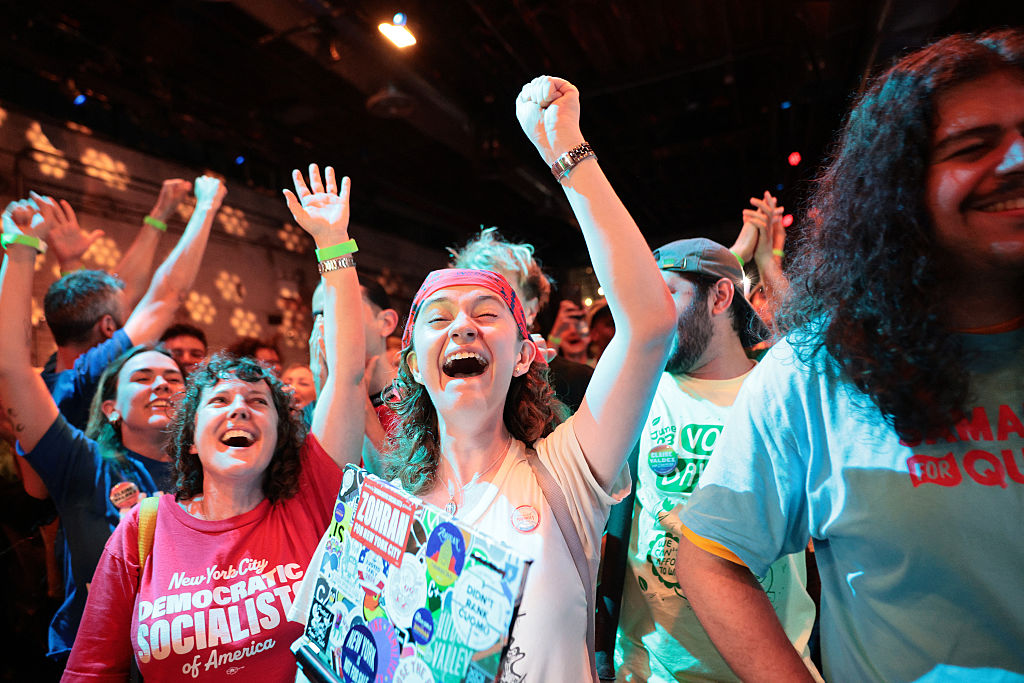
The collective euphoria for the DSA was visible on the ground. At Valdez’s Brooklyn watch party, the crowds broke into chants of “DSA! DSA!” as soon as her victory was called. Later, when Mamdani asked how many people canvassed for a DSA-backed candidate, most hands went up.
While recent results expose how far to the left the political center of gravity has shifted in the city, it has also drawn attention to the DSA’s electoral machinery, which has enabled insurgents with relatively low name recognition, such as Mamdani, Valdez and Avila Chevalier, to break through.
DSA’s field-first approach, built on an extensive network of trained staff and volunteers, has been central to its recent wins against establishment figures such as former Gov. Andrew Cuomo and Espaillat. During the 2025 primary, the network helped Mamdani’s campaign recruit over 50,000 volunteers who knocked on over a million doors and made two million phone calls. This infrastructure became instrumental during the recent races.
Rex Tai, a doctor and organizer who joined DSA in July 2025 after volunteering for Mamdani’s primary campaign, told New Lines that his experience campaigning for Mamdani in Upper Manhattan and the Bronx, neither of them DSA strongholds, laid the groundwork for Avila Chevalier’s campaign. She had herself been a field leader during Mamdani’s run.
But what draws people to DSA is not just the logistics of a well-run campaign. The organization has made space for a broad spectrum of leftist politics and work that extends beyond election cycles, such as labor organizing, street demonstrations and political education.
Members become a part of diverse groups focused on issues such as climate change or racial justice. They also participate in social gatherings, joining running and biking clubs. “This plays a large part in building a culture of community,” said Tai.
Many New Yorkers have also shared that, instead of doomscrolling, volunteering with DSA has become a way to channel their frustration into local politics. That the organization is focused on building political power through the electoral process has also been a draw for many.
As the Brooklyn-based journalist Jill Filipovic observed on X, “If you’re young, lefty and idealistic, the DSA offers a space to cultivate friendships, debate ideas, and deepen ideological commitments.” This, in turn, creates a large pool of volunteers who are mobilized during electoral campaigns.
What’s clear after the recent elections is that the road to understanding New York politics now passes through the DSA.