



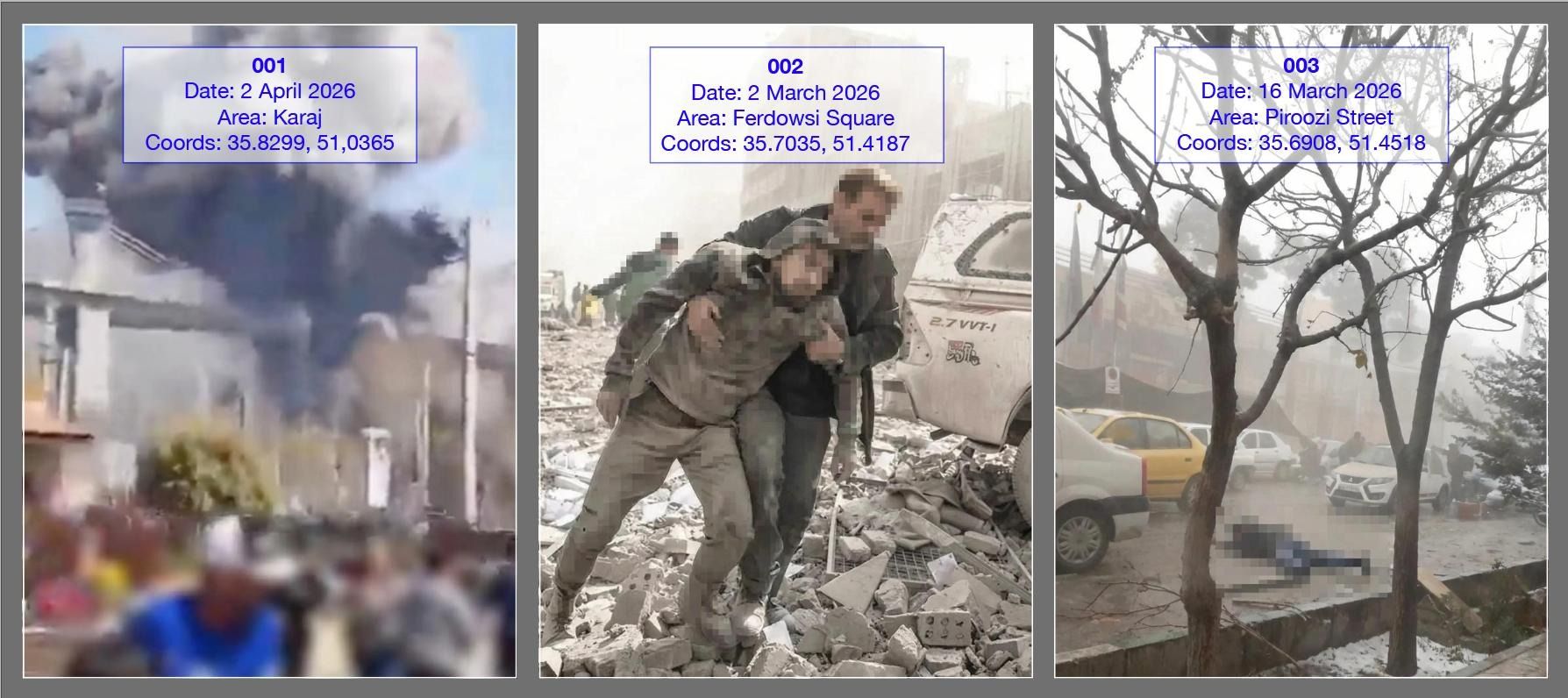
At least 1,700 civilians have been killed since the start of the U.S.-Israeli airstrikes on Iran, according to the U.S.-based Human Rights Activist News Agency. An analysis of a series of strikes by the U.S.-Israeli coalition reveals a pattern of civilian harm — specifically, a number of attacks on infrastructure and facilities in densely populated urban areas, often when bystanders were present.
Across multiple verified cases in Karaj and Tehran, New Lines found that initial strikes were followed by additional explosions that occurred in close proximity to civilian activity, or that affected sites were seemingly different from the military descriptions provided by the U.S. and Israel.
The open-source evidence indicates a distinct pattern: airstrikes causing damage beyond their stated targets, disproportionately affecting the surrounding environments and harming civilians in the immediate vicinity.
“Centcom [U.S. Central Command] said they hit 13,000 targets in just over a month. We’ve been documenting U.S. wars for more than a decade now. In the most intense period of fighting in the war against ISIS [the Islamic State group] — that second-phase, really intense heavy fighting period — they were averaging about 800 targets a month, across both Iraq and Syria,” said Emily Tripp, the executive director of Airwars. “There’s a certain inevitability about [civilian] harm given the scale.”
Taken together, the cases we documented reveal that the U.S. and Israel have employed so-called “double-tap strikes” in their campaign in Iran. The attacks, which involve aircraft bombing a site and then conducting further strikes, usually after civilians and medical personnel have gathered to rescue survivors, have been a consistent feature of the Russian war on Ukraine and Israel’s war on Gaza, and the tactic was repeatedly used by Bashar al-Assad’s regime in Syria. Experts say the strikes show a callous disregard for civilians by the U.S. and Israel, and may show a pattern of seeking to inflict harm on Iranians.
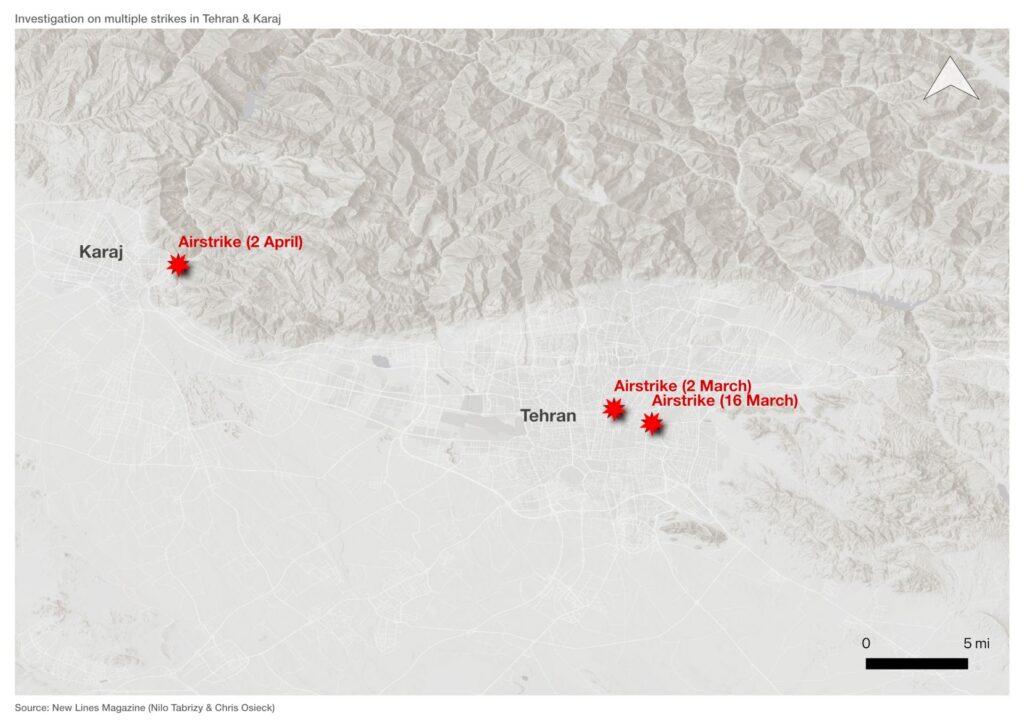
On April 2, videos posted online showed airstrikes on a bridge under construction in Karaj, a city northwest of Tehran in the foothills of the Alborz Mountains. Families had gathered near the bridge to mark Sizdah Bedar, an annual Iranian festival held on the 13th day of Nowruz. Marking the end of the Persian New Year celebrations, Sizdah Bedar is a day when Iranians spend time outside, picnicking and welcoming in the beauty of a new season. But in a year when Nowruz had already been marked by so much grief, Sizdah Bedar in Karaj ended in tragedy.
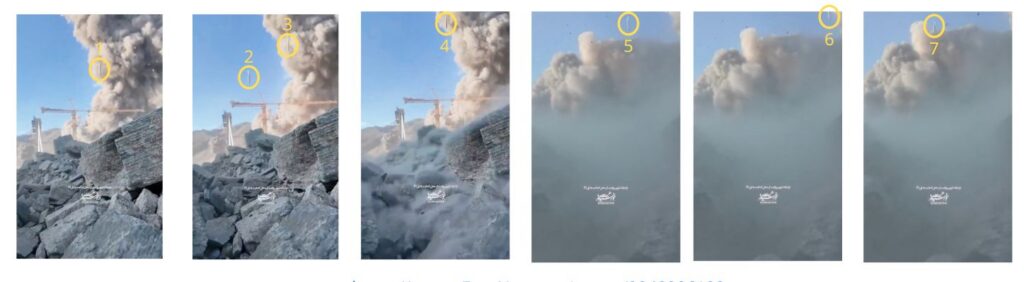
New Lines verified at least seven munitions striking the Bilqan B1 Bridge in Karaj. According to independent investigator and weapons specialist Leone Hadavi, these are consistent with precision-guided 2,000-pound bombs.
Wes Bryant, a former U.S. Air Force Special Operations targeting expert and former chief of civilian harm assessments at the Pentagon, also identified the use of these bombs in this strike. “This is even less of an excuse than launching Tomahawks from hundreds of miles away, where you don’t have a drone or other footage overhead in real time. There’s a capability now in this strike, and all these strikes, to have real-time characterization of the target area via that pilot before a strike is conducted, and then certainly with a reattack,” he said.
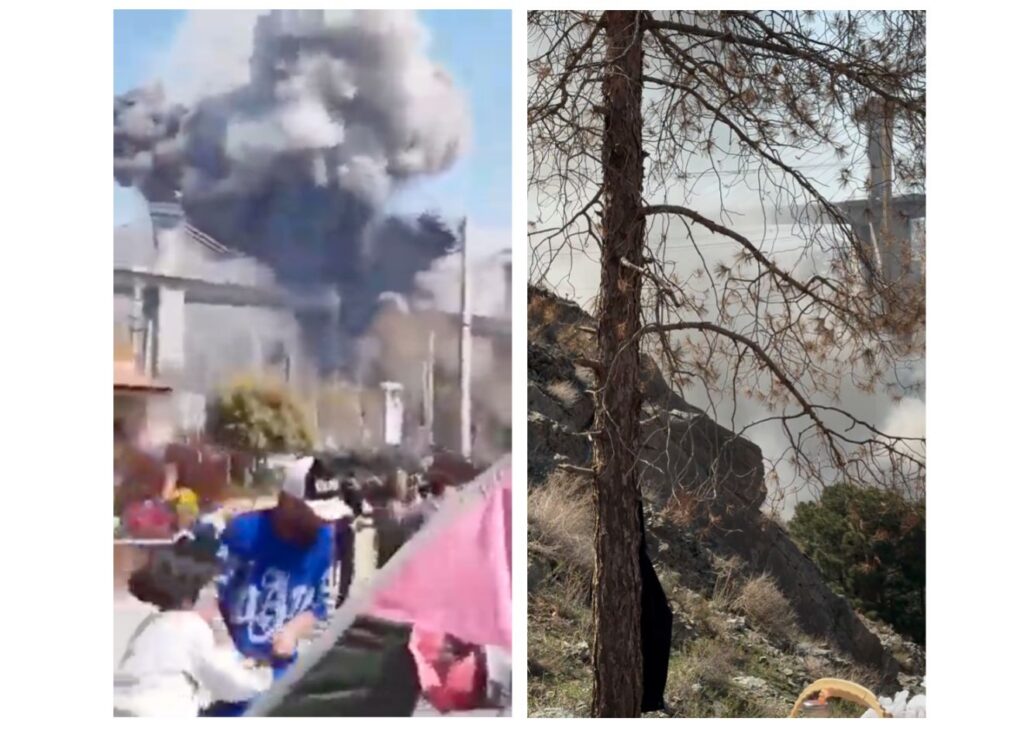
Footage verified by New Lines shows civilians present near the site at the time of the strikes. In one video, a group of people is seen sitting on a hillside near a tree with a picnic basket visible as smoke rises from the bridge. Moments later, a second explosion occurs. A separate video, filmed from another angle, shows a tent nearby as people run from the area following the strikes.
The United States claimed responsibility for the attack. President Donald Trump wrote on Truth Social, “the biggest bridge in Iran comes tumbling down,” adding that more strikes would follow. On April 12, Trump commented on the bridge strike again: “And the other thing you take out are their bridges. I took out one just to show them.” Barak Ravid, a journalist for Axios, reported that a U.S. official said the bridge was targeted because it was allegedly used by Iranian armed forces to move missiles and missile components from Tehran to launch sites in western Iran.
A video shared by Saeed Bahrami, a civil engineering scholar, shows the moment of the strike with the caption: “A war that strikes infrastructure doesn’t just break walls and bridges; it simultaneously buries a past built with suffering and a future that hasn’t yet breathed.” Bahrami had previously documented the bridge on Dec. 22, 2025, when it was still under construction, with cranes visible at the site.
New Lines analyzed satellite imagery from March 19, before the strike, which shows the bridge still under construction. Only the access road on the northern side appears paved. This corresponds with Bahrami’s earlier footage and raises questions about claims that the bridge was operational for military transport at the time of the attack.
“If the bridge was not in current use, then the anticipated military advantage is in the future, it’s attenuated, it’s uncertain — whereas the expected civilian harm is immediate, concrete and very significant. Even if somehow the bridge was a military objective, the attack would have violated the proportionality rule and caused disproportionate civilian harm,” said Adil Haque, a professor and expert on the law of armed conflict at Rutgers University.
“In this case, one large explosive would have been more than enough to achieve any desired military advantage. So there’s no justification for multiple strikes on multiple points.”
On March 16, the Israeli military stated that it had struck what it described as an “intelligence command center” of the Iranian government located within the same compound as the Tehran Regional Electric Company in central Tehran. The statement was shared on multiple platforms, although versions of the post, including an accompanying infographic, were later removed from some channels.
New Lines verified multiple videos showing the moment of the strike near Shohada Square, along Piroozi Street. In one video, filmed near the Etka supermarket, an explosion is visible as civilians stand in the street. A woman recording the scene can be heard panicking while at least three other individuals are visible nearby. One person appears to be lying on the ground following the blast, while debris is scattered across the street and several parked cars are damaged. A second explosion occurs shortly after, followed by another strike in close proximity to the camera position.
In a separate video geolocated to the same street and filmed shortly before the strike, at least 20 civilians are visible walking along the road as smoke rises in the background. The condition of the street and surrounding buildings corresponds with the later footage, indicating that civilians were present in significant numbers in the immediate area before the strike.
Satellite imagery from Airbus on March 24 shows extensive damage within the compound identified as the Tehran Regional Electric Company. At least 10 buildings appear destroyed, with additional surrounding structures damaged. Open-source mapping platforms, including OpenStreetMap and WikiMapia, identify the site as an electricity distribution facility. The compound is located adjacent to commercial premises, including Saba Cafe and Restaurant, a public-facing venue with outdoor seating visible in prestrike imagery.
The configuration of the site, as observed in satellite imagery and ground-level footage, differs from the layout shown in the infographic previously published by the Israeli military. The location identified by the Israeli military did not match the actual strike.
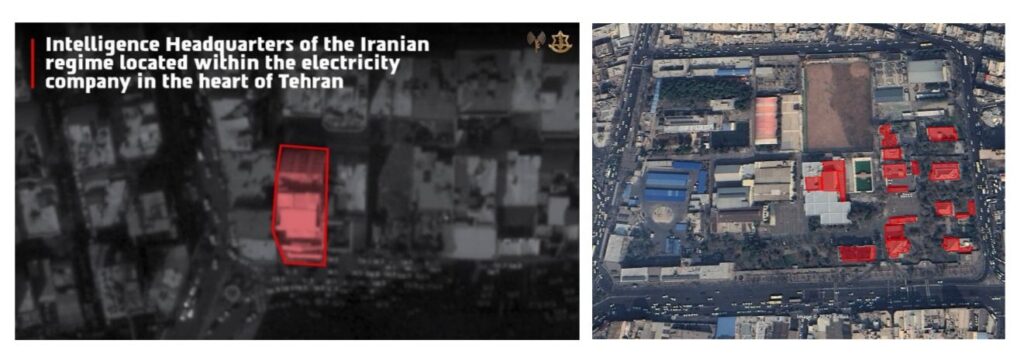
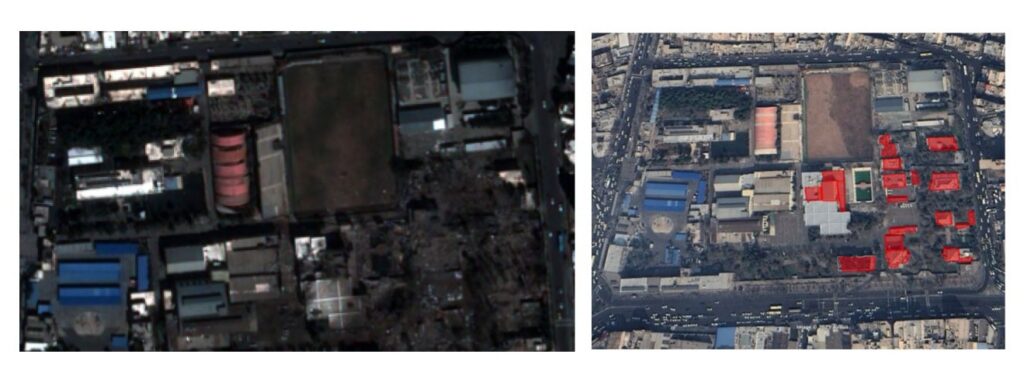
Claims circulated online suggested that the strike may have targeted a nearby facility associated with Iran’s Ministry of Intelligence. These claims could not be independently verified by New Lines. A separate source reported the presence of security personnel, including individuals described as members of the Basij forces, the domestic militia that enforces public modesty laws (among others), who had been present in the surrounding area prior to the strike. The source did not observe such personnel at the electricity company site after the attack.
“This actual targeting tells me they were very clearly trying to degrade or destroy the capabilities of this entire electricity complex,” said Bryant after reviewing the visual evidence of the strike. “It doesn’t align with saying you’re striking an intelligence headquarters.”
Footage of the aftermath shows civilians and individuals in medical clothing responding to the scene, including the evacuation of casualties. Eyewitness accounts posted on social media describe multiple explosions occurring in quick succession, with some reporting six to seven strikes.
“I was going to change my license plate, and then right here, a sound came,” a man, standing next to his destroyed car, said in a video posted to Telegram. Visibly shaken, he stumbled over his words as he recounted what happened. “I was thrown from the [explosion of the] glass. I had just received [the plate] yesterday, right here, I picked it up yesterday.”
Another individual stated that explosions occurred at roughly one-minute intervals.
“We were home about two hours ago. Then the sound of the airplane came. After the first bomb hit, we came outside. After I came outside, then the second bomb [hit]. Exactly six ‘booms’ occurred, once every minute,” one bystander said in the video posted to Telegram.
These accounts are consistent with the pattern of repeated strikes observed in the verified footage in the earlier case reported in Karaj.
“With the second strike, and this is often the case with double taps, the civilian harm increases because civilians come to the area to try to rescue the wounded, and the military advantage typically drops because the first strike had some effect and achieved some of the military advantage you were seeking,” Haque said.
“The second strike is particularly hard to justify, because the civilian harm is greater, the military advantage is less, and so the second strike will typically violate the proportionality rule.”
Additional posts online describe the presence of casualties and the recovery of bodies from the site. While these accounts cannot be independently verified in full because of the connectivity blackout imposed by the Iranian regime, they correspond with visual evidence of destruction and the scale of damage observed in satellite imagery.
Footage shared by Tasnim News Agency on March 26 shows a funeral ceremony held at the Tehran Electricity Company. Images from the ceremony include posters identifying individuals reported to have been killed in the strike. New Lines cross-referenced these names with publicly circulated materials, identifying several engineers and technical staff affiliated with electricity distribution and power management institutions.
Taken together, the available evidence indicates that the strike affected a site identified as an electricity distribution facility located within a densely built urban area, where civilians were present at the time of the attack.
“It’s a pattern for the Israelis, obviously, to not really care about civilians adjacent to target areas that could be hit by blast or fragmentation effects, let alone civilians that are within the targets themselves,” Bryant said.
In the early days of the war, the Israeli Air Force carried out waves of airstrikes across Tehran. The Israeli military stated that it had struck “dozens of headquarters belonging to Iran’s internal security forces.” On March 2, one of these strikes hit the Diplomatic Police Headquarters near Ferdowsi Square.
New Lines verified video footage shared by the Iranian Red Crescent Society and published by the government-owned Press TV showing smoke rising from the site, where the Diplomatic Police Headquarters appears to have been reduced to rubble. Civilians and medical personnel are visible at the scene in the aftermath of the strike.
Footage shows that a second strike occurred shortly after the initial impact, while individuals were present at the site. In the videos analyzed by New Lines, several people appear injured, with others carrying casualties away from the area. Some individuals show visible head wounds, although the full extent of injuries cannot be independently confirmed.
Adjacent to the site is the Allameh Helli 5 school. Footage from the aftermath shows damage to parts of the school building, both externally and internally. New Lines also analyzed satellite imagery from Airbus taken on March 6. The imagery shows that the Diplomatic Police headquarters was destroyed, while surrounding structures, including the school, remained standing despite visible damage.
Israel “has every capability to identify civilian presence before a strike occurs,” Tripp said. “Your evidence suggests not just one but three potential double-tap strikes. Either they aren’t checking if civilians are present, or they’re not capable of checking if civilians are present, or they’re deliberately targeting civilians. There’s no justification for any one of those possibilities.”
The sequence of events captured in verified footage shows that the second strike occurred after civilians and responders had gathered at the site following the initial explosion.
Haque noted not only that double-tap strikes bring greater civilian harm and less military advantage than initial strikes, but also that in all of these cases the intended military advantage was unclear to begin with. “To see it used in multiple instances raises concerns about a pattern of reckless disregard for civilian life.”
After reviewing the evidence showing multiple examples of double-tap strikes, Bryant also shared Haque’s concerns about the clear lack of civilian harm mitigation.
“It makes this whole campaign even more concerning, because it’s not just the targets they’re choosing to hit, which are often civilian, which often have civilians in and around them, but then doing these, these reattacks, or these double taps, where civilians are even more at risk in that second strike,” Bryant said.
“It seems to be a pattern of complete and total disregard for international law at this point, which I believe Israel’s been exhibiting for years, and the U.S. has now embraced.”
Become a member today to receive access to all our paywalled essays and the best of New Lines delivered to your inbox through our newsletters.