


With Christmas just two days away, the weather wasn’t numbingly cold, and multiple people could be heard speaking Persian in one quarter of the terminal. These were the early signs that I had arrived in Los Angeles and was not in New York anymore. As in previous years, the airport was adorned with Christmas trees, LED lights and garlands — I haven’t ever seen a public “war on Christmas,” at least in U.S. airports. I keep a standing Santa Claus figure in my open bookcase.
In search of some answers to my questions about the impact of immigration crackdowns increasingly targeting Iranians, I spent the next 10 days reporting from the city that hosts the largest population of Iranian Americans. Over decades, the portmanteau Tehrangeles has become shorthand for a sanctuary where a contingent of Persians has rebuilt the favored elements of their homeland, lest they forget its flavors. The “Taste of Tehran” is among the area’s most popular restaurants.
According to the latest statistics from the Census Bureau’s American Community Survey, the number of U.S. residents who have reported Iranian ancestry stands at 525,000, and 84,000 of them live in Los Angeles County. Exaggerations suggesting that there are 1.5 or 2 million Iranian Americans have been reiterated from time to time, which is emblematic of diaspora communities that wish to appear more sizable than they are.
For a long time, the Iranian diaspora, as a collective, has projected itself as a far-right, firebrand community — a face that has felt, to me, much less compelling than the stories of the entrepreneurial immigrants from Iran and their offspring who have made it in America. These individual success stories include the first female recipient of a Fields Medal, the first female private space explorer, a Pulitzer Prize winner, the former executive chairperson of Twitter and a former NASA executive.
But marriages of convenience with hawkish politicians, unvarnished expressions of misogyny and racial intolerance and tedious social media fights over ideology have tainted the image of a community that is, on average, more educated and affluent than other immigrant groups in America, according to the Washington-based Migration Policy Institute.
Now, following a stretch of restlessness and confusion in the wake of Iran’s protests in January, in which thousands of demonstrators were killed, the diaspora is beset by bifurcation as the U.S.-Israeli war on Iran extends into its second week. In the eyes of many of the Iranians who call America home, the highlight of the war has been the killing of the Islamic Republic’s unflappable supreme leader, Ayatollah Ali Khamenei, which a large number of them openly celebrated.
The civilian toll of the war has been notably high, and the trail of destruction has exceeded what many thought would be a set of surgical attacks on military sites. With sports venues, hospitals, iconic neighborhoods, civil airports, popular food places and businesses, and UNESCO World Heritage Sites being bombed, however, the apathy in some quarters of the diaspora has drawn scrutiny.
In tandem with the military campaign rattling their country of origin, Iranians in America are bearing the brunt of degrading rhetoric from the White House as an active immigration clampdown threatens their sense of stability. Despite this, many of them still find the administration’s actions, along with those of its Israeli ally, something to be grateful for. One Iranian user addressed Donald Trump and Benjamin Netanyahu on X, writing that “we love you and we’re willing to give our lives in return for your great service.”
When I arrived in Los Angeles on Dec. 23, Immigration and Customs Enforcement (ICE) had just announced the “successful conclusion” of Operation Highway Sentinel, resulting in the arrests of 101 immigrant truck drivers in the area. ICE officers had been roaming the streets of Los Angeles since June, detaining citizens and noncitizens alike, and the agency’s freedoms expanded with a Supreme Court ruling that allowed factors such as apparent race or ethnicity and accent to be considered as a basis for suspicion leading to arrest.
Two weeks earlier, the Department of Homeland Security had announced the apprehension of 10,000 immigrants in a press release on its website, which featured the name of an Iranian at the top of a list of 10 people it described as “the worst of the worst.” A permanent resident since 2008, Alireza Hashemi began engaging in criminal activities after experiencing mental health issues in 2013. He was previously convicted of assault, driving under the influence and shoplifting, and served a two-year prison sentence.
An immigration lawyer in Walnut Creek, California, shared some of the court documents with me. They revealed a pattern of irregularities during Hashemi’s detention last October, including partial denial of medical care and denial of access to legal counsel. ICE told the court that it had given Hashemi an informal interview opportunity before putting him in removal proceedings, but no such interview had taken place, the court documents showed. His attorney declined to talk to me on the record. The court ruled that his detention was unlawful.
Still, this case is only the tip of the iceberg of a rising number of Iranians who have been swept up in the immigration operations carried out by the Trump administration in Los Angeles, which, according to many observers, have been as much about politics as they have been about law enforcement. Most Iranians targeted by ICE have no criminal conviction, and outside of California, they included students with active SEVIS (Student and Exchange Visitor Information System) records and even a well-known university professor.
Data analysis by journalist Meghnad Bose, which is included in a report we co-authored last October for Prism, revealed a meaningful rise in ICE arrests of Iranians after the 12-day war last summer, when 1,062 Iranians were killed in Israel’s airstrikes on the country. Trump joined Israel by authorizing the bombing of three nuclear sites in Iran, two days before a ceasefire ended the hostilities. A new war on Iran was declared on Feb. 28.
In just one week following the first U.S. attacks on June 22 last year, 183 Iranians were taken into custody by federal immigration authorities, whereas only five had been arrested a week prior. It is my view that, in a bid to send a chilling message to the Iranian-American community, and not merely to the Iranian regime, the White House had decided to multiply the number of Iranians in its immigration detention centers.
The state of California, where the presence of Iranian exiles is most visible, was the epicenter of the enforcement activity targeting Iranians. According to the Transnational Records Access Clearinghouse, a project of Syracuse University, of the 320 documented final orders of removal issued to Iranians through September, 83 cases were heard in California courts, and 28 deportees were residents of Los Angeles County.
Only a couple of months before the nationwide protests began in Iran, its leadership and the White House had reached a rare agreement over the deportation of 400 Iranians. In the absence of diplomatic ties, Tehran and Washington have never had an arrangement for the repatriation of immigrants ordered removable by U.S. courts. With a deal signed, three deportation flights landed in Tehran before the outbreak of the latest war.
Fuwad Ahamad, a graduate student at the University of California, Berkeley’s School of Journalism, is a former editor of the India-based publication The Quint, and his reporting on international affairs includes coverage of Iran’s 2022 Woman, Life, Freedom protests. He reached out to me shortly after the publication of the Prism piece to express his interest in the topic. I learned in our chat that his graduate school project was about the toll of immigration enforcement on Iranians in LA.
When I mentioned that I’d be traveling to LA later in the year, he and his colleagues joined me to film my interviews, encounters and observations over 10 days at the heart of the Iranian-American community. Throughout, we saw that community animated by ambitions and drained by divisions.
Like many writers who are increasingly interested in the dynamics of Iranian life in America these days, I expected to be reporting on a demographic in Southern California that is markedly conservative, steadfast in its support for Trump and even in favor of the ongoing immigration raids affecting their fellow Iranians — similar to the politics of Cuban Americans in Florida.
Ahead of my trip, one phone call reinforced my assumptions. An Iranian-American entrepreneur in San Diego — another Southern California city with a high concentration of Iranians — told me that she didn’t believe those who are being rounded up need advocacy; rather, they need to be “grateful,” she said, that they have been given the chance to flee the “repressive, murderous mullahs’ regime” and enjoy the freedoms of America.
The woman, who spoke with me on condition of anonymity, has been with her husband for 55 years. Together, they moved to the United States almost 40 years ago to continue running their family business after they failed to obtain citizenship in two European countries. I asked her if she believed some people were being targeted indiscriminately. She said, “This is the law of the country, and if people want to change it, they need to try to work through the ballot box.”
“But as a journalist, you must try to focus on the beautiful things, not things that people keep complaining about,” she told me. And she had a concluding message: “Why isn’t everybody else behind bars? If people are being arrested, maybe they have done something wrong.”
On a sunny Sunday afternoon in the city of Menifee, 34 miles south of San Bernardino, we drove past livestock farms and family gardens to a serene neighborhood where a wide road separated two rows of country houses fronted by capacious lawns. In one of them, the president of the Iranian-American Democrats of California was expecting me.
Sudi Farokhnia’s journey as a local politician has been punctuated by ups and downs, and she has dedicated her career to a range of social, political and humanitarian causes. She believes Iranians in LA have been “unfortunately a bit numb” to the ICE crackdowns hitting their neighborhoods, which she believes is partly because of fear and partly because “it is triggering a lot of deja vu from oppression in Iran.”
“I was hoping that the community would be more enraged and more committed to help one another. There are obviously good people who do, but not enough,” Farokhnia told me.
Still, she said, the external image of LA Iranians as a hard-line force is not borne out by the facts. “Data show that there are more [Iranian] liberals or people who are ‘no-party preference’ in California than they are right-wing. … What we do know is that the right-wing part of our community is far louder, which is why they give the perception that there’s more of them.”
“We are a traumatized community,” she added. “There is, unfortunately, a little bit of an appreciation for strongman’s presence, that’s why Trump and his macho talk are not so unknown to them. They tend not to get so alarmed by it, because we have been conditioned to have appreciation for strongmen talk.”
On the day of our conversation on Dec. 28, a strike by merchants at Tehran’s grand bazaar following the collapse of the Iranian rial served as the spark of a nationwide uprising that changed the face of Iran. In the weeks that followed, unprecedented scenes of revolt and an iron-fisted crackdown by the authorities resulted in mass casualties that have not even been properly recorded. Thousands have been arrested, and hundreds remain on death row.
When the U.S. president floated the idea of military intervention to help Iranian protesters, a conflagration felt imminent. The unlawful attacks in late February then made the potential flare-up a reality. Countless voices, even from inside Iran, have welcomed Trump’s action to “finish off” the job, even as some conservative pundits advance plans to split Iran up geographically. Sen. Lindsey Graham has described the conflict as a “religious war” that will determine the future of the region for a thousand years.
From the beginning of the protests, Farokhnia and her team worked on organizing rallies, publishing calls to action, releasing statements of solidarity and pushing local and federal officials to reject negotiations with the regime and instead channel their resources into empowering the Iranian people at a time of unprecedented urgency. She’s now speaking out against militarism.
Unrest in Iran has extended well beyond the borders of the country and blanketed the diaspora. Activism has bred violence in real life and degenerated into skirmishes online. Social media name-calling and infighting surfaced quickly, exposing deep rifts in a community that at least enjoys the privilege of living in a culture of declared tolerance and democracy.
In January, massive rallies in support of protesters were organized outside Iran, mostly by loyalists to the deposed Iranian monarchy. Reza Pahlavi, the son of the former shah, has expressed his interest as a contender in the event of a political transition. While his followers say his right to the throne is hereditary, his moderate fans argue that he can also be an alliance-builder. Most demonstrations these days are homages to him. Pahlavi himself has said Iranians want him to fulfill the role of a “father,” which his critics maintain is shorthand for a secular patriarch.
On Jan. 11, a large rally in the Westwood neighborhood of Los Angeles turned violent when a U-Haul truck driver tried to plow through a crowd of pro-monarchy protesters. The truck carried a sign that read “No Shah. No regime. USA: Don’t repeat 1953. No mullah,” and its driver was charged with reckless driving. A group of protesters stopped and swarmed the vehicle, smashed its windows, and tried to drag the driver out before the police escorted him away amid a barrage of insults shouted by the crowd.
In 2010, the intersection of Westwood Boulevard and Wilkins Avenue was named Persian Square by the City of Los Angeles in recognition of the Iranian community. Several popular eateries in the area, including the iconic Greek restaurant Delphi, which has been running since 1985, are owned by an Iranian-American entrepreneur and dissident. Roozbeh Farahanipour was a student activist in Iran who experienced the turmoil of the 1999 uprisings at Tehran University.
In that fateful year, a major student protest in response to the judiciary’s banning of a popular pro-reform newspaper, Salam Daily, rocked the university, prompting a violent reaction by the state when it deployed plainclothes agents to quell the revolt. It was perhaps the most significant confrontation between then-President Mohammad Khatami, who sided with the students, and the supreme leader, who demanded an iron-fisted response.
I met Farahanipour for coffee in his office in the basement of Mary & Robb’s Westwood Cafe, where a rectangular conference room also serves as his personal exhibit: medals, certificates signed by mayors and congresspeople, framed printouts of his interviews with The New York Times and CNN, mentions of his work in Human Rights Watch reports and a portrait of Mahatma Gandhi embellish the walls.
He fled from Iran in 1999, seeking asylum in America a year later. As a U.S. citizen, he is now in favor of intensified immigration restrictions. Still, he is sympathetic to the plight of Iranians facing deportation, an outcome he believes will force them into life-threatening situations. He pleaded with the Trump administration to seek alternatives in dealing with their cases.
“Of course, the Islamic Republic Foreign Ministry loves to take everyone back. They are happy to pay you for the airfare to take these people back and prosecute them over there,” Farahanipour told me. “Send them to Guantanamo Bay, send them to Alligator Alcatraz, but don’t send them to Iran.”
Farahanipour said he waited 17 years after meeting the eligibility criteria to apply for U.S. citizenship because he wanted to take that action when he truly believed in the pledge of allegiance. Over recent decades, he said, America’s immigration system has been abused by those who didn’t have a legitimate claim to asylum but exploited legal loopholes.
“I think 99% of the cases of religious conversion are inaccurate. But what about the 1% or even one person whose life is truly in danger and who will be targeted? Because 99% of people would lie, that one person is going to be deported, then executed or stoned or killed?” he asked.
The Iranian community’s support for Trump’s hard-line immigration policies, despite the national outcry — especially in places like Minneapolis, Chicago and New York — isn’t necessarily a political phenomenon, although it is also a barometer of their leanings on domestic and foreign policy issues.
Several studies have shown the shifting attitudes toward immigration by immigrants who face assimilation pressure. A case in point is the influential cohort of anti-immigration politicians in Britain hailing from immigrant backgrounds who have advocated for deportations and bans. Former Prime Minister Rishi Sunak, his Home Secretary Suella Braverman, former Chancellor Sajid Javid and the current home secretary, Shabana Mahmood, fall into this category.
When the January protests dominated the headlines, many exiles saw the Iranian government’s wanton violence as a call for all-out confrontation. Showing devotion to the most powerful politician who could deliver the coup de grace to the theocracy seemed like a good idea. Self-deprecating alliances with Trump and Netanyahu became a rallying cry in the diaspora, no matter the leaders’ track records. When the war started, a large number of Iranian diaspora activists were euphoric.
In the middle of these outbursts of delight, as the diaspora heaped praise on Trump and Netanyahu, the two men continued to openly gloat over the hypothetical “destruction” of Iran, calling Iranians all sorts of derogatory names. In one instance, Trump said while aboard Air Force One, “They are among the most evil people ever on earth.” Anyone with a modicum of self-esteem would find these statements reprehensible. Many Iranians in exile didn’t.
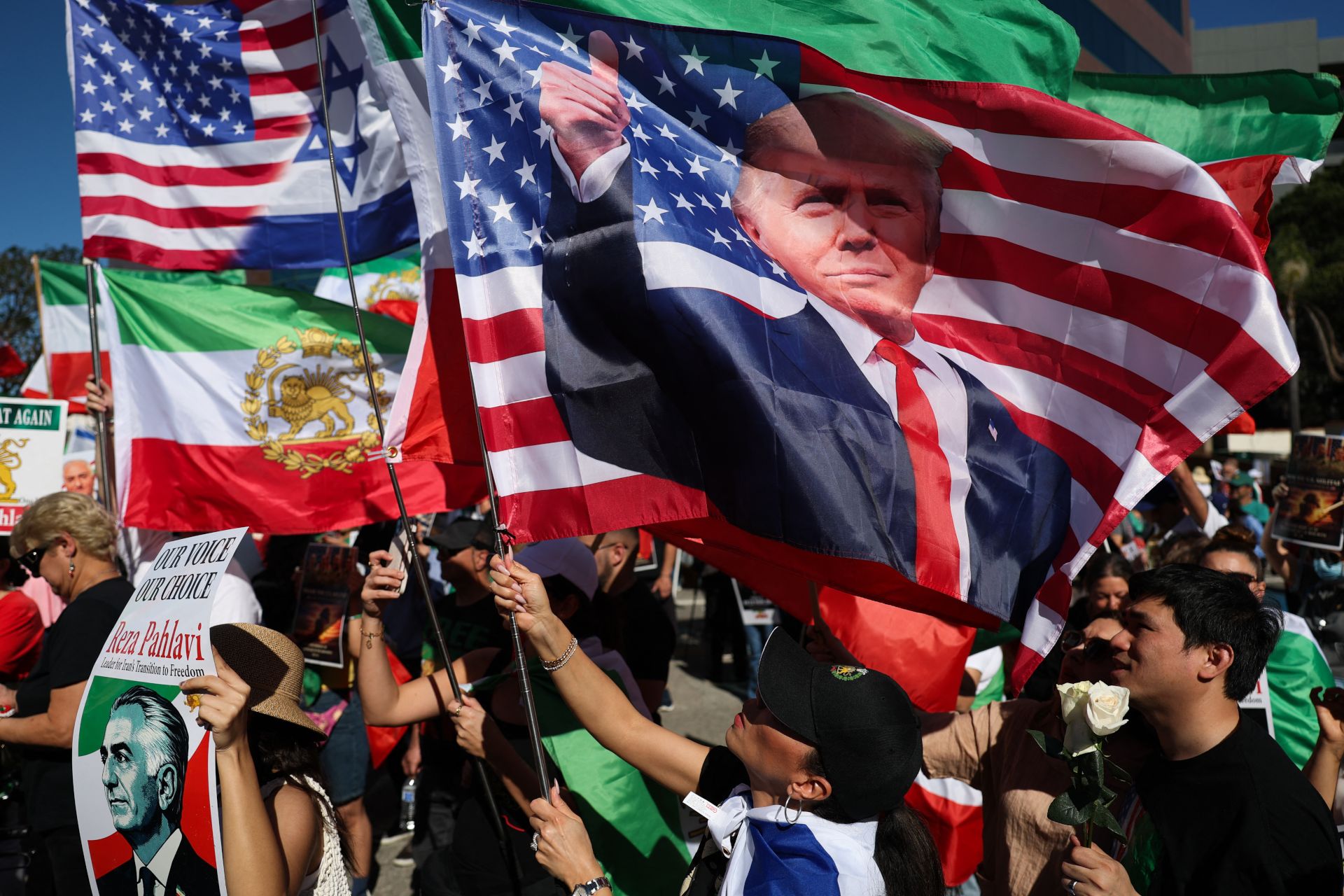
Demonstrations by Iranians in European capitals and cities in North America have almost invariably seen portraits of Trump being raised alongside the picture of Pahlavi, together with the flag of Israel. To outsiders who were particularly disturbed by the U.S. president’s authoritarianism and Israel’s violent behavior, especially since the start of the war in Gaza, these gestures struck a dissonant chord.
One LA activist told me she avoids rallies of Iranians in which the flag of Israel is raised. In a Facebook group chat of Iranians in America, several hijab-wearing Iranian women in California said they were afraid to join pro-democracy protests because the monarchy supporters would either verbally abuse them or engage in physical aggression toward them.
An Iranian mom who withheld her name wrote in the group that she saw many of these rallies as venues for the articulation of violence and misogyny: “The protest leaders act like Shaban the Brainless and the bullies affiliated with the Islamic Republic,” referring to the nickname for Shaban Jafari, an agent provocateur who played a role in the overthrow of Prime Minister Mohammad Mosaddegh in the 1953 coup.
Jafari, who moved to the U.S. before the 1979 revolution, died in 2006 and is buried in the Westwood Memorial Park in Los Angeles. In 1954, Time magazine described his thuggish behavior during the parliamentary elections in Tehran: “Brainless led his knife-armed toughs on tours of the polling places. Systematically, Brainless pulled voters out of line, searched their pockets for an anti-government ballot. When he found one, the voter was cuffed or stabbed, then turned over to the nearest policeman to be arrested and carted off to jail.”
In a different social media post, an Iranian woman in Canada said she didn’t have a reasonable answer when asked by her Canadian friend why Iranians gathered in front of the U.S. diplomatic mission in Ottawa, urging Trump to authorize military strikes against their home country, while every other immigrant group had been requesting the opposite, rejecting war.
However puzzling, the amount of despair gripping Iranians helps to explain their resignation. A 25-year-old sous-chef who has just moved from Tehran to an island near the southern Iranian province of Hormozgan, whom I’ll call Mahnaz, told me before the U.S.-Israeli airstrikes that one of her best friends was shot dead in Tehran during the protests, and his girlfriend was so distraught that she could only process the shock with the help of sedatives.
“The trace of blood on the streets of the island has not been washed away yet, and our only hope is that there’s a war,” Mahnaz said through a secure messaging app. “We’re all waiting for something to happen, and everyone is resolved that if we’re supposed to die, let’s die together. We want to make sure this battle was worth fighting.” I haven’t been able to hear back from her since Feb. 28 because of the ongoing internet blackout.
Still, there remains a gap between, on the one hand, the reality of sociopolitical repression and extreme economic hardship endured by Iranians daily and, on the other hand, the modes of activism adopted by the exiles to spread their messaging. When this gap is widened by insensitivity toward other members of the community, the activists only give the impression of an aggressive mass that doesn’t engage with reason.
A video that went viral at the height of the protests in January showed a woman walking into a Persian restaurant in Vienna, Austria, and introducing herself as a member of the “institution of monarchy” tasked with verifying if businesses properly display the royal flag and the portrait of Pahlavi. She accosted a staff member, saying that the restaurant risked being evacuated if he didn’t put up a flag. The woman has been identified as Aramesh Goorani, a Europe-based activist.
During a 10-minute drive from Westwood, from my temporary lodging at a UCLA housing unit, I was on the phone with the pastor of a home church on the outskirts of LA, where some Iranian Christians have found a community and a space for spiritual healing. Shortly after the conversation, I was on the road with the film crew to Canoga Park, a neighborhood in the western San Fernando Valley, where we met Masoud Massah and his churchgoers.
At the Church of Touran, which is a small campus of the Wilderness International Church in Los Angeles, Massah has been using his personal resources to help members of Iran’s exiled Christian minority navigate challenges such as access to housing, jobs, education and sustenance funds. Several worshippers used to live in conditions that ranged from homelessness to extreme poverty, and in our conversations, they acknowledged the pastor for lifting them up.
“I can say more than 90% of the members of the church community do not have anyone here, so my wife and I have become their family members, and beyond the worship sessions, we host parties and other events to help them overcome their feelings of loneliness,” Massah told me. He has been living in the U.S. since 2017, after several years of serving in Turkey as a religious preacher. He said the majority of his congregants are converts.
One of the converts is a young woman in her 30s who didn’t wish to be named because of the sensitivity of her immigration case. She traveled to the U.S. on a visa a year ago and has been awaiting a decision on her asylum application for four months now, despite assurances from immigration officials last November that she’d be hearing back in two weeks. Her case is pending as of this writing.
“The shared pain of all of us is that we are living between the sky and the earth,” she said. “Even in Persian, we have an expression that goes, ‘Expectation is the worst of punishments.’ We don’t know if the country we have sought refuge in is going to accept us or ultimately turn us away.”
And she recounted her experience with the more established, renowned members of the Iranian-American community whose lack of empathy didn’t match her previously positive perceptions of the diaspora.
“There have been some good people who occasionally offered support, but the Iranian landlords and Iranian employers I’ve seen clearly subjugate the asylum-seekers when they find us in a vulnerable position,” she said. “I’ve met some of these influential people who say their goal is to only support the people of Iran facing repression, but the truth is not what we’re often told.”
“Some of them have refused to take even the smallest steps to help us, coming from the same Iran they say they want to support,” she added. “Iranian landlords charge us $1,500 for a room whose rent is $1,000 a month.”
When it comes to immigration enforcement, fidelity to the powerful does not always translate into immunity. Several influencers from different countries who had vocally defended Trump’s administrative overreach are now in ICE custody. Arpineh Masihi, an Iranian immigrant in ICE detention since last June, told BBC World from Adelanto ICE Processing Center that she would cast her ballot for Trump if she could vote today: “I will support him until the day I die.”
Westwood locals told the documentary team about the ordeals of Erfan Qaneei Fard, an exiled Iranian writer who has been in ICE detention since March 28, 2025. In an opinion piece published by Israel National News last year, Fard revealed that, as of Oct. 16, he had spent a nonconsecutive total of 1,450 days in immigration detention since his arrival in America in 2003, and was once removed from the country.
In a website set up to campaign for his release, he’s described as a “pro-monarchy and pro-Israel advocate,” and an opinion piece in The Jerusalem Post last November suggested that the office of Iran’s former crown prince and “several Israeli lobby organizations” were actively working to set him free.
Ironically, however, Pahlavi hasn’t spoken out against the deportations, and he is yet to publicly comment on the immigration crackdowns targeting his fellow Iranians. It appears that he is not willing to jeopardize a possible rapport with Trump over championing the rights of those who are seen as expendable and not helpful to his political project.
At the church in Canoga Park, a newly converted man who fled Iran with his family and passed through 12 countries — on foot and by boat, car and plane — before arriving at the El Paso border crossing, told me about a woeful past, his plight in ICE custody and his hopes for a brighter future. He had just been granted asylum at a court hearing that wasn’t in his favor.
“The judge asked me questions about the Old Testament and the New Testament and told me he didn’t believe in my asylum case at all,” the man, who didn’t wish to be identified, told me. “The judge said I won’t be facing any issues if I were sent back to Iran, but he ultimately showed mercy, saying he wanted to do me a favor only because of my children, and because of the cross I was wearing around my neck.”
The circumstances of his arrest couldn’t be more harrowing. He spent the first seven days in an ICE facility basement in LA, where food staples were scarce. He was then shackled in chains wrapped around his waist, hands and ankles, and transported to a detention facility in Otero County, New Mexico, on a bus that drove for hours without a restroom break. On the way, an Arizona detention facility turned the busload of immigrants away after a three-hour wait because it was at full capacity.
Then came 13 days of temporary detention in an El Paso facility and a final stretch of five months in ICE custody in the unincorporated community of Chaparral in Otero County. He once told an officer that the food he was given was off, and the guard asked him, with a smirk, if he “preferred McDonald’s or KFC.” Listening to music using the gadgets provided to the inmates would cost $1 for every three minutes of playback. His friend was held in solitary confinement for nine days for being late in returning a pen he had borrowed from the prison.
Stoking fear within immigrant communities continues to be a bedrock of White House policies. Not only are Iranians not spared despite the repeated statements of support for the Iranian people by administration officials and Congress, but they also happen to be a community of interest for increased enforcement activity.
Last June, Iran was named in a presidential proclamation that placed a full travel ban on the nationals of 12 countries. In January, U.S. Citizenship and Immigration Services (USCIS) published new guidelines that suspended the adjudication of immigration benefit requests from the nationals of an expanded list of “high-risk countries.” This means Iranian permanent residents in the U.S. cannot currently apply for naturalization as citizens.
“I think absolutely there are foreign policy motivations behind targeting some of these communities,” said Avideh Moussavian, the former chief of the Office of Policy and Strategy at USCIS. “I don’t think that this is unique to the Iranian community. They have felt it in a particular way and at a particular time that does raise red flags about what kind of message is being sent,” she added.
“The goal is to send a message of invoking fear, to make people afraid and to deter people,” the Iranian-American lawyer told me. “So, you have people who think they should be going through the process, they should be fine, and then they are being pulled out of the line for their oath ceremonies. What message does that send to other people?”
In Tehran, the ossified theocracy that the slain clerical leader Khamenei led for 37 years is in tatters, but despite what the Iranian diaspora imagined for years, it hasn’t been toppled with his killing. It’s too early to say if the pursuit of forcible change by a multinational coalition, engaged in the war directly or indirectly, will improve the chances of Iran becoming a democracy or will block the pathways to democratization.
Deep down, many Iranian exiles agree that Iran’s tyranny and Trump’s repression are cut from the same cloth. For now, they have decided that getting into the good graces of the 47th president may be more expedient. If Tehran doesn’t understand the language of its people, perhaps a U.S. president tormenting Iranian immigrants can be cajoled into being more benevolent.
Become a member today to receive access to all our paywalled essays and the best of New Lines delivered to your inbox through our newsletters.